The Poetics of Impermenance: Jorge Luis Borges on the perception of time, learning and reading

borges

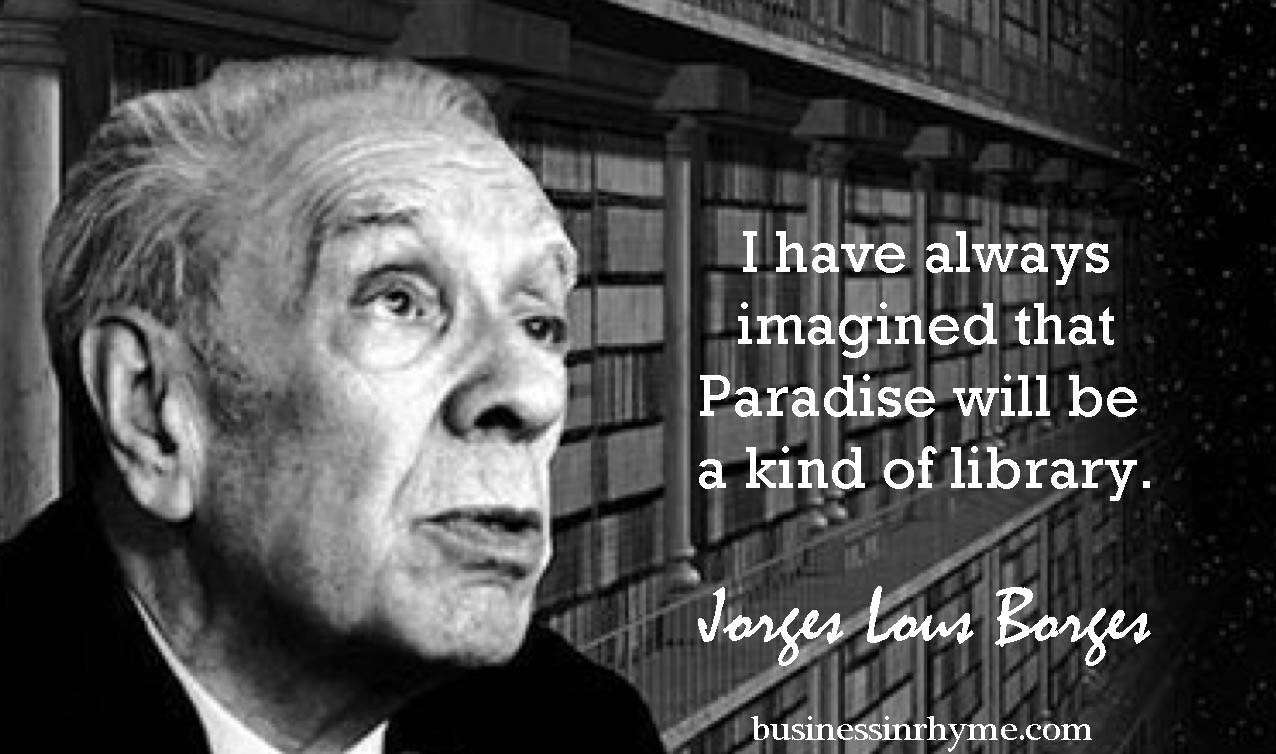
Jorge Luis Borges was a famous writer, essayist, and poet from Argentina. His first poem, ‘Hymn to the Sea,’ was published in the magazine Grecia. Today, he is recognized as one of the most influential figures in Argentinian literature. With wild imagination and innovative literary skills, he left his mark in the world literature as well – especially after receiving the first International Publishers’ Prize, the Prix Formentor in 1961. As fluent in many different languages, he was greatly influenced by European culture. What’s noticeable in his work is how he was preoccupied with the theme of time: the fictional world he was creating was very much inspired by esoteric readings in literature, philosophy, and theology.  In the universe of energy, mass, and speed of light, for him, the central question is time, not space. (source)

He writes:

Time is the substance I am made of. Time is a river which sweeps me along, but I am the river; it is a tiger which destroys me, but I am the tiger; it is a fire which consumes me, but I am the fire.

The impermanence of time and things was always a food for thought for him and a greatest value he saw in it, is an opportunity for learning, maturing and really living life:

After a while you learn the subtle difference
Between holding a hand and chaining a soul,

And you learn that love doesn’t mean leaning
And company doesn’t mean security.

And you begin to learn that kisses aren’t contracts
And presents aren’t promises,

And you begin to accept your defeats
With your head up and your eyes open
With the grace of a woman, not the grief of a child,

And you learn to build all your roads on today
Because tomorrow’s ground is too uncertain for plans
And futures have a way of falling down in mid-flight.

After a while you learn…
That even sunshine burns if you get too much.

So you plant your garden and decorate your own soul,
Instead of waiting for someone to bring you flowers.

And you learn that you really can endure…

That you really are strong

And you really do have worth…

And you learn and learn…

With every good-bye you learn.

He openly showed his love for reading and books.

Personally, I am a hedonistic reader; I have never read a book merely because it was ancient. I read books for the aesthetic emotions they offer me, and I ignore the commentaries and criticism.

Let others pride themselves about how many pages they have written; I’d rather boast about the ones I’ve read.

For every aspiring writer, is a prerequisite to be an avid reader – as from there, every emotion “read” and lived is a fertile soil for every future work. With each reading, book gains new meaning and offers completely new reality:

A book is more than a verbal structure or series of verbal structures; it is the dialogue it establishes with its reader and the intonation it imposes upon his voice and the changing and durable images it leaves in his memory. A book is not an isolated being: it is a relationship, an axis of innumerable relationships.

I think that the reader should enrich what he is reading. He should misunderstand the text; he should change it into something else.

For further diving into the topic of reading and its importance in our lives I recommend:

Are you a ‘deep reader’? 3 reasons why you should nurture this habit

Lean leader is a poetry reader.

How often do you read and what’s your favorite book? Please, share in the comments below.


If you liked this post and you are interested in getting more inspiration for your creativity, sign up for our free bimonthly newsletter.
11 of your most favorite quotes (on writing, creativity and poetry) – all in one place

tinafey

You have to let people see what you wrote. It will never be perfect, but perfect is overrated.

Tina Fey

robertbly

In the process of writing, your energy gradually begins appearing in every line; eventually lines don’t resemble anyone else’s because they are all composed of your energy.

Robert Bly

leonard-cohen

Poetry is just the evidence of life. If your life is burning well, poetry is just the ash.

Leonard Cohen

shakti

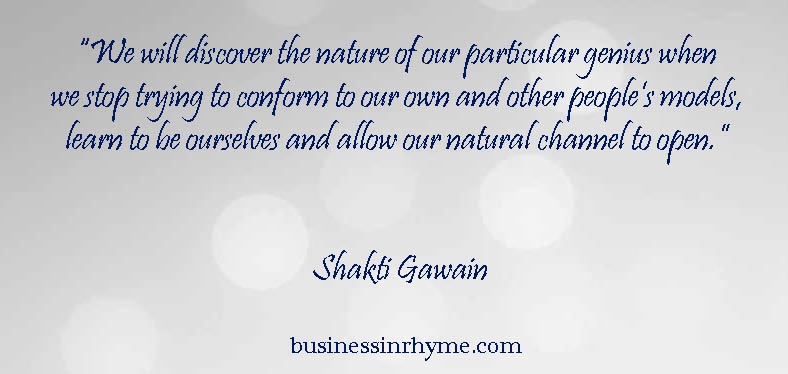
We will discover the nature of our particular genius when we stop trying to conform to our own and other people’s models, learn to be ourselves and allow our natural channel to open.

Shakti Gawain

franz-kafka

Don’t bend; don’t water it down; don’t try to make it logical; don’t edit your soul according to the fashion. Rather, follow your most intense obsessions mercilessly.

Franz Kafka

viktorfrankl

What is to give light must endure burning.

Viktor Frankl

August_rodin

The main thing is to be moved, to love, to hope, to tremble, to live.

Auguste Rodin

aynrand

A creative man is motivated by the desire to achieve, not by desire to beat others.

Ayn Rand

bear

Once, poets were magicians. Poets were strong, stronger than warriors or kings – stronger than old hapless Gods. And they will be strong again.

Greg Bear

alan_alda

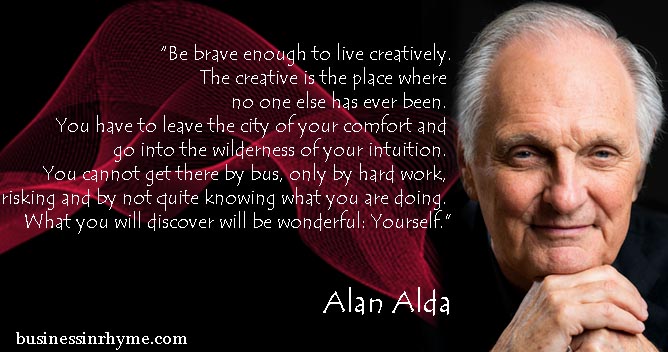
Be brave to life life creatively. The creative is the place where no one else has ever been. You have to leave the city of your comfort and into the wilderness of your intuition. You cannot get there by bus, only by hard work, risking and by quite not knowing what you are doing. What you will discover will be wonderful: Yourself.

Alan Alda

kingsolver

Close the door. Write with no one looking over your shoulder. Don’t try to figure out what other people want to hear from you; figure out what you have to say. It’s the one and only thing you have to offer.

Barbara Kingsolver


If you liked this post and you are interested in getting more inspiration for your creativity, sign up for our free bimonthly newsletter.

Why creativity ‘slips through your hands’ and what can you do about it

garrabrandt

Probably you do recognize yourself in those moments when you think “Oh, today, I’m just not in the mood for writing! I’ll do it some other time”. And it is no secret that many artists, including poets had that need to ‘induce’ their mood through drugs and alcoholism in order to create. For example:

Samuel Taylor Coleridge that it is regarded as one of the founder of  of the Romantic Movement in England was known for his opium addiction in later creative years;

It’s also widely accepted that Arthur Rimbaud’s long poem “A Season in Hell” was written under the influence of opium too;

French poet Charles Baudelaire declared that only when he’s drunk he is able to write. Similar happened to Dylan Thomas who also battled alcoholism for years.

So there is a globally accepted belief that great art can only be produced in moments of sadness, suffering, depression  or that we need some other consciousness altering stimulants to get us in the fruitful creative mood.

Now, we are all aware of the healing properties of art and  that they can provoke ‘creative miracles’. But I want to take your attention to the other side of creativity: being sad, depressed or even taking drugs and other stimulants is not going to boost your creativity.

Many  creative people do experience intervals of sadness, low self-esteem or self-pity, but most of them became their best creative version once they encountered something different, completely.

Most likely, when you didn’t feel like writing or doing anything else creatively you tried to drown your bad mood in endless cups of coffee and indulge with  too many sweet cookies.

Even if you did force yourself to do something, probably it was superficial, unsatisfactory according to your criteria which can only increase already existing bad emotions: you weren’t aligned with yourself, creating from your heart, with full desire and passion.

In order to access your full creative potential, you need to be satisfied with yourself. I’m not using word happiness on purpose, because in some cases it is seen as overrated and too elusive. But being satisfied with who you are, accepting and loving yourself in this very moment, in this very point of your life attracts your best ideas, it fuels your creative urge. And somehow the circumstances around you seem to align to assist you in your creative venture.

I know, as I speak from my own experience. Whenever I feel stress, anxiety and depression it drags me away from my goals, ideas, my focus and concentration. Then, I first try to check in with my self: why do I feel this way? How can I deal with this emotion? And sometimes I do write something just to expel that bad vibes out my system. But that is not my best creative moment. I see it more like a ‘reset button’, an entrance to my creative self: I’m able to keep my creativity firmly in my hands. it doesn’t slips through my fingers like sand.

You have that power always to access your best creative resources, to fabricate joy in what you do and don’t let outer circumstances influence your creative outlets. I know, it sounds easier said than done, but that can be also practiced. When you feel anxious, when something bothers you – go for a walk, do some exercises, talk to a friend, journal, do what ever you need for you to align with your own true, creative nature: where your values, purpose, passion and creativity become one. You have the ability to design your own happiness – you are in control of your emotions.

So, how do you feel at the pick of your creativity?


If you liked this post and you are interested in getting more inspiration for your creativity, sign up for our free bimonthly newsletter.