3 secrets to turn your fear of rejection into a mastery of productivity

plath

Work that is rejected: one of the writer’s worst nightmares. It simply happens that we sometimes put hours, weeks, months and even years into our writing, but it keeps being rejected all over again. And very soon there is a background ‘cheering’ voice: “I completely suck! I should quit writing, there is no use. I’m just losing my time!”

And what to do then? Should we quit writing all together? Just sit in the corner and complain over our bad luck? Or is there something we can do to turn that process and experience into something positive and productive? Looking from psychological point of you, expert John Amodeo, PhD claims:

On a cognitive level, we may be afraid that rejection confirms our worst fear — perhaps that we’re unlovable, or that we’re destined to be alone, or that we have little worth or value. When these fear-based thoughts keep spinning in our mind, we may become agitated, anxious, or depressed.

A big part of our fear of rejection may be our fear of experiencing hurt and pain. Our aversion to unpleasant experiences prompts behaviors that don’t serve us.

Being human, we long to be accepted and wanted. It hurts to be rejected and to experience loss”

Further more, accepting that feeling of failure that is true for us can have a completely counter effect on our whole being, driving us away from what we are passionate about, what keeps us alive. It negatively impacts our health, our relationships and our life in general. How to turn all that experience into an opportunity to grow?

  1. Acknowledge your fear of rejection

Once we acknowledge that there is a fear residing within us, that our work at this time maybe is not at its best-this is actually a first step to combat fear in positive way. By accepting that this fear doesn’t serve us, opens the door for us to move through that fear and explore what’s on the other side. By having that more gentle, kind and less criticizing relationship with our feelings that appear as a result of rejection,  we can “reset” our creative self more quickly and seize the opportunity hidden within our fear.

  1. It’s a part of the process that every writer has to go through.

Nobody is born as an excellent writer. Every writer has to work on their writing craft, refining their style, improving and editing every word they write. It takes time, courage and a lot of effort –  it’s simply a continuous work in progress.

Joshua F. Millburn in his essay How to improve your writing: 3 tips says that if your want to improve your writing: ”Sit in the chair.” Sounds to easy?

These four words changed my life. For a long time, I was an aspiring writer—which meant I didn’t write much. Sure, I aspired daily, but I didn’t make writing a priority. Instead, I spent time passively parked in front of glowing screens: watching TV, perusing Facebook, checking email. I didn’t become a writer until I developed a writing habit. People don’t learn how to write via osmosis; it takes work. So forget word count or page count—focus instead on sitting in the chair distraction-free, writing for at least an hour a day. Do this for a month and you will improve more than you thought possible.

  1. By embracing your rejection graciously, you are already improving your writing.

Once we become grateful for our experiences, we are more able to let go. It gives us clarity and our willingness to learn and put additional effort comes to forefront. Give back yourself permission to enjoy writing. It fuels our persistence to improve ourselves, not only in writing. No matter how many rejection letters pile up, you can use them to improve your skills. And not only will you improve skills, you readiness to write under certain conditions will improve: time you need to write something with a deadline; you get better acquainted with the writing market and that will shorten your time you need to do the research. You become familiar with your fear and with ease you recognize possible mistakes you can mitigate on time.

With each rejection you learn how to be better – as the quality of your writing improves, so does your efficiency.

How do you deal with rejection? Does it impact your writing? Please, share your experience in the comments below.


If you liked this post and you are interested in getting more inspiration for your creativity, sign up for our free bimonthly newsletter.

Curled,

stiff and strong:

your claw plows my soft skin,

where red streams

follow the trails,

succumbing to tearful river,

as droplets gravitate towards the floor.


My eyes are riveted to the closed door.

I can always wear another skin, fur:

dress in feathers or thorny petals.

But how my scarred heart will

continue to beat,

in between these lungs

as it is like raw egg

smashed against the wall?


Maja S. Todorovic

Business in Rhyme is looking for blog guests!

Many of you who have been following this blog for some time know that I’ve always intended to form a community around ideas that poetry as an art form has to offer much more than it is usually implied. For almost a year I’ve been on a quest to explore all benefits that writing and poetry has to bring into our lives. And a lot has been said and written. But I think it’s time we hear (read) some other voices and opinions too.

So this is official invitation to all bloggers to become a guest blogger on Business in Rhyme. This will give you the opportunity to show your work and share your opinions.

The first topic we could explore is how poetry improved your life and why do you write poetry? You could also include crucial poems that you like or that you wrote…Possibilities are endless.I know it might not be easy for some of you to share your vulnerability and intimate times of your lives, but think how you might help someone, inspire and encourage to embrace their feelings …  I’m doing this on the blog for the first time and I have no idea if any of you are interested, but since Business in Rhyme has a growing following of a roughly 5000 people on social media, it is a chance for you to show your work and increase readership.

If you would like to share your experience and inspire others to start/continue writing poetry, you can read the general guidance given in the header menu.

Thank you in advance for your contribution.

Poetry: a savior that comes when you least expect it

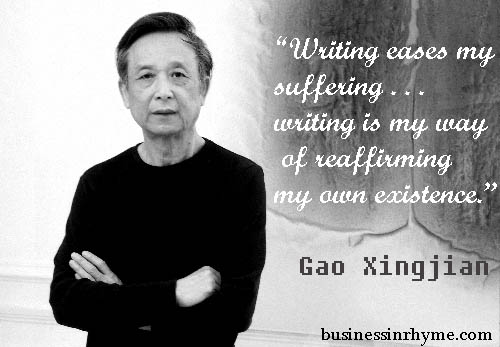
Gao Xingjian

Many of us, engaged in reading and writing are aware of transformative power of poetry, healing power and artistic value it brings to our lives. But how far does that really goes? Can you be saved by a poem?

In this enlightening interview, poet an writer Kim Rosen loudly answers, yes:

In the aha! moment that occurs when the mind bursts open—at a breathtaking metaphor or an insight or a chiming among the words—all levels of being human come into alignment. You feel a sudden integration of body, mind, heart and soul. The fragmentation that many experience in the multitasking onrush of modern life cannot withstand a good poem.

For many years she even feared poetry, thinking it was some kind of elite club, secluded for some ‘special’ and very important people. But on the verge of suicidal depression, poetry came when she most needed and literary saved her life:

In the midst of a suicidal depression, poetry poured back into my life, touching me in a way no spiritual or psychological teaching had been able to—literally saving me. The healing did not come through writing poems or even through reading them. It came when I discovered that taking a poem I loved deeply into my life and speaking it aloud caused a profound integration of every aspect of me—physical, emotional, mental and spiritual. I felt a wholeness I had never before experienced.

Further, she proposes we find a poem that really speaks to us and learn it by heart: read it loud as often as we can until it engraves somewhere deep in our soul and help flourish some better and more supportive thoughts. It can help you establish better relationship with yourself and explore sides of your being you didn’t even knew existed before. That’s what poetry does.

But what about writing your own poetry?

Dr. James W. Pennebaker, one of the most widely published researchers on the benefits of writing, says in his book, “Opening Up: The Healing Power of Expressing Emotions”, that writing about emotional topics improves the immune system by reducing

stress, anxiety and depression, improves motivation and aids people in securing new jobs.

About my own personal experience,  I wrote in this post how poetry came back into my life. And it happened to be that sacred, little place I was looking for to be only mine, that I could decorate, erase, fill, create or destroy the way I wanted. I didn’t have to offer any excuses, explanations or justifications for me being me.That kind of comfort is priceless. You learn to accept yourself just the way you are and you see that world isn’t some ugly place that want to make you miserable. It’s the way you see it and live it. That’s why I say: “Writing poetry helps me fall in love with the world, all over again!”

What are your reasons for having poetry in your life?

I didn’t trust it for a moment
but I drank it anyway,
the wine of my own poetry.

It gave me the daring to take hold
of the darkness and tear it down
and cut it into little pieces.

Lalla Ded. (Lalleshwari) (1320–1392)