Need some more poetic inspiration? Sign up for a free bimonthly newsletter.

Need some more poetic inspiration? Sign up for a free bimonthly newsletter.
Need some more poetic inspiration? Sign up for a free bimonthly newsletter.
According to some resources, today, May 12. is the Limerick day. It is also believed that origins of limerick poetry form can be traced back to 14th century. They are short, easy to compose, often speaking of sexual, ironic and humorous connotations. The name itself derives from the Irish town of Limerick and by many critics is not respected as a valid poetry form. Nevertheless, in the defense of limericks, it is believed that even Shakespeare wrote them.
If you want to try on your own to write a limerick follow the rules:
One of the most famous writers of limericks is Edward Lear and his book of Nonsense, full of funny and witty verses:
“There was an Old Man who supposed,
That the street door was partially closed;
But some very large rats,
Ate his coats and his hats,
While that futile old gentleman dozed.”
or consider this one by Zach Weiner of the comic “Saturday Morning Breakfast Cereal”:
“This limerick goes in reverse
Unless I’m remiss
The neat thing is this:
If you start from the bottom-most verse
This limerick’s not any worse.”
Have you tried writing limericks? Share with us in the comments below.
If you liked this post and you are interested in getting more inspiration for your creativity, sign up for our free bimonthly newsletter.

Need some more poetic inspiration? Sign up for a free bimonthly newsletter.
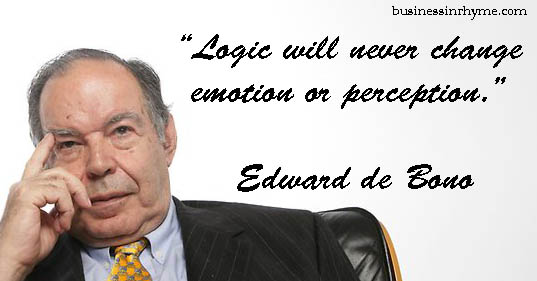
The first definition of the term lateral thinking came in 1967 from Dr Edward de Bono.He has become the world’s leading authority on conceptual thinking and has contributed to development of new tools and approaches to the organizational innovation, strategic leadership, individual creativity, and problem solving. Present in the innovation industry since 1970. his exclusive strategies and methods have brought remarkable results to organizations and to individuals from a wide range of cultures, educational backgrounds, occupations, and age groups.
So, what is actually lateral thinking? It is a way of thinking that solves problems through an indirect and creative approach, using reasoning that is not immediately obvious and involving ideas that may not be applicable by traditional step-by-step logic.
This kind of thinking requires of you to go beyond the obvious and even to take into account parameters that your traditional logic might easily dismiss.
One really attractive and interesting example is given in this article.
Pretend that you’re trapped in a magical room with only two exits. Through the first exit is a room made from a giant magnifying glass, and the blazing hot sun will fry you to death. Through the second door is a room with a fire-breathing dragon. Which do you go through?
There are many ways we can approach this problem in order to solve it. One way could be using poetry techniques, for example kennings.
Bed of fish, smooth path of ships, island-ring, realm of lobsters, slopes of the sea-king, whale-house, land of the ocean-noise, blood of the earth, frothing beer of the coastline…
These are some of the terms and phrases used by the Viking and AngloSaxon poets to name/describe the sea. The word ‘kenning’ comes from the Old Norse verb að kenna, which means ‘to describe’ or ‘to understand’. Poetry asks us to think and view the world from the different perspective. And kennings question our habitual way of thinking. If we apply this technique to the above problem, we could call sun “object that gives light to the earth, object that brings day… “.
So by using this technique, we could come up to a solution by deducting our thinking: sun, in a day time, in the above example is dangerous for us, but what happens when the day goes by? Darkness. And the answer presents itself: we should wait for the sunset, and the first door is a safe passage for us.
The answer to this puzzle is an example of what psychologists call “lateral thinking”: instead of going ahead onto the problem, going sideways can present an elegant solution.
So next time you have a project, creative problem you are working on, try to name it, describe it differently, focusing on its functions and elements and solution might unexpectedly reveal itself.
How often do you use your lateral thinking? 🙂
If you liked this post and you are interested in getting more inspiration for your creativity, sign up for our free bimonthly newsletter.

Need some more poetic inspiration? Sign up for a free bimonthly newsletter.
Embrace your broken parts: each wound, each hurt, each pain
is just a new crack on the wall of your soul pouring more of your
inner light to shine bright.
Is there anything more beautiful than that?
Maja S. Todorovic
The way I slept naked on the floor;
The way I hid myself from the sun;
The way I ate uncooked food with my bare hands;
The way I flossed my teeth three times a day;
The way I laughed at your stupid jokes;
The way I adored your razor-blade thin smile;
The way your huge hands held me around my waist
is the way I loved you.
And still do.
Maja S. Todorovic
Need some more poetic inspiration? Sign up for a free bimonthly newsletter.