Are you ready to enter a new relationship? 9 luscious ways to seduce your reader with your writing!

John Cheever

You as a writer and author, while building your audience are becoming a brand. And your writing is your best branding and marketing tool that exists. Words, emotions, message you transcend through your writing is that magnet that attract readers who share your values and point of view. But once they jump into your writing boat, you and your readers began to interact and build certain relationships; things become different, and a little bit complicated. But you as a writer, don’t want the status: It’s complicated. You want the status: Engaged.

Think about it for a second:

When you are in a relationship with someone and you enjoy it:

  • it is a person you are looking forward to see;
  • it someone you care about and like spending time with;
  • it’s probably someone who shares your values as well;
  • you interact on the basis of mutual trust.

Even classical marketing is moving from brand oriented marketing to marketing that is oriented towards building relationships.

To truly understand what kind of impact is your writing having on your readers you can ask yourself these questions:

Did my writing enabled me to build meaningful connections with my readers?

If not, what can I do to emulate the positive dynamics of such relationships?

  • It has to be a content your reader likes spending time reading;
  • It has to offer something of interest that makes your reader want to  expect fresh content and read it again;
  • That content deals with topics your reader cares about and shares his values.

In order to achieve these objectives you can apply certain tactics through your content:

  1. Offer your readers opportunity to know about you and don’t be afraid to show your vulnerability. In that way you are engraving that human component in your writing and building foundation for future relationship.
  2. Offer understanding, compassion; be helpful through your writing.
  3. Use catchy anecdotes and funny stories that are amusing and captivating.
  4. Show you’re interested in their perspective on things, even if it doesn’t agree with your own.
  5. Don’t be afraid to repeat yourself. What I mean is that pretty much the same message you deliver you can say in different ways and modes of expressing. People digest information differently. I remember while I was working with students, the more graphics I used, the students at the class were more ‘tuned in’ with the information, absorbing it in with wide open eyes, not wanting anything to miss. So use visuals as well, audio features, retell what you have to say in different ways.
  6. Be chatty. Start a conversation by asking questions.
  7. Always spice up everything with your quirkiness, with something that makes you different and that can enrich your content to the level it is worth remembering and sharing.
  8. Let your readers know that you are accountable and professional, but throw some ball once in a while. Add some playfulness in your writing because too much of serious approach can be sobering and counter effective.
  9. But never go across the line of NOT being you. What ever you write, be true to yourself because dishonesty leads to mistrust and deceit and like in any relationship, your reader might just break up with you and your writing (remember: rebound can be painful 😉 ).

Why does this written doe bound through these written woods?
For a drink of written water from a spring
whose surface will xerox her soft muzzle?
Why does she lift her head; does she hear something?
Perched on four slim legs borrowed from the truth,
she pricks up her ears beneath my fingertips.
Silence – this word also rustles across the page
and parts the boughs
that have sprouted from the word ‘woods.’
Lying in wait, set to pounce on the blank page,
are letters up to no good,
clutches of clauses so subordinate
they’ll never let her get away.

Wislawa Szymborska

3 reasons why you should have a purpose statement

TODAY -- Pictured: Dan Brown appears on NBC News' "Today" show (Photo by Peter Kramer/NBC/NBCU Photo Bank via Getty Images)

We are much familiar with mission and vision statements that companies develop in order to communicate their business much clearer to customers and business associates.

Now, I will not go here in detail what mission and vision statements are, but if you think more clearly, we all as individuals “project” ourselves and with our behavior, actions, language (both verbal and body) we communicate who we are. In one of my recent posts I suggested that we should revisit our core beliefs from time to time, as they change with our maturity and conditions around us. This time I propose, just as your business or company can have mission and vision statement, for you to develop your own purpose statement. I believe, by developing our own purpose statement (that encompasses both your mission and vision in life) we can:

  • become more effective; it helps keeping you on track with your goals and plans;
  • develop personal leadership; by referring to it and internalizing its meaning, we make choices that serve our values and discard the things that contradict them.
  • stay motivated to achieve our goals.

In this post, I talked about thinking in reverse,  which literally means having the end goal in mind: what do you want to achieve, in what sense do you want to contribute, what are your values and how your goals you want to achieve align with your values…all that in sum, represents your purpose.

By looking in front of us, that kind of thinking becomes more powerful, more influential in any further decision-making than by being chained by baggage of the past that doesn’t help us.

There is something powerful about writing these things down. And I mean writing by hand on paper: it’s like you are breathing life in those words, you are declaring what you want, who you are and everything becomes more real, and more probable to happen.

I don’t think it should follow any specific format or length, but it has to be relevant to you, to be your motivation in further life decisions.

Some ideas how to start:

  • Write about the project you’ll have in near future and think of outcomes you wish to achieve; what steps you can apply to get you closer to completing a successful project?
  • Collect all the notes, pictures, quotes, poems that inspire you, that you identify with and let that be your guidance in developing your purpose statement.

Of course, there is a flip side that we should all be aware of: life has unfortunately that ugly side of face – frustration, full of trials and errors when is so easy just to give up. For a real passionate purpose you are ready to work hard and endure long enough to get where you want to be. It’s like drudging through the drudgery as writer Joshua Fields Millburn refers to it.  It is part of the process and your purpose statement is there to remind you who you are and who you want to become.

Look at developing your purpose statement as a journey to self-discovery. Nobody can and no one expects from you to have figured all out at once, but it’s a step forward. Purpose can change and evolve with you, or you can have multiple purposes. And why not, as long as they don’t contradict your core values?

Life has loveliness to sell,
All beautiful and splendid things,
Blue waves whitened on a cliff,
Soaring fire that sways and sings,
And children’s faces looking up,
Holding wonder like a cup.

Life has loveliness to sell,
Music like the curve of gold,
Scent of pine trees in the rain,
Eyes that love you, arms that hold,
And for your spirit’s still delight,
Holy thoughts that star the night.

Spend all you have for loveliness,
Buy it and never count the cost;
For one white singing hour of peace
Count many a year of strife well lost,
And for a breath of ecstasy
Give all you have been, or could be.

Sara Teasdale

Experiencing a creative block? Dare to compare!

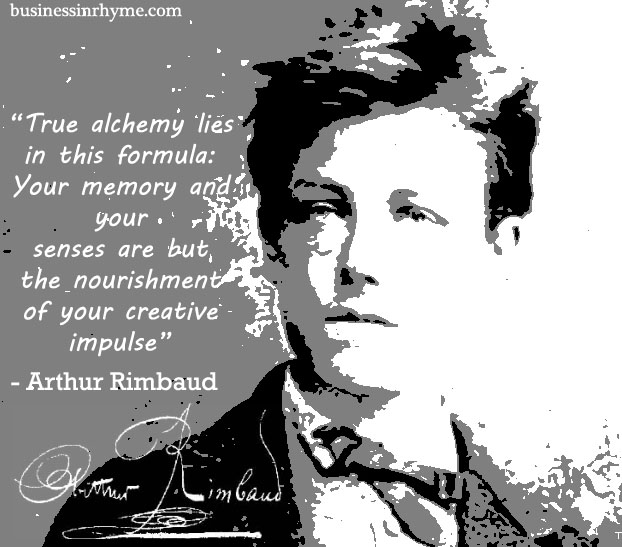
rimbaud

Every one once in a while we face a challenging situation to solve some problem, find an answer to a question; brainstorm an innovative idea. And that got me thinking: what if we challenge ourselves even more? What would happen with our creative flow? Now, I’m not thinking about putting pressure on ourselves, yet we all know we can ‘move’ ourselves towards productive creativity through certain exercises, but creativity is still kinda unpredictable.

What I mean by challenge, I mean challenging us by comparing the problem to something else.

In poetry is very well known technique called similes. Its purpose is to compare two things, so examples of simile poems include any poem that makes comparisons using the words “like” or “as.” Two things compared don’t have to be alike (in poetry usually they are not), and they create different images in our mind, making correlations and connections that doesn’t actually exist. If we apply this to our creative thinking, we are training our creative muscle; it gives us an opportunity to conceptualize different solutions and approaches in problem solving.

Examples of similes in poetry might include something like:

Your eyes were dark as a night without moonlight.

Blank page is like an empty canvas where I paint with my words.

So next time you have trouble getting in your creative mood, try this exercise:

You write down your question/problem and try to find a simile….”My problem is like I…..and finish the sentence. The idea is here for you to challenge yourself to find a similar problem in a completely different life area.

If you have a trouble finding inspiration to start writing, for example, try to remember how it felt when you were trying something else new: a sport, travel, diet, even reading a new book, or developing a new habit? How did you manage to start a new activity? What made you want to stick to your new routine?

Write down your similes and try to analyze them. What of the written ideas you can translate in a given problem? As you brainstorm and think of your answers, probably this will trigger even some emotional response that can act like a drive for generating a flow of new ideas.

You might not get the desired outcome all at once, but using this effective brainstorming tool can distract your attention from a problem. In this way, making distance in your view, will help you get more objective and consider some approaches that might actually work.

3 steps to tap into your intuitive inspiration

Dean-Koontz

Creativity is sometimes hard to grasp: an undefined, unfathomable idea that drives action to make something, introduce change or solve problem. I believe there is a lot of correlation between intuition and creativity. Intuition is also that unexplainable part of us, the “knowing” that goes beyond our rational mind, and is rather deeply rooted in the subconsciousness. It’s sort of a guidance system.

For a normal functioning in our societal organized life we need both: instinct and reason to make the best possible decisions for ourselves, our businesses, and our families.

Hence for a creative part of us, empowering our intuitive nature can be a great advantage.

Here, I propose 3 steps to get more acquainted with your intuition and how to use it for improving your creativity skills:

  1. Spend more time with your best friend (you) and learn more about him/her.

What I mean by this, in reality the only person you can really rely on in this life is you! Our busy and noisy environment  can disguise our true needs, values and purpose. By living a life set on autopilot we forget that we are the ones who can fly the plane. Take time to be alone with yourself and listen what your body and mind tells you. Self-exploration can be easily translated through any kind of self-expression. It can be dancing, writing, painting, singing, or any kind of playing or sports..you are tapping into “your spirit” (inspiration). Life and joy speaks through you and leads you directly to your own unexplored creative possibilities.

The very act of expressing yourself connects you with your true creative being. That sacred moments of alignment with who you really are, it’s invigorating, improves your health, decreases stress levels – which is prerequisite of any productive creative action.

  1. You are part of nature -what it has to tell you?

Now, I have a confession to make: I’m a tree hugger 🙂 It sounds silly (to some of you maybe even stupid) but I like spending time in nature, especially near water and in the woods. I grew up by the Danube river where is a huge park, overpopulated with birches and willows, and this is like I have that engraved need for green surroundings. And every year, in May (now has become a sort of ritual) I like to go to my home country and visit my parents’ weekend cottage, where they have a small orchard and my favorite cherry tree is waiting for me. Still like a kid many years ago, I like to climb it, swing on one of its branches and enjoy the taste of first cherries in the year: sweet, sour, vibrant with life and color. That kind of silence offers me a chance to ‘reset’ my brain, to take a different perspective on life. And also, my geology  studies taught me to even more respect nature and value it hold for us. For me is a habitual thing to spend some time during the day in some natural environment. Even here in the Hague, just a stroll through the park during windy and rainy day can do wonders. It helps me in my clear thinking, and offers connection with life on more subtle levels. Spending time in nature can help you sharpen your instincts and keep you grounded. We relate instincts to animal behavior, but in a way we are “more sophisticated animals”. I suggest you try to find some green oase that can help you ‘calibrate’ your senses to better perceive natural sounds, scents, fresh air, and rest your eyes from artificial colors. It awakens an intuitive part of you.

  1. Make it a meaningful daily practice

To be receptive of creative energy, you have to make it a regular part of your daily life. Along the way, you will discover so much about yourself, how to be more open and aligned. And gaining inspiration you need with time will become easier and more frequent. It’s like an unhoned diamond that with each day you polish, your inner genius shines and sparkle with more intensity.

Become your own most precious gem – an initiator of creative life force within you.

If with light head erect I sing, 
Though all the Muses lend their force, 
From my poor love of anything, 
The verse is weak and shallow as its source.  

Making my soul accomplice there 
Unto the flame my heart hath lit, 
Then will the verse forever wear– 
Time cannot bend the line which God hath writ. 

But now there comes unsought, unseen, 
Some clear divine electuary, 
And I, who had but sensual been, 
Grow sensible, and as God is, am wary. 

It comes in summer’s broadest noon, 
By a grey wall or some chance place, 
Unseasoning Time, insulting June, 
And vexing day with its presuming face. 

Such fragrance round my couch it makes, 
More rich than are Arabian drugs, 
That my soul scents its life and wakes 
The body up beneath its perfumed rugs. 

Such is the Muse, the heavenly maid, 
The star that guides our mortal course, 
Which shows where life’s true kernel’s laid, 
Its wheat’s fine flour, and its undying force. 

Inspiration by Henry David Thoreau (an excerpt)