
Need some more poetic inspiration? Sign up for a free bimonthly newsletter.

Need some more poetic inspiration? Sign up for a free bimonthly newsletter.

Need some more poetic inspiration? Sign up for a free bimonthly newsletter.

Need some more poetic inspiration? Sign up for a free bimonthly newsletter.

Need some more poetic inspiration? Sign up for a free bimonthly newsletter..

Many of us get trapped in ordinary, routine thinking which makes it hard to get into a mood of generating fresh and innovative ideas. We routinely get up every morning, brush our teeth, drink coffee, go to work – mostly every day at a same time, using the same route…And to tell you the truth, it can be a creativity killer. What we need is to mix up things a little bit, challenge our habits, language and way of thinking.
We are also aware that we do live in the world comprised of opposites. In Chinese philosophy and especially in Taoism, Universe is seen through the lens of yin and yang energy, male and female, strong and weak, dark and bright, cold and warm. Perceiving reality from the opposite side can give us clue in which direction we need to move forward in order to sort things out.
So for this exercise, as a warm up I propose you pick some ordinary words, something you frequently use in your language and list the opposite meaning of that word; first that comes to your mind.
For example: sky – bottom, ground
water – dry, yellow, sand
coffee – tea, sweet, cold
work – vacation, free time, relaxation
Do this for a limited time, maybe five to ten minutes. The idea of this warming exercises is to somehow ‘flush out’ that ordinary thinking, and give room for more ideas to come and encourage creative problem solving.
As a next step you can pick your real problem/project you are working on and apply similar technique. If you repeatedly struggle with something, “turn over” your thinking: instead of trying to develop your best solution, think of the worst thing could happen. How can your project fail? What is the worst scenario? Write every detail of that, using some key words related to your project and answering questions when, how, who, why, how much ext. To make it more fun, write a poem about it.
From that vantage point it might be more clearer what you could do in order for your project to succeed. By being able to imagine what we would like to avoid, it may opens a clear path in our mind of right things we need to do: who to contact, when to do something, how to prioritize our time.
Knowing what you don’t want to, is a first step to achieving what you do want.
I am not ambitious at all:
I am not a poet, I know
(Though I do love to see a mere scrawl
To order and symmetry grow).
My muse is uncertain and slow,
I am not expert with my tools,
I lack the poetic argot:
But I hope I have kept to the rules.
When your brain is undoubtedly small,
‘Tis hard, sir, to write in a row,
Some five or six rhymes to Nepaul,
And more than a dozen to Joe:
The metre is easier though,
Three rhymes are sufficient for ‘ghouls,’
My lines are deficient in go,
But I hope I have kept to the rules.Dear Sir, though my language is low,
Let me dip in Pierian pools:
My verses are only so so,
But I hope I have kept to the rules.
J. K. Stephen
If you liked this post and you are interested in getting more inspiration for your creativity, sign up for our free bimonthly newsletter.

Need some more poetic inspiration? Sign up for a free bimonthly newsletter.
Need some more poetic inspiration? Sign up for a free bimonthly newsletter.
Need some more poetic inspiration? Sign up for a free bimonthly newsletter.

Need some more poetic inspiration? Sign up for a free bimonthly newsletter
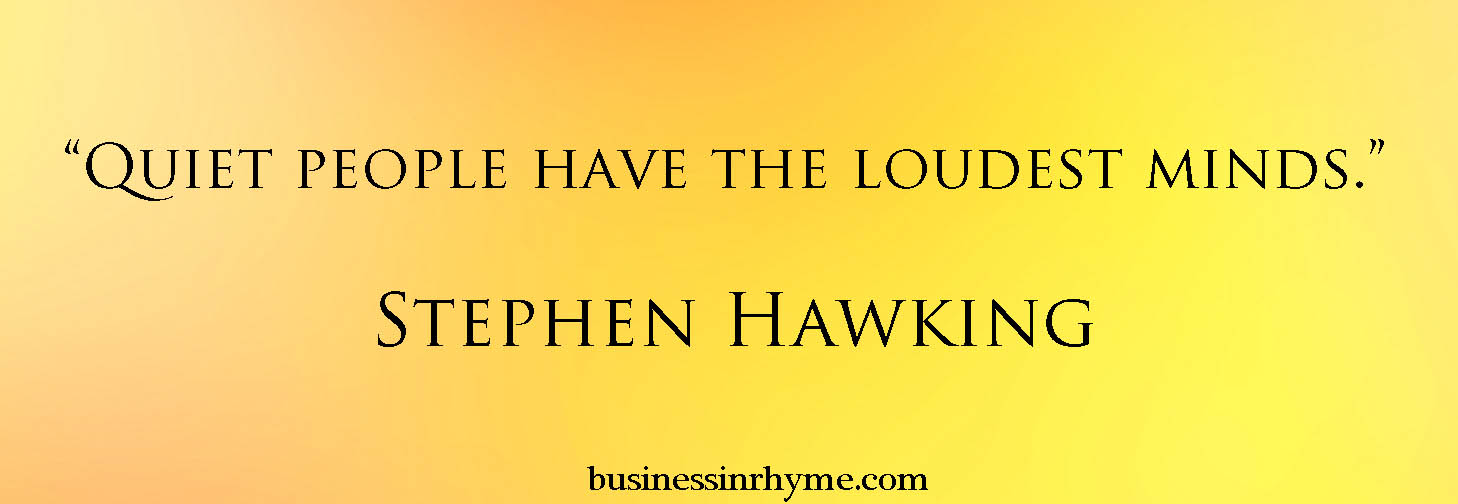
I presume I’ve always been an introvert. And when I was younger I looked at that as a drawback, a negative side. For many years I’ve silently longed to be one of those cool kids that easily steal affection, that with just small gesture or smile so quickly make new friends and become leaders of ‘ the pack’.
I was kind of opposite of all that: only having few friends at the time, never liked to talk about myself – instead I’ve become an ideal ‘shoulder for crying’. As a highly individualistic, books were my favorite company and I never had a problem to spend time alone, with myself. Also, as an introvert I’m somehow on the constant quest for deeper meanings, understandings and knowing. As a motivation, that can be a great advantage in any research profession for example, but somewhere along the way in the recent years, I’ve noticed my introvert side has even grown. That is something I didn’t expect to happen in my late thirties, but it did. And here is where poetry helped me a lot: to express my feelings, thoughts and experiences which I’m not comfortable to share in classical mundane communication.
Poetry can be that articulate tool that gives the voice to those hidden parts of us: sensitive, beautiful, vulnerable, brave, but weak, dark and frightening in the same time. Connection to poetry is always personal and deep that goes to the farthest roots of our being and helps us recognize, accept and communicate who we are: who we truly are. To anyone who is struggling with finding direction in life, self doubt and self acceptance, poetry can help reveal those hidden treasures, strengths that moves us forward; helps us discover our place in the world. In your writing and reading poetry you can find intimacy you might be lacking in an extroverted and often shallow world we are living in.
Having poetry in my life have certainly helped me to better communicate my needs and feelings and generally to cope with pressures of the fast paced world. If you do recognize yourself to be an introvert, introducing more poetry into your life can bring that sensation of nourished soul, that we are taking care of us; that we can find home where ever we are.
There is a place where the sidewalk ends
and before the street begins,
and there the grass grows soft and white,
and there the sun burns crimson bright,
and there the moon-bird rests from his flight
to cool in the peppermint wind.
Let us leave this place where the smoke blows black
and the dark street winds and bends.
Past the pits where the asphalt flowers grow
we shall walk with a walk that is measured and slow
and watch where the chalk-white arrows go
to the place where the sidewalk ends.
Yes we’ll walk with a walk that is measured and slow,
and we’ll go where the chalk-white arrows go,
for the children, they mark, and the children, they know,
the place where the sidewalk ends.
Shel Silverstein
If you liked this post and you are interested in getting more inspiration for your creativity, sign up for our free bimonthly newsletter.
 Business in Rhyme