
Tag: art
Daily verse with purpose: Thomas Merton

From a struggling creative to a thriving entrepreneur: 3 surprising aspects you need to consider

The truth is: you can be very good at arts or writing – creative, interesting, refreshing, innovative, but if you lack certain business skills, hardly will your art ever get real market attention it deserves. There is a snobbery feeling that surrounds the idea of commercializing arts, hence – if you want to make a living from something that you are passionate about; something that comes from creative action – you have to start from somewhere.
When you think more clearly there are certain traits that accompany both artists and entrepreneurs. Like entrepreneurs, artists usually have a vision and a necessary drive to make that vision reality. On the other hand, having your own business requires certain degree of creativity: how to make your business unique or how to attract and impress customers?
But there are three important areas that I would like to emphasize, which every creative should explore and develop in order to become a successful business owner.
1.Know your limitations
Are you a good strategist? Are you firm in your decisions? How much are you prepared of your valuable time to spend on administrating tedious bureaucratic work and how eager are you to invest in the promotion of your work? Do you like to network or you rather spend hours and hours in your secluded creative space, contemplating your next piece and not having interest in anything else? Because, how at the beginning of your entrepreneurship you answer these questions can determine the course of your business. Many talented artists that succeeded, didn’t succeed by chance – they implemented strategically developed plan and had very clear idea what they needed to do. As an aspiring creative at the beginning you are mostly on your own – how much you invest, determines how much it will pay off later.
2.Be curious and do your research
To turn their work into sellable products, creatives first must know market demands. Do you know your audience? You have to be clear if there is an interest in what you have to offer. Then, do you know the monetary value of your work? Many artists struggle with estimating price range of their products because overvaluing is as much bad as underpricing your work.
3.Build your web of collaborators.
Now, the third aspect allows you to work on the first two simultaneously. You are not the only creative/entrepreneur starting his own business. Mingle, meet & greet similar people who have skills or services that you might lack! You can exchange services and help each other move forward with building the business. You will certainly broaden your network and is also an opportunity for you to promote your products/services.
The key is to find a balance and be persistent. There will be good days, but also bad days. Ideally, as proposed by The Design Trust creative entrepreneurs should spend around 40% of their time creating, 40% on marketing, 10% on administration and 10% on professional development. Some of these things can be quite overwhelming, but being determined in setting your goals and working on them will help you derive your priorities, day by day, project by project.
Daily verse with purpose: Giorgo de Chirico

“Collage” your way to creativity: let the rebel out!
You know those days when you have, like a hundred ideas what you would like to do, to write, but somehow you are having hard time to convey and articulate your idea? It’s there, you almost have a breakthrough but your thoughts are fast racing and nothing is coming out. Maybe we should try another way of expressing it?
In the post Organize your own creativity workshop! I propose having an inspiration box, with collected items that we like, that are inspirational to us. We can go step further and by selecting different items that appeal to us, we can try to express our idea or come up with a new one, by rearranging items in a collage.
The idea here is that we challenge ourselves, as much as a situation, a question, a problem that we have.
In this essay I came across interesting fact.The author, Marjorie Perloff states:
In the spring of 1912, Picasso pasted a piece of oilcloth printed with a trompe l’oeil chair-caning pattern to the surface of a small, oval canvas representing a still life on a café table, and then “framed” the composition with a piece of coarse rope, he was challenging the fundamental principle of Western painting from the early Renaissance to the late nineteenth century–namely, that a picture is a window on reality, an imaginary transparency through which an illusion is discerned. For collage typically juxtaposes “real” items–pages torn from newspapers, color illustrations taken from picture books, letters of the alphabet, numbers, nails–with painted or drawn images so as to create a curiously contradictory pictorial surface. For each element in the collage has a kind of double function: it refers to an external reality even as its compositional thrust is to undercut the very referentiality it seems to assert. And further: collage subverts all conventional figure-ground relationships, it generally being unclear whether item A is on top of item B or behind it or whether the two coexist in the shallow space which is the “picture.”
A collage as an art form was especially popular in dada movement. Many artists used this technique to provoke their unconscious thinking and explore metaphysical origins of reality. For example Hans Arp was famous for making a series of collages based on chance; he would stand above a sheet of paper, let squares of contrasting colored paper fall on the larger sheet’s surface, and then he would glue the squares – in any position they took by falling. Arp was interested in I-Ching fortune telling (where coins fallen by chance we interpreted for future forecasting) and he was curios what kind of visceral reaction would his art produce.
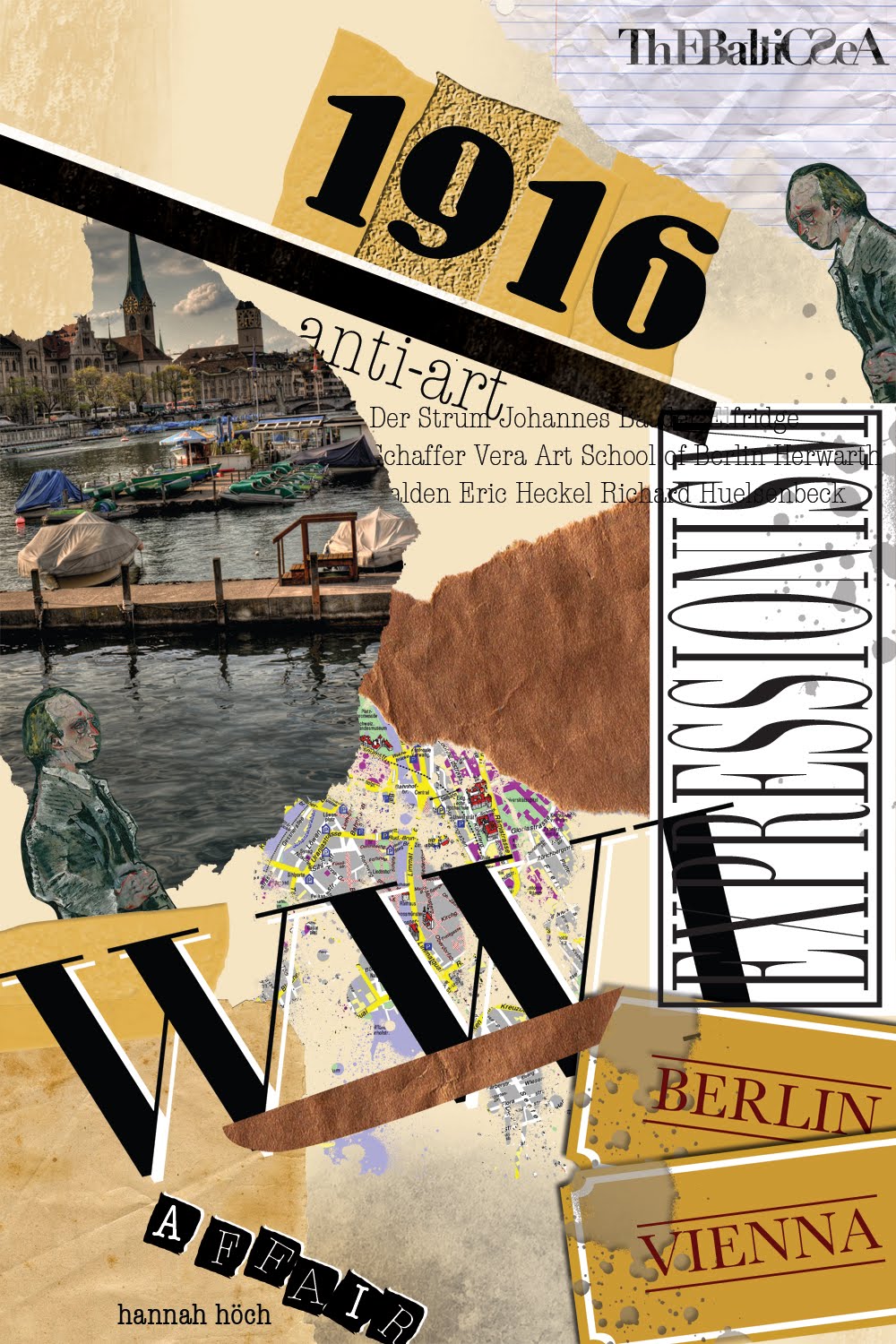

Raoul Hausmann Hans Arp
So how can you use technique of collaging to exercise your creativity?
The basic idea is for you to find small items, pictures, texts and letters from newspaper –anything that moves you and that you can rearrange into your own collage poem. By collaging your items, a new reality will start to form. Prune anything you find excess and look at new relations, surprises, metaphors, combinations. Your mind will try to justify any item by its origin, position, dimension. This is an excellent exercise for your creative rebel, to shout, to say, to sing, to whisper anything in particular you can’t. Let this collage poem be the messenger of your creativity. This exercise is a fun to do in groups also, as a team building game, an exercise in leadership skills, perhaps. Possibilities are endless – don’t restrain yourself – it’s good to rebel from time to time 🙂
After Experience Taught Me by Martin Buber
Take the first two fingers of this hand;
Fork them out—kind of a “V for Victory”—
Whether there might be something whose discovery
Would grant me supreme, unending happiness.
And jam them into the eyes of your enemy.
You have to do this hard. Very hard. Then press
No virtue can be thought to have priority
Over this endeavor to preserves one’s being.
Let your senses guide your creative spirit
That is beautiful which is produced by the inner need, which springs from the soul.
~ Wassily Kandinsky
The idea for this creativity prompt was inspired by Wassily Kandinsky (1866-1944) a Russian painter. He is one of the founders of Expressionism movement and he became famous for his abstract art. Most of his paintings were influenced by the music he was listening to. Kandinsky was on quest to break the barriers between different arts and actually tried to connect them in his work. “Concerning the spiritual art” is the most influential piece that left its mark on the abstract art of the 20th century.
So, as Kandinsky was painting his music, you can go step further and write a poem influenced by the  music you hear. The idea is not to describe the music, but rather let yourself feel the music -take you to different place, different time. In this post, I in length elaborate the importance of finding time and place for your creative activities. Secure that peaceful moment when you are not disturbed and with calm and ease pursue your activity. Sit in a comfortable position, close your eyes and imagine what you hear, absorbs you like sponge and you are like water: liquid, flexible, traveling through different sounds, shapes, colors and words. Let music guide you and write without censoring, without limitation. Along the way you can sketch, you can develop your visual story…what ever feels right at that moment. There is no goal to achieve, except to escape the rational and let your inner creativity shine.
For this exercise I propose three classical pieces:
- Four seasons by A. Vivaldi
- Adagio by T. Albinoni
- Bolero by M. Ravel
Each piece will evoke different emotion. Don’t fight it, just let it be and surrender to it. Your creative spirit will find its way for most appropriate expression. I chose classical music with purpose, because it is believed that classical music makes you more honest with yourself, improves communication, memory and in general improves our stress levels, which is crucial for creative thinking.
You can choose other musical pieces according to your taste, as well. And please, share your experience in the comments below.
A Violin at Dusk by Lizette Woodworth Reese
Stumble to silence, all you uneasy things,
That pack the day with bluster and with fret.
For here is music at each window set;
Here is a cup which drips with all the springs
That ever bud a cowslip flower; a roof
To shelter till the argent weathers break;
A candle with enough of light to make
My courage bright against each dark reproof.
A hand’s width of clear gold, unraveled out
The rosy sky, the little moon appears;
As they were splashed upon the paling red,
Vast, blurred, the village poplars lift about.
I think of young, lost things: of lilacs; tears;
I think of an old neighbor, long since dead.
Can Art impact our health?
Art washes from the soul the dust of everyday life.
~ Pablo Picasso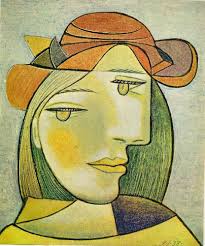
This is one very interesting and emerging topic. In the last decade, there has been done a lot of research with positive results on how arts can help us improve our health and help us in our healing journey – both mentally and physically.
The idea that creative expression can make a powerful contribution to the healing process has been embraced in many different cultures. Throughout recorded history, people have used pictures, stories, dances, and chants as healing rituals.
Each type of arts (visual, acoustic or verbal) has its own benefits.
In this post I will exclusively focus on writing and the power of language. The results of some researches are quite fascinating. For example, Dr. James W. Pennebaker of the University of Texas at Austin has designed several studies to show the links between writing and health:
Writing about emotional upheavals in our lives can improve physical and mental health. Although the scientific research surrounding the value of expressive writing is still in the early phases, there are some approaches to writing that have been found to be helpful.
In a series of exercises, healthy student volunteers who wrote about traumatic experiences had more positive moods, fewer illnesses and better measures of immune-system function than those who wrote about superficial experiences. Even 6 weeks later, the students who’d written about what upset them reported more positive moods and fewer illnesses than those who’d written about everyday experiences.
In another study of students vulnerable to depression, those who did expressive writing exercises showed significantly lower depression symptoms, even after 6 months, than those who had written about everyday matters.
There have been also developed a range of new therapies that use arts as basic methodology and approach with noticeable success. For the visual summary of how arts can beneficially impact our health you can look at the infographic given at this link that was developed by Art and Health Network Canada.
So, whenever you can, surround yourself with art or get involved in some artistic work: it’s fun, creative and most importantly is doing good for your health and wellbeing.
Health by Rafael Campo
While jogging on the treadmill at the gym,
that exercise in getting nowhere fast,
I realized we need a health pandemic.
Obesity writ large no more, Alzheimer’s
forgotten, we could live carefree again.
We’d chant the painted shaman’s sweaty oaths,
We’d kiss the awful relics of the saints,
we’d sip the bitter tea from twisted roots,
we’d listen to our grandmothers’ advice.
We’d understand the moonlight’s whispering.
We’d exercise by making love outside,
and afterwards, while thinking only of
how much we’d lived in just one moment’s time,
forgive ourselves for wanting something more:
to praise the memory of long-lost need,
or not to live forever in a world
made painless by our incurable joy.
 Business in Rhyme