

Blog
How to ‘stage’ your environment for a productive creativity
There are two essential elements in every creative process: time and space. Considering time – we all have the same amount of time in one day. And I couldn’t agree more with the saying: “We manage activities, not time.” When it comes to creative process, as described in some of my previous articles, the moment when a creative outburst will happen is sometimes unpredictable: it’s up to us to be responsive and adaptive to it; turn on our antennas and pick up the signals of creativity as it comes along.
This second element, is one that we have even more control over: space. We make or clutter our space – for anything we do. In this article I go in length about the importance of simplicity for a productive usage of time and executing our tasks. Clean, minimalistic space is a prerequisite in my opinion for developing a fertile conditions for a productive creativity. Removing distractions: visual, acoustic and physical clutter is often an overlooked reason why we procrastinate, don’t react upon given creative urge.
You know the situation: you have an interesting idea, but you have some chores to do, you can’t find paper and pencil to write it down, then you think like “OK, I’ll get to it later”…but later never comes and the creative impulse is gone. Decluttered space gives us the chance to be proactive with our ideas, ready like an alert athlete on the start line to “run” our creative race with best results.
There is an intrinsic relationship between what you do and the place you work. Room that is stuffed with unnecessary things, desk with piles of paper, books, gadgets that we don’t need for our momentary work can bring tension and anxiety and in times acts as an obstacle to our creativity.
But that’s not all. Cleaning your desk and purging stuff is the easy part. Emotional baggage that we all carry and our psychological clutter is also something we need to “clean” from time to time.
Zen masters often refer to something that’s called “a beginner’s mind”. A beginner’s mind is open to many possibilities while expert mind recognizes only few. Now, I try to approach this philosophy from two angles. One, is to be open-minded as much as possible and try somehow to avoid previous experiences to block our view of possible creative processes:
“I’ve tried this one, it didn’t work!”
“It’s out of my reach!”
“I don’t have the skills to do this”…
That kind of internal dialogue should be turned off and we need to detach from previous experiences – especially the bad ones. In a way is a “de-conditiong” the psyche, which allows you to reconnect with your true nature. The second angle of tackling this topic is living in the present moment, without dwelling on the past and future which can distract you from your direction in the creative process.
It’s interesting to note that many writers and creatives have faced creativity block throughout their life. During the most of the 1910s, Rilke had suffered from a severe depression. In the early 1920’s he moved to Switzerland, where he meets Werner Reinhart, a merchant that acted as his patron. He purchased Château de Muzot in Veyras, a thirteenth-century manor, (no gas or electricity) to support Rilke to live there rent-free and focus on his work. Rilke closed himself for days, where without any distractions coming from the outer world, he wrote Sonnets to Orpheus and completed the Duino Elegies in “a savage creative storm” as he used to say, during three weeks in February 1922.
Starting form scratch with your creative work, you need open, clear, bright space (both physically and in your mind) to focus on your raw elements and possible arrangement patterns. Your attention needs to be hostage-free from any distraction, noise, stuff intruders and information pollution. This will increase your chances for innovative thinking, your ability to recognize the opportunity that will not hide behind the curtain of unnecessary things. Being adaptive in dealing with surprise is being able to take advantage of serendipitous, potentially valuable ideas.
The Sonnets To Orpheus: Xix by Rainer Maria Rilke
Though the world keeps changing its form
as fast as a cloud, still
what is accomplished falls home
to the Primeval.
Over the change and the passing,
larger and freer,
soars your eternal song,
god with the lyre.
Never has grief been possesed,
never has love been learned,
and what removes us in death
is not revealed.
Only the song through the land
hallows and heals.
Daily verse with purpose: William Wordsorth

Daily verse with purpose: Cecil B. De Mille
You need these 6 skills to improve your strategic thinking
On a few occasions, I have already written about the strategic thinking and the impact it can have in our everyday life. Today I will try in more detail to break down, which are the skills that comprise strategic thinking. In my own experience I focus on implementing certain steps in my analysis of situation before I make any decision or take a stand in dealing with a problem. These steps can help us work on certain skills that in the long run can improve our strategic thinking and the ability of decision making.
- The foremost critical skill I identified to think strategically is to have a clear vision of what you want to achieve. That includes both business and personal goals with sharp focus on what you really want. I would say that this is a prerequisite in almost any life situation because unclear motivation opens door to insecurity, fear of failure and at the end it leads to indecisiveness.
- The second skill I like to call is thinking in reverse. What I mean by that is once you have the end goal in mind it’s easier to design actionable tasks and objectives that will structure your strategic approach. Each objective needs to have a timeline for execution as well defined needed resources. In business situations is not an uncommon thing to have even different scenarios brainstormed, according to the variability of conditions and environment where by tackling the problem from different angles, we are still able to achieve desired goal.
- Being able to achieve desired milestones a strategic thinkers need to have a high level of responsiveness and adaptability. It requires just letting enough room for flexibility into their plans, where they can review progress and revise the course of action once the conditions change. It’s somehow an innate ability to be proactive and allow intuition to be receptive to anticipate change – which is better approach then responding to change once it occurs. They listen, observe, interact with their environment in such manner that they identify subtle signals that raises the awareness and helps in tailoring the best solutions to a given problem.
- They are lifelong learners, oriented towards growth and are never afraid to ask questions. One of the drivers in developing a better strategic thinking is the desire for new experiences and trying something new. For them is never too late to learn a new language, dance or ride a horse! This avid hunger for life enables them to think better on strategic issues.
- They measure 3 times before they cut. What I mean by that is that the creative part they have, they don’t shut down because some solution is ‘too risky’, ‘too costly’, but rather they have a specific notion how to balance out the surges of creativity with a sense of what is achievable and what will bring the greatest benefit in the long run. It’s a sort of cautious optimism entwined with honest desire to make the best of what’s given to them.
- They make room for ‘me’ time. The best and greatest strategic thinkers take time out for themselves: To relax, to release any tension in their body, to slow down their fast pace thoughts. It allows them to find inner stability and prepare for future tasks.
We can work on improving our skills by challenging our conventional thinking patterns, brainstorm different scenarios for a given a problem and recognizing weaknesses and strengths of any situation or business condition.
Whose woods these are I think I know.
His house is in the village, though;
He will not see me stopping here
To watch his woods fill up with snow.My little horse must think it queer
To stop without a farmhouse near
Between the woods and frozen lake
The darkest evening of the year.He gives his harness bells a shake
To ask if there is some mistake.
The only other sound’s the sweep
Of easy wind and downy flake.The woods are lovely, dark, and deep,
But I have promises to keep,
And miles to go before I sleep,
And miles to go before I sleep.
This poem by Robert Frost is an excellent example on how we make our choices in life. What variables are the most important in our question to which direction to turn? This poem stimulates constant reexamination of situation, “measuring before cutting” and instinctively is actually ‘training’ us to think more strategically.
While reading poetry you are challenging your thinking on more subtle levels. That kind of stimulation empowers both ability of visualization and gaining clarity which is vital in strategic thinking.
Daily verse with purpose: Edward Thomas
Daily verse with purpose: Anatole France

9 questions to ask yourself to know if your creative flow is on the right track
The moment after you had your breakthrough idea, what happens? Sometimes, with steady persistence we continue on refining our creative solution, we try to implement our idea and sometimes the idea bulb turns on just in another minute to disappear in open air like a deflated balloon.
Why do we give up on some ideas?
In my experience, answer might be hidden among these statements:
- I lack discipline and persistence (which might be due to distractions, preoccupation with other things or even due to health reason – simply you don’t feel good).
- It requires more effort from my side than I thought. Certain things ask for constant investment of our time, money, energy.. it just seems too difficult, especially if it’s not ‘a one time thing’ but it needs some kind of repetition and maintenance.
- The end goal is not clear. What do I want to achieve? What’s the value of what I’m doing? If we don’t recognize an instant gratification, it’s a rather a creativity killer than inspirational flow of ideas.
- And the all time famous: fear of failure. “It will not work, I can’t do it, because…” endless reasons we find why we don’t keep up with implementing our idea. Self-doubt is also one of those thirsty worms that creeps into our mind and simply sucks out any creative optimism we might have!
I have found that once I manage to connect my creative pursuits with what I want to achieve goes beyond my own satisfaction and gratification, has meaning and contributes to something larger than myself, I’m more motivated and I manage to put aside all reasons why not to do something.
Now, to keep on track creative project I ask myself simple questions:
- Who else can benefit from my work (is it community or business oriented, for example)?
- What’s the purpose of my idea (solution, project..)?
- Do I have all the resources that I need?
- Is what I do, in alignment with who I am and my beliefs?
- How can I simplify the process (solution)?
- Am I focused enough, or are there any distractions I can remove in order to be more concentrated?
- What action I can implement to move forward with my project?
- Does it bring me joy and fun?
- Does my idea foster beauty and harmony (how does it appeal to senses, what kind of atmosphere it produces)?
You know, when I started this blog a few months ago, I was thinking: “You are crazy, you are starting a blog about poetry, literature and writing and you don’t have a degree in literature or English language. English language is not even your mother tongue!” Yet I wanted to share my amazement about the benefits that poetry brought into my life. So I began to cheer myself: “But I do know about creativity. I do know about the business and management. I am a creative person. I tried many different things. People can learn from me. And I can learn from them.”
So, “Business in Rhyme” was born and I have even more passion to write about the connection of creativity and poetry than at the beginning. There is still much what I want to share, contribute and learn – it’s a journey I’m looking forward to.
How do you keep your creative flow on track?
”There is a voice inside of you
That whispers all day long,
‘I feel this is right for me,
I know that this is wrong.’
No teacher, preacher, parent, friend
Or wise man can decide
What’s right for you–just listen to
The voice that speaks inside.”
~Shel Silverstein
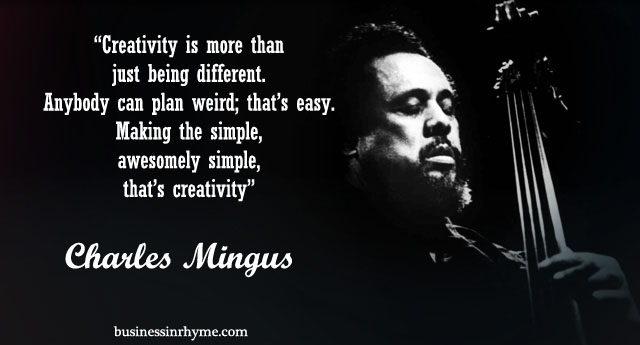
Daily verse with purpose: Charles Mingus
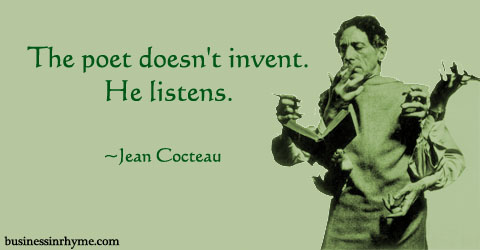
Daily verse with purpose: Jean Cocteau
 Business in Rhyme