

Blog
Daily verse with purpose

Daily verse with purpose: Lord Byron

“Collage” your way to creativity: let the rebel out!
You know those days when you have, like a hundred ideas what you would like to do, to write, but somehow you are having hard time to convey and articulate your idea? It’s there, you almost have a breakthrough but your thoughts are fast racing and nothing is coming out. Maybe we should try another way of expressing it?
In the post Organize your own creativity workshop! I propose having an inspiration box, with collected items that we like, that are inspirational to us. We can go step further and by selecting different items that appeal to us, we can try to express our idea or come up with a new one, by rearranging items in a collage.
The idea here is that we challenge ourselves, as much as a situation, a question, a problem that we have.
In this essay I came across interesting fact.The author, Marjorie Perloff states:
In the spring of 1912, Picasso pasted a piece of oilcloth printed with a trompe l’oeil chair-caning pattern to the surface of a small, oval canvas representing a still life on a café table, and then “framed” the composition with a piece of coarse rope, he was challenging the fundamental principle of Western painting from the early Renaissance to the late nineteenth century–namely, that a picture is a window on reality, an imaginary transparency through which an illusion is discerned. For collage typically juxtaposes “real” items–pages torn from newspapers, color illustrations taken from picture books, letters of the alphabet, numbers, nails–with painted or drawn images so as to create a curiously contradictory pictorial surface. For each element in the collage has a kind of double function: it refers to an external reality even as its compositional thrust is to undercut the very referentiality it seems to assert. And further: collage subverts all conventional figure-ground relationships, it generally being unclear whether item A is on top of item B or behind it or whether the two coexist in the shallow space which is the “picture.”
A collage as an art form was especially popular in dada movement. Many artists used this technique to provoke their unconscious thinking and explore metaphysical origins of reality. For example Hans Arp was famous for making a series of collages based on chance; he would stand above a sheet of paper, let squares of contrasting colored paper fall on the larger sheet’s surface, and then he would glue the squares – in any position they took by falling. Arp was interested in I-Ching fortune telling (where coins fallen by chance we interpreted for future forecasting) and he was curios what kind of visceral reaction would his art produce.


Raoul Hausmann Hans Arp
So how can you use technique of collaging to exercise your creativity?
The basic idea is for you to find small items, pictures, texts and letters from newspaper –anything that moves you and that you can rearrange into your own collage poem. By collaging your items, a new reality will start to form. Prune anything you find excess and look at new relations, surprises, metaphors, combinations. Your mind will try to justify any item by its origin, position, dimension. This is an excellent exercise for your creative rebel, to shout, to say, to sing, to whisper anything in particular you can’t. Let this collage poem be the messenger of your creativity. This exercise is a fun to do in groups also, as a team building game, an exercise in leadership skills, perhaps. Possibilities are endless – don’t restrain yourself – it’s good to rebel from time to time 🙂
After Experience Taught Me by Martin Buber
Take the first two fingers of this hand;
Fork them out—kind of a “V for Victory”—
Whether there might be something whose discovery
Would grant me supreme, unending happiness.
And jam them into the eyes of your enemy.
You have to do this hard. Very hard. Then press
No virtue can be thought to have priority
Over this endeavor to preserves one’s being.
Daily verse with purpose: Carl Sandburg
A simple thing you can do to make your storytelling more engaging
No matter are you a writer, a business owner or you just want to improve your presentation skills, effective storytelling is like having an ace in your sleeve that you can pull out just in time when you have to make your point or become more persuasive. In my previous posts about storytelling I discussed the power of narrative and today I shell go more deeply into how to harness that power to keep your audience active, engaged and responsive. Now, structuring your story, speech or even website content can be hard with distractions coming all over the place. In order to pass your ideas across and stuck to the memory of your audience you have to use all tricks and tools available to you. And avoid little mistakes along the way.
Here is what I mean:
Don’t begin with unattractive facts and figures (unless you are dealing with science and research, but even that kind of story we can make more compelling).
Frankly speaking, nobody cares about that! Stats are boring. We are addicted to stories, actions, emotions, adventures. Humans like a hero that’s on a journey, capable of mastering endless obstacles in order to fulfill his duty and purpose. So give your audience a hero, a story with purpose that delivers message, leaving them motivated and inspired.
One simple thing you can implement in your story telling is to incorporate the technique of a mythological narrative.
It’s a story structure that is found in many folk tales, myths, poems and religious texts from around the world.
In a mono-myth, the narrative goes like this: something happens that provokes our hero to leave his home; hero has (usually) a difficult journey ahead, where the destination and conditions are uncertain; after completing a series of challenges, hero returns with some kind of a reward, wisdom – some kind of benefit that he brings to his community.Think of Gilgamesh or Iliad. These were very long, epic and spoken word poems, that portrait the journey of a hero, all of his struggles, tragedies, misfortunes or little victories.
This is an excellent strategy when you want to accentuate the information you have and how that can benefit your audience. It also shows the pros and cons of taking risks and how we grow while learning something new.
In this article you will find three beautiful examples of using storytelling for small business purpose. The one I would like to share is about company Stio that introduced the outdoor apparel brand with a blog called The Town Hill Chronicles. The blog, by a team of professional writers, profiled people living in mountain communities across the U.S. In doing so, it helped Stio tell its brand story, how ordinary people experience outdoor life and activities (making them heroes of their brand), which eventually turned an audience into real a community that promotes and shares value of living in accordance with nature.
For the end I will leave with some thoughts by John M. Ford:
Against Entropy
The worm drives helically through the wood
And does not know the dust left in the bore
Once made the table integral and good;
And suddenly the crystal hits the floor.
Electrons find their paths in subtle ways,
A massless eddy in a trail of smoke;
The names of lovers, light of other days
Perhaps you will not miss them. That’s the joke.
The universe winds down. That’s how it’s made.
But memory is everything to lose;
Although some of the colors have to fade,
Do not believe you’ll get the chance to choose.
Regret, by definition, comes too late;
Say what you mean. Bear witness. Iterate.
Daily verse with purpose: Elizabeth B. Browning
Daily verse with purpose: Charlotte Bronte
Daily verse with purpose: Charles Bukowski

Simplicity – the ultimate sophistication of your work

Once Jane Austine said that life has turned into a “succession of busy nothings” and unfortunately I have found a lot of truth in her words. We often forget what really matters and get caught in petty, trivial things that deplete our time and energy. About 2 years ago, I took a radically different approach to my life – mostly provoked by my health issues. I began to simplify and minimalise everything I could – from physical stuff, what and how I eat, my everyday habits, what kind of thoughts and conversations I “consume” and interesting – beside the momentary benefits like feeling more free, relaxed and lighter (in every sense!) a need for poetry was born again. And I truly believe in the saying “Less is more”, where minimalism and poetry enriched my life on so many levels.
Today I will not speak much of a poetry, but rather I will try to share my tips and views on simplification, which can help in your writing, work or business; to find what really matters, prioritize and do more of the things you love. In the long run, you will feel more content and accomplished.
1.Learn to say no and cut down on meetings
I know we usually want to please everybody, but try to analyze your obligations more clearly and think: are all those meetings, tasks and chores really necessary? Today? What can’t wait? What can you delegate? What requires your personal, undivided attention? Once you manage to clear your schedule (just a little bit :-)) you will be more productive on the things that really do matter.
2.Take digital sabbatical when ever you can
According to International Association of Business Organizing a typical U.S. worker is interrupted by communications technology every 10 minutes. It’s a productivity killer and developing habits of focusing at a priority task is of vital importance in gaining time –which is your most valuable asset.
3.Find business processes you can automate
This is especially important in our business culture – everything requires approval, signature ext. Sharing files and templates among coworkers can help reduce incoming e-mail and paper jams.
4. Lean is the new black
Once you set your priorities, try to find any gaps where you can develop your own shortcuts to make processes lean as possible. Focus your resources on the things that matter the most.
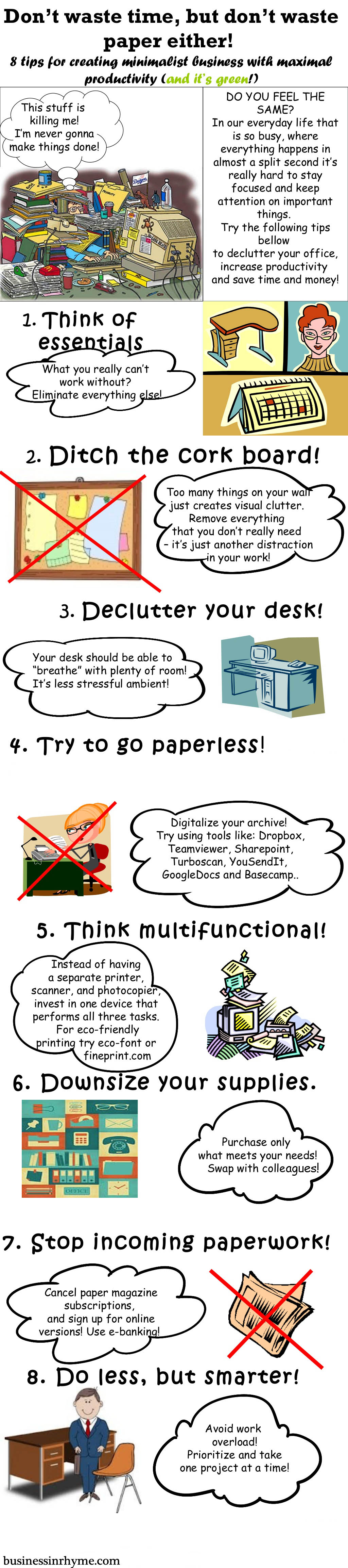
5. Go paperless
Don’t get me wrong: I know, for the writer this one can be really hard.
I personally love the smell and the sound of lisp paper.
I love having blisters on my fingers from extensive handwriting.
I like to taint my fingers with blue ink – nevertheless there are possibilities for us to cut down the paper work and therefore the clutter accumulating on our desk and in our drawers. I’ve included here this simple info-graphic with tips and tricks to help you along the way:
6.Adopt the Zen productivity mindset.
This idea is from Leo Babauta’s phenomenal blog Zen habits, where he proposes for us actually to put limits and strict rules on everything:
Besides forcing you to focus on essential tasks that have a large Return on Investment (ROI), it forces you to eliminate the non-essential tasks. No other system forces you to do that. It forces you to make the best use of your time. It forces you to limit the time you spend on things, which means you have more time for other things that are important to you, and you are able to focus on what you want to focus on, instead of everything coming at you. It simplifies your life and makes you less stressed out.
In a nutshell, limit yourself how many tasks a day you are going to execute; do one task at a time – and put rules on repetitive tasks – like, you will check your e-mail only twice a day. It’s an edgy idea but worth a try. In my post What writing haiku taught me about business the notion of simplicity also came forth, but we can always challenge ourselves even further.
7.Cut the the weeds at their root.
It’s so easy to go back to the old habits. Once you realize you are starting to overcomplicate things again, go back to the rules. Adopting minimalism as an entrepreneurial mindset takes time and effort. Once you see the benefits, “busy nothings” will dissolve by themselves.
But I say unto you,
Take this stuff just as a stuff;
Movement is movement;
Sitting is sitting,
but don’t wobble
under any circumstances!
My stuff has turned into a dragon
and swallowed up the whole world.
Where are the poor mountains and rivers and great earth now?
Yun-men Wen-yen, (Ummon), 864-949
 Business in Rhyme