Visualize with words (creativity exercise)

jonathan-swifts

I like to call visualization : strategic thinking while having fun. When you read about principles of strategic thinking it might sound too managerial and business oriented, but it is actually a sort of visualization: where you tactfully visualize and plan your desired outcome. Once you develop the ability to relive in your mind what you would like to experience, you are somehow training and preparing your mind (and body)  to achieve  in matching that picture with your performance.

Often guided meditations and visualization exercises are tools with aim to awaken all of your senses and help you more easily and vividly imagine you succeeding in your goals.

But also your writing can help you in visualizing what you want. You know you read good book if writer is capable in his words to put you in the center of the story – where you have impression you are experiencing everything written.

So the next exercise I will propose will help you not only in your visualization, but also you are practicing your writing.

Exercise is very simple, yet effective:

Your task is to name three things, topics, projects – what ever you are working on (or would like to achieve) and describe them using words you never used before to describe them; how that accomplishment looks like, feels like. Try to be descriptive as much as you can, use your senses and be precise – write a poem about it.

Let’s give it a try:

  1. First word: writing

Leaving engraved deep trails, beyond all boundaries and false confinements. Soundless I’m heard above all mountains and below every ocean; materialized thoughts in the smell of graphite, focused desires in every beat of pen on paper, caught ideas with smiley face, released drama in every vowel.

Where and when I offer me to you.

2. Second word: coaching

In service, empowering,  alignment of what I am with fruitful response: where other side becomes glitter in its own eyes and smiles with confidence and determination, air is filled with blooming possibilities and every atom of my knowledge is transferred and received openly, crushing any doubt, inability and disbelief.

3. Third word: creativity

Every moment, every day is new and gives new beginning; different, weird and enjoyable – there’s nothing to be afraid, no reason to hide. It’s warm, exciting, giggly, live, sharp, focused and likes to dance and cuddle.

In the sea of everything existing, it’s the laughter that connects, inspires and teach: with every key stroke, plaudit nod and  receptive silence.

It’s making unbelievable desirable, silly sensible and complex simple, but truthful.

So this is my take on the exercise. Now it’s your turn. Do you use visualization in your work? Does it help you in your writing? Please share in the comments below.

And therefore, though thy name shall pass away,
   Even as a cloud that hath wept all its showers,
Yet as that cloud shall live again one day
   In the glad grass, and in the happy flowers,
So in thy thoughts, though clothed in sweeter rhymes,
Thy life shall bear its flowers in future times.
A Vision Of Poesy (an excerpt)
Henry Timrod

If you liked this post and you are interested in getting more inspiration for your creativity, sign up for our free bimonthly newsletter.

Evolution

It’s in the deepest darkness,

where folded life emerges only with the

raging tempest

or when silence occupies rustling shore.


Untouched they eat flickering moonlight

catch laser sunbeams and jump over foaming waves


yet, don’t recognize our white secretions

we are so proud of, cheap surrogate

of every ounce of coaled milk we suck out

of the earth’s mouth


It’s the new plankton,

It’s the new algae,

It’s the new jellyfish


and the liver transplant in that whale

over there,

they never asked for.


Maja S. Todorovic

The importance of capturing ideas and how that impacts your overall creativity

tharp

There is simply too much information out there. And we become forgetful.

And we mix, misplace ideas, dates, terms, names…It’s simply getting hard to

keep up with everything going on around us.

As a creative, in order to nurture your creativity you need to be more than just well organized and  tidy. You want to have all your ideas stored, in one place where you can access them anytime for some further inspiration or the continuation of the project that you put on hold.

Why is that important? Author Steven Johnson, in his book, “Where Good Ideas Come From” suggests that is of vital importance to have that one central storage point, because every time you go to that place where your previous ideas are collected – that encounter is likely to strike some additional inspiration. Further more, combining new ideas with your previous ones, will produce something completely different that you’ll probably like even more – and this is how new, exciting and creative things are born.

In this enlightening interview famous choreographer Twyla Tharp shares how she keeps her inspiration intact:

Plain old file boxes, like the ones that line shelves in lawyers’ offices. I write the project name on the box, and as the piece progresses, I fill it up with every item that went into the making of the dance.”

So what can you do to make your creative work even more creative?

  1. Assign that sacred creative place where will you put your ideas for any later reference and inspiration:

For many writers it is a computer, notebook or evernote: I for example like to put the articles I’m currently working on to be on my desktop so I can access them anytime. Once I’m finished, they are stored to a delegated folder, so my desktop is never crowded or messy.

pinknotebook

My creative corner and pink notebook 🙂

I always have with me this cute pink notebook as I still like to write by hand (sometimes I have a hard time to read what I wrote (I have a terrible handwriting), but persistence is what counts :))

No matter what’s the nature of your creative work you can design your own inspirational box, board, have that shelf or drawer to place all your favorite items and ideas.

  1. Develop your own system.

Once you have that special place, throw in some additional organizing – maybe using index cards, have folders you can arrange by dates or subjects… there are numerous options: it’s important to find the way that works best for you.

  1. Review your creative place from time to time: let out, to let in.

Now, as much as I like to be able to retrieve my ideas whenever I like, there is a hinder that we might get overwhelmed with too much collected stuff, items, papers, books, old hobbies we are not interested in anymore .. that actually can make us feel lost in times and bring additional confusion into our work.

In that case, I simply try to check in with myself – how do I feel about that particular idea or item: if it brings some bad emotions, memories, maybe it’s time to let it go and make room for something new to occupy that creative space. Honesty and looking really deep inside ourselves will tell us if particular idea is worthy of holding on to or not.

In such ways you have your ideas organized and accessible and you are not in danger of becoming a hoarder of trinkets and ‘maybe some day’ items.

How do you organize and store your ideas?

I had the happy idea that what I do not understand is more real than what I do,
and then the happier idea to buckle myself
into two blue velvet shoes.
I had the happy idea to polish the reflecting glass and say
hello to my own blue soul. Hello, blue soul. Hello.
 
It was my happiest idea.
Mary Szybist

If you liked this post and you are interested in getting more inspiration for your creativity, sign up for our free bimonthly newsletter.

11 of your most favorite quotes (on writing, creativity and poetry) – all in one place

tinafey

You have to let people see what you wrote. It will never be perfect, but perfect is overrated.

Tina Fey

robertbly

In the process of writing, your energy gradually begins appearing in every line; eventually lines don’t resemble anyone else’s because they are all composed of your energy.

Robert Bly

leonard-cohen

Poetry is just the evidence of life. If your life is burning well, poetry is just the ash.

Leonard Cohen

shakti

We will discover the nature of our particular genius when we stop trying to conform to our own and other people’s models, learn to be ourselves and allow our natural channel to open.

Shakti Gawain

franz-kafka

Don’t bend; don’t water it down; don’t try to make it logical; don’t edit your soul according to the fashion. Rather, follow your most intense obsessions mercilessly.

Franz Kafka

viktorfrankl

What is to give light must endure burning.

Viktor Frankl

August_rodin

The main thing is to be moved, to love, to hope, to tremble, to live.

Auguste Rodin

aynrand

A creative man is motivated by the desire to achieve, not by desire to beat others.

Ayn Rand

bear

Once, poets were magicians. Poets were strong, stronger than warriors or kings – stronger than old hapless Gods. And they will be strong again.

Greg Bear

alan_alda

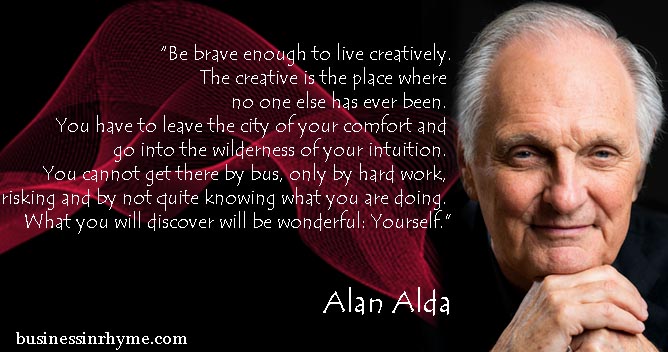
Be brave to life life creatively. The creative is the place where no one else has ever been. You have to leave the city of your comfort and into the wilderness of your intuition. You cannot get there by bus, only by hard work, risking and by quite not knowing what you are doing. What you will discover will be wonderful: Yourself.

Alan Alda

kingsolver

Close the door. Write with no one looking over your shoulder. Don’t try to figure out what other people want to hear from you; figure out what you have to say. It’s the one and only thing you have to offer.

Barbara Kingsolver


If you liked this post and you are interested in getting more inspiration for your creativity, sign up for our free bimonthly newsletter.

Why is poetry (and writing) so important – as seen through the words of writers

Here are three inspirational videos that I believe, if you ever doubted why should you write – will for ever clear up things for you. I hope you will enjoy them as much as I have 🙂

Scott Griffin is a Canadian businessman and philanthropist best known for founding the Griffin Poetry Prize, one of the world’s most generous poetry awards in 2000, and Poetry In Voice, a recitation competition for Canadian high schools. He is also the Chancellor of Bishop’s University. Chancellor Griffin sits on several NGO boards, as a director of Canadian Executive Services Overseas (CESO), a volunteer advisor to CESO, and a director of African Medical and Research Foundation (AMREF) Canada. In 2006, Chancellor Griffin published a memoir entitled My Heart is Africa that recounted his two-year aviation adventure starting in 1996, working for the Flying Doctors Service in Africa. He was appointed an officer of the Order of Canada in December, 2012. His talk explores the importance of poetry in society.

Daniel Tysdal has been a Senior Lecturer in the Department of English at UTSC since 2009. He is the author of three books of poetry and the poetry textbook, The Writing Moment: A Practical Guide to Creating Poems (Oxford University Press 2014). He is the recipient of multiple awards for his work and his research interests include creative writing and poetry. In his talk,  he is going to show you that you are the poet and will walk you through his writing process to showcase the Power of Poetry: to help us remember, grieve and celebrate.

Jarred McGinnis will share his passion for stories and demonstrate the power of words from Speech Act Theory to the genius that is the children’s book ‘That’s Not My Pirate’. Jarred is an American living in London, and the co-founder of the literary variety night, The Special Relationship. His fiction has been commissioned for BBC Radio 4, and appeared in journals in the UK, USA and Ireland. He is wickedtomocktheafflicted.com. In addition to writing fiction, he holds a PhD in Artificial Intelligence.


If you liked this post and you are interested in getting more inspiration for your creativity, sign up for our free bimonthly newsletter.

Business in Rhyme is looking for blog guests!

Many of you who have been following this blog for some time know that I’ve always intended to form a community around ideas that poetry as an art form has to offer much more than it is usually implied. For almost a year I’ve been on a quest to explore all benefits that writing and poetry has to bring into our lives. And a lot has been said and written. But I think it’s time we hear (read) some other voices and opinions too.

So this is official invitation to all bloggers to become a guest blogger on Business in Rhyme. This will give you the opportunity to show your work and share your opinions.

The first topic we could explore is how poetry improved your life and why do you write poetry? You could also include crucial poems that you like or that you wrote…Possibilities are endless.I know it might not be easy for some of you to share your vulnerability and intimate times of your lives, but think how you might help someone, inspire and encourage to embrace their feelings …  I’m doing this on the blog for the first time and I have no idea if any of you are interested, but since Business in Rhyme has a growing following of a roughly 5000 people on social media, it is a chance for you to show your work and increase readership.

If you would like to share your experience and inspire others to start/continue writing poetry, you can read the general guidance given in the header menu.

Thank you in advance for your contribution.

Poetry: a savior that comes when you least expect it

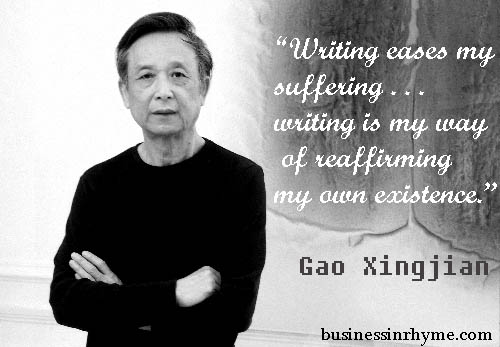
Gao Xingjian

Many of us, engaged in reading and writing are aware of transformative power of poetry, healing power and artistic value it brings to our lives. But how far does that really goes? Can you be saved by a poem?

In this enlightening interview, poet an writer Kim Rosen loudly answers, yes:

In the aha! moment that occurs when the mind bursts open—at a breathtaking metaphor or an insight or a chiming among the words—all levels of being human come into alignment. You feel a sudden integration of body, mind, heart and soul. The fragmentation that many experience in the multitasking onrush of modern life cannot withstand a good poem.

For many years she even feared poetry, thinking it was some kind of elite club, secluded for some ‘special’ and very important people. But on the verge of suicidal depression, poetry came when she most needed and literary saved her life:

In the midst of a suicidal depression, poetry poured back into my life, touching me in a way no spiritual or psychological teaching had been able to—literally saving me. The healing did not come through writing poems or even through reading them. It came when I discovered that taking a poem I loved deeply into my life and speaking it aloud caused a profound integration of every aspect of me—physical, emotional, mental and spiritual. I felt a wholeness I had never before experienced.

Further, she proposes we find a poem that really speaks to us and learn it by heart: read it loud as often as we can until it engraves somewhere deep in our soul and help flourish some better and more supportive thoughts. It can help you establish better relationship with yourself and explore sides of your being you didn’t even knew existed before. That’s what poetry does.

But what about writing your own poetry?

Dr. James W. Pennebaker, one of the most widely published researchers on the benefits of writing, says in his book, “Opening Up: The Healing Power of Expressing Emotions”, that writing about emotional topics improves the immune system by reducing

stress, anxiety and depression, improves motivation and aids people in securing new jobs.

About my own personal experience,  I wrote in this post how poetry came back into my life. And it happened to be that sacred, little place I was looking for to be only mine, that I could decorate, erase, fill, create or destroy the way I wanted. I didn’t have to offer any excuses, explanations or justifications for me being me.That kind of comfort is priceless. You learn to accept yourself just the way you are and you see that world isn’t some ugly place that want to make you miserable. It’s the way you see it and live it. That’s why I say: “Writing poetry helps me fall in love with the world, all over again!”

What are your reasons for having poetry in your life?

I didn’t trust it for a moment
but I drank it anyway,
the wine of my own poetry.

It gave me the daring to take hold
of the darkness and tear it down
and cut it into little pieces.

Lalla Ded. (Lalleshwari) (1320–1392)

The poetic determination: Ella Wheeler Wilcox on positive thinking and how that impacts success in life

ellawilcox

On a few occasions I have used poems of Ella Wheeler Wilcox in my posts and I have always found her verse to be very empowering and inspirational. For that reason, I’ve decided to explore further her philosophy on life and how that impacted her way of thinking and writing

Ella was born in Johnstown, Wisconsin in 1850 and her writing has made significant influence on the late 19th century american poetry. She began writing her poetry very early and managed to get published by the time she graduated from high school. Her writing is remarked by plain and simple rhyme style, which made her poetry accessible across diverse generations and very popular. She was also famous for writing about everyday human problems and struggles.

Lesser known facts are that at times she faced struggle herself when her work was rejected – once even 10 times. But her continues optimism and faith in persistence gave her courage to endure. She writes:

From reincarnated sources and through prenatal causes I was born with unquenchable hope and unfaltering faith in God and guardian spirits.  I often wept myself to sleep after a day of disappointments and worries but woke in the morning singing aloud with the joy of life.

I always expected wonderful things to happen to me.

In some of my hardest days when everything went wrong with everybody at home and all my manuscripts came back for six weeks at a time without one acceptance, I recall looking out of my little north window upon the lonely road bordered with lonelier Lombardy poplars, and thinking, ‘Before night something beautiful will happen to change everything.’  There was so much I wanted.

…Once I read a sentence which became a life motto to me.  ‘If you haven’t what you like, try to like what you have.’  I bless the author for that phrase it was such a help to me.

The trust she had in her work gave her strength to go through all negative events that followed her writer’s life. Seeing the positive side in every misfortune and the way she cheered herself is timeless wisdom we all as writers can adhere. What kind of power our thoughts have she also wrote in one of her poems:

I hold it true that thoughts are things
Endowed with bodies, breath, and wings,
And that we send them forth to fill
The world with good results – or ill

The desire of wanting something so badly is the drive that goes beyond any negative opinion someone else can hold against us. And in spite all stay gentle and kind:

It is easy to be pleasant when life flows by like a song, but the man worth while is the one who will smile when everything goes dead wrong. For the test of the heart is trouble, and it always comes with years, and the smile that is worth the praises of earth is the smile that shines through the tears.”

Always continue the climb. It is possible for you to do whatever you choose, if you first get to know who you are and are willing to work with a power that is greater than ourselves to do it.

Ella Wheeler Wilcox died in 1919, with poetry collections left behind her: Poems of Passion (1883), A Woman of the World (1904), Poems of Peace(1906), Poems of Experience (1910), and Poems (1919).

For this is wisdom- to love and live
To take what fate or the Gods may give,
To ask no question, to make no prayer,
To kiss the lips and caress the hair,
Speed passion’s ebb as we greet its flow,
To have and to hold, and, in time–let go.

Ella Wheeler Wilcox

To further explore the topic on power of belief, I recommend:

  1. 3 reasons why we should “revisit” our core beliefs, from time to time
  2.  Removing your biggest obstacle towards success: fear of failure

If you liked this post and you are interested in getting more inspiration for your creativity, sign up for our free bimonthly newsletter.
Where is the inexhaustible source of inspiration for your writing?

disraeli

I’m going to be quite bold in my next statement and say that it lies in you. You are your most valuable and inexhaustible well of inspiration for any story, poem, article or blog post you want to write. Sounds strange? Now, before you dismiss the rest of the article, let me elaborate a bit:

Often times, we look for external stimulants, information for guidance and ideas for our writing. But I believe that our own actual, raw and vivid experiences are our truest guides in which direction our writing should go. Every event, relationship, travel, struggle, joy, pain, suffering, reasons to be happy…are our best source of inspiration. When you share sincere bits of your personalities, these are the parts that people can relate to most.

You can write a beautiful poem about your ordinary everyday trip to a grocery store (like an ode to strawberries 🙂 ), you can write how technology impacts your life or how you love or dislike your current job…you can write about your need to write..you can find inspiration in children which can trigger some childhood memory and evoke new poem to be written.

But everything is in you. We can just look for some external motivators like current circumstances, sounds or place we are at the moment (I wrote a few poems while being on the plane 🙂 ) that will inspire our writing .

Jorges Luis Borges once said:

A writer – and, I believe, generally all persons – must think that whatever happens to him or her is a resource. All things have been given to us for a purpose, and an artist must feel this more intensely. All that happens to us, including our humiliations, our misfortunes, our embarrassments, all is given to us as raw material, as clay, so that we may shape our art.”

Lessons we learned in our life journey are our greatest teachers and I believe also a huge inspiration for anything further we do in life. And so with writing. I have found that when I share what I learned in my life so far – it’s like opening the door to even greater source of inspiration and it helps me avoid in future some of the mistakes I made in the past.

Or you can write about what you would like to experience – let your wishes and desires simply go wild with your imagination.

As long as you write what you know to be true in life, how you perceive life, beauty, love, pain, suffering..you simply can’t go wrong with that. You are unique and extraordinary human being with universal skills and experiences. Share and write about that, and your writing will be nothing less but exquisite.

I love all beauteous things,
I seek and adore them;
God hath no better praise,
And man in his hasty days
Is honoured for them.

I too will something make
And joy in the making!
Altho’ tomorrow it seem’
Like the empty words of a dream
Remembered, on waking.

Robert Seymour Bridges 


If you liked this post and you are interested in getting more inspiration for your creativity, sign up for our free bimonthly newsletter.


Writing poetry takes courage and a dash of craziness (and how is that good for you, as a writer)

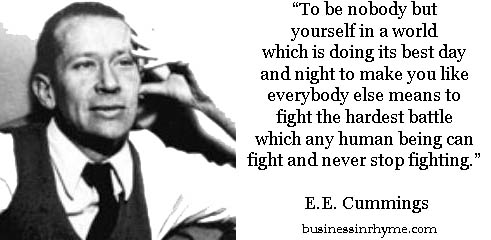
cummings

Confronting blank page takes courage? It might sound silly to many, but if you are a writer, especially a poet, you probably know what I mean:

It takes courage to spend time with yourself and dig deep, to the darkest and scariest parts of yourself and let them shine through your poems.

Only very few are brave enough to go somewhere place quiet, shut down the noise of the outer world and start listen to themselves; to hear who they truly are, and with open heart receive what ever they encounter. All experiences full of disappointments, grief, hurts, desires and happiness live and expand in each of these verses that we can read in the poems of those brave enough to write about their feelings. And they give us opportunity to live them also.

It takes courage to accept who you are and be honest about it.

Poetry is so personal on the one hand and universal on the other, that you simply can’t fake it. In every poem, your writing is like stripping your soul to the bare bones, where you become even more vulnerable. But that doesn’t make you anything more weak – that brevity adds up to your uniqueness that world is hungry for.

It takes courage to write, despite all the negative connotation that majority of people hold against poetry and simply not to care.

Some people simply don’t like poetry. There maybe many reasons for that. But also, there are not very supportive of those who does enjoy writing poetry. And it takes courage to continue to write and share our thoughts, no matter the impressions. I love what Jesse Graves, an assistant professor of English at East Tennessee State University said on the topic in this article:

For me, poetry expresses more about what it is like to be alive in the world today than any other art form. For a poem to work, it needs to address matters of the heart and of the head in almost equal measure. Since there is no interference between the reader and the text, poetry can deal with emotions in an intellectual way, and deal with abstractions in a way that evokes feelings.

It does take courage to try writing poems, especially if you are going to share them with others. Students also have to be willing to enter an unknown territory, even if I give them an assignment to write about, or a form, like a sonnet, they still have to find their own way into the subject matter. There is no real blueprint for how to write a poem..

It takes courage to write poetry and constantly juggle between loving and hating your own writing.

There are days when writing for you is like breathing – that without it you simply couldn’t live. But there are also days when you are unsatisfied with anything you write and you simply need a break. And that’s completely O.K. Actually that distancing yourself from writing can reignite your passion and it takes courage to do that also.

And someone might just call you crazy because you see world a bit differently: you see the joy in the heavy autumn storm, the warmth in the cold winter day or beauty in your teared bag and spilled groceries on the street. For me personally, writing poetry brings the opportunity to see and embrace life’s little imperfections in humble, and sometimes humorous way: instead of dwelling on how everything is wrong and complain – just to accept it, make the best of what I can in given situation and write a great poem about it 🙂

Poetry is everywhere, it just needs editing.

is what James Tate once said, and we are not even aware how much truth there is in those words.

All these aspects, contribute to forming one, in my opinion, a divine process that happens while you write poetry. It shapes you into a person you are supposed to be, the writer you strive to be. And for that kind of growth you do need courage – to accept your weirdness and just enjoy the ride.

It is in the small things we see it.
The child’s first step,
as awesome as an earthquake.
The first time you rode a bike,
wallowing up the sidewalk.
The first spanking when your heart
went on a journey all alone.
When they called you crybaby
or poor or fatty or crazy
and made you into an alien,
you drank their acid
and concealed it.

Later,
if you have endured a great despair,
then you did it alone,
getting a transfusion from the fire,
picking the scabs off your heart,
then wringing it out like a sock.
Next, my kinsman, you powdered your sorrow,
you gave it a back rub
and then you covered it with a blanket
and after it had slept a while
it woke to the wings of the roses
and was transformed.

Anne Sexton


If you liked this post and you are interested in getting more inspiration for your creativity, sign up for our free bimonthly newsletter.