Diversity at workplace: how to use poetry for improving communication and intercultural differences

Diversity: the art of thinking independently together.
~Malcolm Forbes

For many years I had the opportunity to live in the Hague, the Netherlands and it is one of the most diverse cities, where cultures, ethnicity, religion and human rights mix together, forming a unique atmosphere and living diversityconditions. Diversity is a major topic and I’ve been always intrigued to which extent it governs our everyday life – especially if we work and live in diverse community.
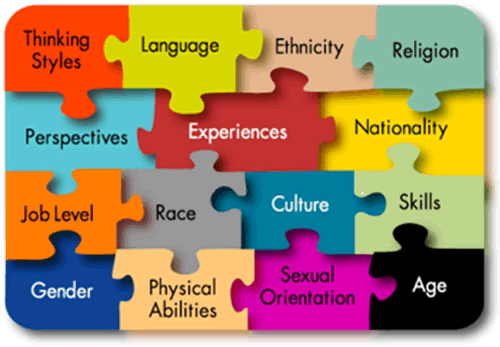
There is a variety of differences that can exist among people within one  organization. In the Forbs recent article, it states:

In addition to creating a workplace inclusive of race, gender, and sexual orientation (to name a few), many organizations are seeking value in something even simpler, diversity of thought. In some industries that are known for being insular – think law or high-tech companies – seeking out talent with different thinking and problem solving backgrounds is critical.

It is very important issue since it influences how we perceive ourselves and others. And as with every other issue, this one can have advantages and drawbacks that can affect our work life.

Some of the positive things might include different points of view, greater adaptability to changing conditions and a larger scale of skills and experiences within the organization. But often there are communication problems that can distract smooth interactions among the coworkers – which is prerequisite for timely and effective execution of projects. Ways and manners of managing diversity at workplace has become a hot topic and a lot of tools have been developed in order to bridge cultural gaps that diversity brings.

In the paper “Use of Poetry to Facilitate Communication about Diversity: An Educational Model”, authors suggest that we can effectively use poetry as a tool to facilitate communication channels among diverse and culturally challenged groups. They propose a workshop (that they tested in the following example) where the main materials for discussion are different poems from ethnically diverse poets and poems that relate to women’s issues.

Proposed workshop would begin with selecting a burning diversity topic that participants would like to discuss. Workshop facilitator afterwards chooses a poem congruent with issues that arose and a volunteer would read a poem. Participants in the group later discuss and talk about the poem.

Afterwards, participants would write their own poems, while they were also encouraged to read their poems in front of the group with the follow-up conversation. The workshop would end with the creation of collaborative poem, in which each member of the group was invited to contribute with one or more words.

Proposed time of the workshop: 3-4 hours, depending on the number of participants.

Workshop resulted in increased innovation, independence, self-discovery, sharing opportunities and collaboration. To measure these results, the Group Environment Scale was used to assess workshop effects on group dynamics.

According to the workshop feedback many participants adopted increased understanding of how gender and cultural issues may affect others.

Authors final conclusion is:

The research findings seem to indicate that the model’s interweaving of cognitive and effective elements has potential for creating changes among the individual’s perception of other cultures….metaphor can be especially instrumental in achieving this integration.

What are your thoughts on diversity, equality and inclusion? Can poetry be of any help?

Also have in mind beautiful words by Maya Angelou:

Human Family

I note the obvious differences
in the human family.
Some of us are serious,
some thrive on comedy.

Some declare their lives are lived
as true profundity,
and others claim they really live
the real reality.

The variety of our skin tones
can confuse, bemuse, delight,
brown and pink and beige and purple,
tan and blue and white.

I’ve sailed upon the seven seas
and stopped in every land,
I’ve seen the wonders of the world
not yet one common man.

I know ten thousand women
called Jane and Mary Jane,
but I’ve not seen any two
who really were the same.

Mirror twins are different
although their features jibe,
and lovers think quite different thoughts
while lying side by side.

We love and lose in China,
we weep on England’s moors,
and laugh and moan in Guinea,
and thrive on Spanish shores.

We seek success in Finland,
are born and die in Maine.
In minor ways we differ,
in major we’re the same.

I note the obvious differences
between each sort and type,
but we are more alike, my friends,
than we are unalike.

We are more alike, my friends,
than we are unalike.

We are more alike, my friends,
than we are unalike.

 

What poetry can teach us about business ethics?

Nature’s first green is gold,
Her hardest hue to hold.
Her early leaf’s a flower;
But only so an hour.
Then leaf subsides to leaf,
So Eden sank to grief,
So dawn goes down to day
Nothing gold can stay. 

These verses are from R. Frost’s poem “Nothing gold can stay”.  At first Business-Ethicssight it might has nothing to do with the world of business – hence, even when I first read it, it made me think in what kind of business world we live in. Most people see the connection between business and poetry in the realm of advertising, and are very skeptical to notions that there might be something deeper. In my opinion, if we just let ourselves go beyond superficial view of poetry – it can actually motivate us to find the meaning in ambiguity.

Poet is not trying to explain or justify anything. He offers you to see the world with his eyes, but the experience and the understanding is only yours. He takes you on the journey of self-exploration. Just as with the poem written above. Reading the poem, reminded me of the transitory quality of life: sometimes we are so allured to run after wrong values; all our activities mainly oriented towards making more profit that we literally forget that the gold is not everything that shines: quite the opposite “nature’s first green is gold”. And nature’s real green is very hard to recognize as due to pollution, smog, too much concrete in our immediate environment, busy lives we don’t have time to see and enjoy real treasures in life.

Or “The moment” by Margaret Atwood:

The moment when, after many years
of hard work and a long voyage
you stand in the centre of your room,
house, half-acre, square mile, island, country,
knowing at last how you got there,
and say, I own this,

is the same moment when the trees unloose
their soft arms from around you,
the birds take back their language,
the cliffs fissure and collapse,
the air moves back from you like a wave
and you can’t breathe.

No, they whisper. You own nothing.
You were a visitor, time after time
climbing the hill, planting the flag, proclaiming.
We never belonged to you.
You never found us.
It was always the other way round.

She is not here dealing with any facts. She doesn’t tell you how many acres of rainforests have been devastated. She doesn’t argue about the amount of plastic bags found in the oceans that are killing our marine wild life. But focusing only on business and material gain, pretending that we are the governors of the nature around us and that we need to subjugate other beings are not the values we should emphasize.  We are integral part of nature. And nature should be integral part of our business endeavors: not by killing and polluting but rather working in accordance with natural laws, fostering any life – no matter how minuscule. The awareness we have is our advantage and we could use it in a way that we can contribute beyond ourselves, beyond profit, beyond corporate expansion. After all, we are just visitors and we can choose what is going to be our legacy that we leave behind.

Reading poetry stimulates specific way of thinking which is vitally important to addressing world’s economic, political and social issues. It can broaden our views, help us recognize wider societal needs and gaps where our qualities can be fully utilized. Especially in entrepreneurship, when difficult and unpleasant decisions needs to be made – is it going to be mainly about the profit or entrepreneurial contribution is going beyond that?

Poetry and Creativity: crucial blocks in building leadership qualities

Hand holding two matching white paper jigsaw puzzles which written leadership word

To lead people, walk behind them.

– Lao Tzu

Success and power can easily hinder our good intentions, making our egos rise like skyscrapers and constantly generate that insatiable need for more. Many of those who fall into this trap, simply never look back, who they are leaving behind, creating unbridgeable gap between themselves as a “leader” and their peers.

But it has never become more clearly as in nowadays modern organizational structures that a good leader cannot be someone who imposes false authority: leader needs to inspire, guide, set an example for other coworkers. A good leader needs to have and foster a dynamic personality, be able to seize the opportunity, recognize talent and bring the best out of people.

I usually think of good leaders as magnificent puzzle solvers: they have that ability to utilize available human resources and reorganize their team in such way that each problem/situation can be managed – like solving the puzzle.

Now, how that relates to poetry?

Poetry can awaken those subtle human qualities that we need to develop in order to become good leaders. It helps us live and understand human experience which is a crucial part of creative process: taste of life and our perspective of the world motivate us  to generate more ideas and innovative solutions.

Organizational life can be draining and sometimes makes us hardly cope with everyday activities. Poetry reconnects us with those forgotten parts – instead of just surviving the working week, it can help us remember who we are and how to thrive, focusing on our best qualities.

In my opinion there is a quite similarity between leaders and poets. Leaders just as poets initiate thoughts and conversation about ideas, causes, motivation and engagement. Both poets and leaders have that ability to touch our souls, minds and connect us on the most intricate levels.

Our world is too complex with overlapping issues and processes: poetry has that magical ability to simplify things and life in general. In other words, reading and writing poetry can support any leader to better conceptualize the world and communicate it.

Furthermore, poem can provide wisdom and insight in the most difficult times. I hope that poem below will inspire your work, persistence and help you seize your value in every team, every relationship, every situation:

Focused Effort Prevails by Henry W. Longfellow

The heights by great men reached and kept

Were not attained by sudden flight,

But they, while their companions slept,

Were toiling upward in the night.


We have not wings, we cannot soar;

But we have feet to scale and climb,

By slow degrees, by more and more,

The cloudy summit of our time.

A Poem by Rudyard Kipling

doubt4For all those days when your feel insecure, discouraged or even lost;

For all those days when disbelief starts to bite you inside and every idea, every step you take seems pointless – read the verses below:


If

…you can keep your head when all about you
Are losing theirs and blaming it on you;
If you can trust yourself when all men doubt you,
But make allowance for their doubting too:
If you can wait and not be tired by waiting,
Or, being lied about, don’t deal in lies,
Or being hated don’t give way to hating,
And yet don’t look too good, nor talk too wise;

If you can dream—and not make dreams your master;
If you can think—and not make thoughts your aim,
If you can meet with Triumph and Disaster
And treat those two impostors just the same:.
If you can bear to hear the truth you’ve spoken
Twisted by knaves to make a trap for fools,
Or watch the things you gave your life to, broken,
And stoop and build’em up with worn-out tools;

If you can make one heap of all your winnings
And risk it on one turn of pitch-and-toss,
And lose, and start again at your beginnings,
And never breathe a word about your loss:
If you can force your heart and nerve and sinew
To serve your turn long after they are gone,
And so hold on when there is nothing in you
Except the Will which says to them: “Hold on!”

If you can talk with crowds and keep your virtue,
Or walk with Kings—nor lose the common touch,
If neither foes nor loving friends can hurt you,
If all men count with you, but none too much:
If you can fill the unforgiving minute
With sixty seconds’ worth of distance run,
Yours is the Earth and everything that’s in it,
And—which is more—you’ll be a [Founder], my son!

-Rudyard Kipling, 1895

Poetry and storytelling: part I

No, no! The adventures first, explanations take such a dreadful time.

-Lewis Carroll

onceuponatim

In these series of posts “Poetry and Storytelling” I will try to explore possibilities of using poetry as a tool for effective way of storytelling, especially for entrepreneurs and small businesses.

On the one hand entrepreneur as a storyteller and entrepreneur story as a cultural phenomena is already intrinsically established in the group consciousness (especially within the emerging social media networks), yet poetry as a narrative technique and genre is rarely considered as a mean of explaining entrepreneurial journey.

Through literature we can find a lot of evidence where entrepreneurial skills, behavior and entrepreneur’s relationship with the world comes in the form of narrative fables like picaresque tales  which McKenzie, B (2002) in “Understanding Entrepreneurship: A Definition and Model Based on Economic Activity and the Pursuit of Self-Identity”, so beautifully demonstrated. The study describes the use of oral narrative by entrepreneurs to exchange important information and induces a new definition of entrepreneurship: an economic activity undertaken by social individuals in their pursuit of self-identity.

O’Connor, E., in the paper “Storied Business: Typology, intertextuality, and traffic in entrepreneurial narrative”, states that “entrepreneur needs to be a storyteller”, an ‘epic hero’, capable of offering emotional connection to his audience, a character with whom audience can identify with, rejoice, suffer, celebrate, fail – simply experience everything. In other words, successful entrepreneur is giving tangible experience through his business story and that’s what makes his story and business alive. Use of mythology, eulogy, metaphor, epic and fairytales, permeated with humor and sudden twists is a winning recipe for a business story that captures attention.

Rationalists, wearing square hats by Wallace Stevens

Rationalists, wearing square hats,

Think, in square rooms,

Looking at the floor,

Looking at the ceiling.

They confine themselves

To right-angled triangles.

If they tried rhomboids,

Cones, waving lines, ellipses—

As for example, the ellipse of the half-moon-

Rationalists would wear sombreros.

These verses clearly signify the importance of creativity as an entrepreneurial skill. Words are empowering and encourage us to think “outside the box”, outside our limited senses and borders given by societal norms.

This poem in particular was used by Price Waterhouse Management Consultants in an advertisement (Sunday Times, 22.10. ’95) to attract open-minded (entrepreneurial) individuals with creative abilities, ready to question and challenge everything that is predefined and ordinary.

Poetry evokes emotions, stimulates thinking and inspiration. In the posts to come, I will further research how successful entrepreneurs have used poetry to communicate their business ideas.

How poetry can stimulate creativity?

1c48070

Poetry is when an emotion has found its thought and the thought has found words.

– Robert Frost

Some interesting results of recent researches, like at the University of Liverpool  – scientists have found that reading poetry and prose can actually stimulate our thinking and creative cognitive abilities much more than for example self-help books, which are nowadays popular way of finding solutions when we are in some sort of crisis or challenging situation. It turns out the more complicated poetry and prose were, the reader’s attention time span was longer and deeper, and it also stimulated their moments of self-reflection.

brain-poetry

Researches in the aforementioned research used a group of volunteers, where with scanners, they have monitored the brain activity as the volunteers read works by William Shakespeare, William Wordsworth, T.S Eliot and others.

After the reading, the volunteers were asked to “retell” the texts using their own words. Scans showed that the more “challenging” prose and poetry set off far more electrical activity: especially the activity in the right hemisphere of the brain, an area concerned with “autobiographical memory” and emotion, helping the reader to reflect on and reappraise their own experiences in light of what they have read.

Poetry is not just a matter of style. It is a matter of deep versions of experience that add the emotional and biographical to the cognitive.

-Proff. Davis from Liverpool University

Some earlier scholar works also attribute poetry to development of cognitive, learning and memory skills. In particular, McGovern and Hogshead in their paper “Learning about writing, thinking about teaching”, describe how poetry can promote writing skills, learning, fosters analytic and creative thinking and problem solving.

Csikszentmihalyi in his paper “Creativity: Flow and the psychology of discovery and invention”, published in 1996, proves that discussing a poem is an exercise in problem finding, a skill essential to creative work in both the arts and the sciences.

Halonen in his paper “Demystifying critical thinking”, (1995) states that poetry often contains unconventional language or unusual treatment of a topic. Surprise becomes a catalyst for critical thinking as the audience works to resolve subsequent feelings of disequilibrium.

So, when I feel stuck, uninspired I just play with words, rearrange them or observe the environment and describe it in more lyrical way. I have noticed that my attention and emotion shifts – it’s like working on the puzzle: thoughts of possibilities are coming – poetry simply jump-starts our brain’s synapses.

Next time when you need a creativity spark, try to write a poem. Something different, something that you are not accustomed to. In this case there is no bad or good poetry. The aim is to start moving creative juices in our minds and poetry is a great tool for that. Even science agrees 🙂

Achievements by Ella Wheeler Wilcox

Trust in thine own untried capacity
As thou wouldst trust in God Himself. Thy soul
Is but an emanation from the whole.
Thou dost not dream what forces lie in thee,
Vast and unfathomed as the grandest sea.
Thy silent mind o’er diamond caves may roll,
Go seek them – but let pilot will control
Those passions which thy favouring winds can be.

No man shall place a limit in thy strength;
Such triumphs as no mortal ever gained
May yet be thine if thou wilt but believe
In thy Creator and thyself. At length
Some feet will tread all heights now unattained —
Why not thine own? Press on; achieve! achieve!