If only

If only I could be a river

a river that goes, flows to the mouth of giant

whale, joining other watery hands to handshake in

the rhythm of waves, rejoicing drop by drop in the

eternity of an ocean;


If only I could be a wind, that carries my breath

collides white clouds, like a spider’s net catches every word

has the strengths to rearrange desserts

and knows how to surrender

in the eye of storm;


If only I could be a tree,

a tree that knows its place under the sun,

how to befriend soil and welcome rain

a tree that accepts its roots – broken sinews

too tired to grow:


I would congratulate myself,

I would sing the song only I hear,

I would visit places only I knew exist

I would finally be who I am.


Maja S. Todorovic

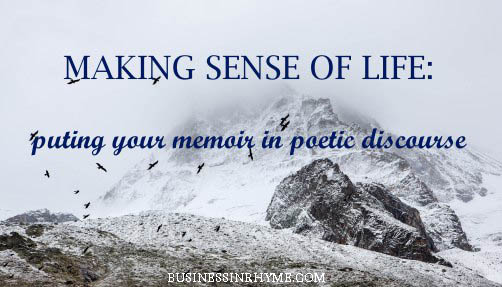
Making sense of life: putting your memoir in poetic discourse (writing prompt)

Dent Blanche im Nebel, 4000er im Kanton Wallis, Schweiz. Alps of Switzerland

Following this post published few weeks ago, it occurred to me: there is always something we haven’t told yet. A story, an event or memory that we shy from for some reason, that we avoid thinking about, talking about. And I don’t mean talking to others, but to ourselves. That internal conversation (or lack of it), has a subtle impact on our day to day life governing our decisions and choices in ways we are not even aware of. Our subconsciousness is like a vast ocean where we can drown deep with our feelings or we can strive for the surface to enjoy the sun and blue sky.

Each emotion and memory from the past has hidden opportunity for growth and healing. And these are the main reasons why people engage in writing memoirs. It’s a path of self-exploration, where time, the main ingredient offers different perspectives and lays a platform for us to embrace and accept our past. Not simply to remember but to celebrate each moment in life as these moments are the foundation for our future self. It can be painful and cathartic, but most importantly – freeing! In this interesting interview, Samantha M. White the author of  Someone to Talk To: Finding Peace, Purpose, and Joy After Tragedy and Loss explains that in your memoir writing  – the results can go beyond your initial intention.

Writing my memoir transformed my life. Not only my day-to-day present, and my future, but even the past about which I had written!

Transformation was not my goal. I wrote it because I had a story pent up inside me, pressing to be told – to share what had happened to me, and how I had found my way out of pain. I wanted to assure readers of the universality of suffering, and the reality of healing and finding new joy. I felt driven, and afraid that if I died before publishing the book, an important message wouldn’t be heard”.

So today I want to propose a bit different writing exercise. Think of any event or situation in your life that you would like to understand better, to explore, analyze or that just needs to be ‘poured’ on your paper and write a poem about it. Tell your story using poetry. And you might ask, why just don”t write about it? I think that poetry goes beyond prose writing and it allows you more freedom to express your feelings in different ways. Often we can’t find the right plain, straightforward words to say something but it needs metaphoric guidance that offers us strengths to deeply dive into the ocean of our subconsciousness. Take your time and write your way through it.

Narrative form of poetry and memoir complements each other to open the door of that internal conversation – you might be surprised what ‘s on the other side.

I personally often use this technique to simply sort my feelings and make a sense of life. These confessional poems are often highly emotionally charged and there’s the beauty: being able to feel is for me a proof that I’m alive. Accept every emotion that comes your way, because that’s human – to be vulnerable and celebrate your flaws, mistakes and successes as you navigate through life – the best you can.


If you liked this post, please share! And if you are interested in getting more inspiration for your creativity, sign up for our free monthly newsletter.

Poetry improves lives: a guest post by Jason J. Michael

This is a guest post, a courtesy of a fellow blogger and poet Jason J. Michael. This essay is a bit longer than usual posts on this blog, but I encourage you to read it through – a touching story on how poetry, particularly haiku has changed his life, literally.

The Healing Power of Haiku

4641
Believe in yourself,
And your ability to
Make a difference.

   On September 3, 2000, when I was twenty-nine, my father died. He smoked himself to death acquiring, in order, blocked arteries, throat cancer, lung cancer, emphysema, and finally congestive heart failure, which in combination with the others claimed his life. His untimely death was fully expected by everyone around him, except for me. A jazz musician, he had quietly sold off his instruments to friends, had delusions of teaching sax quartets in our kitchen, gone to the drugstore in his briefs, and had visions of a mute, glowing boy and girl that accompanied him on errands. All of these I was aware of. None of them I took that seriously. I was living home with my parents temporarily, but consumed by my career goals. I was directing, acting, and composing for a local dinner theatre, I loved the job and it held my full focus. Besides, parents are immortal, right?

I was with him in the hospital, holding his hand, when he passed. In fact, I had been the one to give permission to take him off the machines that were keeping his heart and lungs operational when my mother, in an unexpected wave of grief, refused the honor and responsibility herself, stating “I just can’t do it.” The decision by default fell to me and, sensing no recourse, I ordered him removed from the machines and held his hand till his heartbeat faded. From my point of view, I had just killed my father.

The following year was a blur of work juxtaposed against a backdrop of depression and excessive sleep. One year to the day, on the anniversary of his death, September 3, 2001, I started working as a full-time music teacher at a Catholic boys’ school in Philadelphia. It was exactly the kind of job he would’ve wanted for me, and I felt pushed into it by his overshadowing presence. Everyone there was wonderful, but the pain of his loss coupled with the guilt I had felt over “pulling the plug” was consuming me, and combined with the isolation I felt from having moved away from my family for work, I sank further into depression and almost nightly contemplated suicide.

Then one night in late fall of 2001, while sitting alone in my apartment, I started flipping through channels and stopped on a bald man with a calming presence, wry wit, and warm, gravelly, voice. His name was Dr. Wayne Dyer, the PBS special was There’s a Spiritual Solution to Every Problem, and I found myself drawn to what he was saying. Dyer’s pithy, anecdotal, personal empowerment spirituality resonated and stuck with me long after the special ended, and by the next evening I was reading his book, The Power of intention. Within a few days signature quotes such as “You’ve got to believe it to see it” and “You are a spiritual being having a human experience” started to take up permanent residence in my brain and I was feeling a bit better. One quote, “Don’t die with your music still in you,” held special significance for me.

My degree had been in Music Composition, and my father and I had spent many hours composing together in our basement. When he died the music in my head had gone silent as if it died with him, but I knew instinctively, defiantly, that that wasn’t the case. In my grief I couldn’t access it; my guilt over “killing” him, and my need for his approval had turned my creative volume setting to mute. But I knew it was there, knew that Dr. Dyer’s warning mantra was applicable to my life, and knew that I would have to start slowly if I was to ever rekindle the creative flame inside myself. As a musician I had often been both composer and lyricist. I prided myself on my ability to put words cleverly together. But I would have to start again slowly, with small projects that allowed for a big sense of accomplishment. So, on November 18, a few weeks after watching the special, I sat at a desk over lunch in the center of a crowded school hallway – a reluctant and bored hall monitor – and wrote my first haiku in twenty years.

1
If I ruled the world…
But wait! Life is perception.
Where did I go wrong?

I struggled to write four haiku that day, but the next day I wrote more, and more after that. By January 20, 2002 I had written a hundred little poems, and realized I was starting to feel a bit better. I still wasn’t composing, but my creative juices were flowing, and I was amassing a large body of poetry that I could be proud of.
At the time I didn’t realize the full impact that writing haiku was having on my life, or how much I had almost obsessively fallen in love with distilling my daily thoughts down to a 5-7-5 syllabic format. I didn’t realize fully the therapeutic benefit, that by putting my thoughts simply and creatively on paper and “out there” I was releasing the pent up depression, guilt, and grief that had built up inside me over the last year and a half. I just knew I was being creative and felt better, and when something makes you feel good you keep doing it, don’t you?
Sixteen years after my father’s death, practically no week has gone by that I haven’t written at least one haiku. As of this writing, I’ve composed over 4,600 of the little buggers, self-published two books of poetry, plus a third children’s book. My music took years to return to me, but when it finally did it blew in with a vengeance, and I now compose fairly regularly, along with trying to maintain my blog, of course.
Everyone’s pathway to healing is unique, and for all I know had circumstances been different, perhaps something else would have come along to intervene, lift me up, and rehabilitate my spirit. Then again, perhaps nothing would have changed, and in my grief I may have commit suicide. But thankfully, THANKFULLY, that wasn’t to be my fate, and I ran across Dr. Dyer and his life philosophy when my spirit needed him the most. And that led me to fight for my life, a little bit at a time, with seventeen syllables in a crowded hallway, and with props to Frost, “that has made all the difference” for me. So, in case you ever had any doubts that poetry has magical properties or lasting value, I’m here to tell you that I’m living proof that poetry can change or even save a life. And that is the true healing power of haiku.
Namaste,
Jason

Jason J. Michael is a freelance actor, director, music director, and composer. He has self-published two books of poetry, True Haiku for You and A Haiku a Day; and one children’s book, Daddy Doesn’t Purr (But I Love Him Anyway), all available on Amazon. He won the Writer’s Journal National Poetry Contest with his poem “The Greatest Treasure” many years ago and has written some 4,600 haiku to date. He lives in King George, VA with his wife, son, and three cats. His blog, Reflections from Shangri-La, can be found at https://reflectionsfromshangrila.wordpress.com/

If you would like to contribute with your guest post visit this link for further information. And, if you are interested in getting more inspiration for your creativity,sign up for our free monthly newsletter.

Innocence

Metal bird drums among the clouds,

regularly each morning like broken alarm clock.


Automated, she reached for the bruised pot

the one in which she would usually make coffee.

Instead, she just licks fresh water from her palm.


Warmed up, she searched for silk tights

and fake leather boots.

Instead, she leaves her coarse feet and ingrown

toenails to bloom.


Played in, deceiving softness of her bed

she replaces for ripened hard floor.


Faced to a nameless wall, disarmed void of things

she could finally swell into her own innocence.


Maja S. Todorovic

Poetic inspiration: Why reading?

reading_poetry

Reading not only satisfies your curiosity:

it enriches you inner world like

you lived 1000 lives before.

Maja S. Todorovic


If you liked this post, please share! And if you are interested in getting more inspiration for your creativity, sign up for our free monthly newsletter.

Monetize your writing: 4 publishing contests you shouldn’t miss (no fees)

writing_contests_poetry

About year ago I published this post where I emphasized three creative, more alternative ways you can earn money as a poet. Well, what I left out are writing contests as they are more of a traditional way of monetizing your writing. Nevertheless, they are a great way for emerging poets/writers to get more recognition and practice working under deadlines with focus on a specific topic.

Below is list of 4 competitions/paying publishing opportunities that I think are worth your attention. Now, I haven’t included contests that require fees, as I don’t see them as much motivating. Also, many of the competitions have specific accent on age, gender, location and ext. so I tried to exclude those which are very restrictive.

Here’s my list:

Wergle Flomp Humor Poetry Contest

This is 16th year that this contest exists. There are no fees required for you to enter – only to make them laugh 🙂 If you like poetry and humor, this is the perfect combination for you. From August 15, 2016 until April 1, 2017 you can submit your published or unpublished work and enter run for one of the prizes:

“a first prize of $1,000 and a second prize of $250. Ten Honorable Mentions will receive $100 each. The top 12 entries will be published online. Length limit: 250 lines. No restrictions on age or country.”

Here’s the link where to submit: https://winningwriters.com/our-contests/wergle-flomp-humor-poetry-contest-free

Blue Mountain Arts hosts its twenty-ninth Biannual Poetry Card Contest

Deadline: December 31, 2016
1st prize: $300, 2nd prize: $150, 3rd prize: $50

In addition, the winning poems will be displayed on their website sps.com.

Here are the rules and guidelines:

“Poems can be rhyming or non-rhyming, although we find that non-rhyming poetry reads better.

We suggest that you write about real emotions and feelings and that you have some special person or occasion in mind as you write.

Poems are judged on the basis of originality and uniqueness.

English-language entries only, please.

Enter as often as you like!

Poetry Contest Rules

All entries must be the original creation of the submitting author. All rights to the entries must be owned by the author and shall remain the property of the author. The author gives permission to Blue Mountain Arts, Inc. to publish and display the entry on the Web (in electronic form only) if the entry is selected as a winner or finalist. Winners will be contacted within 45 days of the deadline date. Contest is open to everyone except employees of Blue Mountain Arts and their families. Void where prohibited.”

Complete the contest form here at http://www.sps.com/poetry/index.html

Platypus Press offers an opportunity for publishing contract

Here are the guidelines:

“For poetry, please send at least half of the complete manuscript.

For short story / essay collections, please send at least five stories.

For novels, please send the first three chapters.

We ask that no more than fifty percent of the manuscript be previously published.

Simultaneous submissions are fine, but please let us know if your manuscript is accepted elsewhere.

Authors will receive ongoing royalties whilst the book is in print, but we do not currently offer an advance.

Attach your manuscript as a PDF and include a short third-person bio with your submission (e.g. who you are, any other publications, etc.).

Please note:

For poetry, please don’t send rhyming poetry or translations.

For fiction and essays, we do not accept erotica, horror, religious material or fan fiction.

We are a very small company, but we aim to give you a response within a month. Please query if it has been longer.”

You can submit via email to: submissions@platypuspress.co.uk

The last but not least is a competition for best short stories. I know that many of us flirt and experiment with different writing genres, so some of you, poets, can find this appealing too.

Short Story Competition 2017

“For published and aspiring writers alike – enter our free annual short story competition and be in with a chance of winning a place on an Arvon residential writing course of your choice (worth £1,000), as well as seeing your story published on www.writersandartists.co.uk.

To enter, all you have to do is submit a short story (for adults) of no more than 2,000 words. And that’s it. Unlike previous years, there’s no theme for you to base your story on; all you have to do is make sure you’re registered with the website, the subject line of your email reads ‘W&A Short Story Competition 2017‘ and you send it to competition@bloomsbury.com.

The closing date for entries is midnight on Monday 13th February, 2017. The winner of the competition – along with two runners-up – will be announced on the blog pages of this site in March 2017.

Arvon run three historic writing houses in the UK, where published writers lead week-long residential courses. Covering a diverse range of genres, from poetry and fiction to screenwriting and comedy, Arvon courses have provided inspiration to thousands of people at all stages of their writing lives. Find out more and book a course online at www.arvon.org

Full details, terms and conditions for this contest you can find here.

So there you go, think of these competitions and give it a try – at least it will stir up your writing and keep your creative juices flowing.


If you liked this post, please share! And if you are interested in getting more inspiration for your creativity, sign up for our free monthly newsletter.

Poetic inspiration: What poets do?

emotional_journey_poetry

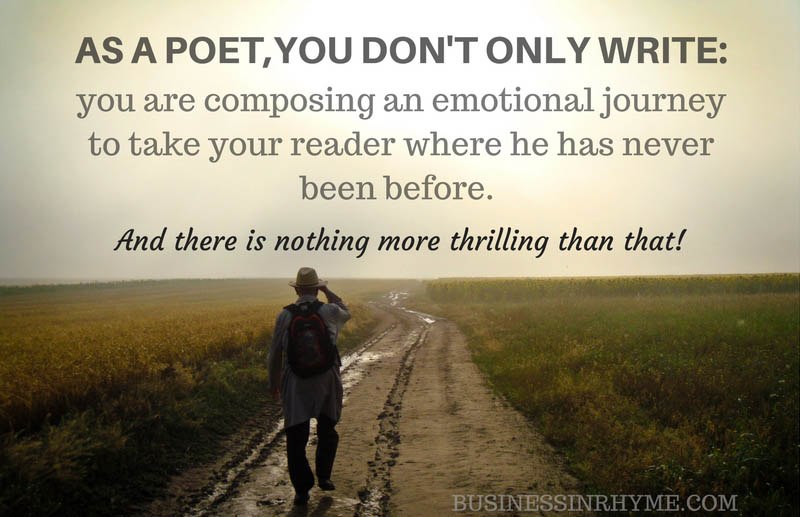
As a poet, you don’t only write:

you are composing an emotional journey

to take your reader where he has never been before.

And there is nothing more thrilling than that!

Maja S. Todorovic


If you liked this post, please share! For getting more inspiration for your creativity, sign up for our free monthly newsletter.

Poetic inspiration: Unlock your untold story

unlock_untoldstory_poetry

Unlock that untold story

residing in you,

for once you

break the chains of yesterday,

you will find the way to your most

creative self.

Maja S. Todorovic


If you liked this post and you are interested in getting more inspiration for your creativity, sign up for our free monthly newsletter.