NaPoWriMo: Day 1

Prompt: awaken creativity

What makes you smile?

What makes you angry?

What are you curious about?

Who would you like to be?
Write a poem using these questions as pointers.

I wanted

Empty hands lying on the table:

it’s not enough to squeeze them in fists
and say you have caught the air.

Wrinkled curtains above the windows:

it’s not enough to drape them down
and say you have hidden the sun.

Cold silence lingering in between us:

it’s not enough to turn your head
and say you didn’t know.

Bony face changes expressions,
fast as traffic lights.

I used to love to place my thumbs
in small wholes of your withered cheeks
and pull them slowly towards your chin.
As self-contained sigh would spread over your face,
my heart would gallop in circles, impatiently waiting
for sign that is safe to walk and cross on the other side
of your presence.

And when red light would start to dim from your metallic eyes
I’d smile, despite the hurdles of your pouting nose
that would tear the clouds, higher than any skyscraper
with tall shadows where we used to hide.

I would pretend I’m angry but all I wanted is just to keep
you safe, near me, but away from my deceiving past
and tell you
everything,

everything,

everything
from the very beginning.

and be free

become free.

I wanted you and me, in us:
wrapped in time,
forged in lust.

Maja S. Todorovic


If you liked this post, please share. And, If you you are interested in getting more inspiration for your creativity, writing and personal growth, sign up for our free monthly newsletter. You’ll get a free e-book with 31 daily prompts to inspire your writing. For additional tips, follow us on twitter and connect with us on facebook.


NaPoWriMo starts tomorrow, are you joining in?

Yes, tomorrow is a big day for all of us poetry lovers, as it is a good chance for us to gear up our writing and improve our poetry skills. As many of you might noticed I haven’t been active very much on the blog lately, which is due to my right elbow injury. It hurts like hell and any repetitive movement like typing is simply causing me to much pain. It’s extremely difficult for me to work. Recovery is too slow and I’m facing 8 weeks of rigorous physical therapy. I truly hope it will help me get back on track with my writing (this paragraph took me almost an hour to type!).

Anyway I don’t want to miss this NaPoWriMo, and I’ll do my best to stick to the challenge until the end. For additional inspiration I intend to use prompts from my ‘Get busy with writing’ e-book. 31 prompts to stir up creativity and if you think you could benefit with some additional inspiration for NaPoWriMo, follow this link to get your free copy.

I wish you all a happy and fruitfull NaPoWriMo! 🙂

Can poetry help you land your dream job – part II

poetry_dreamjob

In the first part of these blog series we discussed the benefits of writing poetry in realm of developing positive identity narrative which can lead us to closer picture and knowing what we want to do in life.But what about when it comes to other people’s poetry? How that can help us achieve our career goals? Here I want to share with you two interesting examples. A college teacher placed a job advert in front of her students and asked them what the job is all about. An advert was mostly listing of technological skills and many students didn’t manage to locate the key skills employer was looking for, as it was cleverly ‘masked’ under technological terms:

Expertise: Information Systems Technology 
Education: Bachelors 
Job Type: Full-Time
Location: Tulsa, OK
Compensation: Commensurate with Experience
Start Date: Immediate

Provide technical support and assistance to both Williams internal application systems users and external customers/partners. Develop familiarity with business, application, and technical processes and use this understanding to improve the processing and accuracy of the data and the performance of the interfaces between internal systems and external customers. Lead efforts to resolve issues across business, application support, and technical support groups seeking the best solution to problems that arise in the process, performance, or accuracy of application systems and the data exchanged between internal and external systems and customers. Problem resolution efforts will often include direct interaction with external customers. Must be a strong leader able to manage cross-functional teams toward a common goal of problem resolution and process improvement. Problem resolution efforts will often involve teams with dissimilar goals and priorities and the need to manage them toward a common goal and gain the support of their disparate management organizations. Must possess exceptional written and oral skills. A good existing understanding of business, application, and technical areas is required and/or the ability to seek out and assimilate information independently and quickly. Must be able to work with little supervision and manage time effectively. Knowledge and experience acquired through this position will serve as excellent preparation for movement into advanced leadership positions within Williams Communications. Bachelors degree or equivalent experience.

When the teacher asked her students to take a look at deeper meaning in this advert, to treat it like they were reading a poem – that approach opend a lively discussion in the class and students managed to locate two key sentences:

Must be a strong leader able to manage cross-functional teams toward a common goal of problem resolution and process improvement. Problem resolution efforts will often involve teams with dissimilar goals and priorities and the need to manage them toward a common goal and gain the support of their disparate management organizations.

Beside the excellent communication and leadership skills, employer is looking for someone whose teams probably at the moment are not getting along; they are looking for someone new, with fresh ideas and perspective and as such who will be able to manage number of smaller groups with cross-purposes.

So the teacher proved to her students in this fun and exciting exercise, how poetry teaches us to take critical approach to what we are confronted with, and how in such fashion we are able to look for underlying causes and hidden facts, which are not obvious at first sight. This skill can be helpful in many life situations – even when it comes to haunting your dream job.

In another interesting  article, we can see the results of survey that Linkendin has conducted – they asked influencers what is the single best piece of advice they’ve ever received when it comes  to career. Angela Ahrendts, Senior Vice President at Apple Retail shared a single poem that encapsulates a lifetime of lessons: The Desiderata.

Its profound principles subliminally shaped and defined my core and have guided me throughout my life.

It was framed on the wall of her father’s office when she was a teenager.

At the time, I repeated the words without reflection, unconcerned by their meaning, but with perspective, I know these simple truths helped form the fabric of my leadership, inspiring me and reminding me of my place and my purpose.”

An excerpt:

Go placidly amid the noise and haste, and remember what peace there may be in silence. As far as possible without surrender be on good terms with all persons. Speak your truth quietly and clearly; and listen to others, even the dull and the ignorant; they too have their story.”

“Enjoy your achievements as well as your plans. Keep interested in your own career, however humble; it is a real possession in the changing fortunes of time.”

So, in the nut shell these are my two recommendations for using poetry as a career guidance:

  1. Use metaphor to describe your problem: strong images and observations that can trigger some additional thoughts on how you can approach your problem differently and observe how you feel about each thought – it’s the best orienteer if you are on the right track with your solution. Positive language can enforce development of positive ‘narrative identity and choices’, which can lead to better understanding what is our purpose and calling in life.
  1. Find inspirational poems that align with your values and outlook on life. Read them frequently, use them as a reminder of what you stand for and what you desire your life to be.

Do you have any poem that profoundly influenced your life? Please share in the comments below.


If you liked this post, please share. And, If you you are interested in getting more inspiration for your creativity, writing and personal growth, sign up for our free monthly newsletter. You’ll get a free e-book with 31 daily prompts to inspire your writing. For additional tips, follow us on twitter and connect with us on facebook.

When you write poetry, remember this…

As we are celebrating World Poetry Day, this is a quick reminder that each poem you write is reflection of you in that particular moment. That holds its own beauty and value that nobody can’t deny.


If you liked this post, please share. And, If you you are interested in getting more inspiration for your creativity, writing and personal growth, sign up for our free monthly newsletter. You’ll get a free e-book with 31 daily prompts to inspire your writing. For additional tips, follow us on twitter and connect with us on facebook.
Can poetry help you land your dream job – part I

poetry_dreamjob

How to choose a career path? In these two-part post series I’ll discuss the benefits of reading and writing poetry for career development.

We all know that career as a definition and societal phenomena has undergone many changes and I do believe that today it has become very personal thing. A stay-at-home mom, having three kids and raising her family can be very satisfied with her life. Or someone who is working every day in an isolated lab, researching and developing new formulas can be very proud of their life. It all comes down to what we perceive that we are good at and what we consider success in life.

But we also have to keep in mind that many factors influence our decisions and how we see ourselves – especially in early adolescence. In my culture, technical sciences were seen as a crown of any scientific advancement and many of us were conditioned to make our educational choices according to that premise. Not what you are talented for, not what you liked to do – but rather what job markets needed. And there is nothing wrong with having that factor in mind, but also trying to find that middle ground where you can really express your talents and true nature – in meaningful and contributive way, is what you can do best for yourself (especially when you have a lots of interests).

What all that has to do with poetry, you might ask? Nothing and everything – depending how you look at things. As we practice writing poetry, I do believe that at the most deepest levels, while training ourselves to observe the world, we also observe ourselves: our feelings, needs, inclinations, behavioral patterns, habits. When you write in the first person, your attention is focused on yourself. You are learning about ‘real you’ and from there what kind of life you want. Poetic language is condescend, emotionally ‘pumped up’ and may contain hidden messages that in regular writing we would easily omit.

Free writing and journaling are quite straightforward and direct. Poetry very much relies on metaphor and figurative language. What we actually see and perceive, once expressed in metaphorical speech can also serve as a basis of developing new reality we want to experience – in any aspect of  life. It can trigger ideas for solutions and new approaches to problems, even when it comes to your career choice.

Instead of saying:” I’m confused, I don’t know what I want, what I want to do”, we can also say:

“Everything is blur and fogy around me,

 I can’t see clearly.

If I walk I might trip and fall.”

This kind of perspective can further opens door to new possibilities instead locking us down in our own thinking, leaving us feeling deprived, depressed or miserable. The above metaphor might apply the need for taking cautious, baby steps, trying to focus on one thing at the time (trying to find direction in dense fog and search for light).

This kind of approach can lead to development of healthy narrative identity, as defined by Northwestern University psychologist Dan McAdams. As further described in this article McAdams sees

narrative identity as an internalized story you create about yourself — your own personal myth. Like myths, our narrative identity contains heroes and villains that help us or hold us back, major events that determine the plot, challenges overcome and suffering we have endured. When we want people to understand us, we share our story or parts of it with them; when we want to know who another person is, we ask them to share part of their story.

How we perceive our lives also leads to “narrative choices” we make. If we are able to see anything good in our past experiences and have that internalized narrative that sheds a light of growth and improvement,  is the key to crafting a positive identity, having control over your life and that you are able to overcome life’s obstacles.

And I often like to say “we can’t change the past, but we can rewrite it”. Poetry can help us  to tell a different story about ourselves. Our capabilities, our desires, but also understanding of different perspectives. But most importantly, as poetry ask you to access your deepest and most hidden thoughts and parts of your personality, it can help you realize what you really want, what is your potential and how to realize it.

To complement this reading I also invite you to read this post about benefits of having  purpose statement and vision for your personal development.


If you liked this post, please share. And, If you you are interested in getting more inspiration for your creativity, writing and personal growth, sign up for our free monthly newsletter. You’ll get a free e-book with 31 daily prompts to inspire your writing. For additional tips, follow us on twitter and connect with us on facebook.

How to find what you didn’t lose? Write!

Writing is an act of desired hope and hidden enthusiasm.

Maja S. Todorovic


If you liked this post, please share. And, If you you are interested in getting more inspiration for your creativity, writing and personal growth, sign up for our free monthly newsletter. You’ll get a free e-book with 31 daily prompts to inspire your writing. To learn more about coaching opportunities click here. For additional tips, follow us on twitter and connect with us on facebook

Quick update

Hello everyone!

Today I just want to share with you a wonderful feature of Business in Rhyme at Endever Publishing Studios. They are very young publishing company with many unique opportunities for writers to get published. I kindly invite you to visit their site and learn more about interesting things they have to offer. It might be just something you were looking for.

Thanks again to Jamie and Endever for such lovely presentation of my blog and I hope this will be just the beginning of the long-term cooperation 🙂


If you liked this post, please share. And, If you you are interested in getting more inspiration for your creativity, writing and personal growth, sign up for our free monthly newsletter. You’ll get a free e-book with 31 daily prompts to inspire your writing. To learn more about coaching opportunities click here. For additional tips, follow us on twitter and connect with us on facebook

Top 10 free wordpress themes for poetry blogs

wordpress-logo-freethemes_poetry

For almost two years I have been blogging constantly on wordpress.com. For that time I had opportunity to follow and read numerous blogs, both on writing and poetry. It made me realize, at least in my case, that certain blogging themes, offered here on wordpress.com in terms of functionality and readability can impact a lot reader’s experience. I have experimented with several themes and today I will share what I think are the best free themes you can use on your blog to better present your poems and make your blog more attractive to your readers. These are my personal preference, but I suggest you play around with different templates and see which one best suits your writing needs. Experiment for couple of days/months and see how it goes. You can always switch to another.

One thing I think is helpful to have in mind is that the theme should always serve your writing. One that presents your content in the most beneficial way, not distracting your reader.

In general what is the best to look for in blogging theme:

  • one that is responsive, which means it looks good on any device;
  • one that offers emphasizing your words, like different typography;
  • one where you can place your social buttons prominent and people can easily access your social media accounts.

So here’s my list:

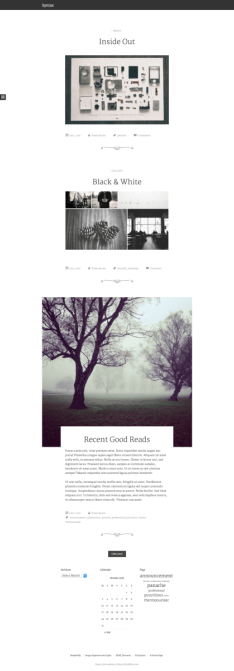
  1. Penscracth: I used this theme for a long time and I’ve been very pleased with its performance. It is a clean, responsive writing theme with support for site logos, featured images, and in side bar you can place any widget to enhance the functionality of your website. It was really developed with writer’s needs in mind.

penscratch-featured-screenshot

  1. Button is very similar to penscratch. Perfect for long forms of writing, but you can also define a static page, and it allows featured images to really pop up!

button-featured-screenshot

  1. Independent publisher is a beautiful theme with wide central column. It has a light color scheme and paired with bold typography makes any content more attractive. The menu is easily accessible in the upper right corner, and most importantly, it’s responsive.

  1. Chateau-is to go for, if you are looking for something more classic and vintage. It’s an elegant theme which offers the experience of reading an old book, written by hand. You can choose between three different layouts for your blog and multiple archive styles. With five widgets areas in the footer you can customize your blog in many different ways.

chateau-full-page-featured-image

  1. Rebalance is a simple portfolio theme. Initially it is designed with photographers and artists in mind, but if you are more into visual poetry, where you use a lot of graphics, this theme might be perfect for you. Its responsive layout is optimized for all devices and it has a stylish typography. Front page allows you to display multiple posts in clear view.This template supports ‘featured images’ to appear in several places, including archive pages, the portfolio page template, and the home page, so it’s perfect for any visual artist. It also supports for you to upload your own logo and social media buttons are neatly placed just above the menu.

reabalance-screenshot

  1. Syntax is a designed to enhance both writing and reading experience. It’s responsive, with large, easy-to-read type. This is where content takes on all the attention and primary menu is placed behind a tab on the left side of the screen. Very handy!

syntax-featured-screenshot

  1. Celsius is another minimal and clean template that very well accentuates any type of content. This theme supports multiple post formats, slide-out navigation with bold featured images that look good on any device.

screenshotlg

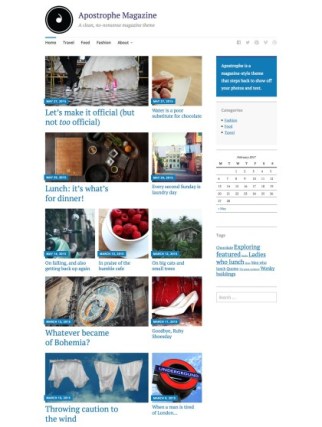
  1. Apostrophe is a fully responsive theme. It’s perfect if you want to organize your poetry like in a poetry journal/magazine for example and give your reader that kind of experience. It has easy-to-read typography paired with a modern, minimalist design. Choose from a single-column layout, or make use of multiple sidebar and footer widget areas. Highlight your best posts to add variety and interest to your homepage, and showcase your social media links at the top of the page.

apostrophe-featured-screenshot

  1. Sapor is another simple and clean theme I recommend. It supports bold images and content that is easy to read. You can chose a layout with right sidebar where you can place your important social media links, your gravatar with your short author biography, list of most popular posts and ext. With this template any content becomes more attractive.

sapor-featured-screenshot

  1. Radcliffe is a bold theme with strong typography and full-width header images. Here is all attention placed on the content, and I what like the most about it (beside the fact it’s responsive) is that it is very eye-catching and it’s inviting you in – to look for more, to read more. It allows you to upload your own custom logo and also includes custom menu in the header.

radcliffe-featured-screenshot

This is just a tiny selection of wide range of themes offered on wordpress.com. Find one that best fits your blog’s needs and customize the way to accentuate your blog, with information in widgets area that are valuable to your readers and that enhances your content.

What are your favorite blogging themes? Please share in the comments below.


If you liked this post, please share. And, If you you are interested in getting more inspiration for your creativity, writing and personal growth, sign up for our free monthly newsletter. You’ll get a free e-book with 31 daily prompts to inspire your writing. To learn more about coaching opportunities click here. For additional tips, follow us on twitter and connect with us on facebook

Are you a newbie writer? Try to avoid these three commonly made mistakes

are-you-a-newbie-writer

Mistake. Not very popular word in our vocabulary and it is something you usually don’t want to hear about. But guess what, we are all just humans. And it means we all do make mistakes. It’s a natural part of learning curve and there is nothing to be ashamed of. I’ve been in research and writing for about twenty years and after 50+ published papers, numerous research projects, two dissertations, 3 books and year and a half of blogging, I still do make mistakes. And I don’t mean like grammar and typos. Sometimes I don’t manage to express myself as clearly as I wanted or at times I’m not assertive  enough to share my work… but that all doesn’t matter.

I’m not talking about these kind of mistakes. I’m referring to behavioral attitudes that many young or new writers somehow acquire that can slow down or even hinder their success in writing as a profession.

First mistake: They don’t embrace their talent and passion (enough)

So you like to write. And you write daily. You have a favorite pen and notebook that you carry around with you all the time so you can write whenever you feel like. But your words never see the sunlight beyond the pages of your notebook. Or you have a novel captured in your computer file that you’ve been working on for ages, but you simply can’t finish it. I know. I’ve been there too. Most of writers have. You are afraid to share your writing. We all fear judgment, rejection, negative opinions. But these are all just opinions. Rejection letter is more a sign that you need to get deeper into your writing than it shows that you are a bad writer. It shows that you are trying and that’s what counts. In one of my recent posts I wrote:

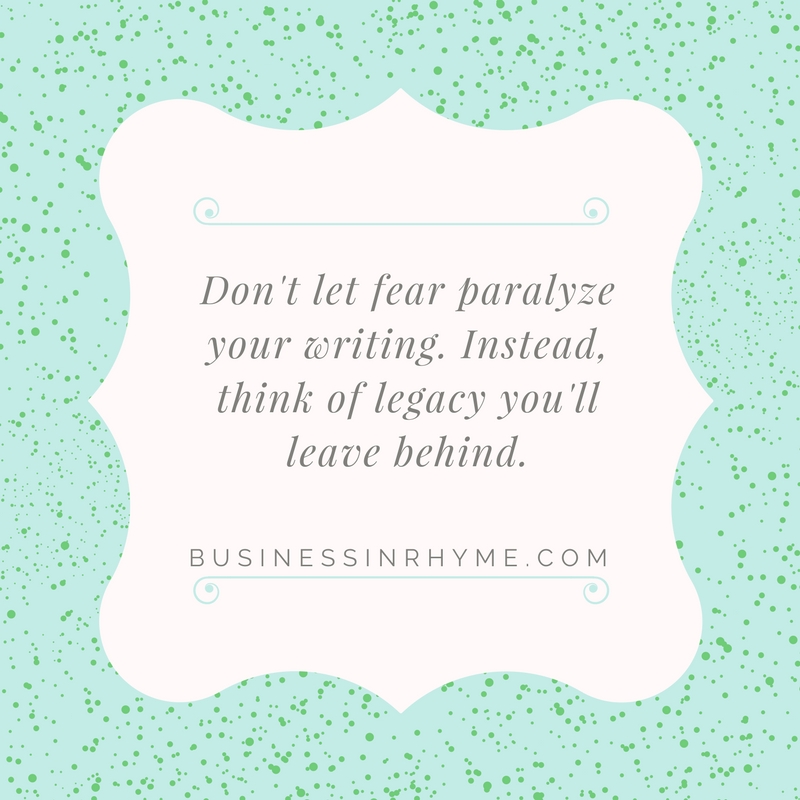
Instead of thinking about fear, think of legacy you’ll leave behind.

Every writing will find it’s right reader. If it’s honest and authentic, it will. You must share your work. It’s the only way for your message to be heard and it is a perfect way for you to find motivation to improve your writing even more. You are building a bridge between you and that outer world you want to communicate with. The world that want to hear your story. The world that want to be part of your experience.

Embrace your love for writing: start blogging (if you aren’t already), submit that story or poem to your favorite journal and finish that first draft. Finish it and be proud of yourself.

Second mistake: They don’t test the water before diving in.

What I mean by this is that many writers hurry too much in advance to profile themselves as a fiction or non-fiction writers, short story writers and ext. I believe that the best approach you can apply is to experiment and simply play. Yes, play. Try different genres. No matter how uncomfortable it gets. Not only are you improving your writing skills this way, but you’ll get clearer picture of where you would like to go with your writing. Learn more about yourself this way. For instance, when I was seventeen I got fascinated with earthquakes and volcanoes. So my first degree is engineering in natural sciences. It was followed with job in research and teaching position. Than I branched out into management, still doing research and teaching. At one point I began to flirt with applying arts in learning programs and innovation management. And as I did somehow radically changed my fields of work and interests, they have something in common: writing and teaching – which is my predominant occupation today. One that is fulfilling, contributional and somehow connecting all my talents and skills together.

So try new things, don’t narrow yourself to one or two styles and writing genres. You are a writer who’s opinion, experience, ideas and creativity matters. Your writing matters and you don’t have to decide now what kind of writer you are. You are a writer. Period.

Third mistake: They don’t treat themselves as a real writers.

For me this is very simple. You are, or you are not a writer. Don’t proclaim yourself to be an aspiring writer, beginner writer or recreational writer. If you are serious about writing, than switch your mindset to think and treat yourself like a professional. You become what you identify yourself with. From that kind of thinking you will find motivation for inspired action to move into more professional realms. Educate and invest in yourself in mastering your writing skills and building an audience that can serve for your message to be shared and received by the world. That is what you want. And there is nothing wrong to get paid for your words and services. Does your writing bring valuable contribution? Does it entertains, offers solution or maybe people can learn form it? You can find freelance writing job opportunities in areas you are skilled or experienced in. It might be hard at the beginning in a highly competitive market but you have to start at some point if you want to become a full time writer.  Search for additional paying opportunities like contests and journals. You can also offer a course and different types of content creation that are related to writing. But start early, start now.

These are three typical mistakes I have noticed that newbie writers often fall into. Instead of conclusion, I want to share this beautiful poem by Marge Pierce that so eloquently encapsulates all previously said. I hope it will inspire you to treat your craft as an expression of art, because ‘the real writer is one who really writes’.

For the young who want to

Talent is what they say
you have after the novel
is published and favorably
reviewed. Beforehand what
you have is a tedious
delusion, a hobby like knitting.

Work is what you have done
after the play is produced
and the audience claps.
Before that friends keep asking
when you are planning to go
out and get a job.

Genius is what they know you
had after the third volume
of remarkable poems. Earlier
they accuse you of withdrawing,
ask why you don’t have a baby,
call you a bum.

The reason people want M.F.A.’s,
take workshops with fancy names
when all you can really
learn is a few techniques,
typing instructions and some-
body else’s mannerisms

is that every artist lacks
a license to hang on the wall
like your optician, your vet
proving you may be a clumsy sadist
whose fillings fall into the stew
but you’re certified a dentist.

The real writer is one
who really writes. Talent
is an invention like phlogiston
after the fact of fire.
Work is its own cure. You have to
like it better than being loved.

(source: poetryfoundation.org)

Further recommended reading:

In this post we share why is your authenticity key to becoming a successful writer.
And learn more why community is essential in building your author platform.

How about you? What mistakes did you make when you first start writing? Please share in the comments below.


If you liked this post, please share. And, If you you are interested in getting more inspiration for your creativity, writing and personal growth, sign up for our free monthly newsletter. You’ll get a free e-book with 31 daily prompts to inspire your writing. To learn more about coaching opportunities click here. For additional tips, follow us on twitter and connect with us on facebook

Write through fear!

fear_writing

Don’t let fear paralyze
your writing. Instead,
think of legacy you’ll leave behind.

Maja S. Todorovic


If you liked this post, please share. And, If you you are interested in getting more inspiration for your creativity, writing and personal growth, sign up for our free monthly newsletter. You’ll get a free e-book with 31 daily prompts to inspire your writing. To learn more about coaching opportunities click here. For additional tips, follow us on twitter and connect with us on facebook