What’s the future of poetry? ~ conclusions from the Belgrade Poetry Festival 2016

svetski dan poezije

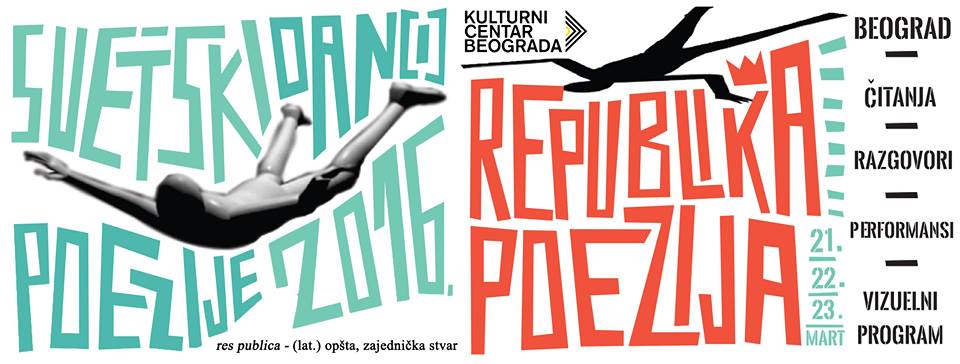
This year I happened to be in Belgrade while traditional poetry ceremony “World Poetry Day(s) 2016” was taking place. This event has been organized by the Belgrade Cultural Center and it was announced that this year’s festival will be dedicated to the relationship between contemporary poetry and society, and the possibility of cooperation of poets, visual artists, and film and theater authors.

Under the name “Republic of Poetry” festival has demonstrated that poetry has once again become an autonomous symbolic territory within which it is possible to develop creative potentials in the wider field of poetry practice.

The festival hosted many diverse participants from around the world like: Jerome Rothenberg, Gerhard Falkner, Maria Grazia Kalandrone, Jaka Zeleznikar, Ursula Kiesling and many others.

Through performances and debates, festival has proven that poetry hasn’t been immune to the phenomenon of globalization and that it is transforming poetry extensively in comparison to previous decades. One of the main conclusions of the festival is that poetry is turning again to experiment, revitalizing thus historical avant garde and neo-avant garde. Poets and artists do have a need for more complex response to  the events we are all exposed to and in order to share their experiences they strive to multimedia expressions combining different resources. As a result, the prevailing poetic practices are transforming under this occurrence. Poets are incorporating some structural elements of other art forms (music, visual arts, theater and dance) while erasing the visible bounders among artistic expressions. Some new literary phenomena are emerging, such as new media poem, which is being created with help of new technologies. Also, the transnational poetic practice can be seen today as one of those emancipatory practices, even though is on the margins of the cultural scene.

Part of festival program was performed on some unconventional locations in Belgrade like clubs, city streets and public transport – with aim to promote more poetry among citizens.

Great focus has been also on discussions about poetry like it’s relations to politics and aesthetics and where is the place of feminism and women’s voices in poetry.

This festival as it tried to answer some questions, it has also opened many new discussions that need to be addressed in the future.

What are your thoughts on future of poetry?

In the Silver Mines

Life in the silver mines nears its end
and soon the time will come
for everyone to take responsibility
for what they didn’t say
the people passing by
touched my cotton shirts
swinging on the line
and my window smashed a thousand times
and Franz Kafka
who sat next to me
in the classroom overlooking the playground
I remember him each time
I fall drunk upon a feather pillow
and put my arms around the fields of grain
swaying in the wind
silently and soundlessly
I will escape people one day
into the forest
that will never become a flooring mill
into the sky
sending rain for eyelashes stuck shut

Zvonko Karanovic


If you liked this post and you are interested in getting more inspiration for your creativity, sign up for our free bimonthly newsletter.

7 tips for improving your creative writing skills

budington kelland

As a writer, you don’t want to be just good or average. You want to be better; you want to improve your skills and you want to have your own recognizable style. Well, all that doesn’t happen overnight. It takes courage, perseverance, consistency in your writing attempts – no matter the rejections, lack of time or inspiration. Your writing can improve with practice and I will share here some tips you might find helpful:

1.Don’t find time – make time for your writing

As I said in the above introductory paragraph, it’s of great importance that you schedule regular time for your creativity, every day. When you have an idea, jot it down – don’t ignore it and let it flourish on your paper. You never know when inspiration will strike, so be prepared with little notebook by your side.

2. Don’t fear rejection

Show the world your creative power – maybe through blog, writing platforms or even through writing journals and open competitions. It’s a great way to practice your writing, refine your own style and maybe your story, poem, article gets published and recognized by editors – you don’t have anything to lose.

3.Join the community

There are many forums and other forms of networks where you can practice along with other fellow writers as response to different topics and prompts. It’s a great opportunity to get feedback about your writing and share your struggles and accomplishments.

4. Challenge yourself

As a poet you might try short story writing. It will provoke your thinking, channel your ideas in different directions. The more you step out of your comfort zone, the more your writing will mature and grow.

5.Read a lot; and then read some more!

Reading is a prerequisite to any good writing. It will not only enrich your vocabulary, but it will give you confidence that you can write too; that you can improve your writing skills and that there is experience and emotion residing inside of you, a story that needs to be told and shared with the world.

6.Feed your soul with some art

Visit museums, exhibitions, go to concerts and listen to music; dance and sing – enjoy other expressions of creativity as it can further inspire your writing. Diverse emotions that come from different senses can generate a feeling that we are creative beings and sometimes that is all you need for writing ideas to spark and come forth into your consciousnesses.

7.Don’t try to invent hot water – every time!

What I mean by this is that many writers are afraid that they are not original enough; that something similar already exists, that every story and poem is already written and told. But I want to remind you that you are unique person with unique points of view and unique experiences. No one can steal and copy that. As long as you are true to yourself it will be reflected in your writing.

How do you work on improving your writing? Please share your experiences in the comments below.


If you liked this post and you are interested in getting more inspiration for your creativity, sign up for our free bimonthly newsletter.


Work with opposites (creativity exercise)

frost


Many of us get trapped in ordinary, routine thinking which makes it hard to get into a mood of generating fresh and innovative ideas. We routinely get up every morning, brush our teeth, drink coffee, go to work – mostly every day at a same time, using the same route…And to tell you the truth, it can be a creativity killer. What we need is to mix up things a little bit, challenge our habits, language and way of thinking.

We are also aware that we do live in the world comprised of opposites. In Chinese philosophy and especially in Taoism, Universe is seen through the lens of yin and yang energy, male and female, strong and weak, dark and bright, cold and warm. Perceiving reality from the opposite side can give us clue in which direction we need to move forward in order to sort things out.

So for this exercise, as a warm up I propose you pick some ordinary words, something you frequently use in your language and list the opposite meaning of that word; first that comes to your mind.

For example: sky – bottom, ground

                          water – dry, yellow, sand

                           coffee – tea, sweet, cold

                           work – vacation, free time, relaxation

Do this for a limited time, maybe five to ten minutes. The idea of this warming exercises is to somehow ‘flush out’ that ordinary thinking, and give room for more ideas to come and encourage creative problem solving.

As a next step you can pick your real problem/project you are working on and apply similar technique. If you repeatedly struggle with something, “turn over” your thinking: instead of trying to develop your best solution, think of the worst thing could happen. How can your project fail? What is the worst scenario? Write every detail of that, using some key words related to your project and answering questions when, how, who, why, how much ext. To make it more fun, write a poem about it.

From that vantage point it might be more clearer what you could do in order for your project to succeed. By being able to imagine what we would like to avoid, it may opens a clear path in our mind of right things we need to do: who to contact, when to do something, how to prioritize our time.

Knowing what you don’t want to, is a first step to achieving what you do want.

I am not ambitious at all:
I am not a poet, I know
(Though I do love to see a mere scrawl
To order and symmetry grow).
My muse is uncertain and slow,
I am not expert with my tools,
I lack the poetic argot:
But I hope I have kept to the rules.
When your brain is undoubtedly small,
‘Tis hard, sir, to write in a row,
Some five or six rhymes to Nepaul,
And more than a dozen to Joe:
The metre is easier though,
Three rhymes are sufficient for ‘ghouls,’
My lines are deficient in go,
But I hope I have kept to the rules.Dear Sir, though my language is low,
Let me dip in Pierian pools:
My verses are only so so,
But I hope I have kept to the rules.

J. K. Stephen


If you liked this post and you are interested in getting more inspiration for your creativity, sign up for our free bimonthly newsletter.
Awakening your creativity (exercise)

marthagraham

Many of the exercises presented here on the blog were focused mainly on premise that we already have creative ideas going on,  and we just need a little nudge to keep us forward and invoke some new ideas. Now, I do get often asked, what about when we don’t feel that we are creative beings, when we need courage and motivation to first discover creative side of us? Well, today I have two little exercise to propose for those grey and uncreative days, when you don’t simple know where to start. I suggest: start simply, from the most basic things:

What makes you smile?

What makes you angry?

What are you curious about?

Who would you like to be?

Write a poem answering these questions – treat them like a little poetry prompts, with that difference that you don’t have to share them with anyone, they are only for your eyes, for your own journey to awakening creativity. You can actually start your own creativity journal where you can daily reflect on your ideas, feelings, experiences, circumstances; how any of these factors influence your creative power you certainly have residing within you. It just needs to be properly initiated and directed.

For the next exercise I want you to think of certain words like:

creativity

passion

purpose

inner voice

stillness

and try to picture in your mind, metaphorically, what kind of living being each word could be? What kind of associations does it bring? Is it an animal, plant, flower, tree, insect, child, another person, describe everything in detail, write a poem about it. It will help you reconnect with your creative force to more vividly sense what it means for you to be alive, creative – where to search for your passions and purpose.

Besides brainstorming exercises I will continue also to post these little nudges for you to instill this creative conversation with yourself that will help you achieve your goals in any creative arena of your life.

Build on resolve, and not upon regret,
The structure of thy future. Do not grope
Among the shadows of old sins, but let
Thine own soul’s light shine on the path of hope
And dissipate the darkness. Waste no tears
Upon the blotted record of lost years,
But turn the leaf, and smile, oh! smile, to see
The fair white pages that remain for thee.

Prate not of thy repentance. But believe
The spark divine dwells in thee: let it grow.
That which the unpreaching spirit can achieve,
The grand and all creative forces know;
They will assist and strengthen as the light
Lifts up the acorn to the oak-tree’s height.
Thou hast but to resolve, and lo! God’s whole
Great universe shall fortify thy soul.

Ella Wheeler Wilcox


If you liked this post and you are interested in getting more inspiration for your creativity, sign up for our free bimonthly newsletter.
Want to improve your writing? Practice receptivity and allowing

holzer

Being receptive and allowing creative flow are somehow two basic modalities that we have to work with in order to engage in creative process. Today’s post is intentionally dedicated to this topic since if we manage to divert these two modalities  to “work for us” – it’s a sure way to combat any type of creative blockage. It might be more suitable for writers beginners, but I think that we all need from time to time to remind ourselves of some basic approaches.

What does it mean being receptive? You probably have noticed that in my writing I often use term ‘tune in with your inner self, inner being’. And that what it exactly means being receptive. You can consciously prepare yourself for receptivity by having faith and trust in that moment, that very second that your mind already knows everything that it needs to know to be fully creative, open and expressive. To sink in to your deep creative core you can practice meditative, rhythmic breathing that is connecting your awareness to what is flowing to you in each moment. Engage your senses, don’t shut down that feelings, let them freely find their space and meaning in your blank page – in that very moment. In order to keep that initial spark, in the quietness of your mind you can ask yourself: what is it that I need/want to say? What did I want to write about?

Ideas will come and start to accumulate and your task is only to write, without hesitation or any type of editing on the go. Something that was bugging you about your creative project, piece your were working on months ago might resolve and just what you needed can appear. Never waste your writing because that just might be the missing puzzle in your future work.

The second part of the process is something I call allowing. Allow yourself, give permission to yourself to write, create – no matter how many disapprovals, rejections, judgments you might received in the past. That negative voice in the back of our mind can block us from engaging in creative work and that’t the last thing you want to do.

You create and write for your own sake, for your own being to feel alive, attuned with creative force around us. You are in charge of your motivation, actions and willingness. And next time, when negative voice speak from nowhere all of a sudden, write everything the opposite.

That negative voice can say something like:

Nobody is interested in anything I have to say.”

And you can write your affirmation:

‘I’m interested in what I have to say. I want to say. I need to say. I write because I want to say!’

‘There is no money in writing. It’s a wasted time.’

and your affirmation:

‘If I write more I will get better in this craft; being better means more opportunities to be published; being published opens possibilities to get a new source of income.’

or

‘I write because I love to write. I don’t need money from writing.’

This is one way to respond to that negative self-talk. Allow yourself just to be creative and you’ll be amazed how your writing improves.

Poetry to us is given
As stars beautify the heaven,
Or, as the sunbeams when they gleam,
Sparkling so bright upon the stream ;
And the poetry of motion
Is ship sailing o’er the ocean
Or, when the bird doth graceful fly,
Seeming to float upon the sky;
For poetry is the pure cream
And essence of the common theme.

Poetic thoughts the mind doth fill,
When on broad plain to view a hill ;
On barren heath how it doth cheer
To see in distance herd of deer.
And poetry breathes in each flower
Nourished by the gentle shower,
In song of birds upon the trees
And humming of busy bees.
‘Tis solace for the ills of life,
A soothing of the jars and strife;
For poets feel it a duty
To sing of both worth and beauty.

James McIntyre


If you liked this post and you are interested in getting more inspiration for your creativity, sign up for our free bimonthly newsletter.