If you liked this post and you are interested in getting more inspiration for your creativity, writing and personal growth, sign up for our free monthly newsletter. For additional tips, follow us on twitter and connect with us on facebook.

If you liked this post and you are interested in getting more inspiration for your creativity, writing and personal growth, sign up for our free monthly newsletter. For additional tips, follow us on twitter and connect with us on facebook.

As a writer, enjoy your
creative process and
you will be amazed with
the end result.
Maja S. Todorovic
If you liked this post and you are interested in getting more inspiration for your creativity, sign up for our free monthly newsletter. For additional tips, follow us on twitter and connect with us on facebook.

Writer’s block: a detrimental feeling that many of us encounter at least once in our writing life when you simply can’t pull yourself together and produce some satisfying work – at least in your own eyes. You feel lack of inspiration, like you have nothing to say and your imagination simply doesn’t exist.
But let’s think about it for a second – who is actually ‘blocking’ us in writing? Is there a concrete block standing on your keyboard, preventing you to type? Who is making us feel that our ideas are not worthy, that we are not creative? We are. We are the only ones standing as an obstacle to our creating.
And though this term is very popular, a modern notion coined in 1947 by Dr Edmund Bergler, a famous Austrian psychiatrist, I don’t truly believe in writer’s block.
I believe that we often fall in monotony, where we are caught by inertia – just like in a river stream. We might find ourselves in yellow, muddy waters and if we long for fresh, clear flow of ideas – we need to swim, move, get out of or change the conditions that clog our thinking.
One thing that years of writing taught me is that you can’t force it. It’s like pedaling upstream – you soon get tired, out of breath and strength, but you haven’t actually made any progress.
Better way than forcing your writing is provoking your writing. This is where your power and control lies. There are many ways you can stir up your imagination and here I will share some of the practices I use to find my way to writing:
I have noticed when I’m not completely in my ‘writing mode’, leaving that aside and doing other activities that are on my TO DO list can be enough to jumpstart my inspiration. This maybe due to subconscious feeling of worry are we going to do everything planed for that day: simply giving us time again for writing when you have the feeling you’ve accomplished your objectives for the day, can be enough for a productive writing session.
Just write without thinking. How you progress, new and exciting ideas will start to appear. Give yourself a chance to play with words and enjoy – you will much more appreciate your writing and the creative process. Here on the blog are many creative exercises you use can as a prompts and inspiration pointers to instantly break any writing barrier.
This might be more applicable to non-fiction writing, but anytime I’m not focused or I have maybe to many ideas, I perform a research on the similar subject. I find this to be very beneficial in terms that similar work I encounter can serve as a guidance on which topic to write or not – or give my own opinion on something that is stereotyped and could use a new input. Getting insight on what other people are doing on similar topic is always helpful.
Listen to some music or visit art exhibition – I have found this to be one of the most helpful ways for me. By listening to my favorite bands or just looking at some of the De Chirico paintings as an instant recentering for me. On Pinterest I have even a board ‘Surrealism’ which I often use as my favorite muse.
Set some rules: Start with what if clause or focus on using specific words. It has been shown that limited creative freedom can have a positive impact on generating new ideas as it provokes you to think differently.
This is fun and clever thing to do. You just leave out there a word to linger and next time you have to deal with it – it will hang on the tip of your tongue, tickle until you figure out what to write!
Lately I have been writing, by hand in separate notebook poems and quotes that I like. It helps me with that feeling of insecurity sometimes I have about my writing. A simple encouragement that you can give yourself and easily destroys doubts is reading and believing in words of your favorite authors.
As said in the beginning, we are the only ones blocking ourselves in doing what we love. And why does it happen? Maybe it’s a message, a sign that we need rest, that we need more attention and time to be kind towards ourselves, destress and restore creative energy. So make room in your schedule to spend time with yourself, doing what makes you feel good -pamper yourself. Your creativity will come rushing back to your arms, making you eager to write again.
Physical exercise makes your heart beat faster, supplying your brain with oxygen. It helps with brain fog we sometimes experiences and your thinking becomes clearer. Going for a walk helps with your senses where change of scenery offers insights to new possibilities and opportunities.
But not any chocolate – with at least of 75% of cocoa, as some researches have found that consumption of cocoa flavanols results in an acute improvement in visual and cognitive function, giving your brain more power to deal with difficult tasks. So eat your way through writer’s block 😉
If you liked this post and you are interested in getting more inspiration for your creativity, writing and personal growth, sign up for our free monthly newsletter. For additional tips, follow us on twitter and connect with us on facebook.

If you liked this post and you are interested in getting more inspiration for your creativity, writing and personal growth, sign up for our free monthly newsletter. For additional tips, follow us on twitter and connect with us on facebook .

I’ve never met real loneliness.
I have a friend that never leaves me.
It’s always there for me.
A friend I call
Poetry.
Maja S. Todorovic
If you liked this post and you are interested in getting more inspiration for your creativity, sign up for our free monthly newsletter. For additional tips, follow us on twitter and connect with us on facebook .
New Year is often a time when we want to close one chapter of our lives and start fresh – with new ideas, with new energy and determination to fulfill our goals.
What usually happens, we do set new goals but as the months progress, so does our goals whittle along with autumn yellow leaves – until they become forgotten, unfulfilled and replaced by random events called life.
Instead of making a New Year’s resolution list, I have a different proposition for you. Why ‘hit your head against the wall’, and think of what and how you can accomplish when you are looking for the answers in the wrong place?
Here are 6 questions for your creative reflection exercise that can help you evaluate what you have accomplished in the previous period/year and maybe start from there? You might have a project that you could finish or idea that didn’t have enough time and space to mature – maybe now it’s the moment to give it a try?
Use this as a starting point for designing more creative life in the next year. It is important for us to make an objective estimate and work from there: building a realistic foundation for inviting more creativity into our lives. Instead of setting, sometimes lofty goals that quickly escape our reach like deflating balloon – making little changes and adjustments in our current schedule can seem less daunting and scary – and more likely achievable.
To get in more depth in planning your projects consult these additional 9 questions that can help you clearing any doubts about your creative ideas, offerings, opportunities..
Do you have any exciting writing or creative ideas for the next year? Do you have a firm plan how to achieve it? Please, share with us in the comments below.
Naomi Shihab Nye
If you liked this post and you are interested in getting more inspiration for your creativity, sign up for our free monthly newsletter. For additional tips, follow us on twitter and connect with us on facebook .

Every poet is brave-
it takes courage to
undress your soul,
dig deep, to the darkest and
scariest parts of yourself and
let them shine through your poems.
Maja S. Todorovic
If you liked this post and you are interested in getting more inspiration for your creativity, sign up for our free monthly newsletter. For additional tips, follow us on twitter and connect with us on facebook .

I can bet that many of you, as a little kid (just as I did) liked to have a small notebook or a diary where you would write your cutest and most intricate secrets – how you hated your lunch or how that boy in the second row always gave you weird looks and laughed at your braces.
And I do believe that even today so far I have never met a real boredom – because I’m always doodling, jotting something down and I find easy ways to amuse myself. That habit of simply recording your thoughts can have a deeper meaning and transfer into something more beautiful and valuable. Today I want to share my experience with that.
I’m a strong advocate for journaling and daily ‘casual’ writing, because if you look at it more clearly, it is a perfect guide and companion: paper can hold on to anything, it is there without any judgment, ‘listening’ and helping you reflect on your daily thoughts, feelings and experiences. I believe that our journal/diary entries can be a great source for poetry writing as it is a simple tool where you express yourself in a variety of ways – writing but also collecting and keeping small memorabilia (like scrap book), photographs, pictures, making interesting collages, vision boards, to do lists, goals and ext.
All that merged with poetry that accentuates language and experience can lead to developing your own little master piece. Any journal entry can be an inexhaustible source to discover poems as journal is a bridge between you and your perception of life. When you start to write, it is adventure for itself as you never know what might happen and where the words will lead you. You might get sudden burst of creative inspiration and from there transform it into the most beautiful poem. There are no barriers, limitations or vocabular sensitivities. You write who you are, in that moment. What I like about having journal as an inspiration for poetry writing is that it allows you to examine questions you probably wouldn’t consider ‘poetical enough’. But there’s the catch: it is a place for openness, no hide and seek games – it’s just you and your real interests, desires, emotions – raw, uncensored.
If you read your writing entries more carefully (and in the title I on purpose used term casual writing instead of journaling because even drawings and doodling can be translated into a poem – many people don’t keep journal per se but like occasionally to write and draw) you can recognize where poetry is well disguised and waits for you to be discovered.
What to look for?
Are there any words and sentences that seem more melodical, poetical, that offer sensual rhythm – being that about your beautiful pet, funny afternoon with your child or romantic evening with your spouse – these are emotions that can be translated into poetry.
Follow your writing entries to see where you write/draw with passion and strength, where you eloquently describe what happened to you (being that injury, pain or even a dispute with a friend), where all your senses are awaken and your descriptions are very detail and elaborate – from there you can derive sincere and strong poem.
These are your central life issues and reveal what is deeply rooted inside and what’s important to you. In your poem you can further elaborate those messages, explore their meaning and get clearer insight on how they are impacting your life. In my case, that’s the issue of health – how that impacts everything that I’m doing, my general quality of life and many of my poems are health and family related.
In one my future posts I intent to discuss in more detail how we can use journal writing to enhance our language and poetic expression.
Do you journal or write every day? How that impacts your poetry writing? Please, share in the comments below.
The tightness and the nilness round that space
when the car stops in the road, the troops inspect
its make and number and, as one bends his facetowards your window, you catch sight of more
on a hill beyond, eyeing with intent
down cradled guns that hold you under coverand everything is pure interrogation
until a rifle motions and you move
with guarded unconcerned acceleration—a little emptier, a little spent
as always by that quiver in the self,
subjugated, yes, and obedient.So you drive on to the frontier of writing
where it happens again. The guns on tripods;
the sergeant with his on-off mike repeatingdata about you, waiting for the squawk
of clearance; the marksman training down
out of the sun upon you like a hawk.And suddenly you’re through, arraigned yet freed,
as if you’d passed from behind a waterfall
on the black current of a tarmac roadpast armor-plated vehicles, out between
the posted soldiers flowing and receding
like tree shadows into the polished windscreen.Seamus Heaney
If you liked this post and you are interested in getting more inspiration for your creativity, sign up for our free monthly newsletter. For additional tips, follow us on twitter and connect with us on facebook .
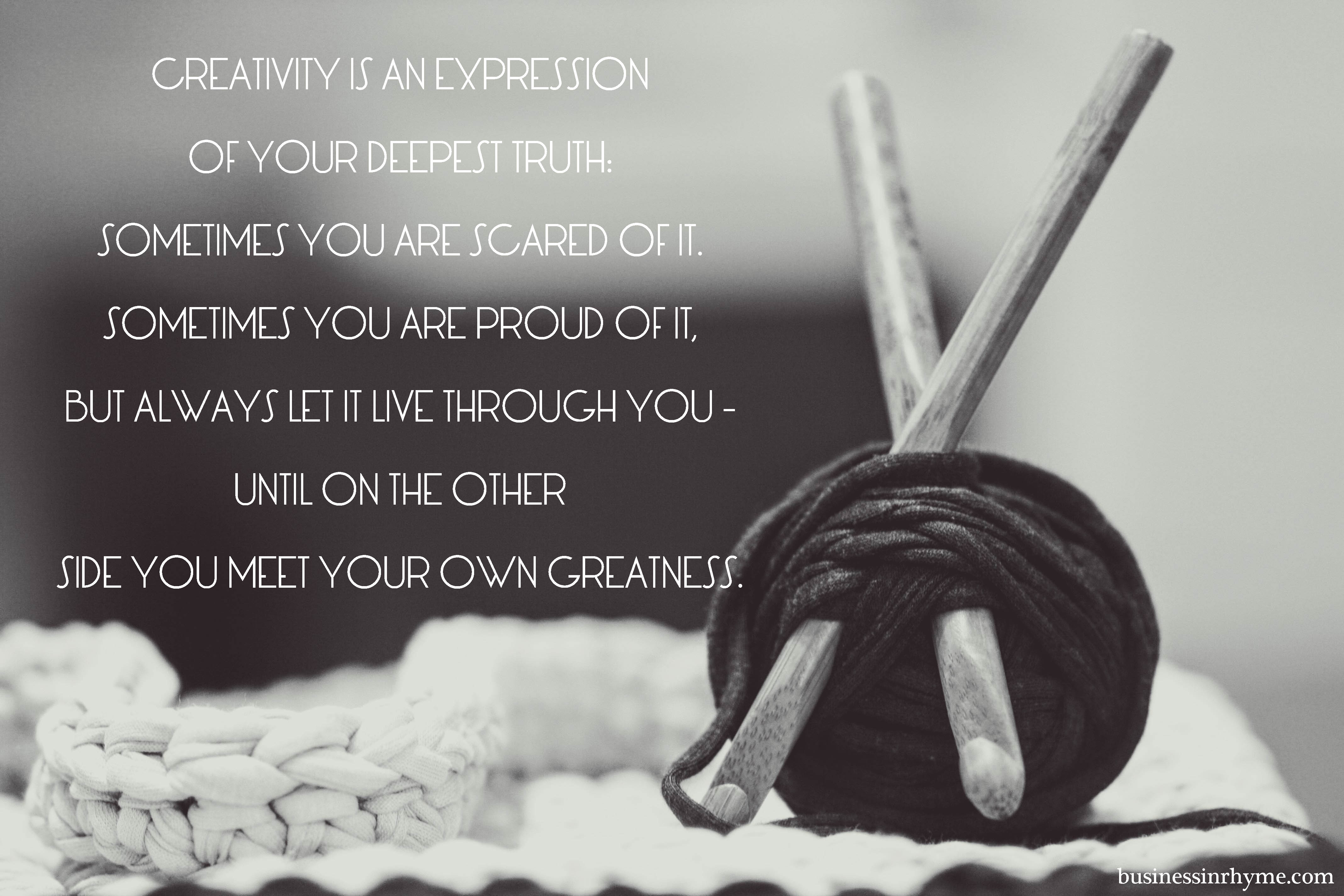
Creativity is an expression
of your deepest truth.
Sometimes you are scared of it.
Sometimes you are proud of it.
But always let it live through you –
until on the other
side you meet your own greatness.
Maja S. Todorovic
If you liked this post and you are interested in getting more inspiration for your creativity, sign up for our free monthly newsletter. For additional tips, follow us on twitter and connect with us on facebook .

Have you ever read your words for a couple of times and thought “Oh my God, this is really bad, this really sucks!” ? Well it happens to every writer from time to time – that his own thoughts seem strange to him, like he’s faking his own writing!
The truth is, many of us struggle to represent themselves as who they are. They’ll rather follow the trends on social media, rambling about safe topics and not expressing their real opinions. Why? We all have that ingrained need to be liked, loved, accepted – if possible by everybody.
And that my friend it’s simply Sisyphean venture. Many do try to ‘fake till they make’ – build a readership and ‘when the time is right’, they’ll start to write what they really think and feel. Well, there is a slight problem with this approach: If you only follow the crowd, your words are just another minuscule drop in the ocean of the sameness.
I do believe that we as writers have a responsibility to say and write our mind – being that in science, history, poetry or religion. Expressing our opinions in bold, courageous way is not easy, but that’s how change happens. That’s how we open doors to new opportunities, and connect with people we never new existed.
People will care about your words if they can sense your honesty and belief behind them.
And here today, let me share with you what I think is (also in my own case) 4 main reasons we sometimes feel like we deceived our own writing:
You have probably noticed that brave writers, with strong words and opinions – just don’t give a damn what other people think of them. They don’t apologize for who they are.
They own their opinions and perspective as a part of their own identity. So neither should you hide yourself behind nicely packed words with silky ribbon. Being bold in your writing is being able to take a stand and give yourself permission to share your story.
At the beginning of writing this blog, I was scared – what on earth a geophysicist has so important to say about poetry? But maybe there’s the catch – it offers completely different point of view from someone who studied English literature or creative writing. And as the blog began to grow so did my confidence to more openly share my opinions, intimate stories, struggles. Because that’s what writers do. You never know how your writing will reach and touch someone else.
I know, world can be a cruel place. When you are completely open in your writing, everything you are becomes naked and so fragile to every negative comment, rejection, criticism… But this is the part of being a real writer. No matter how many slaps in your face you get, you are still there, showing up, continuing your work and firmly standing behind your words. Don’t be afraid to write about what you feel, what you experienced – it is real to you.
At the beginning of writing this blog I also clang towards safe, general topics. Yet with time, I also felt a need to share more personal experiences I got through poetry and I can tell you it is really liberating. As the act of writing is so fulfilling, so it is being able to show everyone how that wonderful, simple craft or art – you can call it whatever you like, is an amazing tool available to everyone. Everyone! And this blog simply transformed itself into a mission to make that more approachable and understandable to people. And I share some of my painful experiences where poetry directed me to the path of healing. I am vulnerable in my writing but it also has a purpose that’s much stronger and bigger than my fear of being hurt.
Not good enough. That is the sentence we repeat like mantra and I believe is the greatest enemy to creativity. As writers we sometimes put so high standards in front of us, that we cloud our reasonable judgment – in times we don’t even see how we are putting the bars higher and higher.
There’s no such thing as perfect writing. There is honest writing, fueled with emotion, passion, purpose and belief. That’s what you should strive for.
You can recognize that this topic is repeating in many of my posts, because I know how it is important to know why you write. Your writing should seek to contribute, offer different perspective, encourage, inspire, support, analyze / synthesize information or simply to entertain.
Once you become clear with that, you can easily translate vision into a writing goal – then you produce meaningful work.
Do you feel like fake sometimes in your own work? What are your thoughts on this topic? Please share in the comments below.
If you liked this post and you are interested in getting more inspiration for your creativity, sign up for our free monthly newsletter. For additional tips, follow us on twitter and connect with us on facebook .
 Business in Rhyme