
Need some more poetic inspiration? Sign up for a free bimonthly newsletter

Need some more poetic inspiration? Sign up for a free bimonthly newsletter

Need some more poetic inspiration? Sign up for a free bimonthly newsletter

Need some more poetic inspiration? Sign up for a free bimonthly newsletter
small, bluish sinews branch into
letter M.
One side of the trunk is darker
due to Sun exposure, with amorph
golden-yellow spots.
As it breathes blood, exhales warmth
to feed small hill above its flesh.
It’s like a map, containing my life line
trimmed at several places.
It used to go all the way around the hill.
Bark is depleted, almost erased.
I cannot count to see how many rings of heart
have left me?
Humming bird’s song
echoes my soul
in the upcoming dawn.
Maja S. Todorovic
Need some more poetic inspiration? Sign up for a free bimonthly newsletter
Need some more poetic inspiration? Sign up for a free bimonthly newsletter

On a few occasions I wrote here on the blog, about the importance of using our own voice and our own words to deliver authenticity in writing. Well, quite the same comes when we want to express, define or articulate our ideas. In my last post I emphasized that the best originality and authenticity comes from our own interpretation of an idea and that can determine its creative potential and inventiveness.
So, today I’m proposing a little bit different approach: instead of working on your own ideas, let’s take one idea you heard about or read about in the last 72 hours, but one that you really liked and admired.
Now, try to express that idea in your own words, but use something that Ken Macrorie defined as a ‘kitchen language’: the language you would use while you are comfy on a Sunday morning, being lazy in your pajamas, when you don’t think about anything – you are just you, being relaxed at home with your coffee, simple and uncensored. You don’t have to impress anyone, or watch your words. It’s your language but not something you would usually use to make your point about something.
Once you have set your ‘comfy’ mood, using your ‘kitchen language’ write a poem about that idea you heard. It’s interesting what might come up, but that’s the point – for you to get comfortable in your own skin and your language while expressing and discussing something you really care about.
Of course being comfy and accustomed to ordinary can have its own hinders. Our everyday life can make our thoughts and words too ordinary, repetitive, and actually can reduce our richness of language and vocabulary. For the second exercise I suggest you do something quite the opposite: imagine you are 5. And you might still don’t know how to pronounce all the words – invent new ones and express that beautiful idea that captured your attention. Wake up that sleepy child inside of you and tell your story about that idea like a 5 year old would – in a form of a cute poem. We know at times children make memorable, funny statements. But as we all progress to school sometimes our language become emptier and lifeless. Well, this exercise is an attempt to fight this and experience that unforgettable writing, with all the giggles it might carry.
These exercises can dramatically shift our thinking patterns, but what will emerge with time is your unique view and interpretation of the world: one that you want to fully accept, embrace and enjoy.
Give it a try and share your thoughts in the comments below.
Be glad your nose is on your face,
not pasted on some other place,
for if it were where it is not,
you might dislike your nose a lot.
Imagine if your precious nose
were sandwiched in between your toes,
that clearly would not be a treat,
for you’d be forced to smell your feet.
Your nose would be a source of dread
were it attached atop your head,
it soon would drive you to despair,
forever tickled by your hair.
Within your ear, your nose would be
an absolute catastrophe,
for when you were obliged to sneeze,
your brain would rattle from the breeze.
Your nose, instead, through thick and thin,
remains between your eyes and chin,
not pasted on some other place–
be glad your nose is on your face!
Jack Prelutsky

Need some more poetic inspiration? Sign up for a free bimonthly newsletter.
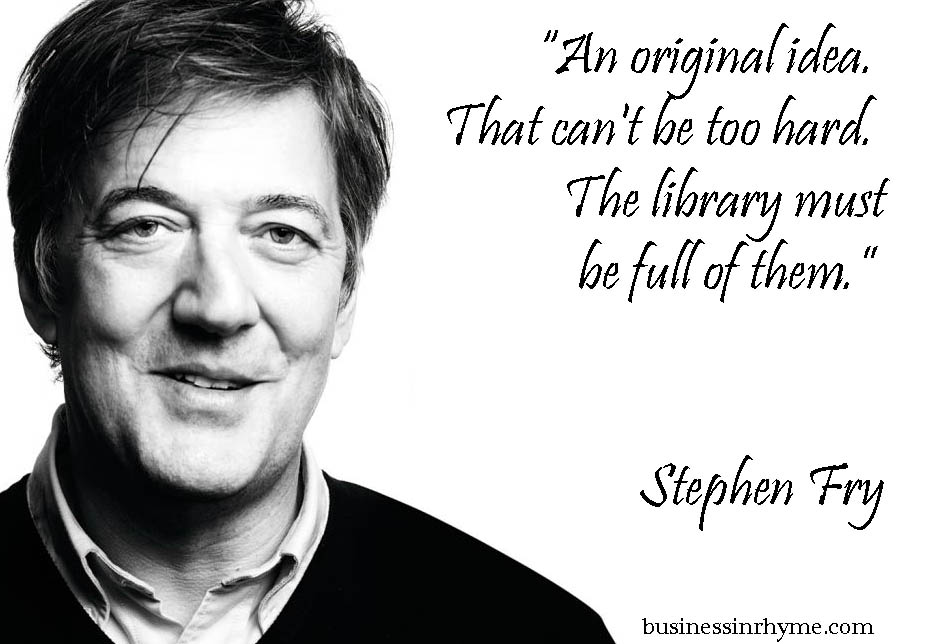
This is one of my favorite topics I’d liked to discuss with my students. With emerging IT technology, inevitably came a ‘cut and paste’ revolution and for many students just wanting to finish their essays and seminars looked as an easy way out.
But here we are not talking only about lower grades for lack of motivation or not doing the assignment the right way: it’s a trap that many carelessly fall into and something like that can easily become a habit. And once something like that becomes a habit, we simply forget to write and discuss ideas in our way, to use our own words and interpretation.
So one of the things that my students taught me is to respect any authentic and honest writing; a writing that comes from an independent thought process – no matter how many mistakes or “wrong views” it might hold. It’s authentic.
Now, too many people often simply terrorize themselves that for something to be valuable and worth reading/hearing has to be original. And the truth is, in our contemporary world where the exchange of information is at such high rate, is very difficult to produce that completely original idea, that doesn’t resemble anything else.
I remember when I was doing my masters degree project. It was a huge task, where I had to mathematically process over 1, 5 million data. It took almost a year to do it (it was 15 years ago so computers were much slower :)). And I also knew at that time that as a young scientist my chances to discover something new or make a remarkable scientific breakthrough (that many scientists before me already did) are very close to zero. And I did get results very similar to already existing. But I did it anyway. And you might wonder why? Well, it was my scientific journey, which means I did it my way. During that process I learnt a lot not only about physics, geology and mathematics, but also about myself and my own expectations. At the end, I gave my own interpretation of results and it was just tiny contribution to already vast worldly resources and databases on the topic. But this one was performed by me and that made it authentic and original in the same time. It’s been years now that I’m out of solar-terrestrial physics, but my work is still cited by many scientists.
And that’s what nowadays we need the most: more of a authenticity. Once you write something on any topic in your own words, the way you talk in your everyday life – it makes it authentic and original in the same time. So I encourage you, when ever you write, write from the heart; when you allow yourself just to be you, discarding any worry are you original, innovative, interesting, attractive enough – you become all of that. You are an original.
Writing
by Howard Nemerov
The cursive crawl, the squared-off characters
these by themselves delight, even without
a meaning, in a foreign language, in
Chinese, for instance, or when skaters curve
all day across the lake, scoring their white
records in ice. Being intelligible,
these winding ways with their audacities
and delicate hesitations, they become
miraculous, so intimately, out there
at the pen’s point or brush’s tip, do world
and spirit wed. The small bones of the wrist
balance against great skeletons of stars
exactly; the blind bat surveys his way
by echo alone. Still, the point of style
is character. The universe induces
a different tremor in every hand, from the
check-forger’s to that of the Emperor
Hui Tsung, who called his own calligraphy
the ‘Slender Gold.’ A nervous man
writes nervously of a nervous world, and so on.
Miraculous. It is as though the world
were a great writing. Having said so much,
let us allow there is more to the world
than writing: continental faults are not
bare convoluted fissures in the brain.
Not only must the skaters soon go home;
also the hard inscription of their skates
is scored across the open water, which long
remembers nothing, neither wind nor wake.
(source: poetryfoundation.org)
If you liked this post and you are interested in getting more inspiration for your creativity, sign up for our free bimonthly newsletter.
Need some more poetic inspiration? Sign up for a free bimonthly newsletter.
 Business in Rhyme