Simplicity – the ultimate sophistication of your work

whitman

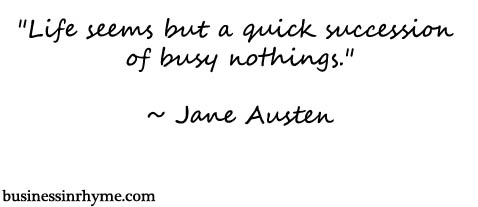
Once Jane Austine said that life has turned into a “succession of busy nothings” and unfortunately I have found a lot of truth in her words. We often forget what really matters and get caught in petty, trivial things that deplete our time and energy. About 2 years ago, I took a radically different approach to my life – mostly provoked by my health issues. I began to simplify and minimalise everything I could – from physical stuff, what and how I eat, my everyday habits, what kind of thoughts and conversations I “consume” and interesting – beside the momentary benefits like feeling more free, relaxed and lighter (in every sense!) a need for poetry was born again. And I truly believe in the saying “Less is more”, where minimalism and poetry enriched my life on so many levels.

Today I will not speak much of a poetry, but rather I will try to share my tips and views on simplification, which can help in your writing, work or business; to find what really matters, prioritize and do more of the things you love. In the long run, you will feel more content and accomplished.

1.Learn to say no and cut down on meetings

I know we usually want to please everybody, but try to analyze your obligations more clearly and think: are all those meetings, tasks and chores really necessary? Today? What can’t wait? What can you delegate? What requires your personal, undivided attention? Once you manage to clear your schedule (just a little bit :-)) you will be more productive on the things that really do matter.

2.Take digital sabbatical when ever you can

According to International Association of Business Organizing a typical U.S. worker is interrupted by communications technology every 10 minutes. It’s a productivity killer and developing habits of focusing at a priority task is of vital importance in gaining time –which is your most valuable asset.

3.Find business processes you can automate

This is especially important in our business culture – everything requires approval, signature ext. Sharing files and templates among coworkers can help reduce incoming e-mail and paper jams.

4. Lean is the new black

Once you set your priorities, try to find any gaps where you can develop your own shortcuts to make processes lean as possible. Focus your resources on the things that matter the most.

5. Go paperless

Don’t get me wrong: I know, for the writer this one can be really hard.

I personally love the smell and the sound of lisp paper.

I love having blisters on my fingers from extensive handwriting.

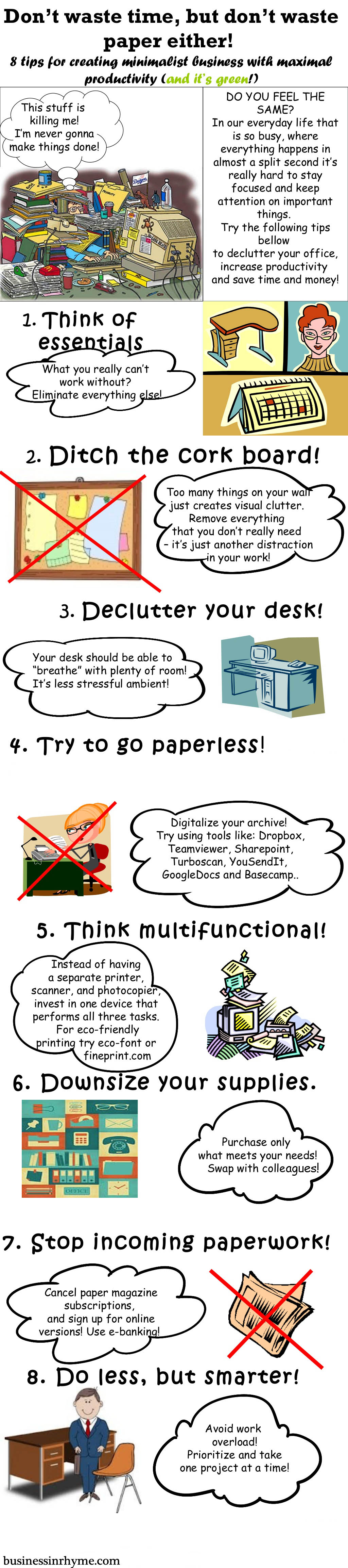
I like to taint my fingers with blue ink – nevertheless there are possibilities for us to cut down the paper work and therefore the clutter accumulating on our desk and in our drawers. I’ve included here this simple info-graphic with tips and tricks to help you along the way:
infographicdont-waste-time-but-dont-waste-paper-either-1-1024

6.Adopt the Zen productivity mindset.

This idea is from Leo Babauta’s phenomenal blog Zen habits, where he proposes for us actually to put limits and strict rules on everything:

Besides forcing you to focus on essential tasks that have a large Return on Investment (ROI), it forces you to eliminate the non-essential tasks. No other system forces you to do that. It forces you to make the best use of your time. It forces you to limit the time you spend on things, which means you have more time for other things that are important to you, and you are able to focus on what you want to focus on, instead of everything coming at you. It simplifies your life and makes you less stressed out.

In a nutshell, limit yourself how many tasks a day you are going to execute; do one task at a time – and put rules on repetitive tasks – like, you will check your e-mail only twice a day. It’s an edgy idea but worth a try.  In my post What writing haiku taught me about business the notion of simplicity also came forth, but we can always challenge ourselves even further.

7.Cut the the weeds at their root.

It’s so easy to go back to the old habits. Once you realize you are starting to overcomplicate things again, go back to the rules. Adopting minimalism as an entrepreneurial mindset takes time and effort. Once you see the benefits, “busy nothings” will dissolve by themselves.

But I say unto you,

Take this stuff just as a stuff;
Movement is movement;
Sitting is sitting,
but don’t wobble
under any circumstances!
My stuff has turned into a dragon
and swallowed up the whole world.
Where are the poor mountains and rivers and great earth now?

Yun-men Wen-yen, (Ummon), 864-949


The Go-getters guide to building your personal author brand

hartman

Branding for sometime now has been a buzz word. We instinctively recognize branding as a purposeful creating of authentic image, identity and most importantly the “feeling” that companies want their consumers to experience – about different products and services. Yet you are a writer, not a company or a product. How that applies to you? Do you really need a brand?

Let us put it this way: Your personal author brand can be seen as a purposeful creating of unique and distinct theme in your marketing approach that you want your audience to remember you by.

How do you that?

Well, there are few questions that can lead you along the way discovering your brand personality. I would start with:

How do you want to be remembered?  Think in terms of senses, feelings, experiences, words, language, ideas, concepts that you want to be associated with. That can also depend on the field and focus of your writing: if you are in area of business writing do you want to be remembered as a tough authority or compassionate leader? Do you want to teach or inspire? As a fiction writer what mood do you want to evoke?

Once you define these primarily goals, you will be more clear on your purpose, message that you want to deliver and who are you trying to reach. That one simple message around which will revolve your whole branding theme is of pivotal importance, since it will communicate your philosophy and your values: what are you bringing to your readership.

Be open, honest, tell your story, since people like to connect on the personal level. This will also help you communicate who you really are and what distincts you from others. You are your brand, but also your readers are your brand – who you attract and what impressions you make.

Follow your distinct writing voice!

The tone and style of your communication should naturally reflect your expertise, brand promise, and core belief.

By consistently building your author brand, you can broaden the areas of your influence and involvement.

You can:

  • get offer for guest blog posts which will increase your readership;
  • get advertising requests for your website;
  • position yourself as an expert in your field;
  • increase probability for future book deals;
  • get broader exposure in media;
  • even get the opportunity for product/service endorsement.

Think about it and start building you brand now!

4 Ideas to supercharge your productivity – the poet way

goethe

Frankly speaking, this is one of my traits and habits that I’ve never struggled with. Even from my early years in school, I was always efficient, on time and productive. Most of the time I managed to do several things at once, but always kept an eye open not to sacrifice the quality of work I’m doing. When I look back, I think that my poetic inclinations have contributed to developing of my productive skills. So, here are my top 4 tricks to keep my productivity levels high:

Think from the end about the task at hand!

The first thing I do is that I always imagine how good I will feel when I finish my task – meaning reducing stuff I need to do (being project, work or house related); how it will give me more time to do things I love – like writing this blog or working on a new poem. It goes with an encouraging thought that later develops into an encouraging process – getting things done brings joy and relaxation.

Amuse and reward yourself for any task you do!

Every task, no matter how tedious you can make more intriguing and fun. I like to invent little games along the way and when I’m satisfied with the outcome I treat my self – with some extra time for reading, having chat with a friend and ext. Element of surprise is something that brings humor, loosens the tension and stress. We are all aware that it’s impossible always to follow the schedule, that little things pop-up out of our control – see them as an inspiration, a learning opportunity for you to be more adaptive to uncommon situations. I sometimes even write little poems where I joke about these tricky uncertainties of life – and it’s a perfect opportunity for us to become more responsive. Predictability is a mood killer and is our choice to game up our working hours.

If you have to repeat, don’t get stuck in defeat!

Any chore you can treat like the most beautiful poem chorus. Repetitive tasks can be tiring and feeling like it sucks out all of our life energy. But again, remember it’s an essential part of keeping life balance and work flow – like the chorus in the poem or a song: it gives meaning to that art expression; it’s base from which starts new adventure in the coming strophe.

Finding your daily beat keeps your productivity in shape and fit!

In order to master your productivity you have to observe yourself first. When you are most productive? What activities give you the most pleasure? Take advantage of those activities for setting the right mood and build momentum you need for finishing things up. Once you find what works for you best, try turning it into a habit. Don’t forget to have fun along the way because in reality – we don’t manage time: we all have the same amount of time in a day; we manage activities and there is your chance to transfer your day into an epic story.

For your further inspiration enjoy the verses:

The butterfly counts not months but moments,
and has time enough.

~

Time is a wealth of change,
but the clock in its parody makes it mere change and no wealth.

~

Let your life lightly dance on the edges of Time
like dew on the tip of a leaf.

– Rabindranath Tagore


3 tips to skyrocket your creativity at work

shaw

There are many ways how companies try to encourage creativity at work. Office furniture and desk organizations with thinking areas and “green zones” with fountains  aim to offer relaxing atmosphere for employees to jump-start their innovative thinking. But sometimes that’s not enough. You know those days when  you simply get stuck and nothing new comes out? You have a deadline and work just piles up and you don’t manage anything to finish?

Innovation is the building block of any business and as we nurture our bodies with food and drink we need to nurture our mind with adequate thought food. In order to awaken our hidden talents and bring forth our skills that can be beneficial both to us and our company, what our mind “consumes” can be of key importance for sparking our creativity.

These are three tips that can help your creative mind to work:

1.Get visual

Colors, shapes, perspective – can literally influence how you perceive your ideas and work. When feeling uninspired and discouraged, disrupt your thinking with some relaxing photos of different landscapes, displaying different colors, locations, architecture, cultures. For instance, exposure to both blue and green in the study performed by Ravi Mehta and Rui (Juliet) Zhu  has been shown to enhance performance on tasks that require generating new ideas. However, the color red has been linked with superior performance on tasks involving attention to detail.

2.Get verbal

In an intriguing book (What poetry brings to business – which also inspired this blog) Claire Morgan argues that language and different perspective on the value and purpose of language can boost surge of creative ideas.

She proposes looking, for instance, at the phrase colorless green ideas sleep furiously conjured by language theorist Noam Chomsky.

The phrase itself has no meaning or value. Some people would consider it’s pure nonsense. The words colorless and green oppose each other – creating notion of irrationality in the mind.

But in the game of language and poetry the phrase could make sense.

Think in the realm of series interlinked questions:

Is the green colorless?

Can sleep have a speed?

Can idea sleep?

Does idea have a color?

Maybe we can analyze the phrase green ideas like something new, yet to be born, to mature, but still invisible to us, colorless?

Furiously, breaking their path towards us, to be revealed and captured, but they are still sleepy in some corner of our mind, or ideas are keeping us awake, furious, while we try to sleep?

Interpretations are endless, with two opposing things, excluding each other, yet forcing us to find meaning, logic, purpose, connection, conclusion.. These associations evoke emotions and images that generate ideas.

So next time try to formulate your problem in the form of a riddle, searching for non-existing meanings. New ideas will begin to flow in and this is a fundamental way how poetry works.

3.Get physical

Engaging in any physical activity can help us generate more creative ideas. In the study “Give Your Ideas Some Legs: The Positive Effect of Walking on Creative Thinking” conducted by Stanford University authors document that creativity is improved by physical exercise. The study found that walking indoors or outdoors similarly boosted creative inspiration. The act of walking itself, and not the environment, was the main factor. Across the board, creativity levels were consistently and significantly higher for those walking compared to those sitting.

In your next search for inspiration, go for a brisk walk, do some stretching or light yoga for work. Giving your neurons more space and time to breath, you will feel more relaxed and eager to solve any problem.