

Blog
Daily verse with purpose: Brian Aldiss

Restorative power of poetry: remembering your own truth

We can find many connections between poetry and its transformative influence on human lives – especially its healing power. Going back as far as mythology takes us, it is very well known fact that the Greek God Apollo, the son of Zeus and Titan Leto, was the God of music, poetry but also the God of healing, transferring the knowledge of medicine to humans and the God of truth.
In Chinese language, for instance the word poem is comprised of two characters – one meaning word, the other meaning temple. So poem is something that is sacred, the ultimate truth.
In many indigenous cultures, illness is viewed as a state in which an individual is distancing himself from his true nature – both physically and emotionally. If we observe a healing as a process coming back to harmony, to wholeness, poetry can be seen as a healing tool, with a restorative component.
Traditional worship practices in many tribal structures are gatherings, accompanied with dance, rhythm, songs and trance. Sacred narratives and beliefs are deeply based in Nature and are rich with the symbolism of seasons, weather, plants, animals, earth, water, sky and fire. The mode of prayer, a poetic narrative is seen as coming back to Nature, reinforcing the feelings of love and acceptance.
Many poets, emerging in our newer history were trained physicians: John Keats, Oliver Wendell Holmes Sr. and William Carlos Williams who wrote:
It is difficult
to get the news from poems
yet men die miserably every day
for lack
of what is found there.
Today, poetry is accepted as a proven healing method and there are many associations that train and accredit poetry therapists. In particular, the American Poetry Therapy Association has approach that they use a set of poems that their patients discuss and then those poems become a model — even a template — for individuals to write their own poems.
Poet, author and retired university professor David B. Axelrod further notes:
The process helps people get their feelings out and into words. Generally, I don’t worry about the form the writing takes at the outset. I will help someone find the poem within the words they first write. Whatever the methodology, yes, poetry, and story writing, can be a healthy outlet. The results of poetry therapy, if not forced into any specific form, can also trigger marvelously original creations.
No matter which poetry you prefer: spiritual words by Rumi, mythological expression of W. B. Yeats or modern linguistic experimentation of E. E. Cummings, words can pave a path to your own wisdom; help you find that missing puzzle inside that you need to feel whole again and hear your wakeup call for inspired action in the world.
When I am asked
how I began writing poems,
I talk about the indifference of nature.
It was soon after my mother died,
a brilliant June day,
everything blooming.
I sat on a gray stone bench
in a lovingly planted garden,
but the day lilies were as deaf
as the ears of drunken sleepers
and the roses curved inward.
Nothing was black or broken
and not a leaf fell
and the sun blared endless commercials
for summer holidays.
I sat on a gray stone bench
ringed with the ingenue faces
of pink and white impatiens
and placed my grief
in the mouth of language,
the only thing that would grieve with me.
Lisel Mueller
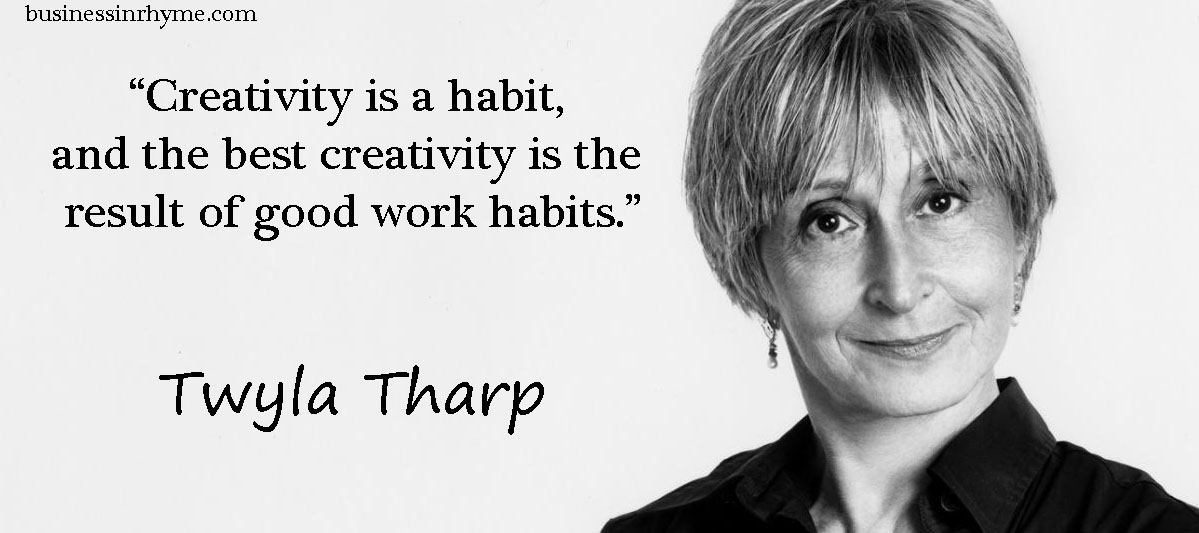
Daily verse with purpose: Twyla Tharp
What would you like to read on “Business in Rhyme”?
This blog has been existing almost 6 months and it’s turning into a great community.But of course, no matter how much it gives me space to learn and share my experience – it’s not only about me. So here I created a simple poll that gives you the opportunity to vote which topic of your interest you would like to read more or know about more. You can add your own answers as well. Poetry will stay the central focus of the blog, but I’m interested to see your opinion in which direction this influence of poetry we can further explore.
We are soon approaching New Year and there are some additional novelties that will enrich Business in Rhyme and make it more interactive. I hope you’ll find them attractive as well.
For now, thanks for taking time to vote.
Maja
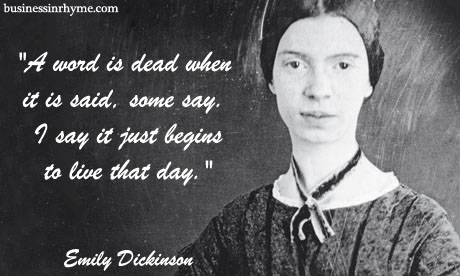
Daily verse with purpose: Emilliy Dickinson
Daily verse with purpose: Benjamin Disraeli

3 step-process to curb fear of creative self-expression

We are creative beings. Even while only sitting and thinking – you are actually creating, but some people need that final nudge – to translate their idea into a physical reality. They are afraid of expressing themselves creatively, and sources of this fear can be numerous: fear of other’s people approval, not being original enough or not meeting some type of criteria (deadline, aesthetic or functional purpose) for what they want to produce.
Most self-help teachings will tell that you need to face your fear, “take the bull by the horns”. But it can be counterproductive – and you can end up being chased by the angry bull, not trained and fast enough to escape this seething fury.
And I believe that there is the key – before facing your fear, prepare and arm yourself with any additional weapon that can help you fight this raging animal.
- Acknowledge your fear. By this I mean that you should be frank with yourself and admit you are somehow scared to publicly express your creativity. As mentioned above, fear is an angry and hungry beast that craves your self-doubt, pessimism, lack of clarity and unreachable perfectionism. Your fear can endlessly haunt you, wanting more, but you don’t have to be the one to feed it: once you accept its existence – it’s much easier to equip yourself and prepare a battle field into your advantage.
- Turn your fear into curiosity. Examine your thoughts carefully: what are you actually afraid of? Right down your thoughts. Is there any credible truth behind those statements? After all these are just thoughts. Thoughts can be changed. And what would happen if you begin to enjoy your creativity? People will think and talk, no matter what you do. But how would your life improve if you give your creativity a chance? Like writing a book or painting? You create for the sake of your own life experience, passion and joy: replace your negative thoughts with more empowering affirmations that will open the door to more inspiration and creative outlet.
- Take meaningful action. If you are still lingering on the edge of insecurity, think of ways you can improve your creativity: what else you need to know? What additional information would help you? Do your research, ask questions, observe other people who did similar things – what actions they have taken..do you need any skill? Educate yourself, take classes, go to workshops…Instead of feeding your fear, feed your creativity, enable it grow, flourish and materialize into something you will enjoy. That’s the sure way for your environment to enjoy your work as well.
I hold it true that thoughts are things
Endowed with bodies, breath, and wings,
And that we send them forth to fill
The world with good results – or ill.
That which we call our secret thought
Speeds to the earth’s remotest spot,
And leaves its blessings or its woes
Like tracks behind it as it goes.
It is God’s law. Remember it
In your still chamber as you sit
With thoughts you would not dare have known,
And yet made comrades when alone.
These thoughts have life; and they will fly
And leave their impress by-and-by,
Like some marsh breeze, whose poisoned breath
Breathes into homes its fevered breath.
And after you have quite forgot
Or all outgrown some vanished thought,
Back to your mind to make its home,
A dove or raven, it will come.
Then let your secret thoughts be fair;
They have a vital part and share
In shaping worlds and moulding fate —
God’s system is so intricate.
Ella Wheeler Wilcox
Daily verse with purpose: Anthony Jay

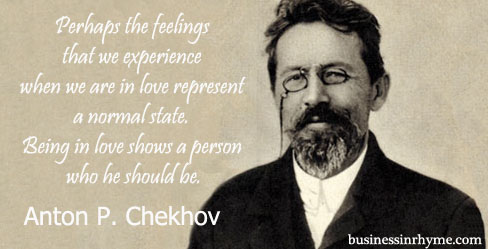
Daily verse with purpose: A. P. Chekhov
 Business in Rhyme