Blog

How poetry inspired Tesla to design one of his most important inventions

tesla image

No matter how much we dwell on the nature of creative process, there are still a lot of uncertainties how creative part of personality develops. Usually it fluctuates between states of exquisite thrill and inspiration and extreme, deep introvert isolation. We have documents about creative processes of highly creative people like Michelangelo, Mozart, Picasso and even Tesla stating that these people managed to sustain prolonged periods of creative display, but one that was often triggered by some depressive mood or trauma, ending also with some distorted thoughts.

Tesla’s descriptions of creative process in his autobiography give important insights into the phenomenon. Right on the first page we read:

…for many years my life was little short of continuous rapture.

Nikola Tesla was, no doubt, a remarkable man, an extraordinary scientist and inventor. If we look more deeply into his habits, infatuations and things he was attracted to, we can observe more clearly his sources of inspiration.

He was born in Smiljane in 1856. in the family of an orthodox priest. Even in his early age he showed inclinations towards science. As a young boy he got ill, infected by cholera. While still fighting with death, he begged his father to let him study technical sciences. A firm promise that his father made, gave strength Tesla to get better and later, in 1875. he enters technical school in Graz. Even during studies he contemplated the idea about alternating current.

It’s interesting to note that while working on new inventions Tesla had visions, images and even could hear strange voices – rather then expressing his thoughts in numbers or terms. He writes:

In my boyhood I suffered from a peculiar affliction due to the appearance of  images, often accompanied by strong flashes of light…When a word was spoken to me the image of the object it designated would present itself  vividly to my vision and sometimes I was quite unable to distinguish whether what I saw was tangible or not.

One of the lesser known facts about Tesla is that he was also a great fan of poetry. It was an excerpt of Goethe’s Faust that inspired him to finalize his invention of  the alternating current-motor. The term “world-changing invention” certainly applies to this innovation.
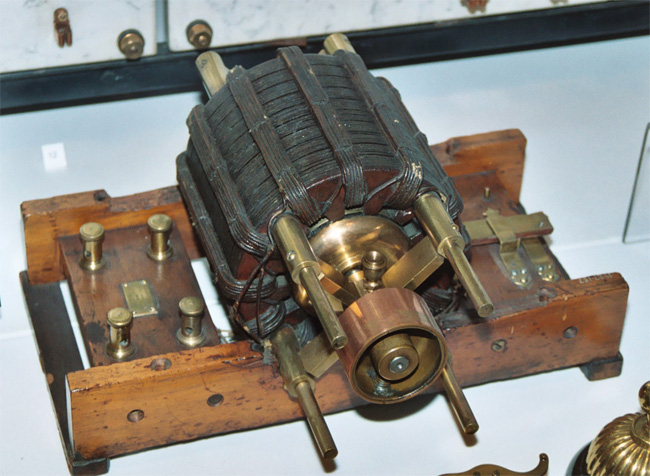
tesla motor

Around 1881., Tesla goes for a walk with his friend Antal Szigety in Budapest. While walking through a park the young Tesla recites a poetic passage by heart:

The glow retreats, done is the day of toil;
It yonder hastes, new fields of life exploring;
Ah, that no wing can lift me from the soil
Upon its track to follow, follow soaring!

I’d see in that eternal evening beam,
Beneath my feet, the world in stillness glowing,
Each valley hushed and every height agleam,
The silver brook to golden rivers flowing.
The mountain wild with all its gorges
Would hinder not the godlike course for me;
Before astounded eyes already surges,
With bays yet warm, the open sea.
And yet at last the god seems to be sinking;
But new impulse awakes, to light
I hasten on, eternal brightness drinking,
Before me day, behind me night,
Above me heaven, and under me the billow.
A lovely dream, while glory fades from sight.
Alas! To wings that lift the spirit light
No earthly wing will ever be a fellow.

What verses described, he was actually experiencing himself at the moment. And as the sun set that day, it is believed that Tesla have drawn the design for the induction motor in the sand.

The passage Tesla quotes is about a dream of flying beyond the sun, the heavens, in eternal daylight. And Tesla finds the metaphor, the parallel between the dream and the priority for human kind. He further writes:

If we want to avert an impending calamity and a state of things which may transform the globe into an inferno, we should push the development of flying machines and wireless transmission of energy without an instant’s delay.

Tesla was also a talented poet himself. A lot of his thoughts and musings he would write in the form of poem that would later serve him as a reminder or a guidance in his future work.

What we can learn from Tesla is that any innovative thinking, being scientific or otherwise, is nourished by diverse influences, conditions and environments and that we should keep our senses always alert.

Sources: McLean, A. ed. 2006 Goethe’s Faust (from 1.act, 1. scene to 2. act, 2. scene)

Tesla, N. 2005, My Inventions; The Autobiography of Nikola Tesla, Wildside Press, LLC


Excercise your creativity through poetry, part III

kintz

Extensive research in area of cognitive science and intellectual skills suggests that intuitive understanding of seeing problems in new ways, analytical ability and effective communication of ideas to others are strong precursors of innovative thinking. Sternberg, R. J. (1986). in “Intelligence applied: Understanding and increasing your intellectual skills” in detail covered this topic.

In other words, sometimes is easy to come up with a good idea, but how we formulate idea, how it “goes into the world” and becomes persevered by the environment, strongly influence the possibility of the idea to become viable.

In the part I and part II of these series, I offered some suggestions on generating new ideas. Hence, writing poetry makes use of all three previously mentioned intellectual skills. Poetry can help us not only with writing and coming up with new ideas but also how to present our idea, make it more attractive to our audience or clients. That’s one of the reasons why I love poetry so much: it really help us work on our confidence, on our belief that we can contribute to something greater than ourselves, that we can provide value by sharing our knowledge and passion.

So for boosting your creative flow I have a little exercise to propose:

Next time you work on new idea, project, script – write like a small presentation of your idea in the form of a poem. Then read it out loud and imagine you have to present (“sell”) your idea to someone (agent, customers, managers ext). How does it feel? Is it empowering or you sense your idea lacks something? Pay attention to your posture: does you body naturally straights up while you read and present? Or you are quailed, with shrugged shoulders, impatient to finish your reading? Are you satisfied with the outcome or you are uncomfortable and insecure? Is your idea understandable? What else you could include in your poem? What kind of reaction you would like to provoke?

Your intuitive guidance, that inner knowing will tell you are you on the right track with your idea. If it doesn’t work try again. Between the verses is your hidden treasure to perfecting your idea.

You can go step further and organize a real audience for pitching your idea-poem. Listen and watch them. Did you capture their attention, how did they react? Your idea, transmuted through poem has to provide experience, to be uplifting, different from already seen and heard.

Note down your observation and work on the refinement of your idea. It will get you closer to your desired result – where both you and your clients enjoy the fruits of your work.

Take back this virgin page

by Thomas Moore

Take back the virgin page,
White and unwritten still,
Some hand more calm and sage
The leaf must fill.
Thoughts come as pure as light,
Pure as even you require:
But oh! each word I write
Love turns to fire.

Yet let me keep the book;
Oft shall my heart renew,
When on its leaves I look,
Dear thoughts of you.
Like you, ’tis fair and bright;
Like you, too bright and fair,
To let wild passion write
One wrong wish there!

Haply, when from those eyes
Far, far away I roam,
Should calmer thoughts arise
Tow’rds you and home;
Fancy may trace some line
Worthy those eyes to meet,
Thoughts that not burn, but shine,
Pure, calm, and sweet.

And as, o’er ocean far,
Seamen their records keep,
Led by some hidden star
Through the cold deep;
So may the words I write
Tell thro’ what storms I stray,
You still the unseen light
Guiding my way.

Systems thinking as a holistic approach to entrepreneurship

Harman

To better understand social systems, thinking from a system perspective allows us to see and recognize interactions between system elements. Systems thinking takes into account larger number of interactions as an issue being studied and therefore results in greater number of conclusions than those delivered by other forms of analysis. It’s quite an effective approach and it can be applied to any type of system, being that business or your life in general. Now, I would go even broader in my definition: successful entrepreneurs have the ability to perceive the world as a system.

Why is that important?

As Michael Gerber states in his article Systems thinking:

Your business should be systems-dependent, not people-dependent.

With no systems in place, your business depends on you and on a few people who run things for you. If you or they disappear, even for a short time, your business is thrown into chaos. But if you have the right systems in place, the systems run your business, and nearly anyone can run the systems. You can decide suddenly to take a three-month holiday and your business won’t skip a beat. Your key employees could quit, and you could replace them easily with no ill effect.

This type of thinking is like taking precaution measures: as you start your own business, with systems thinking approach you are establishing right connections between the elements of your business, allowing for business to become adaptive, responsive – you are able to manage better any change.

But I would go even step further: a real systems thinking approach is a crucial step to becoming a holistic entrepreneur. Not only when the elements of the business system are beautifully interrelated but when your business is aligned with your values, your passion, your whole outlook on the world. There is no separation between your life, work and spirituality – it’s a system that like a hologram reflects in its tiniest atom who you are. You recognize the purpose in everything and your business and life is the realization of that purpose.

To truly think and operate your life and business in such way takes time and practice. We have to work on ourselves every day to improve our habits and how we respond to everyday challenges. I see poetry as a shortcut on this journey. Poetry can be that sixth sense that most of us lack, as it translates hidden agendas and prepare us for new experiences. It disintegrates the complexity of the world around us – opening our eyes for new possibilities and making new thoughts easier to digest. Poets are true systems thinkers: with each poem we read, even for that shortest moment, we take on the world as they contemplate it to a higher level of comprehension.

Life’s Meaning by Fra Giovanni Giocondo

Life is so full of meaning and purpose,

so full of beauty beneath its covering,

that you will find earth but cloaks your heaven.

Courage then to claim it; that is all!

But courage you have, and the knowledge

that we are pilgrims together,

wending through unknown country home.