Blog

Exercise your creativity through poetry, part II

When you invite people to share in your miracle, you create future allies during rough weather.”
― Shannon L. Alder

In this post I intent to recommend some interesting writing exercises, but they are supposed to be done in groups. So grab some of your “pen-friends”, painted-cartoon-of-two-people-talking-for-kiki-by-katy-973x1024play together and see how can you inspire and help each other become more creative.

These exercises can be also performed in the business setting, they’re fun and can be a great way to break out of the ordinary working routine.

Inspired by discovered

Each of you, players, has to write down a rare fact about yourself that most people don’t know about (it can be a secret 😉 ) on a piece of paper, fold it and exchange it with others randomly. Caught by surprise about unknown facts you may find your own fountain of creativity! Write a poem about it and see where it takes you.

Pantomime

Let one of your friends or coworkers gesture with hands: your task is to describe what you see, what you experience and jot it down in words in the form of poem. This can be quite intriguing way of stimulating our creative capabilities, as is discussed in this article, using two hands to explain something prompts the brain to consider issues from multiple perspectives. To spice up a bit, try everything that you write to put in rhyme (in my previous post I explained the benefits of putting boundaries during our brainstorming sessions and how that can stimulate creativity further).

What’s wrong with this picture?

Visual stimulation can unleash your imagination in the most exciting ways. You can pick some random picture and each of players has to make a story in the form of poem, inspired by the picture. Afterwards, you can all debate and see whose story is the most interesting or you can take it step further and compile all stories into one: it has to be believable and follow some logical structure. It’s best suited for groups of two, three people.

With certain moderation you can use these ideas for your own creativity exercises. If you by any chance try them, share your thoughts in the comments below.

It couldn’t be done by Edgar Albert Guest

Somebody said that it couldn’t be done,
    But, he with a chuckle replied
That “maybe it couldn’t,” but he would be one
    Who wouldn’t say so till he’d tried.
So he buckled right in with the trace of a grin
    On his face. If he worried he hid it.
He started to sing as he tackled the thing
    That couldn’t be done, and he did it.

Somebody scoffed: “Oh, you’ll never do that;
    At least no one has done it”;
But he took off his coat and he took off his hat,
    And the first thing we knew he’d begun it.
With a lift of his chin and a bit of a grin,
    Without any doubting or quiddit,
He started to sing as he tackled the thing
    That couldn’t be done, and he did it.

There are thousands to tell you it cannot be done,
    There are thousands to prophesy failure;
There are thousands to point out to you one by one,
    The dangers that wait to assail you.
But just buckle it in with a bit of a grin,
    Just take off your coat and go to it;
Just start to sing as you tackle the thing
    That “couldn’t be done,” and you’ll do it.


3 tips to get your creative leadership to the next level

In the simplest terms, a leader is one who knows where he wants to go, and gets up and goes.

              – John Erskine, author 

When my mother taught me how to cook, she used to say that I should always think from the end: “prepare every pot you are going to use, preheat the oven,  go wash and cut your groceries” –  so I wouldn’t mess the kitchen cabinets with my oily, floury hands. And she was right: it shortens the time of cooking, cleaning and the stress that arise from hurry and clumsiness.

Pretty much the same is with business. Whenever we are able to envision where we want take our project or business, it’s much easier to plan the steps along the way. But in certain times, we don’t have that clarity in which way to turn, what is the desired outcome.

That process of breakthrough ideas – “envisioning” is a rocky journey, full of ups and downs, sometimes with obstacles and sometimes is a smooth sailing across the quiet sea.

Creative leadership can benefit from those bursts of innovative thinking and

Leadership concept on white background. Isolated 3D image

for the sake of project/business idea, the focus should be to emulate, produce and sustain those conditions as much as possible. Poetry as a tool can help us a lot:

  1. Follow the hunch

When the idea is still vague, undeveloped, but you have a hunch, a feeling – write a poem about it. Write about your successful project, the benefits it will bring, how you would feel after accomplishing desired results. This type of writing can stimulate positive mood and enhances your creative abilities.

  1. Combine and play

Creating something new can mean rearranging the existing parts into something different – with different order, structure, introducing new elements. To connect seemingly incompatible in new ways, we can produce something extraordinary and give answers to questions we have. Einstein called this Combinatorial Play.

You can summarize all of your ideas, mix them, connect in every impossible way – in poetry. There is no logic needed, there is no judgment, there is no need for “it doesn’t work” statements. Combine and Play:  you might be surprised with the innovative solutions you come up.

  1. Look at the big picture from a detail perspective

Creative leadership is able to recognize unexpected perspectives, keeping in mind the “big picture” – end result it wants to achieve, but pays attentions to detail, and how the change in tiny, almost invisible parts can make the whole difference.

One useful example is the story of Velcro:

In 1948, de Mestral happened upon his most enduring discovery while hiking. He and his dog returned from a hike covered in burrs from the plants along the trail. De Mestral examined the burrs under a microscope, studying their structure. He began working to develop a synthetic fastening system that mimicked the hooks and loops of the burrs.

The fabric went through a number of phases before it was finalized. De Mestral worked with a weaver in France to create hooks and loops strong and durable enough to cling together as he intended. Originally crafted from cotton, the fabric ultimately proved more successful when made out of nylon. In 1955, de Mestral unveiled his innovative new material: Velcro®. The name is a combination of the French words “velours” and “crochet,” translated to English as “velvet” and “hooks.”

source: biography.com

How poetry relates to this? While examining the world around us, analyzing ideas, exploring available resources – especially in poetry where no rational and logical thinking is required, we can accelerate our ability to see through things, how they work, connect, respond, to understand their background. It’s an unleashed creativity that process of focused logical elimination can jump-start our innovative process.

The idea by Mark Strand

For us, too, there was a wish to possess
Something beyond the world we knew, beyond ourselves,
Beyond our power to imagine, something nevertheless
In which we might see ourselves; and this desire
Came always in passing, in waning light, and in such cold
That ice on the valley’s lakes cracked and rolled,
And blowing snow covered what earth we saw,
And scenes from the past, when they surfaced again,
Looked not as they had, but ghostly and white
Among false curves and hidden erasures;
And never once did we feel we were close
Until the night wind said, “Why do this,
Especially now? Go back to the place you belong;”
And there appeared , with its windows glowing, small,
In the distance, in the frozen reaches, a cabin;
And we stood before it, amazed at its being there,
And would have gone forward and opened the door,
And stepped into the glow and warmed ourselves there,
But that it was ours by not being ours,
And should remain empty. That was the idea.


5 qualities of creative people

When we engage in what we are naturally suited to do, our work takes on the quality of play and it is play that stimulates creativity.

               — Linda Naiman

Many years spent in research and education helped me notice that:

  1. Creative people are not afraid to be childish.
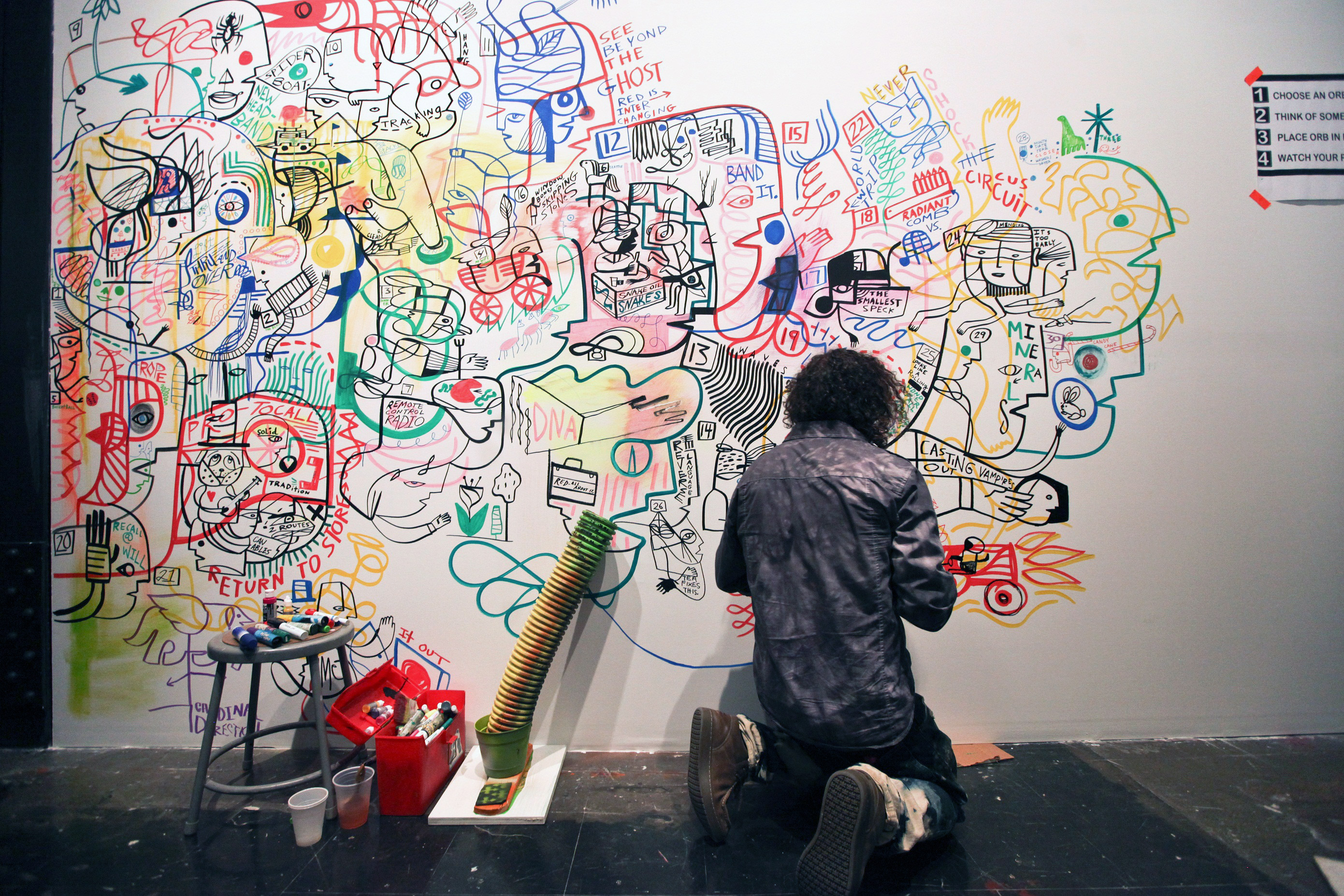
  2. They tend to mix possible with impossible.Gabe-Felice-Psychic-Drawings
  3. They are curious and not afraid to go against the mainstream (follow “the rebel inside”).
  4. Often they are empathetic, emotionally challenged where through creativity they release the pain and initiate healing process.
  5. They embrace their introverted side.

Any of these traits we can emphasize and work on them. I believe we can be creative in whatever field we choose. For example, chefs are creative masters in the kitchen, and sales people or marketers are creative in coming up with strategies to build businesses. Poetry and writing in general can be a useful tool in helping us become more creative in other fields. One of the reasons I like poetry is that you don’t need anything beside paper, pencil and your willingness to commit to writing,

Poetry allows you to play with words – even invent new words which I adored to do when I was i child. I even invented a whole new language and was so proud when nobody could understand me except my best friend. By just playing with words, poetry awakens that forgotten child, loosens our rigid thinking and allows the impossible to become possible -which lead us to the second trait: in poetry we can mix and connect anything we like and you set your own rules for that. There’s no need for explanation, no judgment, just your free mind and spirit. There you can question everything, you can become or be anything you like and the thirst for excitement that comes from the feeling after you finish your little master-piece is what makes everything worthwhile. Being curios about your own capabilities is a sure thicket for more creative outlets.

And more then anything I appreciate my ME time. No in selfish way while neglecting others, but I think in order to develop better creative qualities we need to be alone with ourselves, listen what comes from inside and just let it go. All the pain, hurt, discomfort, disappointment, discontent.. just let it go. Pour your soul into your writing, without censuring anything – you’ll feel like clouds have disappeared and that you can see more clearly: who you are, what you want to accomplish and how.

When I was younger, I used to fear loneliness, why am I different, why I don’t fit in, why do I have different interests, why don’t I have more friends. But the truth is, I always appreciated more meaningful, deeper friendships, you know…people that support you, who are part of your experiences, who witnessed you growing in what you are today. And usually we have only few friends like that. And that’s Ok. It’s Ok to have a lot of superficial acquaintances as well. But being introverted and not easily fit in, can be a blessing in disguise. It can propel your work in the most exhilarating ways and let you experience the world from different perspectives – where by having to much useless encounters would make you too busy and diverted to see. So it’s Ok to be introverted – embrace it in your work and let your creative genius to shine!

Where the mind is without fear by Rabindranath Tagore

Where the mind is without fear and the head is held high
Where knowledge is free
Where the world has not been broken up into fragments
By narrow domestic walls
Where words come out from the depth of truth
Where tireless striving stretches its arms towards perfection
Where the clear stream of reason has not lost its way
Into the dreary desert sand of dead habit
Where the mind is led forward by thee
Into ever-widening thought and action
Into that heaven of freedom, my Father, let my country awake.

Are poets born, taught or both?

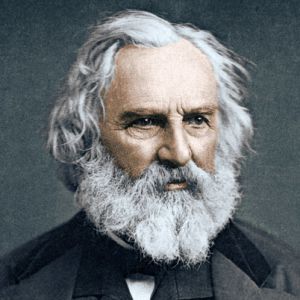
This post is inspired by the poem “The Poet And His Songs” written by Henry Wadsworth Longfellow and it goes like this:MTE5NDg0MDU1MDQ0NTg5MDcx

As the birds come in the Spring,
We know not from where;
As the stars come at evening
From depths of the air;

As the rain comes from the cloud,
And the brook from the ground;
As suddenly, low or loud,
Out of silence a sound;

As the grape comes to the vine,
The fruit to the tree;
As the wind comes to the pine,
And the tide to the sea;

As come the white sails of ships
O’er the ocean’s verge;
As comes the smile to the lips;
The foam to the surge;

So comes to the Poet his songs,
All hitherward blown
From the misty land, that belongs
To the vast Unknown.

His, and not his, are the lays
He sings; – and their fame
Is his, and not his; – and the praise
And the pride of a name.

For voices pursue him by day,
And haunt him by night,
And he listens, and needs must obey,
When the Angel says: Write!

and it left me wondering: are we born writers and poets with innately need to write and create or is it something we discover with time and then put effort and energy into it in order to develop better writing skills? I mean, we all can work to improve our abilities in any area, but are we born with notion that writing is supposed to be our life calling (or any other profession, for that matter)? Do you simply “know” that you must write in order to be yourself, to express your true nature? As Longfellow says “so comes to the Poet his songs…from the misty land…to the vast Unknown”.

For me, some sort of writing was always present. During my career it evolved into scientific writing, yet the most natural way for me to write is in the form of poem – and it showed early in my childhood.

As Marina Abramovic likes to say:

 For me, art is like breathing. You don’t question if you breathe, you have to breathe. So if you wake up in the morning and you have to realize an idea, and there’s another idea, and another, maybe you are really an artist. It doesn’t make you a great artist, it just makes you an artist. To become a great artist is a huge undertaking! So it’s really important, that instinct. You need the instinct to do it”.

There is no doubt that further developing skills requiers hard work – to move from ordinary to extraordinary. But do we need that “special thing” to carry inside in order to go beyond the average crowd? What are your thoughts, please share in the comments bellow.

3 creative ways to earn money as a poet

 Money is everywhere but so is poetry. What we lack are the poets.

               ~Federico Fellini

The truth is no matter how we are aware of the poetry artistic value, writing poetry and therefore reading and buying it, is not popular as reality shows for examples. For most of the publishers the profit they make from publishing poetry is minor or almost non-existent.

When we think of earning money from our writings, we first think of traditional ways, like submitting to literally journals, and different contests where acquired attention and popularity can ultimately lead to publishing offers. In nowadays digital world, the rules of games are changing on the behalf of indie and self-publishing opportunities.1a9af70f265d0cc691471e6b27d27e11

You can start a blog, publish your e-book or chapbook with very little investments but getting needed exposure might be hard. Today I want to share with you examples of successful poets who are doing things a little differently – and it actually pays off.

Explore the possibilities of Instagram

There are many young writers who are combining old typewriters, sentimental atmosphere and witty words to attract readers and viewers. Robert Macias, who goes by the name R.M. Drake, is one of them. He is a self-published writer, with over 1 million followers on Instagram, 16K on Twitter and over 20 000  likes on his Facebook page. His book Beautiful Chaos is one of the best-selling books in Amazon’s poetry category.

Robert was previously an art director, but now with his writing he is able to quit his job and only devote his time to writing. In an interview he gave, he is not very sure what pushed him forward in the poetry fame but he reckons that it might be related to his confessional writing.

The more I write things about myself the more that people relate to it..At least on social media, people want to expose how they’re feeling and things they’re going through and that’s what my writing does. It’s self-exploration and self-therapy.”

He likes his raw, uncensored approach and apparently his readership love that too!

Become next haiku guy/girl

This idea for poetry-writing business emerged when two college friends wanted to do an interview series about entrepreneurship. In Williamsburg they organized a little booth with aim to attract possible interviewers and in return they offered writing a short poem – haiku (since they both were quite artistic and eloquent). Very soon they got an assignment for yoga festival and that’s how haiku guys were born.

Charging between $200 and $250 per hour, The Haiku Guys are able to earn some dissent money by writing poems at events, especially since they sometimes attend up to six a week.

If you are a poet, maybe you can also offer custom-made poems for events, performances and ext.

Publish your poems beyond paper and digital world

This last example is about non-profit organization, but they are doing so diverse and inspirational projects that by far they are my favorite.

The Red Room Company is dedicated to creating unusual and useful poetry projects that positively transform expectations of, and experiences with poetry. Through imaginative projects and learning programs they aspire to make poetry accessible to all, especially those who face the greatest barriers to creative opportunities. Organization is located in Australia and is mostly directed on affirming Australian poets.

One of the projects I really liked is Dust Poems with unique aim to deliver 6  perspectives of the road, both from professional poets and professional truck drivers, exploring their experiences of driving across the country.

Original copies of poems were hidden in 5 locations throughout the Sydney Olympic Park  which the public could find through an interactive online map. An ongoing installation of the poems, as well as audio and visual material was displayed in Sydney Park between March and July 2009.

I think this is very creative, fun and imaginative way of using poetry while creating unique experiences for both the readers and poets. Now, what’s interesting is that in order to popularize poetry we can step out of conventional ways and publish poetry elsewhere. Like small company from the Netherlands, Plint: they print poetry on different objects like tea towels, mugs, boards and pillows. And with the possibilities of Internet you can publish your own poetry on the objects you choose, by using zazzle.com or cafepress.com services. Initial investment is small and you can outreach for more readership this way.

I hope you find this ideas interesting and that ultimately can help you, if you are a writer – to create a valid business model.

Rich or Poor by William  Henry  Davies

With thy true love I have more wealth
Than Charon’s piled-up bank doth hold;
Where he makes kings lay down their crowns
And life-long misers leave their gold.

Without thy love I’ve no more wealth
Than seen upon that other shore;
That cold, bare bank he rows them to –
Those kings and misers made so poor.

Poetry in advertising: misused or too much used?

The most common trouble with advertising is that it tries too hard to impress people.

~James Randolph Adams 

When we think of business and poetry, our first association comes to advertising. And there is a good reason for that. Many companies aware of the power of language, use short, minimal poems that often rhyme with aim to attract customer’s attention and with memorable fable just try to get “stuck” to their minds. From one point of view, poetry is the ultimate, sophisticated artful use of language, a beautiful tool one can use to express emotions, thoughts, experience, where advertising is not even a “stand alone” art. As it is described in the paper Poetry and Advertising:

it is the handmaiden of commercial motives; its name carries connotations (well earned, one might add) of halfruths, deception, and outright fraud, of appeals to vanity, fear, snobbery, and false pride…

But, we shouldn’t forget that poetry and advertising, do have much in common: a tendency for putting what we want to say in rhyme, following specific rhythm and words so precise in their “attack” on our unconscious thinking. They intent to give meaning to everyday life events and subjects, using symbolism and metaphor to express ordinary world. The emotional response that poetry retrieves from customers often means an immediate engagement and we can see how multinational corporations are using poetry to promote their products. For instance:

A narrated ad for McDonald’s (“the Gothy types and scoffy types and like-their-coffee-frothy types were just passing by“) or very good example of the use of more traditional poem like in the Levi’s commercial:   “I see their knavery: this is to make an ass of me; to fright me, if they could. But I will not stir from this place, do what they can: I will walk up and down here, and I will sing, that they shall hear I am not afraid.”

“Midsummer night dream” is a Shakespeare’s classic and here it is stripped down from its original meaning and put into a whole different context. It offers new, refreshed interpretation where a love story is translated into our modern infatuation with fashion. Very interesting approach.

MTE1ODA0OTcxNzgzMzkwNzMz

In one of the Guardian articles  they interviewed two contemporary poets and asked for their opinion on the use of poetry in commercials. Roger McGough, a performance artist from Liverpool wasn’t that happy with use of poetry in advertising, since it’s usually “distasteful and not respectful enough”.

On the other hand Nick Toczek welcomes the exposure that advertising offers poetry:

Shakespeare would have thought commercialism was worth it. Populism is good. The more language matters to people the better.

At the end of the day, good poetry is a sincere appreciation of sadness, love, joy – and even death. And that appreciation comes both from poet and the reader. It’s hardly ever going to be found in the cheeseburger or a bowl of candies, because as poetry did get its role in advertising, the real purpose of poetry is to convey something much more deeper and bigger.

Increase your creative potential in 3 easy steps

The unfed mind devours itself.

              ~ Gore Vidal

Is it creativity something we are innately born with or we can improve our creative skills? I would say that some people are maybe more prone to imaginative thinking and open to new ideas, but we all are creative beings. There are key creativity dimensions like knowledge, divergent thinking (cognitive style), personality, autonomy and intrinsic motivation as authors suggest in “Creative Potential and Practised Creativity: Identifying Untapped Creativity in Organizations”. In particular, research findings suggest that domain of specific knowledge is a necessary prerequisite for effective creative functioning.

In my opinion, the difference is maybe in style and tools we use to express our creativity. One of the worst things that can happen is a creativity block that we all encounter from time to time, but there are certain tricks we can apply in order to move forward with our creative thinking.

  1. Dive in the absurd

In the paper “Connections From Kafka: Exposure to Meaning Threats Improves Implicit Learning of an Artificial Grammar” authors argue that experiencing (reading, hearing or seeing) something absurd like surreal art or literature can increase pattern

salvador-dali-abstract-painting-619-6

recognition of association unrelated to the original meaning threat. In other words, mind always tries to justify, explain what it experiences and “nonsense” art forces mind in faster mode of thinking to recognize what body senses.

So next time you feel uninspired, give your attention to something abstract, surreal (painting, poem, novel) and let you mind drift, loosen up from everything you were trying to accomplish. Let your mind “recharge” this way.

  1. Limit your self on purpose

This might sound strange at first but when you think about it- it might be true. Often we try to find the solutions to new problems by exploring already familiar models and build our new denouement on old foundations. Furthermore, when we have to many options or resources, we try to incorporate everything and unnecessarily over-complicate solution we are seeking. When we put restrictions on what we can use and what path we should follow, it can actually boost our creative thinking. Here I suggest you improvise a bit with your solution, tackle it from different perspective and simplify your approach. It can be that final “click” you need in your mind to move thinking in right direction.

3. Play with “what if” clause

Then, return to your problem and try to look at it from  “What would happen if…. ?” point of view. According to the research, presented in paper Implications of Counterfactual Structure for Creative Generation and Analytical Problem Solving: 

additive counterfactual thinking mind-sets, activated by adding new antecedent elements to reconstruct reality, promote an expansive processing style that broadens conceptual attention and facilitates performance on creative generation tasks”

It’s a great way for creativity “spikes” that we all need when we feel stuck and lack ideas.

These were 3 easy steps that can help us ignite our creative imagination. What do you do when you feel uninspired? Please share your thoughts in the comment section below.

Mobius Strip by Robert Desnos

The track I’m running on
Won’t be the same when I turn back
It’s useless to follow it straight
I’ll return to another place
I circle around but the sky changes
Yesterday I was a child
I’m a man now
The world’s a strange thing
And the rose among the roses
Doesn’t resemble another rose.


Diversity at workplace: how to use poetry for improving communication and intercultural differences

Diversity: the art of thinking independently together.
~Malcolm Forbes

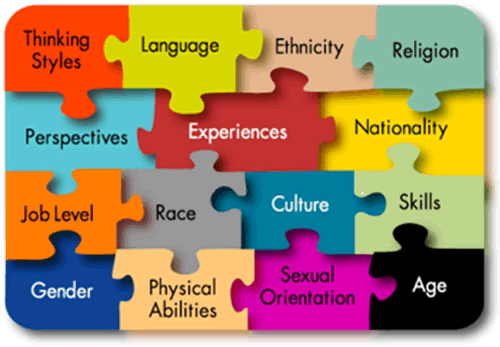
For many years I had the opportunity to live in the Hague, the Netherlands and it is one of the most diverse cities, where cultures, ethnicity, religion and human rights mix together, forming a unique atmosphere and living diversityconditions. Diversity is a major topic and I’ve been always intrigued to which extent it governs our everyday life – especially if we work and live in diverse community.

There is a variety of differences that can exist among people within one  organization. In the Forbs recent article, it states:

In addition to creating a workplace inclusive of race, gender, and sexual orientation (to name a few), many organizations are seeking value in something even simpler, diversity of thought. In some industries that are known for being insular – think law or high-tech companies – seeking out talent with different thinking and problem solving backgrounds is critical.

It is very important issue since it influences how we perceive ourselves and others. And as with every other issue, this one can have advantages and drawbacks that can affect our work life.

Some of the positive things might include different points of view, greater adaptability to changing conditions and a larger scale of skills and experiences within the organization. But often there are communication problems that can distract smooth interactions among the coworkers – which is prerequisite for timely and effective execution of projects. Ways and manners of managing diversity at workplace has become a hot topic and a lot of tools have been developed in order to bridge cultural gaps that diversity brings.

In the paper “Use of Poetry to Facilitate Communication about Diversity: An Educational Model”, authors suggest that we can effectively use poetry as a tool to facilitate communication channels among diverse and culturally challenged groups. They propose a workshop (that they tested in the following example) where the main materials for discussion are different poems from ethnically diverse poets and poems that relate to women’s issues.

Proposed workshop would begin with selecting a burning diversity topic that participants would like to discuss. Workshop facilitator afterwards chooses a poem congruent with issues that arose and a volunteer would read a poem. Participants in the group later discuss and talk about the poem.

Afterwards, participants would write their own poems, while they were also encouraged to read their poems in front of the group with the follow-up conversation. The workshop would end with the creation of collaborative poem, in which each member of the group was invited to contribute with one or more words.

Proposed time of the workshop: 3-4 hours, depending on the number of participants.

Workshop resulted in increased innovation, independence, self-discovery, sharing opportunities and collaboration. To measure these results, the Group Environment Scale was used to assess workshop effects on group dynamics.

According to the workshop feedback many participants adopted increased understanding of how gender and cultural issues may affect others.

Authors final conclusion is:

The research findings seem to indicate that the model’s interweaving of cognitive and effective elements has potential for creating changes among the individual’s perception of other cultures….metaphor can be especially instrumental in achieving this integration.

What are your thoughts on diversity, equality and inclusion? Can poetry be of any help?

Also have in mind beautiful words by Maya Angelou:

Human Family

I note the obvious differences
in the human family.
Some of us are serious,
some thrive on comedy.

Some declare their lives are lived
as true profundity,
and others claim they really live
the real reality.

The variety of our skin tones
can confuse, bemuse, delight,
brown and pink and beige and purple,
tan and blue and white.

I’ve sailed upon the seven seas
and stopped in every land,
I’ve seen the wonders of the world
not yet one common man.

I know ten thousand women
called Jane and Mary Jane,
but I’ve not seen any two
who really were the same.

Mirror twins are different
although their features jibe,
and lovers think quite different thoughts
while lying side by side.

We love and lose in China,
we weep on England’s moors,
and laugh and moan in Guinea,
and thrive on Spanish shores.

We seek success in Finland,
are born and die in Maine.
In minor ways we differ,
in major we’re the same.

I note the obvious differences
between each sort and type,
but we are more alike, my friends,
than we are unalike.

We are more alike, my friends,
than we are unalike.

We are more alike, my friends,
than we are unalike.


3 lessons that writing haiku taught me about business

Clouds come from time to time-

and bring a men chance to rest

from looking at the moon.

~ Basho

Poetry is a mindfulness in its most exquisite form. It is integral part of human nature and therefore is a sort of celebration of life in all its manifestations. Especially haiku, an “instant” form of poetry, focusing on the world around us and fostering each moment of life.

As a form of poetry, haiku originated first in Japan and later became popular in other regions. Haiku poets write short poems, consisting of only 17 syllables. In Japan these poems are valued for their simplicity, openness, depth and lightness.

In original Japanese form the structural rules are:

  • use exactly 17 syllables
  • syllables are arranged in three lines of 5-7-5
  • similes and metaphors are avoided
  • refers to a season of the year.

Haiku poems can describe anything, but mostly they are a result of the observation from the outer world, and have a major theme that appeals strongly to one of the five senses.

Writing and reading haiku is a wonderful way for us to stay connected to our true nature and recognize our role and position in the world. Further more, what we observe and conclude we can use for the purpose of our business practice and it taught me three valuable lessons:

  1. Observe on the outside, as well on the inside

When you want to start your own small business, one of the best strategies you can apply is to build a niche business, where customers are ready to pay more for specialized products/services. In order to determine your own little “gold mine” you have to carefully look around, listen, observe and sense what is that people need; where are neglected and overlooked markets that you perfectly fit in.

But that is only one side of the coin. When you identify those ignored markets, how that complies with what you like to do, with what you are good at; with your own talents, needs, goals and values; how do you actually want to contribute? For those answers wee need to look deep in ourselves and be honest, because anything that contradicts our passion and our own values – won’t produce results in the long run.

And while writing haiku, I learned to observe the world around me more carefully, to see beyond the ordinary. It also helps us learn more about ourselves, our deepest desires and what makes us tick.

2. Keep your business plan short, simple and well structured

Your business plan is a sort of your road map to success – the more simple – less chance you will get lost. That plan is for you, to help you navigate through certain milestones you want to achieve; how to utilize the resources you have; order of actions you need to take and ext. Preferably, it will lead you to do one thing at the time and leave you just enough room, for any adjustments according to the present conditions.

While writing haiku, one of the first things you learn is to live in the now, do things timely and in order. Haiku is a very short and simple poetic form, yet

business plan tree

very powerful. It has specific structure, and by following that structure while writing, you are able to capture and express the beauty of the moment in the most exhilarating way. As you go beyond that, you might get lost, distracted: just as with your business plan. The more simple and structured, the better chance is that your business plan is going to work out for you.

3. The kind of message is your business sending out to the world

Have you thought about what makes your business different form other similar businesses? What’s your uniqueness –if there is any?

The look, the sound, the feel of your business tells a lot about it and all that information people get from your business name, logo, colors, website design, marketing materials, packaging materials etc.; the written content on your site, product descriptions, newsletters; products you offer, your sales approach, and finally you – your customer service.

That everything put together forms a message about your brand and it should be clear and consistent: in every product you make, on every social media platform, in every single interaction with customers you have. The message should reflect what your business stands for and your values.

Just as haiku: it’s a clear vivid image of the world, reflected moment in our minds that is translated into the words.

Analyzing our business practice from all this corners will not only help us improve, but we will begin to appreciate the beauty of simplicity and how that is beneficial for our life in general.

Can we improve our decision making skills?

Choices are the hinges of destiny.

Edwin Markham

In my previous post I wrote about how effective strategic thinking is essential for any project. And today, I go a step further, discussing the importance of developing skills for good decision making.shutterstock_104922425

Looking back, when I was younger – it seemed that making decisions went much easier comparing to my later life events, where contrary to the popular belief – “older and wiser” – indecisiveness crept into my mind. And it takes me much more time, energy, thinking, “measuring” what’s the best thing to do – in every given situation. Apparently, when we have a spectrum of different life experiences sitting in our memory, it can influence a lot our way of thinking and generally our willingness for risk taking.

Successful decision-making can be derived in 4 crucial elements:

  1. Ability to recognize the problem
  2. Possible scenarios to solve the problem
  3. Identifying one that will move us closer to the solution
  4. Make that solution happen, e.g. make decision.

In order to take perspective of all manageable scenarios we try to gather as much possible information and sometimes just get lost in between rational and irrational thinking. Intuition can be a great support, but also a misleading – the key is to find a balance and know when it’s time to take action.

In one of the recent studies, conducted by global creative agency Gyro and The Fortune Knowledge Group, it has been shown that emotion plays a huge part in executive decision making. After surveying 720 senior-level executives in the spring of 2014, study found that nearly two-thirds (65%) of executives say subjective factors that can’t be quantified (including company culture and corporate values) increasingly make a difference when evaluating competing proposals. Only 16% disagreed.

Successful people usually don’t know everything. They go forward, with their eyes fixed to the prize and ready to “jump off the cliff” – regardless of is there a net beneath to catch them.Their wings might be just strong enough to get them on “the other side”.

And next time you struggle with indecisiveness, read this poem by Robert Frost – it helps me every time:

Two roads diverged in a yellow wood,
And sorry I could not travel both
And be one traveler, long I stood
And looked down one as far as I could
To where it bent in the undergrowth;

Then took the other, as just as fair,
And having perhaps the better claim
Because it was grassy and wanted wear,
Though as for that the passing there
Had worn them really about the same,

And both that morning equally lay
In leaves no step had trodden black.
Oh, I kept the first for another day!
Yet knowing how way leads on to way
I doubted if I should ever come back.

I shall be telling this with a sigh
Somewhere ages and ages hence:
Two roads diverged in a wood, and I,
I took the one less traveled by,
And that has made all the difference.