Your writing is
a finger print
of your soul,
would you agree?
Maja S. Todorovic
If you liked this post, please share. And, if you are interested in getting more inspiration for your creativity, sign up for our free monthly newsletter.

Your writing is
a finger print
of your soul,
would you agree?
Maja S. Todorovic
If you liked this post, please share. And, if you are interested in getting more inspiration for your creativity, sign up for our free monthly newsletter.
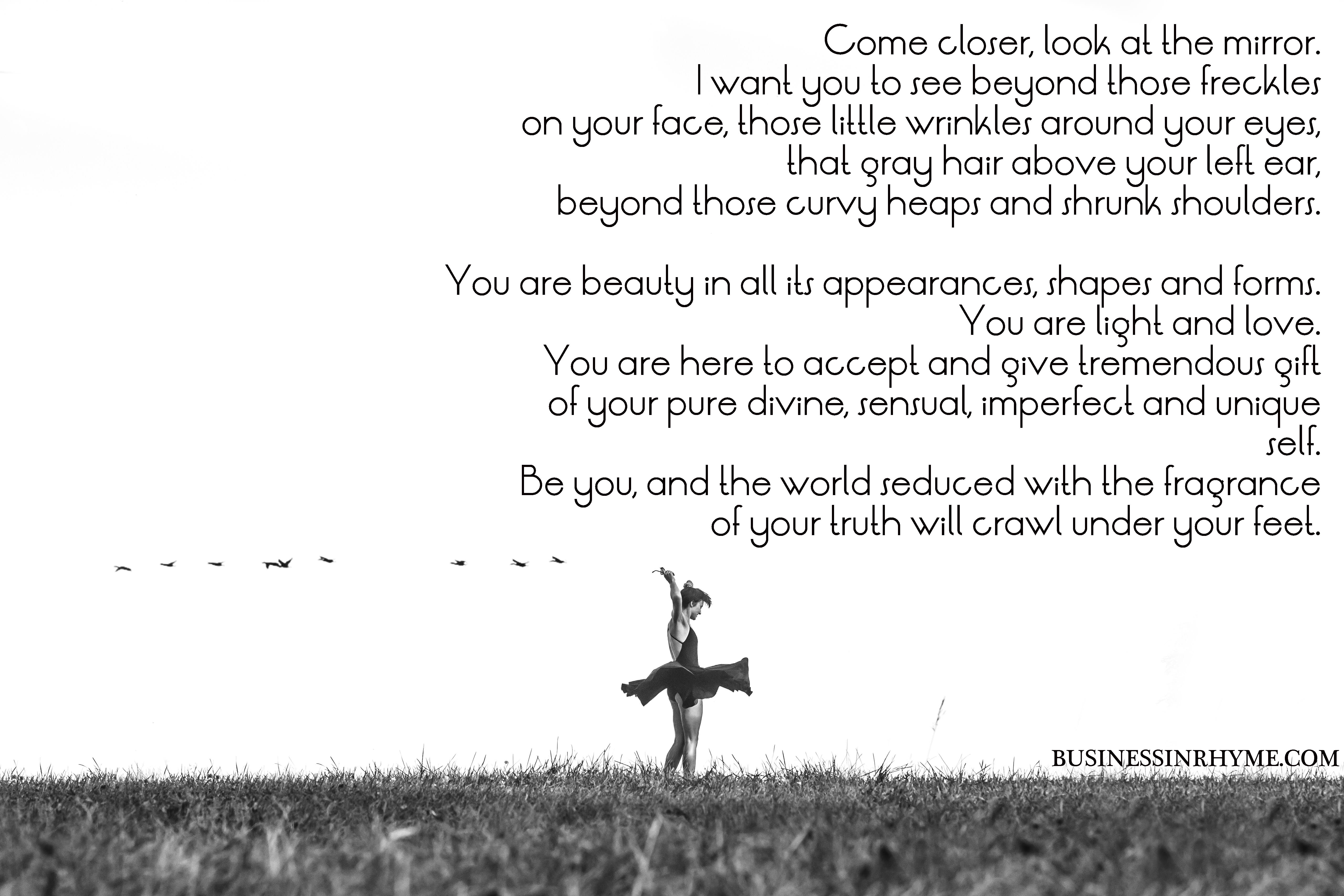
Come closer, look at the mirror.
I want you to see beyond those freckles
on your face, those little wrinkles around your eyes,
that grey hair above your left ear,
beyond those curvy heaps and shrunk shoulders.
You are beauty in all its appearances, shapes and forms.
You are light and love.
You are here to accept and give tremendous gift
of your pure divine, sensual, imperfect and unique
self.
Be you and the world seduced with the fragrance
of your truth will crawl under your feet.
Maja S. Todorovic
If you liked this post, please share! And if you are interested in getting more inspiration for your creativity, sign up for our free monthly newsletter.

Did you know that we can trace origins of word ‘spiritual’ back to the ancient times and it comes from latin word spirare which means to breath and in larger sense it can relate to life itself and living energy force? Taking from these meanings, than anything connected to the pure act of breathing has a spiritual connection, and so does poetry.
A self-actualized spirituality in the most broaden sense might be an acquired integrity, a Self that is truly aware of here and now, and takes actions with compassion and kindness.
For me personally, spirituality also means accepting life and the change that comes with it, learning to navigate with the flow and with the given resources and knowledge make the best of any given moment. It also means dropping the guards of ego-driven principles and having trust in uncertainty, unpredictability of life. Instead of I there is also we and they; there is no scarcity – only abundance for each uniqueness we represent; experience and appreciation for any moment and emotion instead of burdening myself with material stuff.
And finally it is also about connectedness, being true and open to yourself and learning to trust your own honesty.
All these integral parts can be experienced through poetry and let it be our vehicle for learning and growth. Starting from that vantage point of how life should be we work through all that is happening to us – we observe and feel, until we get to an understanding that our perceived reality is as it is.
This whole process of spiritual awakening, poetess Jane Hirshfield so finely portrayed in this essay:
The moon in Japanese poetry is always the moon; often it is also the image of Buddhist awakening.
Although the wind
blows terribly here,
the moonlight also leaks
between the roof planks
of this ruined house.Izumi Shikibu (Japan, 974?-1034?) [translated by Jane Hirshfield with Mariko Aratani]
This poem reminds that if a house is walled so tightly that it lets in no wind or rain, if a life is walled so tightly that it lets in no pain, grief, anger, or longing, it will also be closed to the entrance of what is most wanted.
Ant that openness to life is our first gate and allowing we give ourselves to enter the spiritual growth.
On a branch
floating downriver
a cricket, singing.Issa (Japan, 1763-1827) [translated by Jane Hirshfield]
Issa’s singing cricket is Cavafy’s “great Yes” in action. The haiku offers a portrait of the circumstances of all our lives. Carried by capricious currents, certain to die, we nonetheless fully live.
Nature always knows the best way to express itself and in the most difficult circumstances finds a tiny sun beam and a drop of water to carry on life. We all have that knowing in ourselves, but in the process of making a living we forgot to live.
And what I most like about poetry is it reminds me, teaches me and supports me in this process of learning to live again.
If you liked this post, please share! And if you are interested in getting more inspiration for your creativity, sign up for our free monthly newsletter.
Poem is an ocean stirring
your imagination
and your pen pours rivers of creativity.
Take a deep breath and dive in!
Maja S. Todorovic
This is a guest post, a courtesy of a fellow blogger and poet Jon Freedman – another enlightening story on how we can enrich our lives through words.
Hi. I’m Jon Freedman. My blog, middaymidlife.com chronicles the midlife changes I’m going through after my 28 year marriage ended last April.
In addition to writing about my journey, I write about books and music important to me. Though I haven’t written on poetry, my very first blog post concludes with a poem I wrote, Wrecked in Rejkavik
While i rarely write poetry these days, my appreciation for the art form has not waned. Certain poems remain so poignant, so powerful that I am forever awed and and perhaps, even a tad jealous of their existence.
A good poem blends sound and meaning. A good poem is a song without music, meant not to just be read, but read aloud. A good poem has no shelf life.
I’d like to present two poems by Charles Bukowski. The first dark, the second not. Extremely different but connected by the power of the simple words.
I discovered Bukowski late in life. I knew of him but wasn’t at all familiar with his oeuvre. I was somewhat familiar with his fiction, but not his poems.
Bukowski’s personal story is a fascinating study of an artist who finally reaches recognition later in life, enabling him to focus on his art. There are a ton of biographies on the Interweb, if you’re interested.
Reading about Bukowski’s life raises the debate over art appreciation and how critical it is to understand the context of the artist’s life. As an English professor, and writer, Nabokov summarized it best, “does one need to know the spider to appreciate the web?”
In literature I find myself leaning towards “yes”. Though not in music or fine arts for the most part.
What say you? I’d love to hear your perspective on the question of the importance of knowing an artist’s “backstory” for lack of a better term, to appreciate the creation.
Until then,
Stay in touch. Share, comment, connect!
Jon Freeman
The Meek Shall Inherit The Earth
if I suffer at this typewriter think how I’d feel among the lettuce- pickers of Salinas? I think of the men I’ve known in factories with no way to get out- choking while living choking while laughing at Bob Hope or Lucille Ball while 2 or 3 children beat tennis balls against the wall. some suicides are never recorded.
From Love is a Dog From Hell by Charles Bukowski
The Laughing Heart
your life is your life don’t let it be clubbed into dank submission. be on the watch. there are ways out. there is light somewhere. it may not be much light but it beats the darkness. be on the watch. the gods will offer you chances. know them. take them. you can’t beat death but you can beat death in life, sometimes. and the more often you learn to do it, the more light there will be. your life is your life. know it while you have it. you are marvelous the gods wait to delight in you.
From Betting On The Muse by Charles Bukowski
Jon Freedman is a Washingtonian whose love for words was inspired while growing up in a household where reading was much more than fundamental. After college, he worked in advertising and marketing. Jon has worked for start-ups, Fortune 500’s as well as marketing in pro sports. Along the way, he married, and has three adult daughters, who are the lights of his life. When he’s not reading, Jon is busy chronicling his own midlife experiences in the latest chapter of his journey. In addition to writing, Jon is an avid cook and lover of music. You can find his writings at middaymidlife.com
If you liked this post, please share. And, if you are interested in getting more inspiration for your creativity, sign up for our free monthly newsletter.
You are warrior of kindness.
Your courage is your sword and
persistence is your shield.
You bravely walk through life
and with owl-like wise eyes
you observe and admire the world.
Embrace this wisdom:
don’t be afraid to spread the wings
of your own powerful potential.
Maja S. Todorovic
Probably you have encountered yourself thinking that what you wrote was not good enough, that nobody would like to read it, ext. And as writers we all have that moments. It’s so easy to let that moment overpower us – just let it flood us with self-loathing about our own skills and capabilities. But today I want to offer you a different perspective on your writing and tell that anything, any word you write has value and it’s not your waste of time.
I so immensely believe in the power of written words, our own words we spill on pages that I’m quite confident in the following statements I’m about to make:
Each writing session is actually part of something much bigger, a pattern, a recorded reflection of you in particular moment in time. It doesn’t matter do you write a novel, an article, or purely stating your opinion and commenting on someone else’s work – it’s part of you. And anything that is coming from your own sincerity and open heart has value.
What you write at this moment doesn’t have to be perfect. Probably this exact information you are reading can be written in better style, using better words (especially concerning that English is not my mother tongue), but still you can understand the encouragement I want to give you here. And that is what counts, the message and intention behind it.
But this moment me writing this, leads to another writing moment, another blog post, another poem and inevitably we become more comfortable and confident in our writing, which reveals my second reason:
As long as you trust your authenticity your writing is original. The way you select and arrange words – especially in poetic writing which is so sophisticated, each time you write poem you are discovering your specific writing expression. It’s unique just as your finger print – you learn to use the words to best express your nature, personality, opinions, belief system and anything you stand for.
Each poem or paragraph you write doesn’t have to be approved by editors, experts or published in high impact journals in order to be of value. You write what is true and real for you in that exact moment. While we progress with writing, as it changes so do we. At the beginning of my writing practice I used to write long prose-poems, where I needed a lot of space and words to express myself. As mindfulness begins to dominate my writing lines, so my writing becomes simple and clear. You probably also can relate to this: compare your early works with something you recently wrote and you will see how your poems/writing is more coherent, straight to the point and purposeful.
These are my top 3 reasons why you should keep writing, each time you start to doubt and feel discouraged. There is no word, minute or paper wasted.
And probably the 4th and most obvious (and important) reason that I didn’t list above it’s because it simply brings you joy and fulfillment. Yet, I focused on another crucial elements that most people don’t recognize and easily overlook. These are my three reasons giving me that push I sometimes need to write and commit myself to get the words out there.
Trust your yourself – your writing has value.
The time will come
when, with elation
you will greet yourself arriving
at your own door, in your own mirror
and each will smile at the other’s welcome,and say, sit here. Eat.
You will love again the stranger who was your self.
Give wine. Give bread. Give back your heart
to itself, to the stranger who has loved youall your life, whom you ignored
for another, who knows you by heart.
Take down the love letters from the bookshelf,the photographs, the desperate notes,
peel your own image from the mirror.
Sit. Feast on your life.Derek Walcott
If you liked this post, please share! And if you are interested in getting more inspiration for your creativity, sign up for our free monthly newsletter.
If only I could be a river
a river that goes, flows to the mouth of giant
whale, joining other watery hands to handshake in
the rhythm of waves, rejoicing drop by drop in the
eternity of an ocean;
If only I could be a wind, that carries my breath
collides white clouds, like a spider’s net catches every word
has the strengths to rearrange desserts
and knows how to surrender
in the eye of storm;
If only I could be a tree,
a tree that knows its place under the sun,
how to befriend soil and welcome rain
a tree that accepts its roots – broken sinews
too tired to grow:
I would congratulate myself,
I would sing the song only I hear,
I would visit places only I knew exist
I would finally be who I am.
Maja S. Todorovic

Your writing is a silent messenger
of who you are.
Use it to accept, love and share
your true self,
because sky has an immense space
for another shining star, your star.
Don’t let that corner stay cold and unreached far,
trapped and forgotten in dark.
Maja S. Todorovic
If you liked this post, please share! And if you are interested in getting more inspiration for your creativity, sign up for our free monthly newsletter.

The more I write and search for inspiration for blog posts, the more I come across analogy of how certain natural laws that govern universe actually can be very well applied to our everyday life. If we fast rewind our memory to a high-school years we might recall the 2nd law of thermodynamics that basically says: the universe tends to go from present order to bigger disorder. And does that apply to your everyday life? Well imagine: you can spend all day cleaning your messy room and within couple of working hours, you are practically at square one – like you didn’t tidied it up at all.
Sounds familiar?
We all live our lives chaotic to some degree. We cannot control every circumstance but we can put some effort and take charge to at least try make some order. And making that order can mean finding more time to write.
My first recommendation is to:
If you write for a blog or a book, have clear mind about what you want to accomplish. For a blog having in advanced prepared editorial calendar with defined frequency of your posting can be handy in overall estimate on what you need to write, does it require research and ext. Pretty much the same comes with a book. That writing goal can be a number of pages, chapters or developing your story concept.
Squeeze writing in your schedule like you plan other activities: your meals, working out, household chores. Once it becomes that ingrained part of your everyday life, the lesser are chances for you to skip it in favor of some other activity.
That can also mean:
and writing during that peaceful time where dreams and reality collide.
Instead of being hypnotized in front of a glowing screen, indulge in your imagination and focus on your writing.
If you travel by bus or train to work, this is an excellent opportunity to use this (almost wasted) time to think about our writing, jot some ideas down or brainstorm new poem/story.
Organize your weekends in such way that part of your relaxing routine be writing.It could be as simple as sitting down to enjoy cup of coffee or if you go for a walk: use these breaks to elaborate your writing ideas or finish previous writing tasks.
Putting physical order in your everyday environment can be helpful in terms it will motivate you to write instead of dealing with stressful petty things. Having that special, inspiring place you dedicate to your writing can help you in making writing a priority – being that small gesture like clearing out a counter to write down your new idea. Such small acts of generosity towards our passions and creativity can be a triggering point to transform our writing into a regular practice.
How do you deal with chaos and find time for writing?
If you liked this post, please share! And if you are interested in getting more inspiration for your creativity, sign up for our free monthly newsletter.
 Business in Rhyme