Poetry improves lives: a guest post by Dave Brooks

This is a guest post, a courtesy of a fellow poet and writer Dave Brooks and his insightful reflection on how poetry can benefit our lives. A must read 🙂

The use of creativity in business is a vast subject and has been covered in a number of dimensions in the past, with both positive and negative connotations. Creative accountancy is seen as bending the rules. Being overly creative can sometimes be taken as not being practical. But in reality, in the office disciplines such as general management, line management and business management, creativity has a role to play in the areas of engagement, communication and more importantly of late, compliance.

I want to talk about poetry as opposed to just generic creativity, but for this we need to understand what poetry is. It would appear to mean different things to different people. Many folks still remember the rote learning of classic lines during childhood. There is a general assumption that poetry must rhyme and often there is a distrust of anything more sophisticated than a birthday card ditty. Why not start with a definition or two, to get us on the same page.

1. Literary work in which the expression of feelings and ideas is given intensity by the use of distinctive style and rhyme.

2. Writing that formulates a concentrated imaginative awareness of experience in language chosen to create a specific emotional response through meaning, sound and rhyme.

There are so many bones to pick over in these two definitions, it is hard to know where to start, but let’s drop a few of the more obvious words as these can cloud the picture. “Literary” might make us think we are writing something not for business, but I would like to think that all good writing should be judged by this standard, whether for artistic purposes or for the annual accounts.

One might argue “Feelings” or “emotional response” are inappropriate as an aspect of business communication but I say oh contraire. The most common speech written for internal business use is that for a regular management update to the staff or stakeholders. These pieces are designed to engender passion and followership, sometimes in the case of our US colleagues on the edge of religious zeal or fervour.
We also know that rather like poetry that there are horses for courses. One rambling heroic poetic does not fit the space available for a Haiku. Where time and audience dictate the medium and the composition, we cut out cloth accordingly. So on this point, I think the use of “distinctive style and rhyme” is spot on.

But the part of these definitions I wish to focus on today is that of the transference of ideas and the concentrated imaginative awareness of experience. Yes, my friends, I wish to lead you on the road to compliance. Compliance is not a dirty word. We all agree to abide by some conditions when we start to work for a company. Even those of you out there who are like me, self-employed have to meet the rules set by the bank, the tax office and often business specific regulator. However, there are two big issues with regulation and compliance with it; initial awareness and change.

When first joining a company, a dozen or more documents will arrive at your door and you are deemed to have read them and understood them. This will be anything from the pension scheme to the use of a corporate dentist. They will also include the use of IT policy, security, ethical behavior and external communication with the press and third parties. We are overwhelmed by them and the best way to make sure nobody reads a policy document is to thump them over the head with it. Big paper documents which are measured by quantity not quality provide no value. Yes, you need a long form of the policy, but you also need a simpler way to get the message across.

Do you remember “Concentrated” from the definitions above? Well if we combine with this “Ideas”, “Experience” and “Imaginative” we come to only one conclusion, the use of analogy or imagery. By explaining through the use of metaphor or telling of war stories, a general level of awareness can be created, maintained and improved.
This is equally true with the second scenario, the ongoing maintenance of compliance.

The use of simile and imagery can open tired eyes and part of the role of poetry is the selection of language that engages. We should not be tied to the same old staid subset of English but rather make use of our fabulous language made rich by an array of poets from the Bard up to Carol Anne Duffy and beyond. Lowest common denominator thinking and writing belittles the intelligence of our audience. A fine example of this in practice is through an organisation I have been working with for two years called the analogies project (www.theanalogiesproject.org) that specialise in uses of analogy and story-telling to improve Information security compliance. But why stop there? The sky is literally the limit. Why not use story-telling to make pensioners more aware of the perils of life online? Why not use metaphor in schools to encourage road safety?
In all of this, the written word is at the heart of this work. Good words, strong words, creative and imaginative words. The use of vocabulary that sometimes calls for the use of a dictionary. My second-language speaking colleagues do this without any more of embarrassment. So why does the thesaurus seem to be a book that gathers dust when we leave school. My poetic heart underlies the work I do with my business brain. One feeds my stomach and one feeds my soul. I encourage every one of you to do the same.

Dave Brooks is a poet, novelist, contributor on the Analogies Project, freelance risk consultant and vocalist on the YouTube single Fiscal Cliff by the Academy of Rock. More about his work you can find at http://poetryonthemove.webs.com/


If you would like to contribute with your guest post visit this link for further information. And, if you are interested in getting more inspiration for your creativity, sign up for our free bimonthly newsletter.

IsLand

There fire germinates with melting tongues:

rainbow icicles mirror the drifting land

growing new skin every day,

cracked, suspended in the serene call

of lactating mountains

under the Midnight Sun.


I’ll place my feet on that warm, spacious

ground, glacial time,

when Sky turns cosmic green,

in waves, traveling in between.

Maja S. Todorovic

Why creativity ‘slips through your hands’ and what can you do about it

garrabrandt

Probably you do recognize yourself in those moments when you think “Oh, today, I’m just not in the mood for writing! I’ll do it some other time”. And it is no secret that many artists, including poets had that need to ‘induce’ their mood through drugs and alcoholism in order to create. For example:

Samuel Taylor Coleridge that it is regarded as one of the founder of  of the Romantic Movement in England was known for his opium addiction in later creative years;

It’s also widely accepted that Arthur Rimbaud’s long poem “A Season in Hell” was written under the influence of opium too;

French poet Charles Baudelaire declared that only when he’s drunk he is able to write. Similar happened to Dylan Thomas who also battled alcoholism for years.

So there is a globally accepted belief that great art can only be produced in moments of sadness, suffering, depression  or that we need some other consciousness altering stimulants to get us in the fruitful creative mood.

Now, we are all aware of the healing properties of art and  that they can provoke ‘creative miracles’. But I want to take your attention to the other side of creativity: being sad, depressed or even taking drugs and other stimulants is not going to boost your creativity.

Many  creative people do experience intervals of sadness, low self-esteem or self-pity, but most of them became their best creative version once they encountered something different, completely.

Most likely, when you didn’t feel like writing or doing anything else creatively you tried to drown your bad mood in endless cups of coffee and indulge with  too many sweet cookies.

Even if you did force yourself to do something, probably it was superficial, unsatisfactory according to your criteria which can only increase already existing bad emotions: you weren’t aligned with yourself, creating from your heart, with full desire and passion.

In order to access your full creative potential, you need to be satisfied with yourself. I’m not using word happiness on purpose, because in some cases it is seen as overrated and too elusive. But being satisfied with who you are, accepting and loving yourself in this very moment, in this very point of your life attracts your best ideas, it fuels your creative urge. And somehow the circumstances around you seem to align to assist you in your creative venture.

I know, as I speak from my own experience. Whenever I feel stress, anxiety and depression it drags me away from my goals, ideas, my focus and concentration. Then, I first try to check in with my self: why do I feel this way? How can I deal with this emotion? And sometimes I do write something just to expel that bad vibes out my system. But that is not my best creative moment. I see it more like a ‘reset button’, an entrance to my creative self: I’m able to keep my creativity firmly in my hands. it doesn’t slips through my fingers like sand.

You have that power always to access your best creative resources, to fabricate joy in what you do and don’t let outer circumstances influence your creative outlets. I know, it sounds easier said than done, but that can be also practiced. When you feel anxious, when something bothers you – go for a walk, do some exercises, talk to a friend, journal, do what ever you need for you to align with your own true, creative nature: where your values, purpose, passion and creativity become one. You have the ability to design your own happiness – you are in control of your emotions.

So, how do you feel at the pick of your creativity?


If you liked this post and you are interested in getting more inspiration for your creativity, sign up for our free bimonthly newsletter.


Why is poetry (and writing) so important – as seen through the words of writers

Here are three inspirational videos that I believe, if you ever doubted why should you write – will for ever clear up things for you. I hope you will enjoy them as much as I have 🙂

Scott Griffin is a Canadian businessman and philanthropist best known for founding the Griffin Poetry Prize, one of the world’s most generous poetry awards in 2000, and Poetry In Voice, a recitation competition for Canadian high schools. He is also the Chancellor of Bishop’s University. Chancellor Griffin sits on several NGO boards, as a director of Canadian Executive Services Overseas (CESO), a volunteer advisor to CESO, and a director of African Medical and Research Foundation (AMREF) Canada. In 2006, Chancellor Griffin published a memoir entitled My Heart is Africa that recounted his two-year aviation adventure starting in 1996, working for the Flying Doctors Service in Africa. He was appointed an officer of the Order of Canada in December, 2012. His talk explores the importance of poetry in society.

Daniel Tysdal has been a Senior Lecturer in the Department of English at UTSC since 2009. He is the author of three books of poetry and the poetry textbook, The Writing Moment: A Practical Guide to Creating Poems (Oxford University Press 2014). He is the recipient of multiple awards for his work and his research interests include creative writing and poetry. In his talk,  he is going to show you that you are the poet and will walk you through his writing process to showcase the Power of Poetry: to help us remember, grieve and celebrate.

Jarred McGinnis will share his passion for stories and demonstrate the power of words from Speech Act Theory to the genius that is the children’s book ‘That’s Not My Pirate’. Jarred is an American living in London, and the co-founder of the literary variety night, The Special Relationship. His fiction has been commissioned for BBC Radio 4, and appeared in journals in the UK, USA and Ireland. He is wickedtomocktheafflicted.com. In addition to writing fiction, he holds a PhD in Artificial Intelligence.


If you liked this post and you are interested in getting more inspiration for your creativity, sign up for our free bimonthly newsletter.

Your name

Wears its own fame.

Starting with B.

I like how B blows out of my mouth.

Like a playful Boo!

child’s ambush from

a hidden corner

or

your surprise from behind,

hands eclipsing my eyes

and kiss in the neck,

wistful sighs.


R likes to roll on my tongue.

Wants to get out –

doesn’t want to get out.

Jumps, bounce of my teeth

and rolls like a train speeding its feet.


S likes to become shhhhh…

when I put my heavy, tired head on your

chest, nest.

All vowels and consonants

are disciplined solders, creating brigades of

syllables,

always ready to march,

when desire knocks on the door of my mouth.

Hurrying deep south.

Maja S. Todorovic

Also published here.

Curled,

stiff and strong:

your claw plows my soft skin,

where red streams

follow the trails,

succumbing to tearful river,

as droplets gravitate towards the floor.


My eyes are riveted to the closed door.

I can always wear another skin, fur:

dress in feathers or thorny petals.

But how my scarred heart will

continue to beat,

in between these lungs

as it is like raw egg

smashed against the wall?


Maja S. Todorovic

Business in Rhyme is looking for blog guests!

Many of you who have been following this blog for some time know that I’ve always intended to form a community around ideas that poetry as an art form has to offer much more than it is usually implied. For almost a year I’ve been on a quest to explore all benefits that writing and poetry has to bring into our lives. And a lot has been said and written. But I think it’s time we hear (read) some other voices and opinions too.

So this is official invitation to all bloggers to become a guest blogger on Business in Rhyme. This will give you the opportunity to show your work and share your opinions.

The first topic we could explore is how poetry improved your life and why do you write poetry? You could also include crucial poems that you like or that you wrote…Possibilities are endless.I know it might not be easy for some of you to share your vulnerability and intimate times of your lives, but think how you might help someone, inspire and encourage to embrace their feelings …  I’m doing this on the blog for the first time and I have no idea if any of you are interested, but since Business in Rhyme has a growing following of a roughly 5000 people on social media, it is a chance for you to show your work and increase readership.

If you would like to share your experience and inspire others to start/continue writing poetry, you can read the general guidance given in the header menu.

Thank you in advance for your contribution.

Poetry: a savior that comes when you least expect it

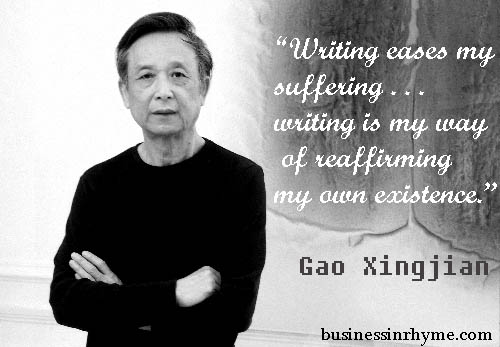
Gao Xingjian

Many of us, engaged in reading and writing are aware of transformative power of poetry, healing power and artistic value it brings to our lives. But how far does that really goes? Can you be saved by a poem?

In this enlightening interview, poet an writer Kim Rosen loudly answers, yes:

In the aha! moment that occurs when the mind bursts open—at a breathtaking metaphor or an insight or a chiming among the words—all levels of being human come into alignment. You feel a sudden integration of body, mind, heart and soul. The fragmentation that many experience in the multitasking onrush of modern life cannot withstand a good poem.

For many years she even feared poetry, thinking it was some kind of elite club, secluded for some ‘special’ and very important people. But on the verge of suicidal depression, poetry came when she most needed and literary saved her life:

In the midst of a suicidal depression, poetry poured back into my life, touching me in a way no spiritual or psychological teaching had been able to—literally saving me. The healing did not come through writing poems or even through reading them. It came when I discovered that taking a poem I loved deeply into my life and speaking it aloud caused a profound integration of every aspect of me—physical, emotional, mental and spiritual. I felt a wholeness I had never before experienced.

Further, she proposes we find a poem that really speaks to us and learn it by heart: read it loud as often as we can until it engraves somewhere deep in our soul and help flourish some better and more supportive thoughts. It can help you establish better relationship with yourself and explore sides of your being you didn’t even knew existed before. That’s what poetry does.

But what about writing your own poetry?

Dr. James W. Pennebaker, one of the most widely published researchers on the benefits of writing, says in his book, “Opening Up: The Healing Power of Expressing Emotions”, that writing about emotional topics improves the immune system by reducing

stress, anxiety and depression, improves motivation and aids people in securing new jobs.

About my own personal experience,  I wrote in this post how poetry came back into my life. And it happened to be that sacred, little place I was looking for to be only mine, that I could decorate, erase, fill, create or destroy the way I wanted. I didn’t have to offer any excuses, explanations or justifications for me being me.That kind of comfort is priceless. You learn to accept yourself just the way you are and you see that world isn’t some ugly place that want to make you miserable. It’s the way you see it and live it. That’s why I say: “Writing poetry helps me fall in love with the world, all over again!”

What are your reasons for having poetry in your life?

I didn’t trust it for a moment
but I drank it anyway,
the wine of my own poetry.

It gave me the daring to take hold
of the darkness and tear it down
and cut it into little pieces.

Lalla Ded. (Lalleshwari) (1320–1392)

Getting into the flow (creativity exercise)

csikszentmihalyi-mihaly

Probably you can recall that there were moments in your life when time seemed to stop, everything around you just froze and you were riding this wave of creativity where everything was possible; you felt like you can accomplish anything, you were so immersed in what you were doing that all of your senses were focused and sharpened on that one particular activity, and your body excluded everything else? Fun and exciting in the same time, right?

And today it might seem harder to achieve that creative bliss we are all looking for, since we are so distracted and interrupted with everything going on around us. In this TED talk Dr. Csikszentmihalyi, explains that our nervous system is incapable of processing more than 110 bits of information per second. If you’re listening to someone talking, you need to process about 60 bits of information per second in order to understand what they’re saying.

He further points out that when you are doing something with high focus, your mind don’t have enough room to process other information concerning how you feel, bodily functions or other needs. Creative people often call this as the entering the state of flow and like nothing else except what they are creating exists.

chart-state-of-flow-300x233

“The flow” graph.

So how can you enter the ‘flow’? Can it be practiced? How can we use it to improve our creative skills?

As you can see on the above graph, the state of flow is dependable on the level of skills you use and the level of challenge you pursue. The higher the challenge and the more skills we need to engage, the better chance we have for entering the sate of flow.

During his research dr Dr. Csikszentmihalyi  and his team have evaluated many people on this topic and they managed to derive  few crucial points that describe how it feels to enter the state of flow:

  1. There is complete focus and determination;
  2. There is an overwhelming joy and excitement;
  3. There is an inner knowing that task can be delivered;
  4. All worrisome thoughts disappear and they are replaced with clarity and motivation on what needs to be done;
  5. The self-awareness is concentrated on the present moment.

It’s interesting to note that this research was performed on the topic of happiness and what makes people happy. Simple answer came out to be: being creative and enjoying it as much as possible.

So how can we use these key findings and apply them to our writing? How can we practice entering the state of flow?

Here are few suggestions:

  1. Pick an enjoyable, yet challenging activity with clearly defined goal.

Since we are talking about writing you can chose to write a poem that has certain amount of words, poetic form that is new to you, story on the topic you need to do further research and inquiries – something that goes beyond your ordinary writing practice. Remember that here you need to be fully engaged and use your skills. The challenge you pick can also help you enhance your capabilities, so don’t be afraid to go overboard of your usual writing. Play with words and dictionaries, learn foreign phrases – all that helps you become more creative and inventive in writing.

  1. Remove distractions as much as you can.

Once you enter that creative flow, if something interrupts you, the harder is to go back in and continue. So clear your desk, turn off your phone and concentrate on the task at hand.

  1. Let go of any past experiences that might influence your expectations and results of the activity.

Mastering that flow mindset takes time and practice so be gentle towards yourself and monitor your emotional response. You are in control of your attitudes so if you get too excited (angry, anxious, worried), calm down and try to regain your steady levels of energy: being sluggish and bored is also a sign that you fell of the ‘flow wagon’.

  1. To spice things up – give your self a time frame:

to work on a poem, a story, a chapter, an article in a continual interval – for example 30 minutes, and give all you’ve got. Focus on your writing and you’ll see how time will past in split second.

  1. Make it a regular habit.

Getting into the flow and enjoying the activity that brings desired results takes practice, so make it a part of your daily routine. Schedule your ‘ time flow’ every day and commit to it. Not only are you working on your creativity and skills, but you are improving your mood and bringing more happiness into your life. After all, isn’t that what we all are looking for? It’s worth a try.