Need some more poetic inspiration? Sign up for a free bimonthly newsletter

Need some more poetic inspiration? Sign up for a free bimonthly newsletter

On a few occasions I wrote here on the blog, about the importance of using our own voice and our own words to deliver authenticity in writing. Well, quite the same comes when we want to express, define or articulate our ideas. In my last post I emphasized that the best originality and authenticity comes from our own interpretation of an idea and that can determine its creative potential and inventiveness.
So, today I’m proposing a little bit different approach: instead of working on your own ideas, let’s take one idea you heard about or read about in the last 72 hours, but one that you really liked and admired.
Now, try to express that idea in your own words, but use something that Ken Macrorie defined as a ‘kitchen language’: the language you would use while you are comfy on a Sunday morning, being lazy in your pajamas, when you don’t think about anything – you are just you, being relaxed at home with your coffee, simple and uncensored. You don’t have to impress anyone, or watch your words. It’s your language but not something you would usually use to make your point about something.
Once you have set your ‘comfy’ mood, using your ‘kitchen language’ write a poem about that idea you heard. It’s interesting what might come up, but that’s the point – for you to get comfortable in your own skin and your language while expressing and discussing something you really care about.
Of course being comfy and accustomed to ordinary can have its own hinders. Our everyday life can make our thoughts and words too ordinary, repetitive, and actually can reduce our richness of language and vocabulary. For the second exercise I suggest you do something quite the opposite: imagine you are 5. And you might still don’t know how to pronounce all the words – invent new ones and express that beautiful idea that captured your attention. Wake up that sleepy child inside of you and tell your story about that idea like a 5 year old would – in a form of a cute poem. We know at times children make memorable, funny statements. But as we all progress to school sometimes our language become emptier and lifeless. Well, this exercise is an attempt to fight this and experience that unforgettable writing, with all the giggles it might carry.
These exercises can dramatically shift our thinking patterns, but what will emerge with time is your unique view and interpretation of the world: one that you want to fully accept, embrace and enjoy.
Give it a try and share your thoughts in the comments below.
Be glad your nose is on your face,
not pasted on some other place,
for if it were where it is not,
you might dislike your nose a lot.
Imagine if your precious nose
were sandwiched in between your toes,
that clearly would not be a treat,
for you’d be forced to smell your feet.
Your nose would be a source of dread
were it attached atop your head,
it soon would drive you to despair,
forever tickled by your hair.
Within your ear, your nose would be
an absolute catastrophe,
for when you were obliged to sneeze,
your brain would rattle from the breeze.
Your nose, instead, through thick and thin,
remains between your eyes and chin,
not pasted on some other place–
be glad your nose is on your face!
Jack Prelutsky

Need some more poetic inspiration? Sign up for a free bimonthly newsletter.
Need some more poetic inspiration? Sign up for a free bimonthly newsletter
This is one of my favorite topics I’d liked to discuss with my students. With emerging IT technology, inevitably came a ‘cut and paste’ revolution and for many students just wanting to finish their essays and seminars looked as an easy way out.
But here we are not talking only about lower grades for lack of motivation or not doing the assignment the right way: it’s a trap that many carelessly fall into and something like that can easily become a habit. And once something like that becomes a habit, we simply forget to write and discuss ideas in our way, to use our own words and interpretation.
So one of the things that my students taught me is to respect any authentic and honest writing; a writing that comes from an independent thought process – no matter how many mistakes or “wrong views” it might hold. It’s authentic.
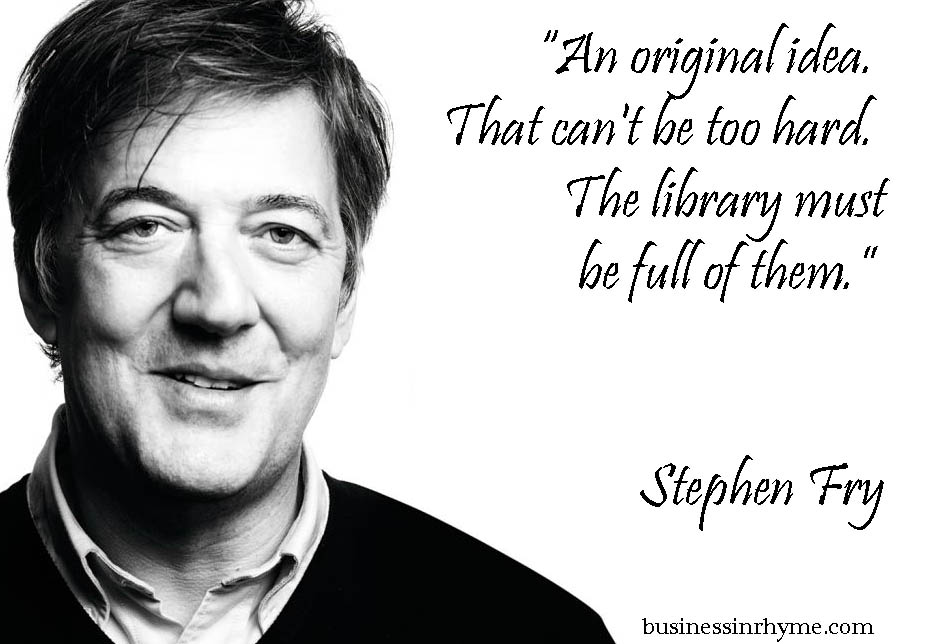
Now, too many people often simply terrorize themselves that for something to be valuable and worth reading/hearing has to be original. And the truth is, in our contemporary world where the exchange of information is at such high rate, is very difficult to produce that completely original idea, that doesn’t resemble anything else.
I remember when I was doing my masters degree project. It was a huge task, where I had to mathematically process over 1, 5 million data. It took almost a year to do it (it was 15 years ago so computers were much slower :)). And I also knew at that time that as a young scientist my chances to discover something new or make a remarkable scientific breakthrough (that many scientists before me already did) are very close to zero. And I did get results very similar to already existing. But I did it anyway. And you might wonder why? Well, it was my scientific journey, which means I did it my way. During that process I learnt a lot not only about physics, geology and mathematics, but also about myself and my own expectations. At the end, I gave my own interpretation of results and it was just tiny contribution to already vast worldly resources and databases on the topic. But this one was performed by me and that made it authentic and original in the same time. It’s been years now that I’m out of solar-terrestrial physics, but my work is still cited by many scientists.
And that’s what nowadays we need the most: more of a authenticity. Once you write something on any topic in your own words, the way you talk in your everyday life – it makes it authentic and original in the same time. So I encourage you, when ever you write, write from the heart; when you allow yourself just to be you, discarding any worry are you original, innovative, interesting, attractive enough – you become all of that. You are an original.
Writing
by Howard Nemerov
The cursive crawl, the squared-off characters
these by themselves delight, even without
a meaning, in a foreign language, in
Chinese, for instance, or when skaters curve
all day across the lake, scoring their white
records in ice. Being intelligible,
these winding ways with their audacities
and delicate hesitations, they become
miraculous, so intimately, out there
at the pen’s point or brush’s tip, do world
and spirit wed. The small bones of the wrist
balance against great skeletons of stars
exactly; the blind bat surveys his way
by echo alone. Still, the point of style
is character. The universe induces
a different tremor in every hand, from the
check-forger’s to that of the Emperor
Hui Tsung, who called his own calligraphy
the ‘Slender Gold.’ A nervous man
writes nervously of a nervous world, and so on.
Miraculous. It is as though the world
were a great writing. Having said so much,
let us allow there is more to the world
than writing: continental faults are not
bare convoluted fissures in the brain.
Not only must the skaters soon go home;
also the hard inscription of their skates
is scored across the open water, which long
remembers nothing, neither wind nor wake.
(source: poetryfoundation.org)
If you liked this post and you are interested in getting more inspiration for your creativity, sign up for our free bimonthly newsletter.
When I first started this blog, my intention was to explore the benefits that poetry can bring to the world of business; how can we become better in what we do, by improving our creativity, leadership skills, cognitive and strategic thinking, communication, tacit knowledge and ext. With time, blog evolved into something much more and deeper and on a few occasions I’ve also wrote about the transformative power of poetry.
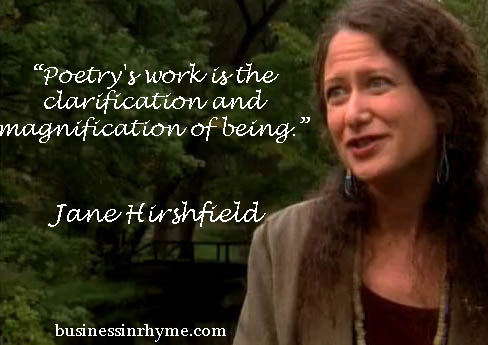
Recently, I came a cross an article, an interview with poet Jane Hirshfield where she shares her view on how poetry can help us move forward in dealing with even bigger social problems:
I think we know the world needs changing. Things are going awry left and right. I firmly believe that in our very practical, technological, and scientific age, the values of all the arts, but of poetry in particular, are necessary for moving the world forward. I’m talking about things like compassion, empathy, permeability, interconnection, and the recognition of how important it is to allow uncertainty in our lives.
One of the current great problems in the world is fundamentalism of every kind – political, spiritual — and poetry is an antidote to fundamentalism. Poetry is about the clarities that you find when you don’t simplify. They’re about complexity, nuance, subtlety. Poems also create larger fields of possibilities. The imagination is limitless, so even when a person is confronted with an unchangeable outer circumstance, one thing poems give you is there is always a changeability, a malleability, of inner circumstance. That’s the beginning of freedom.
With these beautiful words, I think she captured the true essence of poetry; its purpose and reason for existence: every poem is like taking a journey to a different world where everything is possible and we can truly chose our experiences and taste liberation in every sense.
In her wonderful book “Ten Windows: How Great Poems Transform the World.” Jane Hirshfield, further explores hidden strength that poetry holds and especially focuses on the beauty of uncertainty, not knowing everything – just enjoying to be.
And today, I invite you when you write, at least for a minute stop asking yourself questions on how, where, why – liberate yourself from any false predicaments and just be present, sink into your own being and feel your inner world; connect with your own subtle energies, where self-acceptance and self-trust takes place – you might be surprised how your reality change.
By allowing ourselves to transform our inner world, we are transforming the world around us as well.
Some stories last many centuries,
others only a moment.
All alter over that lifetime like beach-glass,
grow distant and more beautiful with salt.
Yet even today, to look at a tree
and ask the story Who are you? is to be transformed.
There is a stage in us where each being, each thing, is a mirror.
Then the bees of self pour from the hive-door,
ravenous to enter the sweetness of flowering nettles and thistle.
Next comes the ringing a stone or violin or empty bucket
gives off –
the immeasurable’s continuous singing,
before it goes back into story and feeling.
In Borneo, there are palm trees that walk on their high roots.
Slowly, with effort, they lift one leg then another.
I would like to join that stilted transmigration,
to feel my own skin vertical as theirs:
an ant-road, a highway for beetles.
I would like not minding, whatever travels my heart.
To follow it all the way into leaf-form, bark-furl, root-touch,
and then keep walking, unimaginably further.
Jane Hirshfield
If you liked this post and you are interested in getting more inspiration for your creativity, sign up for our free bimonthly newsletter.

What triggers and inspires creativity in one person is quite individually. There are a lot of factors influencing this process, but usually it is something that catches our attention, (like curiosity) and initiates that idea from which everything else begins. So today I want to invite you to pay attention to your surroundings. We all tend to sink into our own minds, thoughts drifting on their own…But focusing and paying attention to our surrounding is of great importance since it reflects our abilities to spot opportunities, and act upon them; turn that inspirational thought into something viable and move forward with our creativity.
I propose two exercises:
By following the steps and doing the exercises I propose here on the blog, you may find your creativity increase dramatically. We create and develop opportunities, but we also need to be able to recognize something that might work for us – we can train our minds to get better at this; to be more responsive to an external stimulant. It’s a sort of getting into habit to cultivate inspiration and is a sure way towards leading an inspirational life.
‘T is you that are the music, not your song.
The song is but a door which, opening wide,
Lets forth the pent-up melody inside,
Your spirit’s harmony, which clear and strong
Sings but of you. Throughout your whole life long
Your songs, your thoughts, your doings, each divide
This perfect beauty; waves within a tide,
Or single notes amid a glorious throng.
The song of earth has many different chords;
Ocean has many moods and many tones
Yet always ocean. In the damp Spring woods
The painted trillium smiles, while crisp pine cones
Autumn alone can ripen. So is this
One music with a thousand cadences.

Need some more poetic inspiration? Sign up for a free bimonthly newsletter.

Most people think that time is our most valuable asset – and in a sense it is. Once is gone, it is irreversible. We can’t make for a lost time, if something so vague and abstract can be lost at all.
Recently I turned 40. When I entered my thirties I felt excited, invigorated about the things that were ahead of me, what I can and will do. But of course not everything always goes the way we plan it and wish. Something similar happened to me in the last couple of years which I described in this post. My life was somehow always on the rush until my health warned me to slow down and pay attention to things I probably have neglected – which also meant that I needed to rearrange my plans and re-prioritize. My 40th birthday made me think about those things again. It felt overwhelming like being stuck ‘in the middle’: you are not old, but hey you entered your 5th decade and that must be something 🙂 So thoughts about how I spent my last couple of years, have I missed something, am I too late for something … began to creep in my mind again. And I must admit I was never fond of birthdays. Especially mine. As born on 31st December is like..how to describe it..it never felt like my day or special day, particularly in my childhood years. Everyone was always too busy with preparation for New Year’s Eve, my friends were busy and I with my birthday was just “lingering” there, not feeling like it belonged to me.
So this birthday turned out too be a little bit heavy too, but then I decided to write a poem about it. It’s something that my subconsciousness just expelled out of my mind and is interesting in what it resulted: You can read it bellow:
I dreaded my 40th birthday.
That was the day I truly wished there was a time machine
to reverse this number or at least
erase that rounded chubby space
behind the wall of four.
To undo all those wasted tears,
not even spilled, just dried in the corner of my eyes;
to count not years, but smiles that flooded my face
each time his touch, in slow pace traveled across my spine.
to collect less of strange, signed and approved confessions
that I can, may, want and know
and to dance more wrapped in the smoke
of my momentary desires
and just swing from one digit to another.
to admit I am good enough,
to accept this short breathing experience is only mine,
that what ever I do it will be fine.
to decide just to live, in spite of all
imposed societal thrills…
That was the day – time,
conveniently invented unit of remorse
stopped to weigh my loss
stopped to count
stopped.
After writing and reading it, I felt amazingly better. It’s like passing through a gate or reaching some sort of threshold realization that can be summarized in 4 little words: It’s never too late … to get creative, to do what you love, in a way you want to do it. You can be sidetracked, have obstacles, but unless you say it’s late, it isn’t. You can count your time the way you like it and you are old the way you feel inside – not by the numbers in your birth certificate.
With this post I want to encourage you that in what ever phase of your life you are, you can start with what ever your heart desires: to learn, to write, to teach, to play sports, to travel, to get creative…Your phase of life might influence how and where you do it, but the essence is still there, you can do it if you wish for it. You are never late and never old.
If you liked this post and you are interested in getting more inspiration for your creativity, sign up for our free bimonthly newsletter.
Need some more poetic inspiration? Sign up for a free bimonthly newsletter.
 Business in Rhyme