Exercise your creativity through poetry, part II

When you invite people to share in your miracle, you create future allies during rough weather.”
― Shannon L. Alder

In this post I intent to recommend some interesting writing exercises, but they are supposed to be done in groups. So grab some of your “pen-friends”, painted-cartoon-of-two-people-talking-for-kiki-by-katy-973x1024play together and see how can you inspire and help each other become more creative.

These exercises can be also performed in the business setting, they’re fun and can be a great way to break out of the ordinary working routine.

Inspired by discovered

Each of you, players, has to write down a rare fact about yourself that most people don’t know about (it can be a secret 😉 ) on a piece of paper, fold it and exchange it with others randomly. Caught by surprise about unknown facts you may find your own fountain of creativity! Write a poem about it and see where it takes you.

Pantomime

Let one of your friends or coworkers gesture with hands: your task is to describe what you see, what you experience and jot it down in words in the form of poem. This can be quite intriguing way of stimulating our creative capabilities, as is discussed in this article, using two hands to explain something prompts the brain to consider issues from multiple perspectives. To spice up a bit, try everything that you write to put in rhyme (in my previous post I explained the benefits of putting boundaries during our brainstorming sessions and how that can stimulate creativity further).

What’s wrong with this picture?

Visual stimulation can unleash your imagination in the most exciting ways. You can pick some random picture and each of players has to make a story in the form of poem, inspired by the picture. Afterwards, you can all debate and see whose story is the most interesting or you can take it step further and compile all stories into one: it has to be believable and follow some logical structure. It’s best suited for groups of two, three people.

With certain moderation you can use these ideas for your own creativity exercises. If you by any chance try them, share your thoughts in the comments below.

It couldn’t be done by Edgar Albert Guest

Somebody said that it couldn’t be done,
    But, he with a chuckle replied
That “maybe it couldn’t,” but he would be one
    Who wouldn’t say so till he’d tried.
So he buckled right in with the trace of a grin
    On his face. If he worried he hid it.
He started to sing as he tackled the thing
    That couldn’t be done, and he did it.

Somebody scoffed: “Oh, you’ll never do that;
    At least no one has done it”;
But he took off his coat and he took off his hat,
    And the first thing we knew he’d begun it.
With a lift of his chin and a bit of a grin,
    Without any doubting or quiddit,
He started to sing as he tackled the thing
    That couldn’t be done, and he did it.

There are thousands to tell you it cannot be done,
    There are thousands to prophesy failure;
There are thousands to point out to you one by one,
    The dangers that wait to assail you.
But just buckle it in with a bit of a grin,
    Just take off your coat and go to it;
Just start to sing as you tackle the thing
    That “couldn’t be done,” and you’ll do it.


3 tips to get your creative leadership to the next level

In the simplest terms, a leader is one who knows where he wants to go, and gets up and goes.

              – John Erskine, author 

When my mother taught me how to cook, she used to say that I should always think from the end: “prepare every pot you are going to use, preheat the oven,  go wash and cut your groceries” –  so I wouldn’t mess the kitchen cabinets with my oily, floury hands. And she was right: it shortens the time of cooking, cleaning and the stress that arise from hurry and clumsiness.

Pretty much the same is with business. Whenever we are able to envision where we want take our project or business, it’s much easier to plan the steps along the way. But in certain times, we don’t have that clarity in which way to turn, what is the desired outcome.

That process of breakthrough ideas – “envisioning” is a rocky journey, full of ups and downs, sometimes with obstacles and sometimes is a smooth sailing across the quiet sea.

Creative leadership can benefit from those bursts of innovative thinking and

Leadership concept on white background. Isolated 3D image

for the sake of project/business idea, the focus should be to emulate, produce and sustain those conditions as much as possible. Poetry as a tool can help us a lot:

  1. Follow the hunch

When the idea is still vague, undeveloped, but you have a hunch, a feeling – write a poem about it. Write about your successful project, the benefits it will bring, how you would feel after accomplishing desired results. This type of writing can stimulate positive mood and enhances your creative abilities.

  1. Combine and play

Creating something new can mean rearranging the existing parts into something different – with different order, structure, introducing new elements. To connect seemingly incompatible in new ways, we can produce something extraordinary and give answers to questions we have. Einstein called this Combinatorial Play.

You can summarize all of your ideas, mix them, connect in every impossible way – in poetry. There is no logic needed, there is no judgment, there is no need for “it doesn’t work” statements. Combine and Play:  you might be surprised with the innovative solutions you come up.

  1. Look at the big picture from a detail perspective

Creative leadership is able to recognize unexpected perspectives, keeping in mind the “big picture” – end result it wants to achieve, but pays attentions to detail, and how the change in tiny, almost invisible parts can make the whole difference.

One useful example is the story of Velcro:

In 1948, de Mestral happened upon his most enduring discovery while hiking. He and his dog returned from a hike covered in burrs from the plants along the trail. De Mestral examined the burrs under a microscope, studying their structure. He began working to develop a synthetic fastening system that mimicked the hooks and loops of the burrs.

The fabric went through a number of phases before it was finalized. De Mestral worked with a weaver in France to create hooks and loops strong and durable enough to cling together as he intended. Originally crafted from cotton, the fabric ultimately proved more successful when made out of nylon. In 1955, de Mestral unveiled his innovative new material: Velcro®. The name is a combination of the French words “velours” and “crochet,” translated to English as “velvet” and “hooks.”

source: biography.com

How poetry relates to this? While examining the world around us, analyzing ideas, exploring available resources – especially in poetry where no rational and logical thinking is required, we can accelerate our ability to see through things, how they work, connect, respond, to understand their background. It’s an unleashed creativity that process of focused logical elimination can jump-start our innovative process.

The idea by Mark Strand

For us, too, there was a wish to possess
Something beyond the world we knew, beyond ourselves,
Beyond our power to imagine, something nevertheless
In which we might see ourselves; and this desire
Came always in passing, in waning light, and in such cold
That ice on the valley’s lakes cracked and rolled,
And blowing snow covered what earth we saw,
And scenes from the past, when they surfaced again,
Looked not as they had, but ghostly and white
Among false curves and hidden erasures;
And never once did we feel we were close
Until the night wind said, “Why do this,
Especially now? Go back to the place you belong;”
And there appeared , with its windows glowing, small,
In the distance, in the frozen reaches, a cabin;
And we stood before it, amazed at its being there,
And would have gone forward and opened the door,
And stepped into the glow and warmed ourselves there,
But that it was ours by not being ours,
And should remain empty. That was the idea.


5 qualities of creative people

When we engage in what we are naturally suited to do, our work takes on the quality of play and it is play that stimulates creativity.

               — Linda Naiman

Many years spent in research and education helped me notice that:

  1. Creative people are not afraid to be childish.
  2. They tend to mix possible with impossible.Gabe-Felice-Psychic-Drawings
  3. They are curious and not afraid to go against the mainstream (follow “the rebel inside”).
  4. Often they are empathetic, emotionally challenged where through creativity they release the pain and initiate healing process.
  5. They embrace their introverted side.

Any of these traits we can emphasize and work on them. I believe we can be creative in whatever field we choose. For example, chefs are creative masters in the kitchen, and sales people or marketers are creative in coming up with strategies to build businesses. Poetry and writing in general can be a useful tool in helping us become more creative in other fields. One of the reasons I like poetry is that you don’t need anything beside paper, pencil and your willingness to commit to writing,

Poetry allows you to play with words – even invent new words which I adored to do when I was i child. I even invented a whole new language and was so proud when nobody could understand me except my best friend. By just playing with words, poetry awakens that forgotten child, loosens our rigid thinking and allows the impossible to become possible -which lead us to the second trait: in poetry we can mix and connect anything we like and you set your own rules for that. There’s no need for explanation, no judgment, just your free mind and spirit. There you can question everything, you can become or be anything you like and the thirst for excitement that comes from the feeling after you finish your little master-piece is what makes everything worthwhile. Being curios about your own capabilities is a sure thicket for more creative outlets.

And more then anything I appreciate my ME time. No in selfish way while neglecting others, but I think in order to develop better creative qualities we need to be alone with ourselves, listen what comes from inside and just let it go. All the pain, hurt, discomfort, disappointment, discontent.. just let it go. Pour your soul into your writing, without censuring anything – you’ll feel like clouds have disappeared and that you can see more clearly: who you are, what you want to accomplish and how.

When I was younger, I used to fear loneliness, why am I different, why I don’t fit in, why do I have different interests, why don’t I have more friends. But the truth is, I always appreciated more meaningful, deeper friendships, you know…people that support you, who are part of your experiences, who witnessed you growing in what you are today. And usually we have only few friends like that. And that’s Ok. It’s Ok to have a lot of superficial acquaintances as well. But being introverted and not easily fit in, can be a blessing in disguise. It can propel your work in the most exhilarating ways and let you experience the world from different perspectives – where by having to much useless encounters would make you too busy and diverted to see. So it’s Ok to be introverted – embrace it in your work and let your creative genius to shine!

Where the mind is without fear by Rabindranath Tagore

Where the mind is without fear and the head is held high
Where knowledge is free
Where the world has not been broken up into fragments
By narrow domestic walls
Where words come out from the depth of truth
Where tireless striving stretches its arms towards perfection
Where the clear stream of reason has not lost its way
Into the dreary desert sand of dead habit
Where the mind is led forward by thee
Into ever-widening thought and action
Into that heaven of freedom, my Father, let my country awake.

Increase your creative potential in 3 easy steps

The unfed mind devours itself.

              ~ Gore Vidal

Is it creativity something we are innately born with or we can improve our creative skills? I would say that some people are maybe more prone to imaginative thinking and open to new ideas, but we all are creative beings. There are key creativity dimensions like knowledge, divergent thinking (cognitive style), personality, autonomy and intrinsic motivation as authors suggest in “Creative Potential and Practised Creativity: Identifying Untapped Creativity in Organizations”. In particular, research findings suggest that domain of specific knowledge is a necessary prerequisite for effective creative functioning.

In my opinion, the difference is maybe in style and tools we use to express our creativity. One of the worst things that can happen is a creativity block that we all encounter from time to time, but there are certain tricks we can apply in order to move forward with our creative thinking.

  1. Dive in the absurd

In the paper “Connections From Kafka: Exposure to Meaning Threats Improves Implicit Learning of an Artificial Grammar” authors argue that experiencing (reading, hearing or seeing) something absurd like surreal art or literature can increase pattern

salvador-dali-abstract-painting-619-6

recognition of association unrelated to the original meaning threat. In other words, mind always tries to justify, explain what it experiences and “nonsense” art forces mind in faster mode of thinking to recognize what body senses.

So next time you feel uninspired, give your attention to something abstract, surreal (painting, poem, novel) and let you mind drift, loosen up from everything you were trying to accomplish. Let your mind “recharge” this way.

  1. Limit your self on purpose

This might sound strange at first but when you think about it- it might be true. Often we try to find the solutions to new problems by exploring already familiar models and build our new denouement on old foundations. Furthermore, when we have to many options or resources, we try to incorporate everything and unnecessarily over-complicate solution we are seeking. When we put restrictions on what we can use and what path we should follow, it can actually boost our creative thinking. Here I suggest you improvise a bit with your solution, tackle it from different perspective and simplify your approach. It can be that final “click” you need in your mind to move thinking in right direction.

3. Play with “what if” clause

Then, return to your problem and try to look at it from  “What would happen if…. ?” point of view. According to the research, presented in paper Implications of Counterfactual Structure for Creative Generation and Analytical Problem Solving: 

additive counterfactual thinking mind-sets, activated by adding new antecedent elements to reconstruct reality, promote an expansive processing style that broadens conceptual attention and facilitates performance on creative generation tasks”

It’s a great way for creativity “spikes” that we all need when we feel stuck and lack ideas.

These were 3 easy steps that can help us ignite our creative imagination. What do you do when you feel uninspired? Please share your thoughts in the comment section below.

Mobius Strip by Robert Desnos

The track I’m running on
Won’t be the same when I turn back
It’s useless to follow it straight
I’ll return to another place
I circle around but the sky changes
Yesterday I was a child
I’m a man now
The world’s a strange thing
And the rose among the roses
Doesn’t resemble another rose.


Diversity at workplace: how to use poetry for improving communication and intercultural differences

Diversity: the art of thinking independently together.
~Malcolm Forbes

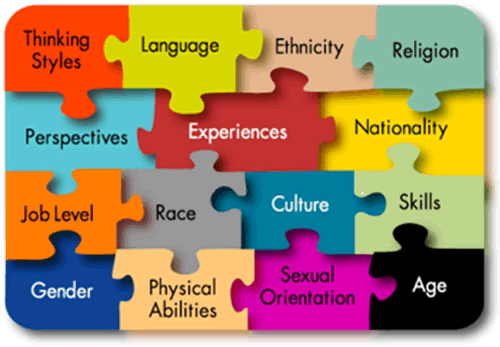
For many years I had the opportunity to live in the Hague, the Netherlands and it is one of the most diverse cities, where cultures, ethnicity, religion and human rights mix together, forming a unique atmosphere and living diversityconditions. Diversity is a major topic and I’ve been always intrigued to which extent it governs our everyday life – especially if we work and live in diverse community.

There is a variety of differences that can exist among people within one  organization. In the Forbs recent article, it states:

In addition to creating a workplace inclusive of race, gender, and sexual orientation (to name a few), many organizations are seeking value in something even simpler, diversity of thought. In some industries that are known for being insular – think law or high-tech companies – seeking out talent with different thinking and problem solving backgrounds is critical.

It is very important issue since it influences how we perceive ourselves and others. And as with every other issue, this one can have advantages and drawbacks that can affect our work life.

Some of the positive things might include different points of view, greater adaptability to changing conditions and a larger scale of skills and experiences within the organization. But often there are communication problems that can distract smooth interactions among the coworkers – which is prerequisite for timely and effective execution of projects. Ways and manners of managing diversity at workplace has become a hot topic and a lot of tools have been developed in order to bridge cultural gaps that diversity brings.

In the paper “Use of Poetry to Facilitate Communication about Diversity: An Educational Model”, authors suggest that we can effectively use poetry as a tool to facilitate communication channels among diverse and culturally challenged groups. They propose a workshop (that they tested in the following example) where the main materials for discussion are different poems from ethnically diverse poets and poems that relate to women’s issues.

Proposed workshop would begin with selecting a burning diversity topic that participants would like to discuss. Workshop facilitator afterwards chooses a poem congruent with issues that arose and a volunteer would read a poem. Participants in the group later discuss and talk about the poem.

Afterwards, participants would write their own poems, while they were also encouraged to read their poems in front of the group with the follow-up conversation. The workshop would end with the creation of collaborative poem, in which each member of the group was invited to contribute with one or more words.

Proposed time of the workshop: 3-4 hours, depending on the number of participants.

Workshop resulted in increased innovation, independence, self-discovery, sharing opportunities and collaboration. To measure these results, the Group Environment Scale was used to assess workshop effects on group dynamics.

According to the workshop feedback many participants adopted increased understanding of how gender and cultural issues may affect others.

Authors final conclusion is:

The research findings seem to indicate that the model’s interweaving of cognitive and effective elements has potential for creating changes among the individual’s perception of other cultures….metaphor can be especially instrumental in achieving this integration.

What are your thoughts on diversity, equality and inclusion? Can poetry be of any help?

Also have in mind beautiful words by Maya Angelou:

Human Family

I note the obvious differences
in the human family.
Some of us are serious,
some thrive on comedy.

Some declare their lives are lived
as true profundity,
and others claim they really live
the real reality.

The variety of our skin tones
can confuse, bemuse, delight,
brown and pink and beige and purple,
tan and blue and white.

I’ve sailed upon the seven seas
and stopped in every land,
I’ve seen the wonders of the world
not yet one common man.

I know ten thousand women
called Jane and Mary Jane,
but I’ve not seen any two
who really were the same.

Mirror twins are different
although their features jibe,
and lovers think quite different thoughts
while lying side by side.

We love and lose in China,
we weep on England’s moors,
and laugh and moan in Guinea,
and thrive on Spanish shores.

We seek success in Finland,
are born and die in Maine.
In minor ways we differ,
in major we’re the same.

I note the obvious differences
between each sort and type,
but we are more alike, my friends,
than we are unalike.

We are more alike, my friends,
than we are unalike.

We are more alike, my friends,
than we are unalike.


Can we improve our decision making skills?

Choices are the hinges of destiny.

Edwin Markham

In my previous post I wrote about how effective strategic thinking is essential for any project. And today, I go a step further, discussing the importance of developing skills for good decision making.shutterstock_104922425

Looking back, when I was younger – it seemed that making decisions went much easier comparing to my later life events, where contrary to the popular belief – “older and wiser” – indecisiveness crept into my mind. And it takes me much more time, energy, thinking, “measuring” what’s the best thing to do – in every given situation. Apparently, when we have a spectrum of different life experiences sitting in our memory, it can influence a lot our way of thinking and generally our willingness for risk taking.

Successful decision-making can be derived in 4 crucial elements:

  1. Ability to recognize the problem
  2. Possible scenarios to solve the problem
  3. Identifying one that will move us closer to the solution
  4. Make that solution happen, e.g. make decision.

In order to take perspective of all manageable scenarios we try to gather as much possible information and sometimes just get lost in between rational and irrational thinking. Intuition can be a great support, but also a misleading – the key is to find a balance and know when it’s time to take action.

In one of the recent studies, conducted by global creative agency Gyro and The Fortune Knowledge Group, it has been shown that emotion plays a huge part in executive decision making. After surveying 720 senior-level executives in the spring of 2014, study found that nearly two-thirds (65%) of executives say subjective factors that can’t be quantified (including company culture and corporate values) increasingly make a difference when evaluating competing proposals. Only 16% disagreed.

Successful people usually don’t know everything. They go forward, with their eyes fixed to the prize and ready to “jump off the cliff” – regardless of is there a net beneath to catch them.Their wings might be just strong enough to get them on “the other side”.

And next time you struggle with indecisiveness, read this poem by Robert Frost – it helps me every time:

Two roads diverged in a yellow wood,
And sorry I could not travel both
And be one traveler, long I stood
And looked down one as far as I could
To where it bent in the undergrowth;

Then took the other, as just as fair,
And having perhaps the better claim
Because it was grassy and wanted wear,
Though as for that the passing there
Had worn them really about the same,

And both that morning equally lay
In leaves no step had trodden black.
Oh, I kept the first for another day!
Yet knowing how way leads on to way
I doubted if I should ever come back.

I shall be telling this with a sigh
Somewhere ages and ages hence:
Two roads diverged in a wood, and I,
I took the one less traveled by,
And that has made all the difference.


Can poetry help you become a better strategist?

You have to be fast on your feet and adaptive or else a strategy is useless.

               – Charles de Gaulle

Strategic thinking at its core is a careful planning process where project or business idea is directed in such a way that it has a greater chance for successful, desired outcome. It usually applies innovation, especially in the operational processes.

thinking

It’s true we can learn a lot from our past experiences, but we shouldn’t build our future strategic foundation merely on that, but rather considering how to create a value for customers, long-term contribution. And strategic planning helps us analyze and put in perspective the “how” and “when” in our business applications. It requires a dose of creativity and innovation where mixed with our current knowledge is a winning formula for successful strategy. It serves us as a framework for decision making – namely about direction of the business and resource utilization.

This is about strategic thinking seen form a managerial point of view. But what happens on the more subtle levels, when we try to conceive new strategy, innovative approach to an old problem?

C.K. Prahalad and Gary Hamel suggest in one of their papers that in order to be a successful strategic thinker, you must be aware of the competitive environment, have grasp of the future and be able to motivate others to practically do the same: share the view of the big picture.

In the article “How strategists really think” Giovanni Gavetti and Jan W. Rivkin argue that the reasoning by analogy plays a crucial role in the successful strategic thinking. In the example they’ve given in the paper, you will see how Intel chairman Andy Grove came up with an important business strategy:

In the 1970s, upstart minimills established themselves in the steel business by making cheap concrete-reinforcing bars known as rebar. Established players like U.S. Steel ceded the low end of the business to them, but deeply regretted that decision when the minimills crept into higher-end products. Andy Grove, seized on the steel analogy, referring to cheap PCs as “digital rebar.” The lesson was clear and Intel soon began to promote its low-end Celeron processor more aggressively to makers and buyers of inexpensive PCs.

Our brain frequently uses metaphors in order to compare experiences, make choices, decisions, exclude or include certain things from desired experience –  somehow it guides our conclusive thinking. In our minds we form one set of conditions analogous to another from which we derive great idea for action.

The mind of a good strategist needs to have an intellectual flexibility, a sort of adaptation mode which enables him to come up with the best possible solutions to challenging situations. It’s interesting that by reading poetic metaphors, using them for better understanding of the world around us we enhance our own capabilities of envisioning possible scenarios in every given situation; it helps us train our thinking in a way that from the given conditioning we can set the course of future development in the most favorable direction for us.

And as Emily Dickinson pointed in her poem Life:

 The brain is deeper than the sea,
For, hold them, blue to blue,
The one the other will absorb,
As sponges, buckets do.

The brain is just the weight of God,
For, lift them, pound for pound,
And they will differ, if they do,
As syllable from sound.


Excercise your creativity through poetry, part I

Creativity is not the finding of a thing, but the making something out of it after it is found.”

— James Russell Lowell

This post will not be reflective as the previous one, but rather fun and entertaining (I hope 😉 )

I ‘ve always been fascinated by the facts how mind works and its crcreateeative processes. Words and language are the tools we mostly use to express ourselves and it comes so naturally to us. In the same fashion, I believe that words and language can be our igniting spark to initiate creative thinking. And what about using words and language in different, innovative way? It can be beneficial for us in any case of creative process and problem solving. So here today I will share some of my ideas and little exercises I practice to start creative juices flowing.

React to given act

Remember Newton’s Third Law in physics? Every action has a reaction. That’s simply how Universe works. Thus, use the following statements to imagine a dramatic situation – express emotions, describe scenery, what each of your senses feel and try to write your story or poem. It’s a refreshing activity and your untamed imagination and power of visualization will move your creativity in positive direction.

Example statements:

You woke up alone, hurt and wet on the sand beach. What happend to you?

You heard a noise on the stairs, behind the closed door. What made that noise?

A smiling child runs into you. How do you react?

A crowd has gathered below your window. What do they want?

You are in the unknown country: nobody speaks your language, nobody understands you. How do you communicate?

The moment

Whenever you feel lack of inspiration, go back to some pleasant moment in life – something nice that you experienced for first time like first bike ride, first swim, first love, hanging out with friends, moments from your travel: those special events in your life can be an inexhaustible source of emotions for a touching poem. Re-living the moments again reconnects you with your true nature and helps you get that intensity you need to move forward with your thinking and creativity.

Acrostic alphabet

Write a poem, where the first letter of the verse in the poem spells out a word you choose, subject, message. You can go even further: write a poem where each starting letter of the line is a consecutive letter of the alphabet, from a to z.

In poetry it is called acrostic technique and poets frequetly use it while experimenting with their own writing.

Below is an example I did using acrostic technique:

Acrostic allowed animated alignment:

Bright blue bird borrows beatiful barn

“C’mere!” – Coherently cried crow, crawling cowardly!

Windy waves widely warned

X-rated xylophone:

“Yuck”- yawned yak

Zoological zodiac zen.

It’s funny what can really come out – no matter how quirky it might look and sound. Fun and humor are those additional spices that make the process of creativity even more enjoyable!

And when questions like what…? and how..? begin to bother you, remember the answer below:

O Me ! O Life! by Walt Whitman

O ME! O life!… of the questions of these recurring;
Of the endless trains of the faithless—of cities fill’d with the
        foolish;
Of myself forever reproaching myself, (for who more foolish than I,
        and who more faithless?)
Of eyes that vainly crave the light—of the objects mean—of the
        struggle ever renew’d;
Of the poor results of all—of the plodding and sordid crowds I see
        around me;
Of the empty and useless years of the rest—with the rest me
        intertwined;
The question, O me! so sad, recurring—What good amid these, O me, O
        life?

                               Answer.

  That you are here—that life exists, and identity;
  That the powerful play goes on, and you will contribute a verse.