Embrace your broken parts: each wound, each hurt, each pain
is just a new crack on the wall of your soul pouring more of your
inner light to shine bright.
Is there anything more beautiful than that?
Maja S. Todorovic

Embrace your broken parts: each wound, each hurt, each pain
is just a new crack on the wall of your soul pouring more of your
inner light to shine bright.
Is there anything more beautiful than that?
Maja S. Todorovic
The way I slept naked on the floor;
The way I hid myself from the sun;
The way I ate uncooked food with my bare hands;
The way I flossed my teeth three times a day;
The way I laughed at your stupid jokes;
The way I adored your razor-blade thin smile;
The way your huge hands held me around my waist
is the way I loved you.
And still do.
Maja S. Todorovic
Need some more poetic inspiration? Sign up for a free bimonthly newsletter.
One of the things I like to do in my leisure time is to brows some very interesting online literary magazines as it helps in my inspiration but I also like to be informed about the newest trends in literature and writing styles.
As a result of my research I managed to compile a list of 9 magazines that pretty much on regular basis accept submissions for new poems and prose, and of course you might find some of them interesting in your publication process.
So here it is:
1.Hootreview. This is maybe one of my favorite. They focus on a micropoetry and microfiction, giving a real chance to aspiring writers.
2.32poems. They accept unsolicited poetry year round and also simultaneous submissions. As a rule, preference is given to shorter poems that fit on a single page (about 32 lines). For more visit their guidelines page.
3.Aleola journal of poetry and art.
This journal of poetry and prose was created to preserve the vanishing species known as “enjoyable poetry”. Ours is not the poetry or fiction enjoyed by connoisseurs of modernism today, filled with inexplicable juxtapositions of meaningless words that leave the reader feeling confused, fatigued, and overcome by a vague ennui. No; the sole requirement for our poetry and prose is that it expands the mind, captures the interest, and can be enjoyed by the average reader. We welcome nature poems, imagistic poetry, humor, and literature that tells a story.
4. Allegro poetry magazine aims to publish the best contemporary poetry. March and September issues are for general poems and June and December for poems on a set theme. It is a UK based online magazine, published four times a year.
5.Knot magazine is currently accepting submissions for fall issue. They have a large spectra of poetry genres included. Worth checking it out.
6.Juked. In publication since 1999, this is an independent journal that appears online as well as in annual print issues. They don’t adhere to any particular themes or tastes and are fond of aspiring writers 🙂
7.Rattle. This magazine accepts submissions all year around and if your are into translating poems – this is a place for you.
8. Thrush. If you like to experiment with your writing and flirt with unusual, thrush journal is one of the best publication references you can get:
Our taste is eclectic. We want poems that move us, a strong sense of imagery, emotion, with interesting and surprising use of language, words that resonate. We want fresh. We want voice.
Established and new poets are encouraged to submit. Experimental poetry is fine, randomness is fine also. However, we do not want experimental and random just for the sake of calling it such. No long poems. We prefer a poem that will fit on one page. We are not interested in inspirational poetry or philosophical musings.
9. Contrary. As the name of the journal says it deals with contrary issues, thoughts, attitudes, questions…Publishes 4 times a year and new, summer cycle is open until June 1st. Don’t miss this opportunity, on the contrary! 🙂
I hope you find this list interesting and it helps you in your publishing journey.
If you liked this post and you are interested in getting more inspiration for your creativity, sign up for our free bimonthly newsletter.
We travel, come here the same
in fragile teary, pink skin
with jelly bones and hungry eyes.
Yet, each stay differs
makes us wonder:
“How did I board a wrong boat?”
Maja S. Todorovic

Need some more poetic inspiration? Sign up for a free bimonthly newsletter.

Need some more poetic inspiration? Sign up for a free bimonthly newsletter.
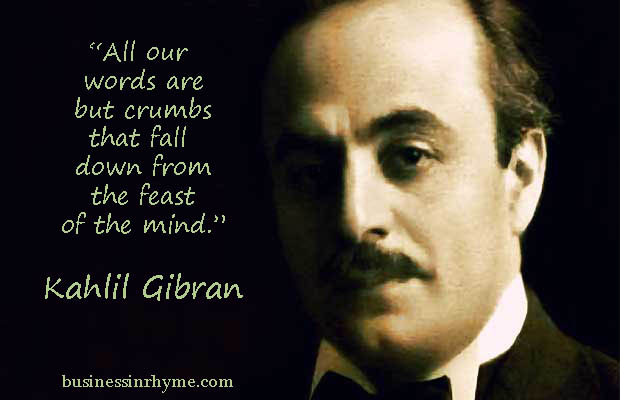
Kahlil Gibran, born in Lebanon, was a poet, artist, philosophical essayist and a novelist,who emigrated to New York in 1885. His work, written both in Arabic and English was very much influenced by the European modernists of the nineteenth century, with deep mystical, philosophical and spiritual understanding of the world.
Gibran had simple, yet direct style and he used writing to liberate himself; to portrait immigrant life of his family and topics relating to alienation, disruption, industry that eats natural beauty – were often present in his work. For him, poetry was an ideal vehicle to transcend the feelings of emptiness, longing and a way to communicate most intimate desires:
Poetry is a deal of joy and pain and wonder, with a dash of the dictionary. Trees are poems the earth writes upon the sky, We fell them down and turn them into paper, That we may record our emptiness.
How we experience the world around us and allow our mind to make it’s on meaning and relations, that’s how our language is going to be:
All our words are but crumbs that fall down from the feast of the mind.
He also recognized that without innate feeling and sense of love, all our efforts in any life direction are simply futile. In his, maybe the most popular piece “The Prophet” (1923) in 26 prose poems he discusses and shares his view on most intriguing topics of human kind, ranging from marriage, laws and friendship to the meaning of work, punishment, pain and joy. Even though it wasn’t seen as a piece of distinct value among American critics, it achieved cult status among American youth for several generations.
For Gibran work equals love:
And all urge is blind save when there is knowledge,
And all knowledge is vain save when there is work,
And all work is empty save when there is love;
And when you work with love you bind yourself to yourself, and to one another, and to God.
And what is it to work with love?Work is love made visible.
And if you cannot work with love but only with distaste, it is better that you should leave your work and sit at the gate of the temple and take alms of those who work with joy.
For if you bake bread with indifference, you bake a bitter bread that feeds but half man’s hunger.
Once we fuel our work with passion and love, it’s much probable that we will achieve our goals. And there is nothing more joyful, than the alignment of our values, passions and purpose. Than work is not just work. It becomes eager part of life, intentional and deliberate living, bringing meaning to all aspects of our lives.
If you would like further to explore similar topics, I recommend:
If you liked this post and you are interested in getting more inspiration for your creativity, sign up for our free bimonthly newsletter.

 Business in Rhyme