
Need some more poetic inspiration? Sign up for a free bimonthly newsletter.

Need some more poetic inspiration? Sign up for a free bimonthly newsletter.

Since our creativity can be unpredictable, often times we can find ourselves having that huge idea, but still not managing to record all details, write everything down without losing a bit of it.
So today, I want to to share with you my impressions about little tool I use regularly to brainstorm a problem, or a project idea that I have found to be quite helpful. It’s mind mapping – with a twist. Probably most of you are aware of this technique but as the old Latin proverb says, “Repetition is the mother of all knowledge.” Mind mapping can help you become more creative, train your visual thinking, memory, and solve problems more effectively.
The basic notion behind this technique is to visually capture, connect and sort out information, or even get a great amount of information under control in order to generate new and fresh ideas.
The process is quite simple:
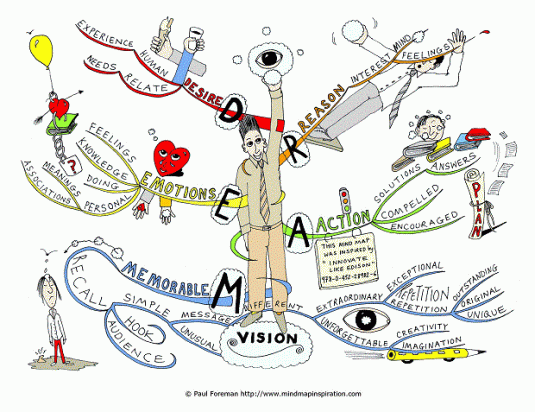
Instead of dry listing topics and ideas, with the words and phrases you chose, give your map a rhythm, lyrical note. Use adjectives, describe emotions related to your idea, expectations, why is it important. Imagine you are writing a concrete poem for example.
In this manner, your project will become more vivid and real to you. You are actually mapping your visualization, through words giving your senses the chance to “live” everything in your mind. By “breathing” in that emotion with your words, positive energy, you become more eager to put everything in work and apply solutions you came up with. It’s fun and interesting way to brainstorm every time you need more clarity and focus.
Now, this technique can be used for writing actual poems, novels and books (great as a storytelling technique as well) , but it can help you even in your vacation planning and job search.
What do you think? Worth a try? Please share your thoughts in the comments, below.
If you liked this post and you are interested in getting more inspiration for your creativity, sign up for our free bimonthly newsletter.
Starts with the a drop, hardly visible to human eye;
migrating through phases, changing shape, evoking sounds.
From below and from above together
becoming river; running unmercifully through
heavy stones and soft sands:
it’s a burble in the nearby forest
sometimes is a messenger of a tempest, cobalt-sparkling weather
when at last, becomes an ocean
remarkable and vast, yet infallible and modest
the giver of life, the purpose of any notion.
Maja S. Todorovic
Need some more poetic inspiration? Sign up for a free bimonthly newsletter.
It had a triangular shape – reminded me of a miniature souvenirs you would find on the crowded streets of Cairo..But it was light as feather, as a snowflake resistant to melt on my fingers. It had the color of sinking west Sun. The skin was crisp and fragile. I played with it in my hand for a while. It’s cookie like any other cookie you are eager to eat. But this one, instead of delectable white, sweat cream hid just few words I was reluctant to read.
Everybody believed:
The truth, curled in this little floury shell is just waiting to hatch out like a baby lizard from its egg, wanting to develop into u full grown destiny, a path that is a head of me?
“It’s a game, just a game!”…everybody cheered around me, but I didn’t hear their voices any more. From that moment I knew:
There is only one writer
of the unfolding book
of my life.
Maja S. Todorovic

Need some more poetic inspiration? Sign up for a free bimonthly newsletter.
Borealis bright,
counterpart,
deactivated:
encounter in between invisible lines
fragile in the morning with
glandular geomagnetic particle osmosis.
He likes rainbow, but
I, there is no I in threesome.
Journey to the fake space Odyssey during
Kp>7!
Longitudinal or Latitudinal?
Mmmmmmmm…
Nada! Usted comprendes nada!
Olive skin you get under:
trying to satisfy stormy weather.
Ultrasound inspection just under my feet acquiring
velocity of the Northern lights:
We need to be there tonight to
X-ray previously charged love.
You and I, preforming the language of stars,
zip-locked by sparkling green stain in the sky.
Maja S. Todorovic

Need some more poetic inspiration? Sign up for a free bimonthly newsletter.

Hermann Hesse’s life and literary quest was always preoccupied with constant search for meaning of life and faith. He was born into a Protestant-Pietist family of missionaries, preachers and theologians, but somehow Christianity didn’t offer him answers he was looking for. Soon, very much influenced by Hinduism, Buddhism and Taoism, he developed his own notion that humanity actually belongs to some kind of Universal truth that goes beyond any religion and metaphysical explanation. In most of his work, especially in his spiritual poetry he always emphasized the importance of living in the now: on letting go and finding contentment within ourselves.
Whenever in doubt, he invites us to look in nature, observe the flow of life that goes around us and how we are part of that life. It is upon us to say yes to life, to affirm that we are part of some eternal life force and intelligence bigger than us; that we need to trust life and ourselves.
He writes:
Trees are sanctuaries. Whoever knows how to speak to them, whoever knows how to listen to them, can learn the truth. They do not preach learning and precepts, they preach, undeterred by particulars, the ancient law of life.
A tree says: A kernel is hidden in me, a spark, a thought, I am life from eternal life. The attempt and the risk that the eternal mother took with me is unique, unique the form and veins of my skin, unique the smallest play of leaves in my branches and the smallest scar on my bark. I was made to form and reveal the eternal in my smallest special detail.
A tree says: My strength is trust. I know nothing about my fathers, I know nothing about the thousand children that every year spring out of me. I live out the secret of my seed to the very end, and I care for nothing else. I trust that God is in me. I trust that my labor is holy. Out of this trust I live.
When we are stricken and cannot bear our lives any longer, then a tree has something to say to us: Be still! Be still! Look at me! Life is not easy, life is not difficult. Those are childish thoughts. Let God speak within you, and your thoughts will grow silent. You are anxious because your path leads away from mother and home. But every step and every day lead you back again to the mother. Home is neither here nor there. Home is within you, or home is nowhere at all.
So the tree rustles in the evening, when we stand uneasy before our own childish thoughts: Trees have long thoughts, long-breathing and restful, just as they have longer lives than ours. They are wiser than we are, as long as we do not listen to them. But when we have learned how to listen to trees, then the brevity and the quickness and the childlike hastiness of our thoughts achieve an incomparable joy. Whoever has learned how to listen to trees no longer wants to be a tree. He wants to be nothing except what he is. That is home. That is happiness.
~ Hermann Hesse, Bäume. Betrachtungen und Gedichte
Life is not good or bad. It is what it is. If we dislike something it is mirrored part of ourselves that we don’t like.
If you hate a person, you hate something in him that is part of yourself. What isn’t part of ourselves doesn’t disturb us.
When it comes to writing, if it is something we really want to do in life, we will find the way to work for us. Once we recognize that we have that gift to share with world, gift and value of our own vulnerability, that we accept and admire it with all virtues and flaws – that is real happiness. Words can be seen as our proof of existence and how we use them makes the whole difference.
“You must find your dream, then the way becomes easy. Happiness is a how; not a what. A talent, not an object. Without words, without writing and without books there would be no history, there could be no concept of humanity.
In the following poem I think that Hesse so vividly and accurately in the same time managed to capture the notion of happiness and why we are all during our lives so allured with it:
Happiness
If luck you chase, you have not grown
enough for happiness to stay,
not even if you get your way.
If, what you lost, you still bemoan,
and grasp at tasks, and dash and dart,
you have not known true peace of heart.
But if no wishes are your own,
and you don’t try to win the game,
and Lady Luck is just a name,
then tides of life won’t reach your breast
and all your strife
and all your soul will rest.
I hope that his thoughts will help you and inspire you in your further creative endevours. You can complement this reading with Mark Strand’s take on creativity, what writing haiku can teach us and little tips on how to develop your own mindfulness practice.
If you liked this post and you are interested in getting more inspiration for your creativity, sign up for our free bimonthly newsletter.

Need some more poetic inspiration? Sign up for a free bimonthly newsletter.
 Business in Rhyme