Poetic inspiration: The length of writing

poetry_emotion

Count your words by

the strength of emotions they

evoke, not by

numbers.

Maja S. Todorovic


If you liked this post and you are interested in getting more inspiration for your creativity, sign up for our free monthly newsletter. For additional tips, follow us on twitter and connect with us on facebook .

7 actionable strategies to attract more readers to your poetry blog

strategy_poetry_blog-2

Did you know that the roughly estimate of number of blogs on the Internet is over 150 million?

And no doubt we as writers do want to find new, interesting ways to attract readers and popularize content. To cut through all that noise of useless information, spam, adverts…it comes especially hard for poetry blogs, since traditionally we are more accustomed to read poetry in books and magazines. But more and more social media networks like Instagram are taking place and becoming a great resource for finding fresh and inspirational poetry – and you do want to take advantage of that.

Today I want to share with you some actionable ways that I have observed to work (especially for some popular poetry blogs here on the wordpress.com platform) and you can easily apply in your blogging scheme to attract more readers. But first of all, be aware that it takes time and persistence. Many of the high visited and read blogs are ‘in business’ for years and their success didn’t happen over night.

  1. Analyze the direction of your blog and readjust your writing sails accordingly

Focus of the blog: do you post only poetry or do you blog also about personal stuff, writing tips, non-fiction articles, ext? Analyze your stats and see which of your posts are most visited and popular. It will give you a clue to what kind of topics are your readers most attracted. If they are not poetry related, than you might need to readjust your focus that dominant part of your writing is poetry. Initially you might lose some of the subscribers, but always keep in mind why do you blog and who you would like to read your blog. Shape your writing according to that.

  1. ‘Poke’ other bloggers

I do believe that the intricate purpose in every blogging attempt is connection and sharing. Link with other bloggers with similar affinities.

That can go by:

  • participating in conversations on other blogs (like comments), which will divert attention to your blog and content as well;
  • offer some type of collaborative work (writing a collaborative poem, story, initiating a challenge or a guest post);
  • interact with your readers – always respond to comments as it is the basis of building the trust between you and your reader – you are increasing the likelihood of reader to share your content/poem.

One of the biggest features in blogging in last couple of years is that this the era of engagement and there you should pour most of your energy. Engage your readers and with your readers in any form – it’s the key to attracting more traffic.

  1. Go visual, where applicable

Poetry is about beauty of language and words – we should never forget that. For traditional blogging format, I still believe that accent should  be on the background and space that allow words to pop up. But blogging trends are changing and you might want to stir up things by pairing your words with adequate visuals which can contribute to your poetry to become even more appealing to the reader.

As I mentioned, Instagram is fostering some great poetry networks and communities. Share your work in the form of engaging photos, videos and you are opening the doors to completely new type of readership.

  1. Post regularly

Google loves fresh, unique and interesting content so update your blog frequently. People will have more reasons to come back, read and share your poetry.

  1. Share your poetry on different poetry platforms

Allpoetry.com and poemhunter.com are useful resources for you to publish poetry especially as a newbie blogger and poet. You can get very good feedback for your writing and increase exposure of your work.

  1. Share your publishing progress and success

This I find especially important if you want to connect with other poets in the blogosphere as sharing your experience can impact and give additional inspiration to other poets when it comes to submitting their work.

  1. Be you – everyone else is already taken

Poetry offers unique experience so your writing will attract unique readers. Most of the tips given here are proven to work, but at the bottom of the line there are no strict rules what grows one blogs – especially when it comes to poetry.

Be yourself and enjoy your creative process – these are the two most important merits. From that space of trustful and peaceful enjoyment , your work will find most intriguing ways to captivate your readers.

Do you have any interesting strategy for attracting more readers to your poetry blog? Please share in the comments below.


If you liked this post and you are interested in getting more inspiration for your creativity, sign up for our free monthly newsletter.

Poetic inspiration: Write every day

writing_every_day

Make a pact with yourself that you will write

every day – not because you don’t know how to write,

but simply for learning to love and enjoy your words – no matter

how distant, fake or fade

in the beginning they may stray.

Maja S. Todorovic


If you liked this post and you are interested in getting more inspiration for your creativity, sign up for our free monthly newsletter.

Poetic inspiration: just let go..

writing_past

This is a quick reminder that you can any event treat as an opportunity for expanding your awareness. As a writer, every detail of your life you can turn into a most beautiful story, novel or a poem. And from there new worlds emerge. That’s how powerful is writing.


If you liked this post and you are interested in getting more inspiration for your creativity, sign up for our free monthly newsletter.

6 savvy ways to fulfill your writing goals

 writing_goals

As we’ve already entered the nanowrimo writing month, many of you’ve probably committed to this writing goal which is not easy to achieve. There are many strategies you can employ in order to do that. I particularly in this article shared some of the tips how to stay on the top of your creativity during the day and how to find time for writing in our hectic lives. Today I will share some additional tricks that occasionally have helped me to sustain with my writing and get things done.

  1. Write down your goal

Instead of just thinking about your goal, write it down. Write in bold and strong letters what is it you want to achieve. Write it on a card that you can place in your wallet and see it frequently or make a screensaver for your phone and computer where would popup randomly as a reminder. Once you write your goal down and read it several times a day, you are stating and giving life to what you want to do. It becomes an ingrained part of your thinking and subconsciously you are already pushing things towards fulfilling your set intention.

  1. Set achievable benchmarks

If your goal is writing 50 000 words in 30 days, it does look and sound scary. But we must keep in  mind that most of our goals are comprised of smaller doable steps. We don’t have to know everything at the beginning of our writing journey. For us is important to break our desired milestone in daily benchmarks and work from there. In this case, you might set your writing goals to achieving writing 1500 and 1700 words a day. You can continue to cut it in even smaller chunks, like writing 500 words in the morning, afternoon and evening. Some days you will write more or less, but this benchmarks are a great way for you to follow your progress.

  1. Meditate towards writing

Besides having enough time, finding concentration and focus are additional factors that contribute to achieving our writing goals. We need to free our minds of cluttering thoughts and useless information in order to stimulate creativity. One good habit to practice is to set a side 5 to 10 minutes for peaceful meditation that will help you get in the writing mode. Sit comfortably, with your both feet placed firmly on the ground with spine, neck and head aligned and simply begin to breathe in rhythmical motions. Think of what you would like to write, what is that part of the story that simply needs to be to told, that has to get out of you.

In the beginning you might struggle and feel uncomfortable, but if you trust the process and continue to practice, you will find ideas coming easily to you, your writing will become more consistent and less stressful.

  1. Use writing prompts to stir up your imagination

Use writing prompts into your advantage to stir your thinking and help you get started with writing. It doesn’t matter if they have nothing to do with your writing theme – use them to break the initial barriers for writing and spark ideas for your story or other written assignment.

  1. Use available non-writing tools

This has become quite handy in my case. Many times, during walk, shopping or commute I get an idea which I can easily forget if I’m in distracting environment (like street or train). I don’t have always an opportunity to write them down, so than I try to use voice recorder (that I believe most of smart phones have today) to do the work for me. It can be just a phrase, or few words that will be my reminder for the initial idea, poem or story plot.

  1. Celebrate your achieved goals.

Think of interesting  and fun ways you will reward yourself after achieving desired goals. As you walk each step on your writing journey, remember your vision and how it will make you feel once you hit the biggest benchmark – like writing 50 000 words in 30 days. Sustain that emotion during the writing process and use it as motivational fuel each time you feel discouraged or lack inspiration. You are your best support and biggest writing fan. You deserve it.


If you liked this post and you are interested in getting more inspiration for your creativity, sign up for our free monthly newsletter.

Poetic inspiration: Writing is like playing sports – it takes practice

poetic-inspiration-new-poems

I often play

basketball

with words

in my head:

the one that scores,

ends up on paper.

That’s how my new poems are born.

Maja S. Todorovic


If you liked this post, please share! And if you are interested in getting more inspiration for your creativity, sign up for our free monthly newsletter.

A comprehensive guide to developing a lasting writing practice

writing_guide_practice

We all in the beginning have a motivation to start a new habit: we are pumped up, ready to take on that challenge we set for us and stick to it – being that healthier eating, exercise regime or writing habit. And then, after couple of days/weeks our motivation starts to wane, something comes up that distracts us or it takes more of our investment than we anticipated and what happens next? We are back, indulging in social media and TV instead of working on ourselves.

Having a lasting writing habit is like any other habit. Once it becomes ingrained in your subconsciousness there are lesser chances for you to skip it.

Here are my favorite tips on  making writing a regular practice:

  1. First, make room for your writing.

It means that you have to mercilessly evaluate and edit your schedule and maybe lifestyle in order to see where is your time and probably energy leaking. Writing requires you to focus, to devote your whole being to it, to find that sacred creative moments. If you start writing while you are preoccupied with other things, probably it won’t work – and you’ll end up being even more stressed because you are unsatisfied with your writing.

  1. Always have clear mind: why do you write?

What’s the driving force behind that urge to sit and record your thoughts? Whenever I feel doubt I ask myself this question and it helps me recenter my initial intention. Once you have that clear goal you will have that important thought to cling on, each time you feel discouraged. I even think this the most important part of developing a lasting writing habit: it’s almost like brushing your teeth: you are doing it because you want your teeth to be healthy and it makes you more confident. Treat writing the same way – find your best reasons and you can even place them as a reminder on spots where you will frequently read them. It will always give you the boost you need.

  1. Don’t think about the product, it will come as a natural result of your enjoyment of the process.

What I mean by this, many times in writing and other forms of creative actions we might be driven by fear (of reaching a deadline, being rejected, ext.). But look at it from this angle: you are going to do it anyway, so why just simply don’t let yourself surrender to creativity and stop worrying? Some of you might not agree with me on this one, but let me share with you part of my writing and research journey. When I was writing my master’s degree thesis, at that moment I was employed at the faculty as a postgraduate researcher. At some point my one-year contract expired, it couldn’t be prolonged (the funds were cut off due to political situation in the country) and I was on my own – searching for another job. New opportunity presented itself very soon, at the Institute where I was performing research, but the colleague I was supposed to replace was to be retired very soon -which meant I needed to start working very soon. As it was a government institution, it required for me to already have a master’s degree. So in the next few months I was working 20 hours a day to get that research done, written, defended in order to secure that position for me. I did succeed, but I think I could’ve enjoyed my writing more, instead of worrying all the time. And who knows, my thesis would’ve come even better as a result of that. I remember, it was exactly 15 years ago, I pushed myself so hard to a point I got ill. And it didn’t have to be that way. My most honest advice I can give you is to celebrate and enjoy each page you write, that’s what counts – achievements and awards come and go. Experience is what lasts.

  1. Connect writing action to some other trigger – make a ritual.

I like to write while I drink my smoothie in the morning – having that big mug is like a sure sign -writing is due right after – if I skip that, chances I will skip writing all together. Many famous writers are known for having that action, telling him it’s time to write. For instance, Stephen King each time had breakfast or drank tea used this as reminder to sit and write.

  1. Make yourself accountable – find a writing buddy.

This can be fun and interesting way for you to enjoy writing more. You can join some online community, meetups face to face or make a pact with an old friend and develop some rules on how, what, how much you will write and then share and discuss your writings. Many writing schools, like Writer’s studio that I attended use this technique where each week there is a different writing topic and later we would discuss our writings and get feedback. It’s a proven method that seems to work.

I hope this will help you to develop your own writing habit, one that is enjoyable, fun and productive. Do you have any tips? Please share in the comments below.


If you liked this post, please share. And, if you are interested in getting more inspiration for your creativity, sign up for our free monthly newsletter.


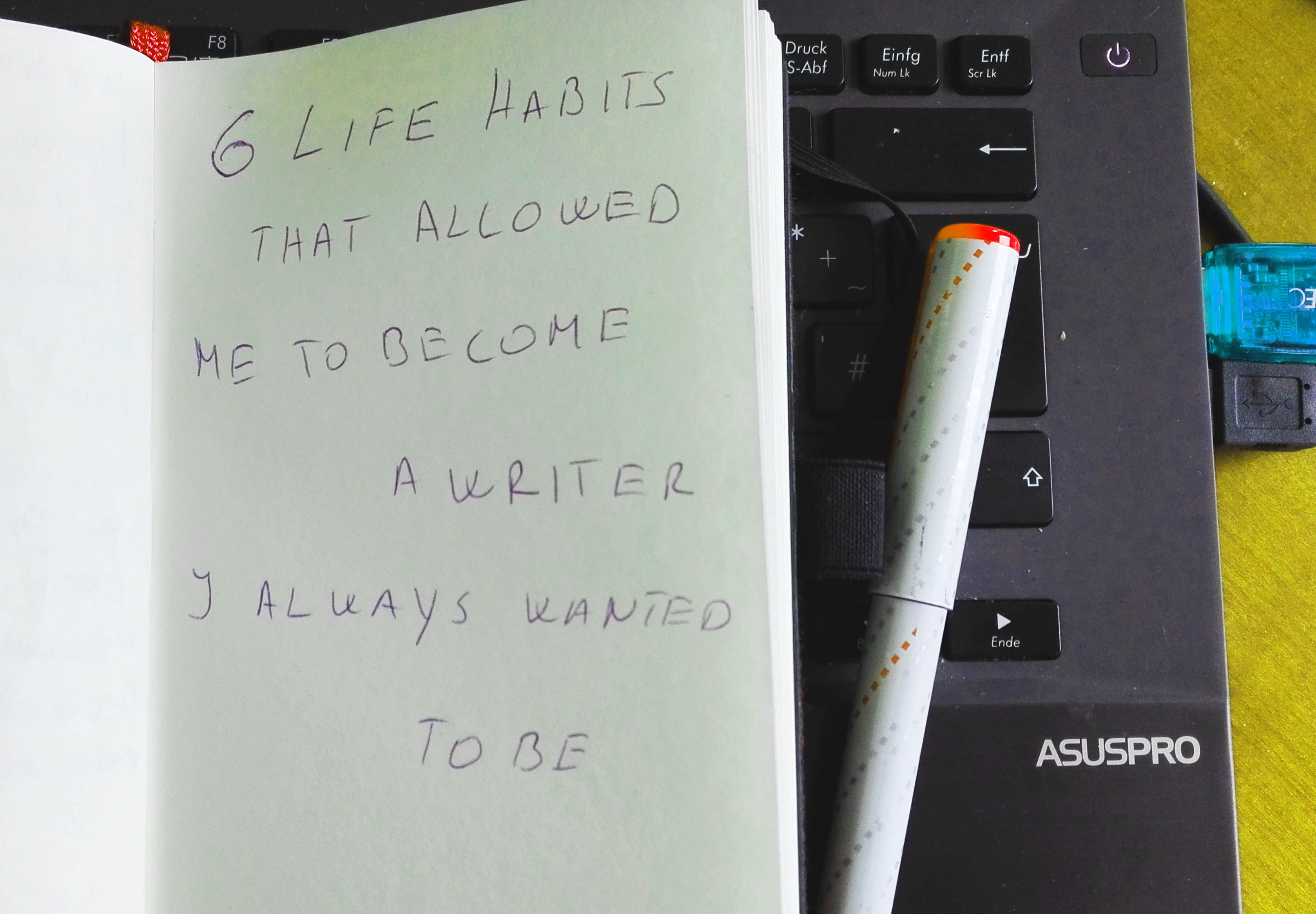
6 life habits that allowed me to become a writer I always wanted to be

lifehabits_writing

I guess, ever since I entered my graduate studies, I was involved in some sort of writing: assignments, seminars – later came academic papers, books and presentations. But all that writing was somehow constrained – I had to obey certain rules, to follow procedures and satisfy requirements I was asked to. As all that can be fun and is a learning path – it lacked freedom. For me, becoming a writer I always wanted to be, means writing what I want, when I want, under my own terms – to share my experiences and have opportunity to contribute to larger community. And blogging is a fabulous way of doing that. Business in Rhyme really allowed me to explore topics I previously didn’t have time for or I didn’t know how to communicate. Finally I think I’m on the right track of becoming a writer I always strove to be deep in side with needed courage and strength to endure.

In the last seven yeas a lot of things changed in my life. Previously, in my home country I worked as University professor, and a business consultant, which led to being ‘stretched’ between my work with students, writing textbooks and doing research for projects.

Coming to the Netherlands brought a lot of challenges, meaning I didn’t know what I really wanted:  to teach, to do research or something else. In the meantime I kept my ongoing projects at the University. Along the way with my move and adjustments in the new country, first health issues appeared in the form of thyroid dysfunction and peripheral neuropathy as a side effect. I knew something has to change: to take life much easily, pay more attention to myself and what I really needed.

So my first change and habit I developed is

1.Always assessing my needs

When you from very active and vibrant person become someone who lacks energy, has a lot of pain and struggle with everyday activities, you start to ask yourself questions like:

How did I get here?

What went wrong?

What is it that I actually need?

In that process I started to remove anything that didn’t serve me anymore: clutter, habits, ‘stale’ relationships… I started to meditate, devote most of time to myself and nurturing my peace. I realized I didn’t want to live a hectic academic life I so ‘adored’ and was proud of. But there is so much more to life than being busy – like learning about your real needs, writing and reading poetry that earlier I didn’t have time for. And all those realizations culminated in this blog. Here I’m finally a writer always wanted to be: with no degrees, grades, awards – it’s just me,  pure me translated in words.

The second one is:

2. Cleaning my diet

The process of simplification I embarked on meant also evaluation of what I was putting in my system and how that has contributed to my conditions. I now eat so simply that my friends usually laugh at me 🙂 But it means I’m pain free, medication free, and it takes less time to prepare my meals. Eating more fruits and leafy greens (in their raw state) brings clarity and patience you need in order for your creativity to flourish. Improving your digestion, sleep, energy levels – all that is vital to exploit your real creative potential.

3.Creating meaningful morning routine

I was always a morning person. I use that time to start my day with setting right attentions, with loose schedule so I can achieve desired outcome without stress. Doing some short exercises, meditation or yoga helps me refocus my thoughts and concentrate on the tasks ahead of me.

4.Reading more poetry

This is a habit I wish so many people acquire. Benefits of reading poetry are numerous, but fulfillment it brings to my inner self is immeasurable. Having that another lens to look at world is enjoyment and amazement I now need every day.

5.Enjoying solitude

I am quite individualistic when it comes to work and I’ve always enjoyed hours in solitude to sort my thoughts and figure things out. The same applies to my writing. Spending time ‘alone with myself’ enables me to have that internal conversation and dive deep in search for both answers and questions I explore further on paper.

6.Change of scenery

Whenever I’m confused or I don’t know how to articulate what I want to say, changing my environment helps a lot – being that going for a walk, short travels or vacations. All that contributes to inflow of fresh ideas, creative opportunities and stirs your imagination. Changing environment brings inevitably change of our perspective on things. Sometimes that is all you need to start/continue writing.

So this is my list of habits that helped me improve and devote more time to writing. I wholeheartedly encourage you to assess your needs and habits – look for space where you can devote more of your energy to writing and become a writer you always dreamed of.


If you liked this post, please share! For getting more inspiration for your creativity, sign up for our free monthly newsletter.


9 best practices that can drive your editing process, part II

Art-Plotnik

In the first part of this blog post I shared some of my favorite practices that can help you become more efficient when it comes to editing. But there are more things you can do to become even more productive:

  • Track Your Bad Habits.  If you want to be better at your writing and editing, try to notice your typical mistakes and actions. Commonly misusing a word or phrase? Highlight that word or write it on a sticky note somewhere you will see it often. It will remind you not to use it and think of more creative ways to say something. One thing that really works for me is to write myself notes  for anything I need to correct. It’s a learning process in progress and how your writing improves, less things you will want to fix.
  • Try reading it backwards. This is a bit weird, but it helps you become more aware of what you wrote. Begin with the last sentence and move up from there. You can see does your writing builds momentum, some sort of positive tension of expectation: words play with your logic and your focus improves – you can better sense the fluency and rhythm of your writing
  • Don’t be hard on your self. The truth is there is no perfect writing. Your task is to do your best with given time-frame, conditions and knowledge you have. That has to be enough.

Now, my students often used  to ask me: “Can you over-edit your work and how that can harm your writing?” and I think it’s a good question to answer.

Over-editing can prevent you from sharing your knowledge and message with rest of the world. Your writing doesn’t have to be 100% perfect in order to help and inspire someone. When you you are tempted not to publish your work, that’s almost the same as you have erased all of your work – it can’t help anyone if it’s hidden in your computer folders. Instead of torturing yourself  over grammatical perfection, ask yourself does your writing brings any value to your readers? The next thing is, it simply kills your productivity. Over-editing wastes time and energy. It’s tiring, it sucks the inspiration out of your body and mind.

How to recognize you are over-editing?

  • you are endlessly rewriting what you already wrote, without moving on to write something new. That holds the danger of you losing your own writing voice and the purpose of your writing. When you edit your piece too many times, you can end up editing every drop of life out of it. A conversational style is becoming more popular and you shouldn’t shy from it. It helps you connect with your readers and express your won personality through words. Even in business communication you need to stir up your writing and avoid being too stiff;
  • you let fear command your editing and you start to doubt something you previously considered good.
  • you sense something is wrong or missing but you can’t figure it out and that keeps you stuck at one page.

So, what to do about it?

Our habit to over – edit is connected with critical side of our brain that seeks approval and strives for impossible perfectionism. One little trick that might help is to make notes for yourself what you want to accomplish in writing that day – bring intentionality to your writing.

Monitor your self-talk and tell yourself you’ll deal with it later. You might be saying to yourself something like “This is just too boring.” Or “I’m a really bad writer.” The trick is to be conscious of it. Then, answer to yourself in kind and gentle way–

“I’m writing right now the best I can;  I’ll deal with these concerns later.”

This kind of silent promise you give to yourself shuts down that resentful critic and allows more space for creativity.

Many of us spend more time editing than on the actual writing. Editing is a just a tool that helps us improve what we already wrote, but it doesn’t determine are you bad or good writer. What mostly matters is the idea and the purpose behind it.

Now, it’s your turn: do you have any editing tricks to share with us?


If you liked this post and you are interested in getting more inspiration for your creativity, sign up for our free bimonthly newsletter.

9 best practices that can drive your editing process, part I

blake morrison

This is one of the topics I haven’t written about on the blog before and finally that time came. I know how it is hard to edit your own writing and I will share what in my experience has brought me the most effectiveness in this area.  This post will be divided in two parts and I hope it will help you in your editing process as well.

One of the first things I noticed, depending on your genre of writing and worth keeping in mind is that:

  • Editing of non-fiction writing is far different from editing fiction writing – there are more factors involved that constitutes making a good story, character than in developing an instructional texts, for example.
  • When you are writing an e-book, that requires different format and ‘packaging’ in comparing to your shorter versions you write for an online community like blog posts.
  • A paper copy of your book is very hard to correct (actually once it goes in printing that’s about it) than comparing to a digital version of your work.
  • Your final version of the manuscript that goes to agents, publishers or to be used as reference in some way (like student books) requires that you give all you’ve got to make it understandable and comprehensive as much as possible.

Now, when you spend years in some form of writing, your editing approach evolves as much as your writing. How your writing improves, somehow your need for editing is adapting – still, I always aim to stay true to myself in my communication. That’s the core rule.

Nevertheless, there are few effective tricks that help me become more productive in my editing:

1. Reading out loud.

Only by reading your writing out loud you can get the feel how it gets perceived by the reader. You notice the rhythm and fluency of your words. It can help you immensely.

To carefully edit, read it out loud a few times, and then move on.

2.Let it ‘marinate’ over night.

It gives you an opportunity to observe your writing from fresh and clear perspective; it helps you restore your inspiration and tap into your own creativity – than any revision goes smoothly and you are able to express your thoughts more eloquently.

3. Edit in intervals.

When you read your writing, a lot of things might bug you at the same time: poor grammar, repeating phrases, mushy sentences…When you edit, try to focus on only one thing at the time. For example:

The first time, go through content, cohesion and rhythm of your writing. Are there any ideas that are disconnected, gaps of information, ext? Reading out loud helps you find these omissions. Or even better –  read the piece out loud to someone unfamiliar with the subject and listen to where they start asking questions or looking for clarity. That means you haven’t explained something well enough, and requires further elaboration.

The second time pay attention to your structure and with what impression leaves you the piece as a whole when read? Is there anything you need to emphasize? Does the format supports the purpose of your writing? Always format accordingly to your requirements to show your professionalism. It’s easier for readers to digest information presented and editors prefer industry-standard formatting.

The third time you edit, focus on details, typos and grammar. Probably  you’ve already found some of these by reading your work twice before. Some tips you can use here include:

– use action verbs instead of passive ones;

– avoid using grammar expletives;

– don’t dwell too much on punctuation rules.

Do you know your 5 most frequent words you use in your writing? Overuse of certain words can make your writing repetitive, boring, uninviting. Don’t be afraid to use different words especially in fiction like slang, words from different languages and less used phrases. I like to use slang or terms of natural phenomenon when I want to accentuate a situation or a character. It can spice up your writing and make it more interesting. Can that confuse your reader? Maybe, but look at it like you are offering your reader an opportunity to learn something new. A tiny dash of mysteriousness in your writing can do no harm – on the contrary – it gives special charm and flavor to your piece.

In the next part we’ll talk more about how to silent that inner critique that simply sabotages our editing productivity.

How does your editing process look like?


If you liked this post and you are interested in getting more inspiration for your creativity, sign up for our free bimonthly newsletter.