Are you a newbie writer? Try to avoid these three commonly made mistakes

are-you-a-newbie-writer

Mistake. Not very popular word in our vocabulary and it is something you usually don’t want to hear about. But guess what, we are all just humans. And it means we all do make mistakes. It’s a natural part of learning curve and there is nothing to be ashamed of. I’ve been in research and writing for about twenty years and after 50+ published papers, numerous research projects, two dissertations, 3 books and year and a half of blogging, I still do make mistakes. And I don’t mean like grammar and typos. Sometimes I don’t manage to express myself as clearly as I wanted or at times I’m not assertive  enough to share my work… but that all doesn’t matter.

I’m not talking about these kind of mistakes. I’m referring to behavioral attitudes that many young or new writers somehow acquire that can slow down or even hinder their success in writing as a profession.

First mistake: They don’t embrace their talent and passion (enough)

So you like to write. And you write daily. You have a favorite pen and notebook that you carry around with you all the time so you can write whenever you feel like. But your words never see the sunlight beyond the pages of your notebook. Or you have a novel captured in your computer file that you’ve been working on for ages, but you simply can’t finish it. I know. I’ve been there too. Most of writers have. You are afraid to share your writing. We all fear judgment, rejection, negative opinions. But these are all just opinions. Rejection letter is more a sign that you need to get deeper into your writing than it shows that you are a bad writer. It shows that you are trying and that’s what counts. In one of my recent posts I wrote:

Instead of thinking about fear, think of legacy you’ll leave behind.

Every writing will find it’s right reader. If it’s honest and authentic, it will. You must share your work. It’s the only way for your message to be heard and it is a perfect way for you to find motivation to improve your writing even more. You are building a bridge between you and that outer world you want to communicate with. The world that want to hear your story. The world that want to be part of your experience.

Embrace your love for writing: start blogging (if you aren’t already), submit that story or poem to your favorite journal and finish that first draft. Finish it and be proud of yourself.

Second mistake: They don’t test the water before diving in.

What I mean by this is that many writers hurry too much in advance to profile themselves as a fiction or non-fiction writers, short story writers and ext. I believe that the best approach you can apply is to experiment and simply play. Yes, play. Try different genres. No matter how uncomfortable it gets. Not only are you improving your writing skills this way, but you’ll get clearer picture of where you would like to go with your writing. Learn more about yourself this way. For instance, when I was seventeen I got fascinated with earthquakes and volcanoes. So my first degree is engineering in natural sciences. It was followed with job in research and teaching position. Than I branched out into management, still doing research and teaching. At one point I began to flirt with applying arts in learning programs and innovation management. And as I did somehow radically changed my fields of work and interests, they have something in common: writing and teaching – which is my predominant occupation today. One that is fulfilling, contributional and somehow connecting all my talents and skills together.

So try new things, don’t narrow yourself to one or two styles and writing genres. You are a writer who’s opinion, experience, ideas and creativity matters. Your writing matters and you don’t have to decide now what kind of writer you are. You are a writer. Period.

Third mistake: They don’t treat themselves as a real writers.

For me this is very simple. You are, or you are not a writer. Don’t proclaim yourself to be an aspiring writer, beginner writer or recreational writer. If you are serious about writing, than switch your mindset to think and treat yourself like a professional. You become what you identify yourself with. From that kind of thinking you will find motivation for inspired action to move into more professional realms. Educate and invest in yourself in mastering your writing skills and building an audience that can serve for your message to be shared and received by the world. That is what you want. And there is nothing wrong to get paid for your words and services. Does your writing bring valuable contribution? Does it entertains, offers solution or maybe people can learn form it? You can find freelance writing job opportunities in areas you are skilled or experienced in. It might be hard at the beginning in a highly competitive market but you have to start at some point if you want to become a full time writer.  Search for additional paying opportunities like contests and journals. You can also offer a course and different types of content creation that are related to writing. But start early, start now.

These are three typical mistakes I have noticed that newbie writers often fall into. Instead of conclusion, I want to share this beautiful poem by Marge Pierce that so eloquently encapsulates all previously said. I hope it will inspire you to treat your craft as an expression of art, because ‘the real writer is one who really writes’.

For the young who want to

Talent is what they say
you have after the novel
is published and favorably
reviewed. Beforehand what
you have is a tedious
delusion, a hobby like knitting.

Work is what you have done
after the play is produced
and the audience claps.
Before that friends keep asking
when you are planning to go
out and get a job.

Genius is what they know you
had after the third volume
of remarkable poems. Earlier
they accuse you of withdrawing,
ask why you don’t have a baby,
call you a bum.

The reason people want M.F.A.’s,
take workshops with fancy names
when all you can really
learn is a few techniques,
typing instructions and some-
body else’s mannerisms

is that every artist lacks
a license to hang on the wall
like your optician, your vet
proving you may be a clumsy sadist
whose fillings fall into the stew
but you’re certified a dentist.

The real writer is one
who really writes. Talent
is an invention like phlogiston
after the fact of fire.
Work is its own cure. You have to
like it better than being loved.

(source: poetryfoundation.org)

Further recommended reading:

In this post we share why is your authenticity key to becoming a successful writer.
And learn more why community is essential in building your author platform.

How about you? What mistakes did you make when you first start writing? Please share in the comments below.


If you liked this post, please share. And, If you you are interested in getting more inspiration for your creativity, writing and personal growth, sign up for our free monthly newsletter. You’ll get a free e-book with 31 daily prompts to inspire your writing. To learn more about coaching opportunities click here. For additional tips, follow us on twitter and connect with us on facebook

Write through fear!

fear_writing

Don’t let fear paralyze
your writing. Instead,
think of legacy you’ll leave behind.

Maja S. Todorovic


If you liked this post, please share. And, If you you are interested in getting more inspiration for your creativity, writing and personal growth, sign up for our free monthly newsletter. You’ll get a free e-book with 31 daily prompts to inspire your writing. To learn more about coaching opportunities click here. For additional tips, follow us on twitter and connect with us on facebook

5 hints to make reading poetry more enjoyable

5-hints-to-reading-poetry

As much as I do believe that technology has given us a lot – a sort of commodity and easiness in our lives, it is also taking from us. We are becoming more accustomed to live fast, do as much as possible while some little enjoyable things flash in a split second, that we are forgetting how they used to feel.

Scrolling down the silver screen, just superficial browsing of information without any deeper thought of what we are actually reading has transferred also on other types of written media. When it comes to poetry – it does require your whole being’s attention.

As discussed here on why people don’t like poetry, I want today to offer you some pointers that might help you enjoy reading poetry even more and discover other poets who’s work sometimes stays undeservedly neglected.

  1. Read the poem more than once. If possible, even try reading it out loud. Poetry differs from prose in sense that is not everything straightforward and open. Words are usually condensed and with each rereading we gain more clarity and can appreciate the message it carries. I have found that it is important not to force ourselves to understand everything, all at once. It is similar to saying ‘when the student is ready, teacher will appear’. For some poems we might not be ready to ‘digest the truth’ it has to offer, in one particular time. Not every poem is ‘our cup of tea’ and that is completely fine and acceptable. Our ultimate goal shouldn’t be to fathom what the poet wanted to say or what question the poem answers, but rather to let something in the experience of reading catches our intention, to find our own value and meaning.
  1. Be aware of your thoughts and feelings that arise while reading the poem. Is there a specific word or phrase you like/dislike? Look at the prevailing theme in the poem and examine those internal images poem is provoking in you.
  1. In our reading practice we may often encounter poems with strange structure, omitted syntax and broken grammar rules. As at the beginning such poem might look weird, focus on the words – as it creates greater emotional response in the reader. Poetry connects unrelated things in the most unusual ways, so stay open to any appearing ambiguity. Enjoy the metaphors, images, rhythm – be rather the appreciator of the artistic expression, than the critic.
  1. Is there a poem you find special and dear to you? Write your response to that poem. Or ‘upgrade’ the existing poem with your own life experiences, thoughts and feelings. In such way, not only you are enjoying reading your favorite poem, but you are working on your own writing skills.
  1. And the last hint I can offer you is in your own writing practice, try to mimic the style of your favorite poet. It will help you to better understand a poet’s intentions and how to express yourself in a different writing form.

Maybe C. Darwin’s quote  sums it all the best:

My mind has changed during the last twenty or thirty years… Now for many years I cannot endure to read a line of poetry… I have also almost lost any taste for pictures or music… My mind seems to have become a kind of machine for grinding general laws out of large collections of facts…

If I had to live my life again I would have made a rule to read some poetry and listen to some music at least once every week… The loss of these tastes is a loss of happiness, and may possibly be injurious to the intellect, and more probably to the moral character, by enfeebling the emotional part of our nature.

The Autobiography of Charles Darwin, 1809-1882 (pp. 138-139)


If you liked this post, please share. And, If you you are interested in getting more inspiration for your creativity, writing and personal growth, sign up for our free monthly newsletter. You’ll get a free e-book with 31 daily prompts to inspire your writing. To learn more about coaching opportunities click here. For additional tips, follow us on twitter and connect with us on facebook

How writing poetry every day made more patient and emotionally resilient

poetry_patience

This post, and the thing I experienced today is a perfect opportunity for me to write about patience and emotional resilience. I actually wrote this post few days ago, but I saved it on my desktop, for further editing and my laptop crashed. Yep, and with it the first version of this post, which I liked much more, but of course, I didn’t back it up, so we are patient and writing again. I hope I’ll manage to express clearly enough what I want to say.

Life consists of many little moments like that. Situations and people we encounter on a daily basis and how we are able to deal with them makes all the difference. And talking about my self – well I’ve never been a champion in mastering those things. Actually I’m quite short-tempered. A quality that I’m not very proud of.

It’s not that I enjoy any kind of quarrel or verbal conflict, but I am very passionate person (in both good and negative way) and it has impacted my life on so many levels. When I believe that I have arguments to defend my case, people can find me too assertive and not very approachable. Especially at work, no matter how you are right (or believe you are right), you need skills to manage situation in such way not to go against your own interests, and when you are under pressure, imprisoned by deadlines and other shortcomings – diplomacy is not the first word that pops up to your mind. When you are emotionally charged up and you let yourself fall into dispute, you are not hurting only the other person, but most importantly you are hurting yourself. And it doesn’t serve you at all.

I’ve been writing poetry on daily basis now for almost three years. And people have been telling me about subtle changes they noticed in my behavior. Positive changes. And I know I worked hard in last couple of years to improve my lifestyle and habits, but this particular I do believe has a lot to do with writing poetry. My colleagues have noticed a that I deal with stressful situations more efficiently, with calm and ease. And when I think more clearly about what they imply to is that instead of reacting to situation, I’m taking my time to respond to situation. I am able to step back and analyze it from different angles. I’m not attacker and I’m not a victim. I am observer and from that vantage point, I deal with problem with much care, taking into consideration other side’s point of view. Writing is like dumping whatever emotional load I could be holding on to, which leaves the space for clarity, compassion and understanding. Or sometimes when I write poem about the situation, it turns on a humorous tone, which makes me laugh and immediately lessens the tension in my body.

And in some other instances..it’s quite interesting. I for example don’t like any type of waiting. In the supermarket, for public transport…what ever it is. I always try to find some shortcut. I might walk instead of waiting, go late in the evening to buy stuff…but you can’t predict and control everything. For New Year’s I went to Belgrade to visit my parents and of course there were many people traveling. Amsterdam’s Schiphol airport is one of the largest in Europe and you can imagine how it can get crowded during the holidays. It was so congested that I waited more than hour to pass security. In previous times, it would probably freak me out, but this time I enjoyed watching people, their characters and thought of dear friends I haven’t seen in a long time.

Writing poetry teaches me to understand the world as it is, without judgment. In such way, you are more flexible to adapt to current conditions instead of trying to mold everything to fit your scenario.  And believe me, it is so liberating!

The best advice I can give you is try to use your daily writing habit to relieve stressful thoughts and feelings. Use it as tool to connect with yourself, honor your most deepest and honest feelings. It will empower your emotional preparedness, clarity, understanding of you current experience and most importantly, it will bring you moments of peace to restore you energy in the crazy and hectic world we live in.

Patience, Though I Have Not

Patience, though I have not
   The thing that I require,
I must of force, God wot,
   Forbear my most desire;
For no ways can I find
To sail against the wind.
Patience, do what they will
   To work me woe or spite,
I shall content me still
   To think both day and night,
To think and hold my peace,
Since there is no redress.
Patience, withouten blame,
   For I offended nought;
I know they know the same,
   Though they have changed their thought.
Was ever thought so moved
To hate that it hath loved?
Patience of all my harm,
   For fortune is my foe;
Patience must be the charm
   To heal me of my woe:
Patience without offence
Is a painful patience.
Sir Thomas Wyatt

If you liked this post, please share. And, If you you are interested in getting more inspiration for your creativity, writing and personal growth, sign up for our free monthly newsletter. You’ll get a free e-book with 31 daily prompts to inspire your writing. To learn more about coaching opportunities click here. For additional tips, follow us on twitter and connect with us on facebook


How to become a highly efficient writer in 3 easy steps

efficient-writer

What exactly is high efficiency? In broader sense, in my own interpretation being highly efficient is being able to accomplish all desired goals in defined time-frame with satisfying results. The most accomplished people in any industry are those who are highly efficient and for writers this is a very  ‘handy trait’ to acquire.

Many of us are not born as highly efficient and productive. But we can learn to improve our performance in any realm of life which can lead to more energy, focus, confidence, productivity and satisfaction – something that any writer desperately needs.

You want to be efficient not occasionally when ‘all pieces of your life fall in the right place in the right time’. You want that sustained confidence and ability to be at the top of all things, having your life and writing under control – not the other way round.

And the next few things I’m about to say here are nothing new to you. You probably heard them a lot of times before, but yet we do forget and slip of our writing wagon. So take my recommendations as a friendly reminder and a guidance to help you examine your life  habits and how that is impacting your writing.

Step 1: take care of your basic needs properly, so you have more time for writing.

You probably could see this one coming. I simply can’t stress enough how this is important. When your basic needs like eating, sleeping  and daily movement/exercise are fulfilled then your body and mind are prepared for any challenge. It’s a prerequisite to any productivity. Fueling your body with healthy whole foods will give you energy, strengthen your immune system and endurance you need in order to achieve what you want. This, paired with enough sleep and relaxation instead of indulging in useless TV program will give you clear mind and focus you need in order to write and jump over that writers block.

I know I named this post easy steps and all this might not be easy in the beginning, but in a way we need to unlearn our unhealthy habits; to start fresh with open mind, heart and faith that with little baby steps we can retrain ourselves  –  to cultivate better habits and allow ourselves become writers we want to be.

Step 2: set reasonably achievable writing goals.

This is where, in my opinion is one of the traps we often as writers fall in. Setting too much goals or goals that are defined in tight time-frames can sometimes play as a true motivator, but more often it produces more pressure which leads to additional stress and discontent. I know that some people can have high performance under pressure, but think about it: how will that actually impact your life in the long run?

I am unfaltering advocate of being true and clear with yourself: what are your priorities? Chose one or two things you really need/want to do and start from there. Doing everything, everywhere in the same time is not a sustainable efficiency.

Step 3: do it, write it – no excuses

We are, with our human nature a real champions when it comes to excuses – why not to do something. You lack time, energy, you are busy, you are hungry, you are too hot or too cold, sleepy or..whatever. If you notice some of these thoughts creeping to your mind, go back to steps one and two. There is all magic happening. Your next poem, story, manuscript or blog post is hiding right up there. When you conquer steps one and two, your productivity will improve, your desire to learn and acquire new skills, have fun and immerse yourself in creative outlets will naturally come back running to you.

Do you have any tips on writing productivity? Please share with us in the comments below.


If you liked this post, please share. And, If you you are interested in getting more inspiration for your creativity, writing and personal growth, sign up for our free monthly newsletter. You’ll get a free e-book with 31 daily prompts to inspire your writing. To learn more about coaching opportunities click here. For additional tips, follow us on twitter and connect with us on facebook

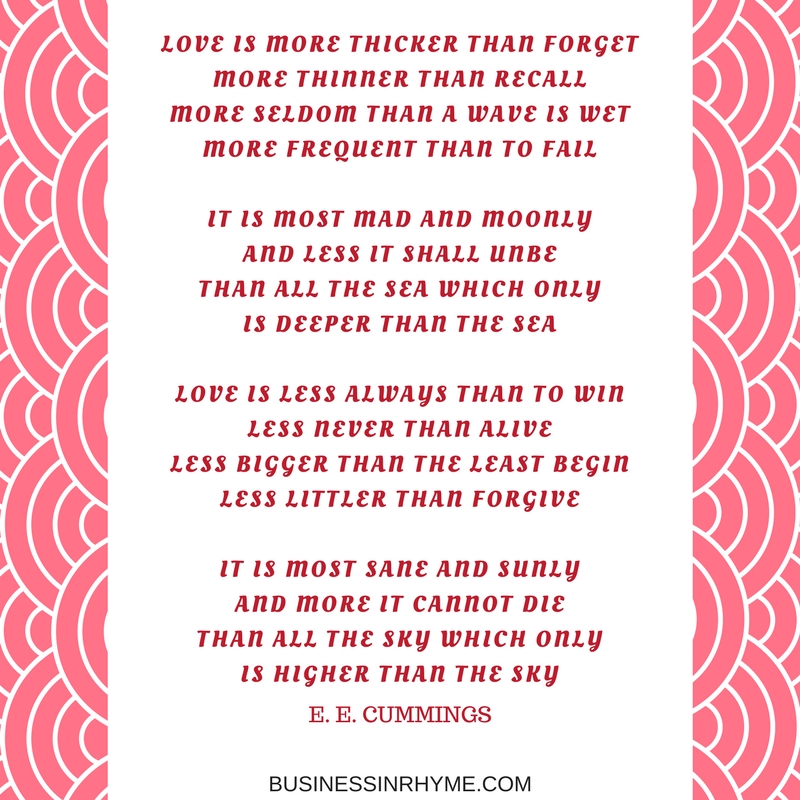
Love is more thicker than forget

poem_eecummings

Happy Valentine’s Day!


If you liked this post, please share. And, If you you are interested in getting more inspiration for your creativity, writing and personal growth, sign up for our free monthly newsletter. You’ll get a free e-book with 31 daily prompts to inspire your writing. To learn more about coaching opportunities click here. For additional tips, follow us on twitter and connect with us on facebook

Inappropriate

Never did I know this will happen:
inappropriate courtship of my feelings.

Announced it happens and
it doesn’t recognize
day or hour.

No age  and no place
exists in a love play.

With rushing wave and
crushed to ground
I drink possibility from
your salty lips before
I enter inviting sweetness.

Darkness envelopes me
in sudden expectations
and skin awakens with memory
of buried wanting.

Your eyes still haunt me,
apparition in every corner.
And I hurry back to my old life
before impossible turns me into dust.

Maja S. Todorovic


If you liked this post, please share. And, If you you are interested in getting more inspiration for your creativity, writing and personal growth, sign up for our free monthly newsletter. You’ll get a free e-book with 31 daily prompts to inspire your writing. To learn more about coaching opportunities click here. For additional tips, follow us on twitter and connect with us on facebook

3 ways poetry promotes health and wellbeing

3-ways-poetry-promotes-health-and-wellbeing

I often write how poetry is a life-savior. But in this particular post I want to dive even deeper in specific ways poetry can help you deal with every day stress and anxiety.

For me, personally poetry is a space, a huge empty room I can fill with anything I want.

Any emotion, fear, anger, desire and love I can put there, observe with care and sort them out. It’s a perfect mechanism to put your feelings under control and actually get freedom to breathe easily again, take off that pressure from your chest. Poem gives you back your voice, your permission to shout, to rebel, to smile! The American poet, Edna St Vincent Millay so beautifully put it in her famous sonnet

 I will put Chaos into fourteen lines And keep him there.

And even those who turn their heads and ears from poetry will still now and then switch on their radio, bang their hands in the rhythm on the stirring wheal and sing along their favorite tune. Aren’t poetry, songs and lyrics very close cousins offering us that immediate relief we look for in everyday life?

Another thing I have observed that poetry offers as a healing component is that many of us reach for literature in hope to find explanation for the things we cannot articulate, express or even understand ourselves. Poet knits a story in his poem ‘as it is’, yet it stays subjective and mono-observant. Still, there’s an inclination, that when we are sad, we are most comforted by sad poems and sad music. Often poetry comes with some sort of solidarity in times of solace where while you read your favorite authors somehow even subconsciously, you validate your own experiences as universal – which  makes acceptance of particular situation  much easier and less volatile. 

Jeanette Winterson, in her book ” Why Be Happy When You Could Be Normal” says,

you can use poetry as a light and a laser.  It shows up your true situation and it helps you cut through it.

But also, on the other side of word-spectrum lies different possibility. And with every reading of a poem you are empowering yourself with additional hope and inspiration.

We know this at the most fundamental level as with reading each line we bring forth our own meaning, analyses, forcing us to make new connections among images, events, people and situations. ‘What is’ can be easily transferred to ‘what if’ and there is your healing power. The poem always brings you in the now, in the present moment: that creative pause you steal for your self in the every day routine is an escape from dreadful, petty ordinary things and a gate to inner peace and stillness.

Poetry is the celebration of life. Dark and bright moments – what ever they are, poetry is your companion. It can make you laugh, or even fall in love with yourself like Susana Thenon writes in ‘Nuptial Song’ (about being ‘happily married’ to yourself).

Use poetry as a beautiful distraction in your life instead of indulging in junk food, tabloids and TV realities. That is your safe harbor in the tumultuous time of your every day situations.


If you liked this post, please share. And, If you you are interested in getting more inspiration for your creativity, writing and personal growth, sign up for our free monthly newsletter. You’ll get a free e-book with 31 daily prompts to inspire your writing. To learn more about coaching opportunities click here. For additional tips, follow us on twitter and connect with us on facebook

How to blog a poem: 8 tips to get you started

how-to-blog-a-poem

Is there a proper way to blog a poem? No. I don’t believe so. Simply, poetry as an art form is very subjective to poet and reader in different ways. It promotes freedom of speech, freedom of written word and expression, so trying to foster any rules is actually diminishing its essential function as an art piece. But I also believe it is important for us to acknowledge we are living in a digital world and available technological tools we can use in our own advantage to reach more like-minded readers, spread our message and have desired impact in the world.

Technology paired with different art forms, such as poetry is birthing other artistic, somehow hybrid, multimedia forms and that’s the moment where all the fun begins.

Becoming creative on how you present your poems, how you enhance the written word can have a great influence on your reader. Especially this could be of interest for newly established poetry blogs. Words should always be your focus, but how you access your audience across diverse social media platforms is also important.

Almost any blog platform, just as wordpress allow authors to post different types of content like photos and videos. You can pair your poem with suitable photo to accentuate the atmosphere and experience you want to convey, but even more important it can be using feature to record yourself reading your poem. Your voice and your emotions have a great power to move your readers, and you sharing your deepest intimacy in such way is making any feeling, image and interpretation even more believable and true.

To get your reader more acquainted with your poetry pieces, you can share your opinion on different poetry styles, your writing and creative process, how poetry impacts your life, your favorite poems and poets. This is a great opportunity for someone who is new to poetry and your blog to get acquainted with your background, style formats, different poets. You can form a page like ‘start here’ to present such information.

If you have attention of becoming more professional writer, than your blog becomes your portfolio, where you showcase pieces of your work.

So what are the actual steps you can do to improve your blogging process?

  1. My experience has shown that it is the best to blog at least few times a week. You are getting your readers accustomed to reading regular content and it is also good routine to get you in a writing mode. To make it easier, you can draft a lose editorial schedule to keep you focused and on track.
  2. Pick 2 -3 social media platforms you are most comfortable and connect with your wordpress account. Do your research and see where your writing style fits best – like Instagram and Tumblr are very popular for short and visual poetry. Use Publicize feature which allows you to directly publish your post to your social media accounts. Make sure in the title to use adequate hashtags as it will make your post more prominent and easier to find.
  3. To consolidate your audience, you can start building you email list of subscribers by installing a prominent signup or MailChimp account offering something like ‘next week’s poem in your inbox’.
  4. Other cool thing I liked and some writers have been doing is collecting their most popular pieces and offering them as a bundle in pdf booklet or ebook that readers could download for free. It’s a great promotional tool for you to show to prospective publishers and media agencies.
  5. Use small snippets and excerpts of your poems to engage your followers on twitter and drive that traffic back to your site.
  6. Consider submitting your poetry to different literary journals. You can treat your blog as a writer’s resume and update your blog regularly with your published work. In such way you are building your writer’s reputation.
  7. Repost. You can ‘recycle’ your old content/poem by refreshing or publishing it in the same form which allows newcomers to your blog to get acquainted with your older poems/articles.
  8. And maybe best advice one can give you is, to follow your instinct and publish your poems in a way you think best represents what you want to say. Reading poetry is unique experience, just as your writing. Be open to learn and experiment and with time you will develop your recognizable style.

As long as you keep your readers engaged and keep conversation going, they will frequently return to read new content. And more importantly share your beautiful poems 🙂


If you liked this post, please share. And, If you you are interested in getting more inspiration for your creativity, writing and personal growth, sign up for our free monthly newsletter. You’ll get a free e-book with 31 daily prompts to inspire your writing. To learn more about coaching opportunities click here. For additional tips, follow us on twitter and connect with us on facebook

New website. New chapter. New opportunities.

This is a quick update about Business in Rhyme. As many of you have noticed, there is new website design, more professional, but I’m still keeping everything minimal, clean and readable. This year and my current freelance projects schedule, revealed an opportunity for me to share my knowledge and expertise in different manner, which means I have time and I’m available for personal coaching 1-on-1 in relation to creativity and writing.

I kindly invite you to visit my coaching page and if you need any help or support, please free to contact me. Some coaching slots are already filled up, but there is enough room for additional coaching sessions.

If you have been following my blog, than you already know my background, my style, my view on creativity, productive and purposeful writing. Here you can read more about my writing journey.

Happy writing! 🙂

Maja


If you liked this post, please share. And, If you you are interested in getting more inspiration for your creativity, writing and personal growth, sign up for our free monthly newsletter. You’ll get a free e-book with 31 daily prompts to inspire your writing. To learn more about coaching opportunities click here. For additional tips, follow us on twitter and connect with us on facebook