Blog

Mark Strand and his take on creative action

MarkStrand

Mark Strand was one of the most celebrated American poets. He had a very dynamic career, where besides writing poetry, he was accomplished editor, translator, and prose writer.

With very distinctive style in most of his work he dwells on the position of human consciousness, exploring the ideas of the self and life purpose in general.

In 1990 he was named the U.S. Poet Laureate, and along his career he won numerous prizes like  In 1999 he was awarded the prestigious Pulitzer Prize for Poetry for his collection Blizzard of One.

During his 5 decades long career he worked as a Professor at many Universities, encouraging young generations to take the leap and find their career in creative writing and poetry. (source: poetryfoundation.org)

But what’s mostly interesting about Strand are his responses in an interview he had with with psychologist Mihaly Csikszentmihalyi, who during the 1990s interviewed 91 people dedicated to intellectual pursuits about their take on the creative process. Strand believed that creativity is an expression of consciousness itself; that speaks and communicates through human spirit and search for the most exquisite ways to be delivered and brought to daily light. In each and every act of creation Universe is mirroring and proving its own existence:

We’re only here for a short while. And I think it’s such a lucky accident, having been born, that we’re almost obliged to pay attention. In some ways, this is getting far afield. I mean, we are — as far as we know —the only part of the universe that’s self-conscious. We could even be the universe’s form of consciousness. We might have come along so that the universe could look at itself. I don’t know that, but we’re made of the same stuff that stars are made of, or that floats around in space. But we’re combined in such a way that we can describe what it’s like to be alive, to be witnesses. Most of our experience is that of being a witness. We see and hear and smell other things. I think being alive is responding.

[When] you’re right in the work, you lose your sense of time, you’re completely enraptured, you’re completely caught up in what you’re doing, and you’re sort of swayed by the possibilities you see in this work. The idea is to be so… so saturated with it that there’s no future or past, it’s just an extended present in which you’re, uh, making meaning. And dismantling meaning, and remaking it. (source: brainpickings.org)

Here Strand’s offers us a different view on the act of creation and that  aligning ourselves with who we truly are, is the only way to find our place in the world – where we can express our full potential. There is no wrong or right, good or bad – we only need to be fully aware of who we are and that moment creation speaks and lives through us.

Keeping Things Whole

by Mark Strand

In a field

I am the absence

of field.

This is

always the case.

Wherever I am

I am what is missing.

When I walk

I part the air

and always

the air moves in   

to fill the spaces

where my body’s been.

We all have reasons

for moving.

I move

to keep things whole.
3 R (creativity exercise)

pablo

In many years of environmental practice what I learned is that everything revolves around resources: how you use them, manage or generate them.

Well, this same notion we can apply in different ways in order to get our creativity flowing – especially when it comes to writing. Rewriting, revising our own or somebody else’s work helps us not only to become better writers, but also it helps us develop our reading and analytical skills. You learn to question ideas, statements and arguments. You learn to notice and search for new relations, discover weaknesses and come up with new ways to improve what’s already there. So, this is what I propose:

1.Reuse

your old books, magazines or even shopping receipts and try to create new poem. It can be similar to collage, but this time try to focus specifically on words and create your poem out of them. Cut out your favorite words and phrases or circle them on the given page and make them the constituent part of your new writing venture. Play with the words. Try different arrangements. Pick words that somehow inspire you or relate to a project/problem you are working on. Once you found an arrangement you like, you’ve created a found poem. What kind of emotions or reaction words trigger?  Read them, play with them and they just might offer some new, fresh perspective on the questions you have.

2. Reduce

Now, this one I believe is going to be fun – at least was for me and can really help you in you writer’s block. Try to find a poem that you dislike, that you feel negative about and simply wreck it! That’s right: tear it apart! I don’t mean tearing the physical paper, but omit, reduce, erase, everything from the poem you don’t like and use it as the basis for writing a new one –  in a way that feels and sounds right to you. This little, simple exercise can be really helpful later in your own writing.

3. Recycle

This one is similar to the previous but it refers to your own writing. Find something that you wrote long time ago, when you were in a different mood, influenced by other circumstances and give your writing a make-over. Use your own writing as an inspiration for your new poem, dress it in new words, develop stanzas out of sentences and see where it takes you. Our past experiences are our best teachers and what we’ve learned we can use to adequately manage our creativity and direct future actions. Take the knowledge you acquired into your own advantage and just let your free writing do the rest.

If you liked this post and you are interested in getting more inspiration for your creativity, sign up for our free bimonthly newsletter.

3 simple truths about your online presence

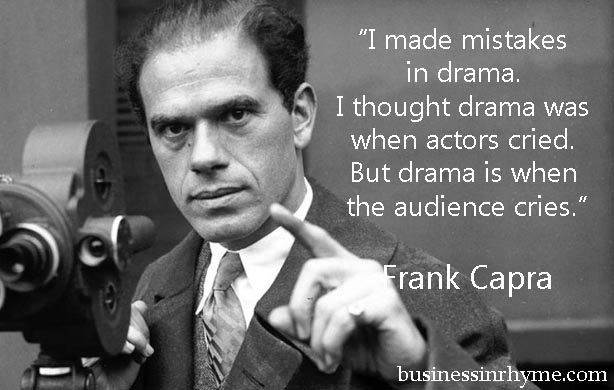
frank capra

In one of my previous posts I talked about the importance of building your community of supporters, people who share your view of the world and values –your tribe as some refer to it.

And when I think of community, I think in every aspect of it: people in physical community are organized and engaged in certain activities and mostly are oriented towards shared goals, values and trust.

Well, much of that we can apply to our online community as well:

  1. Engagement. For fostering mutual trust we need interaction, honest exchange of information and responsiveness to inflow of new ideas, opinions and views. In every community, communication is a two-direction street, a beating heart of your online presence. No matter how large community you might think you have, empty number without discussion and healthy exchange of ideas is like living in an empty, cold, dark cave when from time to time you stumble upon some living creature, and the only sound returning to you is your echo … I always encourage even having smaller group, but the one that is your real audience, ready to complement your every victory and comfort you in your small omissions…that is warm and feisty; that in the same time can understand you and guide you. One simple way to improve engagement is a call for action. Invite your audience to share their experiences, their views, problems… by honoring them in this way your empty and cold cave is transforming into a warm home, filled with real emotions.
  1. Sharing is caring. In old times, before the internet era, companies were in charge of disseminating information, which means they had better control of what kind of information went into the ether. Now we have a different problem: we are facing the challenge of getting the right information. People are turning to internet and social media to dig up what they need to know. In order for your content to be noticed, It has to be relevant to your audience, that is helpful and contributes to improving their lives in some way; entertaining or provides different experience. That’s why sharing is important. It’s your ritual of giving pieces of your time, knowledge and energy and this type of investment that adds value, is building even stronger connections of trust – among you and your target audience.
  1. Make your message clear and focused as much as possible. In other words, find your writing niche. I like to read poetry, for example. But even in poetry I have preferences: I like long, prose poems, with lot of mythology even Gothic atmosphere entwined. So the writings of Margaret Atwood, W. B. Yeats and Kelly Boyker appeal to me very much. Or surrealist approach to poetry.

So, even in your writing, when you try to be narrow as much as possible, you attract right people. If you write to be liked by everyone-chances are you hardly get noticed. People like to feel special, like you are writing specifically for them or referring to their specific experience. When people identify with the message you are sharing, they like to talk about it, share it further: in simple words – your community is growing.

And of me say the fools:
With my poetry
I violated the sky’s commands.
Said who
Love is
The honor-ravager of the sky?
The sky is my intimate.
It cries if I cry,
Laughs if I laugh
And its stars
Greatens their brilliance
If
One day I fall in love.
What so
If in the name of my beloved I chant,
And like a chestnut tree
In every capital I, her, plant.

Fondness will remain my calling,
Like all prophets.
And infancy, innocence
And purity.
I will write of my beloved’s matters
Till I melt her golden hair
In the sky’s gold.
I am,
And I hope I change not,
A child
Scribbling on the stars’ walls
The way he pleases,
Till the worth of love
In my homeland
Matches that of the air,
And to love dreamers I become
A diction-ary,
And over their lips I become
An A
And a B.

Nizar Qabbani
If you liked this post and you are interested in getting more inspiration for your creativity, sign up for our free bimonthly newsletter.