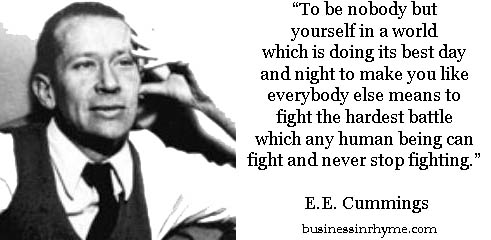
Writing poetry takes courage and a dash of craziness (and how is that good for you, as a writer)

cummings

Confronting blank page takes courage? It might sound silly to many, but if you are a writer, especially a poet, you probably know what I mean:

It takes courage to spend time with yourself and dig deep, to the darkest and scariest parts of yourself and let them shine through your poems.

Only very few are brave enough to go somewhere place quiet, shut down the noise of the outer world and start listen to themselves; to hear who they truly are, and with open heart receive what ever they encounter. All experiences full of disappointments, grief, hurts, desires and happiness live and expand in each of these verses that we can read in the poems of those brave enough to write about their feelings. And they give us opportunity to live them also.

It takes courage to accept who you are and be honest about it.

Poetry is so personal on the one hand and universal on the other, that you simply can’t fake it. In every poem, your writing is like stripping your soul to the bare bones, where you become even more vulnerable. But that doesn’t make you anything more weak – that brevity adds up to your uniqueness that world is hungry for.

It takes courage to write, despite all the negative connotation that majority of people hold against poetry and simply not to care.

Some people simply don’t like poetry. There maybe many reasons for that. But also, there are not very supportive of those who does enjoy writing poetry. And it takes courage to continue to write and share our thoughts, no matter the impressions. I love what Jesse Graves, an assistant professor of English at East Tennessee State University said on the topic in this article:

For me, poetry expresses more about what it is like to be alive in the world today than any other art form. For a poem to work, it needs to address matters of the heart and of the head in almost equal measure. Since there is no interference between the reader and the text, poetry can deal with emotions in an intellectual way, and deal with abstractions in a way that evokes feelings.

It does take courage to try writing poems, especially if you are going to share them with others. Students also have to be willing to enter an unknown territory, even if I give them an assignment to write about, or a form, like a sonnet, they still have to find their own way into the subject matter. There is no real blueprint for how to write a poem..

It takes courage to write poetry and constantly juggle between loving and hating your own writing.

There are days when writing for you is like breathing – that without it you simply couldn’t live. But there are also days when you are unsatisfied with anything you write and you simply need a break. And that’s completely O.K. Actually that distancing yourself from writing can reignite your passion and it takes courage to do that also.

And someone might just call you crazy because you see world a bit differently: you see the joy in the heavy autumn storm, the warmth in the cold winter day or beauty in your teared bag and spilled groceries on the street. For me personally, writing poetry brings the opportunity to see and embrace life’s little imperfections in humble, and sometimes humorous way: instead of dwelling on how everything is wrong and complain – just to accept it, make the best of what I can in given situation and write a great poem about it 🙂

Poetry is everywhere, it just needs editing.

is what James Tate once said, and we are not even aware how much truth there is in those words.

All these aspects, contribute to forming one, in my opinion, a divine process that happens while you write poetry. It shapes you into a person you are supposed to be, the writer you strive to be. And for that kind of growth you do need courage – to accept your weirdness and just enjoy the ride.

It is in the small things we see it.
The child’s first step,
as awesome as an earthquake.
The first time you rode a bike,
wallowing up the sidewalk.
The first spanking when your heart
went on a journey all alone.
When they called you crybaby
or poor or fatty or crazy
and made you into an alien,
you drank their acid
and concealed it.

Later,
if you have endured a great despair,
then you did it alone,
getting a transfusion from the fire,
picking the scabs off your heart,
then wringing it out like a sock.
Next, my kinsman, you powdered your sorrow,
you gave it a back rub
and then you covered it with a blanket
and after it had slept a while
it woke to the wings of the roses
and was transformed.

Anne Sexton


If you liked this post and you are interested in getting more inspiration for your creativity, sign up for our free bimonthly newsletter.
This limerick goes in reverse…

According to some resources, today, May 12. is the Limerick day. It is also believed that origins of limerick poetry form can be traced back to 14th century. They are short, easy to compose, often speaking of sexual, ironic and humorous connotations. The name itself derives from the Irish town of Limerick and by many critics is not respected as a valid poetry form. Nevertheless, in the defense of limericks, it is believed that even Shakespeare wrote them.

If you want to try on your own to write a limerick follow the rules:

  • the last word in lines 1, 2, and 5 must rhyme and contain 8-9 syllables each;
  • the last word in lines 3 and 4 must rhyme and contain 5-6 syllables each.

One of the most famous writers of limericks is Edward Lear and his book of Nonsense, full of funny and witty verses:

“There was an Old Man who supposed,
That the street door was partially closed;
But some very large rats,
Ate his coats and his hats,
While that futile old gentleman dozed.”

or consider this one by Zach Weiner of the comic “Saturday Morning Breakfast Cereal”:

“This limerick goes in reverse

Unless I’m remiss

The neat thing is this:

If you start from the bottom-most verse

This limerick’s not any worse.”

Have you tried writing limericks? Share with us in the comments below.


If you liked this post and you are interested in getting more inspiration for your creativity, sign up for our free bimonthly newsletter.

Boost your lateral thinking for creative problem solving + exercise

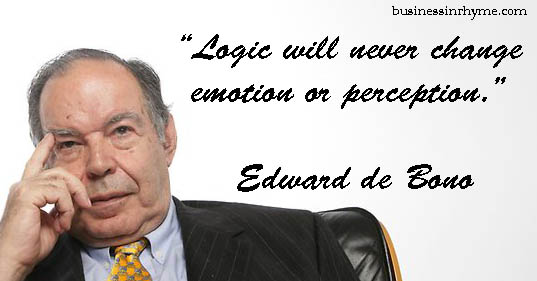
edward-de-bono

The first definition of the term lateral thinking came in 1967 from Dr Edward de Bono.He has become the world’s leading authority on conceptual thinking and has contributed to development of new tools and approaches to the  organizational innovation, strategic leadership, individual creativity, and problem solving. Present in the innovation industry since 1970. his exclusive strategies and methods have brought remarkable results to organizations and to individuals from a wide range of cultures, educational backgrounds, occupations, and age groups.

So, what is actually lateral thinking? It is a way of thinking that solves problems through an indirect and creative approach, using reasoning that is not immediately obvious and involving ideas that may not be applicable by traditional step-by-step logic.

This kind of thinking requires of you to go beyond the obvious and even to take into account parameters that your traditional logic might easily dismiss.

One really attractive and interesting example is given in this article.

Pretend that you’re trapped in a magical room with only two exits. Through the first exit is a room made from a giant magnifying glass, and the blazing hot sun will fry you to death. Through the second door is a room with a fire-breathing dragon. Which do you go through?

There are many ways we can approach this problem in order to solve it. One way could be using poetry techniques, for example kennings.

Bed of fish, smooth path of ships, island-ring, realm of lobsters, slopes of the sea-king, whale-house, land of the ocean-noise, blood of the earth, frothing beer of the coastline…

These are some of the terms and phrases used by the Viking and AngloSaxon poets to name/describe the sea. The word ‘kenning’ comes from the Old Norse verb að kenna, which means ‘to describe’ or ‘to understand’. Poetry asks us to think and view the world from the different perspective. And kennings question our habitual way of thinking. If we apply this technique to the above problem, we could call sun “object that gives light to the earth, object that brings day… “.

So by using this technique, we could come up to a solution by deducting our thinking: sun, in a day time, in the above example is dangerous for us, but what happens when the day goes by? Darkness. And the answer presents itself: we should wait for the sunset, and the first door is a safe passage for us.

The answer to this puzzle is an example of what psychologists call “lateral thinking”:  instead of going ahead onto the problem, going sideways can present an elegant solution.

So next time you have a project, creative problem you are working on, try to name it, describe it differently, focusing on its  functions and elements and solution might unexpectedly reveal itself.

How often do you use your lateral thinking? 🙂


If you liked this post and you are interested in getting more inspiration for your creativity, sign up for our free bimonthly newsletter.

9 literary journals that want your poems – now!

One of the things I like to do in my leisure time is to brows some very interesting online literary magazines as it helps in my inspiration but I also like to be informed about the newest trends in literature and writing styles.

As a result of my research I managed to compile a list of 9 magazines that pretty much on regular basis accept submissions for new poems and prose, and of course you might find some of them interesting in your publication process.

So here it is:

1.Hootreview. This is maybe one of my favorite. They focus on a micropoetry and microfiction, giving a real chance to aspiring writers.

2.32poems. They accept unsolicited poetry year round and also simultaneous submissions. As a rule, preference is given to shorter poems that fit on a single page (about 32 lines). For more visit their guidelines page.

3.Aleola journal of poetry and art.

This journal of poetry and prose was created to preserve the vanishing species known as “enjoyable poetry”. Ours is not the poetry or fiction enjoyed by connoisseurs of modernism today, filled with inexplicable juxtapositions of meaningless words that leave the reader feeling confused, fatigued, and overcome by a vague ennui. No; the sole requirement for our poetry and prose is that it expands the mind, captures the interest, and can be enjoyed by the average reader. We welcome nature poems, imagistic poetry, humor, and literature that tells a story.

4. Allegro poetry magazine aims to publish the best contemporary poetry. March and September issues are for general poems and June and December for poems on a set theme. It is a UK based online magazine, published four times a year.

5.Knot magazine is currently accepting submissions for fall issue. They have a large spectra of poetry genres included. Worth checking it out.

6.Juked. In publication since 1999, this is an independent journal that appears online as well as in annual print issues. They don’t adhere to any particular themes or tastes and are fond of aspiring writers 🙂

7.Rattle. This magazine accepts submissions all year around and if your are into translating poems – this is a place for you.

8. Thrush. If you like to experiment with your writing and flirt with unusual, thrush journal is one of the best publication references you can get:

Our taste is eclectic. We want poems that move us, a strong sense of imagery, emotion, with interesting and surprising use of language, words that resonate.  We want fresh. We want voice.

Established and new poets are encouraged to submit. Experimental poetry is fine, randomness is fine also. However, we do not want experimental and random just for the sake of calling it such. No long poems. We prefer a poem that will fit on one page. We are not interested in inspirational poetry or philosophical musings.

9. Contrary. As the name of the journal says it deals with contrary issues, thoughts, attitudes, questions…Publishes 4 times a year and new, summer cycle is open until June 1st. Don’t miss this opportunity, on the contrary! 🙂

I hope you find this list interesting and it helps you in your publishing journey.


If you liked this post and you are interested in getting more inspiration for your creativity, sign up for our free bimonthly newsletter.
 

Kahlil Gibran’s timeless wisdom on the purpose of poetry and meaning of work

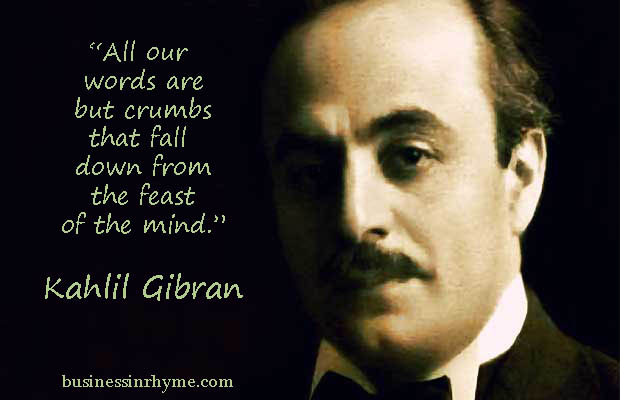
kahlil-gibran

Kahlil Gibran, born in Lebanon, was a poet, artist, philosophical essayist and a novelist,who emigrated to New York in 1885. His work, written both in Arabic and English was very much influenced by the European modernists of the nineteenth century, with deep mystical, philosophical and spiritual understanding of the world.

Gibran had simple, yet direct style and he used writing to liberate himself; to portrait immigrant life of his family and topics relating to alienation, disruption, industry that eats natural beauty – were often present in his work. For him, poetry was an ideal vehicle to transcend the feelings of emptiness, longing and a way to communicate most intimate desires:

Poetry is a deal of joy and pain and wonder, with a dash of the dictionary. Trees are poems the earth writes upon the sky, We fell them down and turn them into paper, That we may record our emptiness.

How we experience the world around us and allow our mind to make it’s on meaning and relations, that’s how our language is going to be:

All our words are but crumbs that fall down from the feast of the mind.

He also recognized that without innate feeling and sense of love, all our efforts in any life direction are simply futile. In his, maybe the most popular piece “The Prophet” (1923) in 26 prose poems he discusses and shares his view  on most intriguing topics of human kind, ranging from marriage, laws and friendship to the meaning of work, punishment, pain and joy. Even though it wasn’t seen as a piece of distinct value among American critics, it achieved cult status among American youth for several generations.

For Gibran work equals love:

And all urge is blind save when there is knowledge,
And all knowledge is vain save when there is work,
And all work is empty save when there is love;
And when you work with love you bind yourself to yourself, and to one another, and to God.
And what is it to work with love?

Work is love made visible.
And if you cannot work with love but only with distaste, it is better that you should leave your work and sit at the gate of the temple and take alms of those who work with joy.
For if you bake bread with indifference, you bake a bitter bread that feeds but half man’s hunger.

Once we fuel our work with passion and love, it’s much probable that we will achieve our goals. And there is nothing more joyful, than the alignment of our values, passions and purpose. Than work is not just work. It becomes eager part of life, intentional and deliberate living, bringing meaning to all aspects of our lives.

If you would like further to explore similar topics, I recommend:


If you liked this post and you are interested in getting more inspiration for your creativity, sign up for our free bimonthly newsletter.


Results of NaPoWriMo experiment

The April month is over so is the napowrimo. I successfully went through, publishing every day a poem, along with all scheduled posts. Most of the poems were result of free-writing so I won’t go into the quality of writing, but there are other benefits that I noticed as a result of this frequent scheduled poetry scribble.

1.During the month I felt much more emotionally stable.

On a few occasions I had some difficult situations and even though I didn’t channel my stress through poetry, the actual act of writing was a great tool for me to divert my thoughts into something creative instead to rewind in my head something that is already in the past. It turned out to be a great mindfulness tool for me.

2. It made me productive in other areas as well.

When you do something you like, it really can fuel you with beautiful energy and gives you drive to get involved in other tasks. My working hours were joyes and filled with vigor to accomplish as much as I can.

3. I came up with ideas much easier.

Even though I didn’t use poetry as a brainstorming tool, I noticed I came up with new ideas with ease, without any struggle and doubt. It felt quite natural just to follow already ignited thoughts and that was the half of job done.

If you were participant in the NaPoWriMo, how that impacted your daily routine? Please share your experience and insights in the comments below.


If you liked this post and you are interested in getting more inspiration for your creativity, sign up for our free bimonthly newsletter.

Are you losing readership? Probably you are making one of these 3 mistakes

NadineGordimer

When I was younger, I didn’t like very much to read. I liked books and I liked to collect them, but because of the nature of my studies and later my work, I was already so much time “wrapped” in books (researching specialized information) that I didn’t find any interest in spending my free time reading, again. 🙂 So, poetry and prose were not much on my reading menu. But while reading, what I liked the most is that I can search for targeted information whenever I need it and access it any time.

Now, with time my needs and wants changed. I do enjoy reading more poetry and prose. I find it relaxing and comforting. It enhances my writing, my creativity, my way of thinking and self-confidence, my knowledge of languages…the benefits are numerous. I still do search for certain information, relating to skills and knowledge I’m interest in, but the existence of Internet in last 20 years has changed that for us in many ways.

So, one of the reasons to see a decline in your reading stats might be:

1.You don’t know who are you writing for.

You need to know your audience; what are their needs and wants, because it changes with time and evolves. As a writer you need to be able to sense their reading pulse and offer types of information that will attract and intrigue them. Writing also means fostering a community, sharing mutual insights and experiences. This is the first thing that needs to be cleared up, and it will undoubtedly improve your writing too.

2. You don’t recognize the purpose of your writing.

Here, I mean you do need to have clearly defined  what kind of information you are offering; As I said, people do like targeted information, especially if you are a non-fiction writer. As a fiction writer do you have recognizable style, writing voice that your readers can relate to.

3. Your writing is more like ‘a stale pond’ instead of a ‘running river’.

What I mean is that do you offer fresh content on regular basis? Is your content related to contemporary topics and events that people are genuinely interested in?

Do you blindly follow one literary style or do you like to experiment? The point is even in the actual action of writing we do need to be somehow innovative and creative. You like haikus? Great! Next time try to write a longer story. Maybe you could share how actually you like writing short forms. Why? What is there that excites you? Believe it or not, your readers want to read that stuff as well. How do you create, what invigorates you. Share small pieces of you in new, affirmative ways and watch your audience grow.

Do you have any tips and tricks on attracting more readers? Please share in the comments below 🙂


If you liked this post and you are interested in getting more inspiration for your creativity, sign up for our free bimonthly newsletter.

How to use poetry as a self-development tool

hafez

We all know how change can be scary, wanting from you to let go of your previous beliefs and habits and pushing you out of your comfort zone. It’s a work you have to do on your own and there is no right way on how to embrace change on your growth journey. I often like to say that we will meet success in life, once we are able to master ourselves.

What I mean by that?

Let me explain:

Becoming too much immersed and attached to our ego can transform into a real hinder and obstacle on our path of self-improvement. Once we are able to conquer our mind, the self-awareness of who we truly are begins to expand. The motivation and inspiration behind the process is unique, personal and for that purpose we can use variety of tools. Hence plain reading text-books and taking workshops will do little unless you become really motivated and inspired to take a leap towards positive change.Poetry can be noninvasive tool that in  one non-judgmental manner helps you improve your life. It can improve your creativity, decision-making and you can become even more empathetic. When you are inspired by the poetry you read, when you write your own thoughts, change occurs silently, unnoticeably removing fear, bringing maturity to personality at all levels. That’s why I think that it can be a better approach to self-development than reading self-help books and learning lessons like at school class.

Here are just few examples how you can use poetry for self-development purposes:

Find inspirational poems and read them as often as you can.

Select about 5-10 poems that you like and that really ‘speak’to your heart. They should be aligned with your personal goals and what you want to achieve in life.

Write them down in your notebook.

By writing down the words, it’s easier for words to enter your subconsciousness, you are giving them life.You are already creating new experience while connecting with the words in a meaningful way. You can also write down any new idea or comment that comes to your mind while reading the poems.

Find your own inspirational meaning.

Read your poems slowly, absorbing in every stanza. You can use those poems even for a meditation practice. Find most suitable interpretation behind the poet’s words that is motivational for you. You will be more open to what writer is trying to tell you and you will pave your own road towards achieving self-development goals.

Inspired by poems, develop your own affirmative sayings.

Affirmations are powerful way for us to take action. By repeating them we become more inclined to make a change – we will experience desired results only by taking timely inspired actions, where fear is replaced by curiosity about our own potentials and ego by desire to become a better person.

Life is like a sandwich!

Birth as one slice,
and death as the other.
What you put in-between
the slices is up to you.

Is your sandwich tasty or sour?

Allan Rufus


If you liked this post and you are interested in getting more inspiration for your creativity, sign up for our free bimonthly newsletter.

Elizabeth Bishop on the importance of travel and richness of our inner world

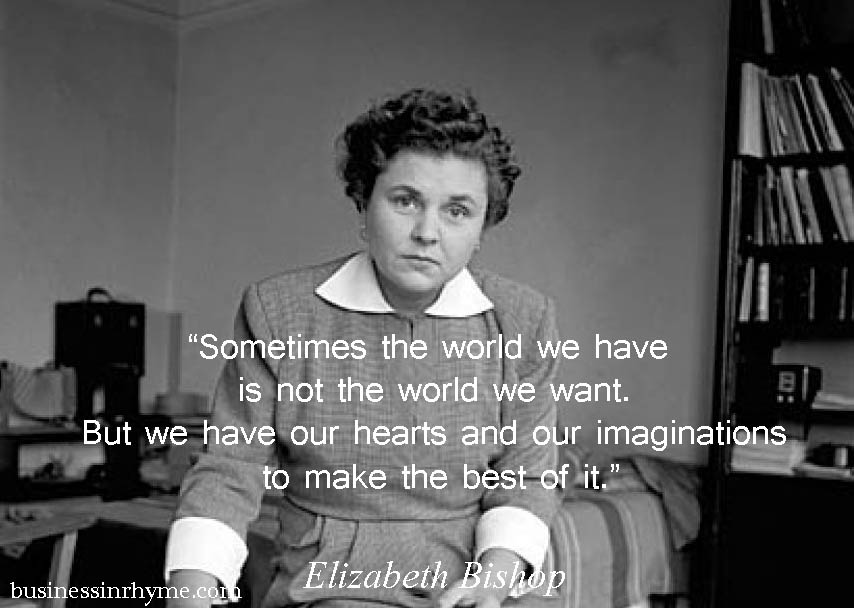
EBishop

Elizabeth Bishop was an American poet, born in 1911. Very early, both of her parents left, so most of her life was marked with moving from city to city, country to country and living with different relatives. For her life time she published only around 100 poems, but she was quite a perfectionist, constantly rewriting and editing her work. In the later years of her career she was globally recognized for her work, winning in the 1956 Pulitzer Prize for her collection, Poems: North & South/A Cold Spring (Houghton Mifflin, 1955).

Her writing is best known for the usage of rich descriptions, giving sensual experience of her physical world to the reader, like in this poem:

Arrival At Santos

Here is a coast; here is a harbor;
here, after a meager diet of horizon, is some scenery:
impractically shaped and–who knows?–self-pitying mountains,
sad and harsh beneath their frivolous greenery,

with a little church on top of one. And warehouses,
some of them painted a feeble pink, or blue,
and some tall, uncertain palms.

For a subsequent amount of time she lived in South America, where especially the stay in Brazil has made a profound influence on her work, which can be seen in her Questions of Travel (1965) poetry collection. In many of the poems, in this collection she raises question, why do we have the need for new experiences? How do we interact with something that is foreign to us? And what and where exactly is home?

In this poem, Question of travel she writes:

Think of the long trip home.
Should we have stayed at home and thought of here?
Where should we be today?
Is it right to be watching strangers in a play
in this strangest of theaters?
What childishness is it that while there’s a breath of life
in our bodies, we are determined to rush
to see the sun the other way around?
The tiniest green hummingbird in the world?
To stare at some inexplicable old stonework,
inexplicable and impenetrable,
at any view,
instangly seen and always, always delightful?
Oh, must we dream our dreams
and have them, too?
And have we room
for one more folded sunset, still quite warm?

But surely it would have been a pity
not to have seen the trees along this road,
really exaggerated in their beauty,
not to have seen them gesturing
like noble pantomimists, robed in pink.
—Not to have had to stop for gas and heard
the sad, two-noted, wooden tune
of disparate wooden clogs
carelessly clacking over
a grease-stained filling-station floor.
(In another country the clogs would all be tested.
Each pair there would have identical pitch.)
—A pity not to have heard
the other, less primitive music of the fat brown bird
who sings above the broken gasoline pump
in a bamboo church of Jesuit baroque:
three towers, five silver crosses.
—Yes, a pity not to have pondered,
blurr-dly and inconclusively,
on what connection can exist for centuries
between the crudest wooden footwear
and, careful and finicky,
the whittled fantasies of wooden cages.
—Never to have studied history in
the weak calligraphy of songbirds’ cages.
—And never to have had to listen to rain
so much like politicians’ speeches:
two hour of unrelenting oratory
and then a sudden golden silence
in which the traveller takes a notebook, writes:

“Is it lack of imagination that makes us come
to imagined places, not just stay at home?
Or could Pascal have been entirely right
about just sitting quietly in one’s room?

Continent, city, country, society:
the choice is never wide and never free.
And here, or there…No. Should we have stayed at home,
wherever that may be?”

Among other themes, Bishop plays around with the notions of identity and its relation to the understanding of “being at home”, and “belonging somewhere”. We observe and absorb new experience, but how that impacts our inner world stays individualistic and personal. She further stirs thoughts and emotions on questions like: does travel makes us more aware of who we truly are, where do we come from and where we are heading?

How deeply rooted are beliefs? How the change of environment can enhance our attitudes and the way we see/perceive things?

Bishop implies that once we are self-confident enough, home is where we are. We don’t have to go to search for something out there, it’s our inner world that requires the most attention and nurturing.

She writes:

All my life I have lived and behaved very much like the sandpiper – just running down the edges of different countries and continents, ‘looking for something’.

New experiences are important. They shape our personalities, but once you begin to live your purpose, becoming who you truly are, you are at home. And your home will be with you wherever you go.


If you liked this post and you are interested in getting more inspiration for your creativity, sign up for our free monthly newsletter.


Hermann Hesse on happiness, writing and how to say ‘yes’ to life

herman-hesse

Hermann Hesse’s life and literary quest was always preoccupied with constant search for meaning of life and faith. He was born into a Protestant-Pietist family of missionaries, preachers and theologians, but somehow Christianity didn’t offer him answers he was looking for. Soon, very much influenced by Hinduism, Buddhism and Taoism, he developed his own notion that humanity actually belongs to some kind of Universal truth that goes beyond any religion and metaphysical explanation. In most of his work, especially in his spiritual poetry he always emphasized the importance of living in the now: on letting go and finding contentment within ourselves.

Whenever in doubt, he invites us to look in nature, observe the flow of life that goes around us and how we are part of that life. It is upon us to say yes to life, to affirm that we are part of some eternal life force and intelligence bigger than us; that we need to trust life and ourselves.

He writes:

Trees are sanctuaries. Whoever knows how to speak to them, whoever knows how to listen to them, can learn the truth. They do not preach learning and precepts, they preach, undeterred by particulars, the ancient law of life.

A tree says: A kernel is hidden in me, a spark, a thought, I am life from eternal life. The attempt and the risk that the eternal mother took with me is unique, unique the form and veins of my skin, unique the smallest play of leaves in my branches and the smallest scar on my bark. I was made to form and reveal the eternal in my smallest special detail.

A tree says: My strength is trust. I know nothing about my fathers, I know nothing about the thousand children that every year spring out of me. I live out the secret of my seed to the very end, and I care for nothing else. I trust that God is in me. I trust that my labor is holy. Out of this trust I live.

When we are stricken and cannot bear our lives any longer, then a tree has something to say to us: Be still! Be still! Look at me! Life is not easy, life is not difficult. Those are childish thoughts. Let God speak within you, and your thoughts will grow silent. You are anxious because your path leads away from mother and home. But every step and every day lead you back again to the mother. Home is neither here nor there. Home is within you, or home is nowhere at all.

So the tree rustles in the evening, when we stand uneasy before our own childish thoughts: Trees have long thoughts, long-breathing and restful, just as they have longer lives than ours. They are wiser than we are, as long as we do not listen to them. But when we have learned how to listen to trees, then the brevity and the quickness and the childlike hastiness of our thoughts achieve an incomparable joy. Whoever has learned how to listen to trees no longer wants to be a tree. He wants to be nothing except what he is. That is home. That is happiness.

Hermann Hesse, Bäume. Betrachtungen und Gedichte

Life is not good or bad. It is what it is. If we dislike something it is mirrored part of ourselves that we don’t like.

If you hate a person, you hate something in him that is part of yourself. What isn’t part of ourselves doesn’t disturb us.

When it comes to writing, if it is something we really want to do in life, we will find the way to work for us. Once we recognize that we have that gift to share with world, gift and value of our own vulnerability,  that we accept and admire it with all virtues and flaws – that is real happiness. Words can be seen as our proof of existence and how we use them makes the whole difference.

“You must find your dream, then the way becomes easy. Happiness is a how; not a what. A talent, not an object. Without words, without writing and without books there would be no history, there could be no concept of humanity.

In the following poem I think that Hesse so vividly and accurately in the same time managed to capture the notion of happiness and why we are all during our lives so allured with it:

Happiness

If luck you chase, you have not grown
enough for happiness to stay,
not even if you get your way.

If, what you lost, you still bemoan,
and grasp at tasks, and dash and dart,
you have not known true peace of heart.

But if no wishes are your own,
and you don’t try to win the game,
and Lady Luck is just a name,

then tides of life won’t reach your breast
and all your strife
and all your soul will rest.

I hope that his thoughts will help you and inspire you in your further creative endevours. You can complement this reading with Mark Strand’s take on creativity, what writing haiku can teach us and little tips on how to develop your own mindfulness practice.


If you liked this post and you are interested in getting more inspiration for your creativity, sign up for our free bimonthly newsletter.