Poetic inspiration: Writing is like playing sports – it takes practice

poetic-inspiration-new-poems

I often play

basketball

with words

in my head:

the one that scores,

ends up on paper.

That’s how my new poems are born.

Maja S. Todorovic


If you liked this post, please share! And if you are interested in getting more inspiration for your creativity, sign up for our free monthly newsletter.


6 tips to make the most of your poetry practice

6-tips-to-make-the-most-of-poetry

Do you remember your first time writing a poem? That feeling of possibility of written word acting like a bridge between your ordinary world and other limitless realities?…We can revive those moments each time we commit to writing or reading poetry, to have that freshness we are looking for in sometimes routine and monotones practice.

Here I will share few tips that I’ve found to work for me, each time I start to lose that feeling of connectedness and intimate conversation I need in order to make ‘poetry work for me’.

While writing:

  1. Always bring intention forward

This is one of the ways to shut down that judgmental part of mind and simply surrender yourself to words. Be open to whatever comes up – no matter how silly or unfocused it might sound. Instead of trying to control your thoughts, bring your intention to poem – let your poem take over and simply capture that true moment of your life. That kind of release can give you an emotional upheaval and leave you feel lighter and regenerated.

  1. Engage all your senses

You have your senses for a reason and use them to adequately express what ever you are experiencing in that moment. Your eyes, your mouth, your ears, your nose and your skin can tell the story – let them help you in your writing practice. The more details you put in describing that moment, the more authenticity your poem gets and portraits better experience to your reader. Poem takes a life on its own and reader  becomes the part of your world. In this way you are practicing also your objectivity, focus and ability to stay mindful.

  1. Entwine emotion in your writing

Often we fall into trap of writing about emotion, describing feelings and sensations instead of letting out words to translate our immersion into emotion. To have that internal satisfaction with your writing you need to write while reliving that particular feeling. It will make presented experience believable for your reader. Writing good poem is not always about using better technique, fancy words and adjectives. Sometimes is quite the opposite. Turning off that analytical side of mind and simply  diving deep into your subconsciousness is a creation of poem where you’ve just found that raw, unpolished diamond – valuable but one that needs right words to shine through.

  1. Proactively read poetry

It is well known fact that writers must read in order to  grow. But you can take some simple steps to make more of your reading time. One of the things I like to do is to rewrite in separate notebook poems I particularly like. Instead of having them in separate poetry collections or computer files in this way I can refer to them in one place whenever I like. Writing down poems by hand has another benefit for me as it allows me to more easily follow the rhythm of poem and simply feel it through my hand. It helps me also to remember phrases and words I would like to incorporate in my writing. As it is suggested in this article you can make lists of words you like, your own ‘poetry stacks’ that you can refer to as a resource for inspiration and writing prompts. I’ve been entertaining this idea for some time now and I think is worth a try.

5. Support poetry

in different creative ways by listening to it, reciting it, buying it and most importantly by sharing your own work. Submit and publish whenever opportunity presents itself – it’s a sure way towards impact and contribution we want to make. And as plus you improve your writing skills!

6.Find other interesting ways to incorporate more poetry in your life

That can be through studying, journaling, mindfulness practice…you can use it for brainstorming creative solutions to problems or simply to create an intimate and sincere gift for your loved one. Possibilities are endless, but the more you engage in this practice the more world around you will start to match your new found perspectives – don’t miss that beauty.


If you liked this post, please share. And, if you are interested in getting more inspiration for your creativity, sign up for our free monthly newsletter.

Poetic inspiration: Creative expression

creativity_expression

This is a quick, weekend reminder that you are creative person and writing is one of the simplest, yet powerful ways to express it.

It’s an inseparable part of you and never reject it – you might be surprised where it takes you.


If you liked this post, please share. And, if you are interested in getting more inspiration for your creativity, sign up for our free monthly newsletter.
A comprehensive guide to developing a lasting writing practice

writing_guide_practice

We all in the beginning have a motivation to start a new habit: we are pumped up, ready to take on that challenge we set for us and stick to it – being that healthier eating, exercise regime or writing habit. And then, after couple of days/weeks our motivation starts to wane, something comes up that distracts us or it takes more of our investment than we anticipated and what happens next? We are back, indulging in social media and TV instead of working on ourselves.

Having a lasting writing habit is like any other habit. Once it becomes ingrained in your subconsciousness there are lesser chances for you to skip it.

Here are my favorite tips on  making writing a regular practice:

  1. First, make room for your writing.

It means that you have to mercilessly evaluate and edit your schedule and maybe lifestyle in order to see where is your time and probably energy leaking. Writing requires you to focus, to devote your whole being to it, to find that sacred creative moments. If you start writing while you are preoccupied with other things, probably it won’t work – and you’ll end up being even more stressed because you are unsatisfied with your writing.

  1. Always have clear mind: why do you write?

What’s the driving force behind that urge to sit and record your thoughts? Whenever I feel doubt I ask myself this question and it helps me recenter my initial intention. Once you have that clear goal you will have that important thought to cling on, each time you feel discouraged. I even think this the most important part of developing a lasting writing habit: it’s almost like brushing your teeth: you are doing it because you want your teeth to be healthy and it makes you more confident. Treat writing the same way – find your best reasons and you can even place them as a reminder on spots where you will frequently read them. It will always give you the boost you need.

  1. Don’t think about the product, it will come as a natural result of your enjoyment of the process.

What I mean by this, many times in writing and other forms of creative actions we might be driven by fear (of reaching a deadline, being rejected, ext.). But look at it from this angle: you are going to do it anyway, so why just simply don’t let yourself surrender to creativity and stop worrying? Some of you might not agree with me on this one, but let me share with you part of my writing and research journey. When I was writing my master’s degree thesis, at that moment I was employed at the faculty as a postgraduate researcher. At some point my one-year contract expired, it couldn’t be prolonged (the funds were cut off due to political situation in the country) and I was on my own – searching for another job. New opportunity presented itself very soon, at the Institute where I was performing research, but the colleague I was supposed to replace was to be retired very soon -which meant I needed to start working very soon. As it was a government institution, it required for me to already have a master’s degree. So in the next few months I was working 20 hours a day to get that research done, written, defended in order to secure that position for me. I did succeed, but I think I could’ve enjoyed my writing more, instead of worrying all the time. And who knows, my thesis would’ve come even better as a result of that. I remember, it was exactly 15 years ago, I pushed myself so hard to a point I got ill. And it didn’t have to be that way. My most honest advice I can give you is to celebrate and enjoy each page you write, that’s what counts – achievements and awards come and go. Experience is what lasts.

  1. Connect writing action to some other trigger – make a ritual.

I like to write while I drink my smoothie in the morning – having that big mug is like a sure sign -writing is due right after – if I skip that, chances I will skip writing all together. Many famous writers are known for having that action, telling him it’s time to write. For instance, Stephen King each time had breakfast or drank tea used this as reminder to sit and write.

  1. Make yourself accountable – find a writing buddy.

This can be fun and interesting way for you to enjoy writing more. You can join some online community, meetups face to face or make a pact with an old friend and develop some rules on how, what, how much you will write and then share and discuss your writings. Many writing schools, like Writer’s studio that I attended use this technique where each week there is a different writing topic and later we would discuss our writings and get feedback. It’s a proven method that seems to work.

I hope this will help you to develop your own writing habit, one that is enjoyable, fun and productive. Do you have any tips? Please share in the comments below.


If you liked this post, please share. And, if you are interested in getting more inspiration for your creativity, sign up for our free monthly newsletter.
 

3 reasons why anything you write has value

quote_writingvalue

Probably you have encountered yourself thinking that what you wrote was not good enough, that nobody would like to read it, ext. And as writers we all have that moments. It’s so easy to let that moment overpower us – just let it flood us with self-loathing about our own skills and capabilities. But today I want to offer you a different perspective on your writing and tell that anything, any word you write has value and it’s not your waste of time.

I so immensely believe in the power of written words, our own words we spill on pages that I’m quite confident in the following statements I’m about to make:

  1. Your writing has value because it’s inevitable part of your own self-exploration and the way to know yourself better.

Each writing session is actually part of something much bigger, a pattern, a recorded reflection of you in particular moment in time. It doesn’t matter do you write a novel, an article, or purely stating your opinion and commenting on someone else’s work – it’s part of you. And anything that is coming from your own sincerity and open heart has value.

What you write at this moment doesn’t have to be perfect. Probably this exact information you are reading can be written in better style, using better words (especially concerning that English is not my mother tongue), but still you can understand the encouragement I want to give you here. And that is what counts, the message and intention behind it.

But this moment me writing this, leads to another writing moment, another blog post, another poem and inevitably we become more comfortable and confident in our writing, which reveals my second reason:

  1. Your writing has value because it’s part of the process where you improve your writing skill and you ‘calibrate’ your writing voice.

As long as you trust your authenticity your writing is original. The way you select and arrange words – especially in poetic writing which is so sophisticated, each time you write poem you are discovering your specific writing expression. It’s unique just as your finger print – you learn to use the words to best express your nature, personality, opinions, belief system and anything you stand for.

  1. Your writing has value as it teaches you to be more mindful of your thinking and stay present in the writing moment.

Each poem or paragraph you write doesn’t have to be approved by editors, experts or published in high impact journals in order to be of value. You write what is true and real for you in that exact moment. While we progress with writing, as it changes so do we. At the beginning of my writing practice I used to write long prose-poems, where I needed a lot of space and words to express myself. As mindfulness begins to dominate my writing lines, so my writing becomes simple and clear. You probably also can relate to this: compare your early works with something you recently wrote and you will see how your poems/writing is more coherent, straight to the point and purposeful.

These are my top 3 reasons why you should keep writing, each time you start to doubt and feel discouraged. There is no word, minute or paper wasted.

And probably the 4th and most obvious (and important) reason that I didn’t list above it’s because it simply brings you joy and fulfillment. Yet, I focused on another crucial elements that most people don’t recognize and easily overlook. These are my three reasons giving me that push I sometimes need to write and commit myself to get the words out there.

Trust your yourself – your writing has value.

The time will come
when, with elation
you will greet yourself arriving
at your own door, in your own mirror
and each will smile at the other’s welcome,

and say, sit here. Eat.
You will love again the stranger who was your self.
Give wine. Give bread. Give back your heart
to itself, to the stranger who has loved you

all your life, whom you ignored
for another, who knows you by heart.
Take down the love letters from the bookshelf,

the photographs, the desperate notes,
peel your own image from the mirror.
Sit. Feast on your life.

Derek Walcott


If you liked this post, please share! And if you are interested in getting more inspiration for your creativity, sign up for our free monthly newsletter.

Autumn

For some reason autumn has always been my favorite time of the year. Dark green, yellow and deep red are colors that always reminded me of maturity, contentment and that satisfying feeling of carrying enough knowledge and experience into the colder and darker days…

For the first official day of autumn let us enjoy these simple yet mindful words by Amy Lowell:

A photo by davide ragusa. unsplash.com/photos/4jcFu1byopQ


If you liked this post, please share! And if you are interested in getting more inspiration for your creativity, sign up for our free monthly newsletter.

INFOGRAPHIC: 9 benefits of reading poetry

As opposed to the most popular post on this blog ‘Why people don’t like poetry’, I have compiled according to my so far done research a little, simple (yet cute, you have to admit 🙂 ) infographic about beneficial aspects of reading poetry.  Many of us do like reading/writing poetry and we all know that it goes beyond pure use of certain words and language functions.

infographic_benefits_reading_poetry

I think this is especially interesting to the newcomers to this blog and how they are not that much acquainted with the previous work done, here are also links of the specific posts leading to creation of this infographic.

How poetry can stimulate creativity?

Poetry and Creativity: crucial blocks in building leadership qualities

Can poetry help you become a better strategist?

Are you a ‘deep reader’? 3 reasons why you should nurture this habit

How important is tacit knowledge for your creativity and one simple way to get more of it

Develop your own mindfulness practice for more patience and joy at work

Diversity at workplace: how to use poetry for improving communication and intercultural differences

Raise your emotional intelligence for creative entrepreneurial leadership- part I

Raise your emotional intelligence for a creative entrepreneurial leadership – part II

Are you an introvert? Poetry can help you access your inner treasures

Please, feel free to share this info as we together can inspire more people to make poetry essential part of their lives.


If you liked this post, please share! And if you are interested in getting more inspiration for your creativity, sign up for our free monthly newsletter.

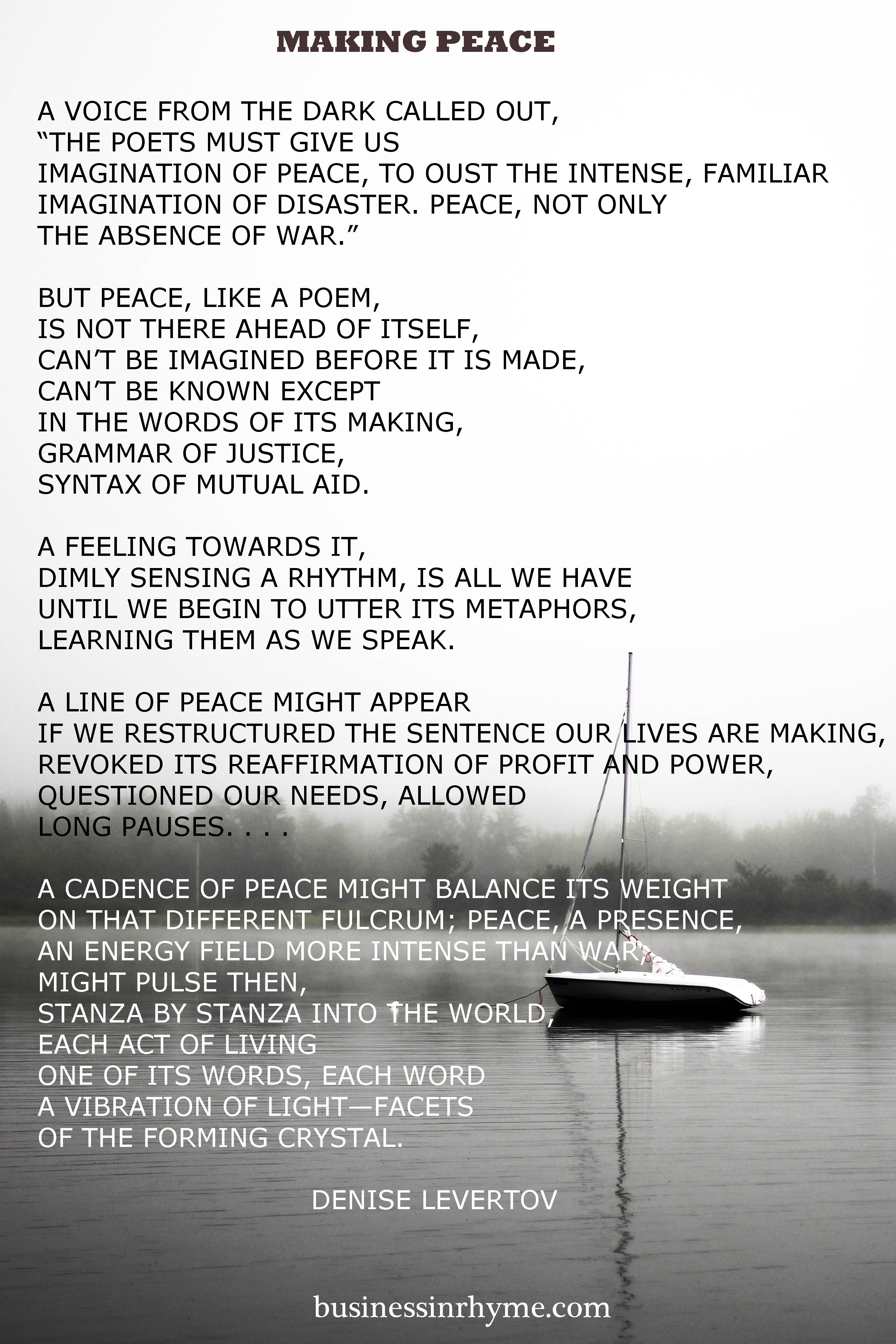
Making Peace by Denise Levertov

As today we are celebrating a World Peace Day, I thought of sharing this beautiful words by Denise Levertov, “Making Peace” and through poetry take opportunity to first find peace within ourselves and simply let that energy transcend further, around us:

peace_poetry


If you liked this post, please share! And if you are interested in getting more inspiration for your creativity, sign up for our free monthly newsletter.