The hunter

For many moon returns I’ve been collecting words. I made a bed. A garden. A bed, planted garden and mounted house, I made of tough love. My heart is even now. It beats in the rhythm of the street clock, only speeds up 6 minutes before noon when it hears the song of trash trucks.

Day sits on my back like a bride’s veil, light but deceiving in this hour of zenith. Nothing stops. You can’t stop. Each worth is measured by a sixteen year old thumbs made of french fries. Exteriors sublimes, narrow walls of sudden disapproval are in front of me. I’m not alone. There’s many of us. Disgruntled, as I rise above superficial daily, biphasic outcomes, executioner appears with an ax, rope, whip in whoop to behead my intentions.

Non-approbation sprouts fear like a weed in the field of your purple smiles;  it’s a black sheep in the white flock of your thoughts, unwanted spurt hair in a bushy emotions you would like to pluck. They say you need to face you fear. I don’t have time for that. I can smell it from a long distance, I can sense its millihertz vibrations. I sneak, like stealthy snake I eat it raw, fragile, undeveloped and spit out the shells made of careless, nameless sentences.

I look deep in side of  myself: satiated garden groomed, blooms in the color of your eyes.

Maja S. Todorovic


Conjunction

She slowly travels towards destined ninth house

where Mercury peacefully waits for Jupiter to arrive

in peregrine flight, exalted in graceful detriment

of opposing stone monolith in the third,

(wanting to return in second)

strong, but humble in the waiting room

of offspring stars breast-fed by the ever-giving moon


Maja S. Todorovic

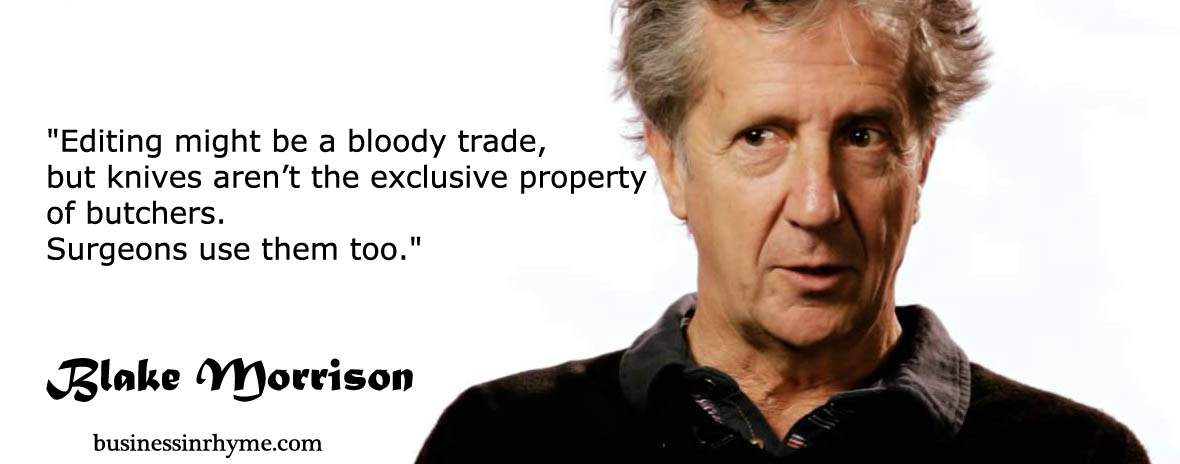
9 best practices that can drive your editing process, part I

blake morrison

This is one of the topics I haven’t written about on the blog before and finally that time came. I know how it is hard to edit your own writing and I will share what in my experience has brought me the most effectiveness in this area.  This post will be divided in two parts and I hope it will help you in your editing process as well.

One of the first things I noticed, depending on your genre of writing and worth keeping in mind is that:

  • Editing of non-fiction writing is far different from editing fiction writing – there are more factors involved that constitutes making a good story, character than in developing an instructional texts, for example.
  • When you are writing an e-book, that requires different format and ‘packaging’ in comparing to your shorter versions you write for an online community like blog posts.
  • A paper copy of your book is very hard to correct (actually once it goes in printing that’s about it) than comparing to a digital version of your work.
  • Your final version of the manuscript that goes to agents, publishers or to be used as reference in some way (like student books) requires that you give all you’ve got to make it understandable and comprehensive as much as possible.

Now, when you spend years in some form of writing, your editing approach evolves as much as your writing. How your writing improves, somehow your need for editing is adapting – still, I always aim to stay true to myself in my communication. That’s the core rule.

Nevertheless, there are few effective tricks that help me become more productive in my editing:

1. Reading out loud.

Only by reading your writing out loud you can get the feel how it gets perceived by the reader. You notice the rhythm and fluency of your words. It can help you immensely.

To carefully edit, read it out loud a few times, and then move on.

2.Let it ‘marinate’ over night.

It gives you an opportunity to observe your writing from fresh and clear perspective; it helps you restore your inspiration and tap into your own creativity – than any revision goes smoothly and you are able to express your thoughts more eloquently.

3. Edit in intervals.

When you read your writing, a lot of things might bug you at the same time: poor grammar, repeating phrases, mushy sentences…When you edit, try to focus on only one thing at the time. For example:

The first time, go through content, cohesion and rhythm of your writing. Are there any ideas that are disconnected, gaps of information, ext? Reading out loud helps you find these omissions. Or even better –  read the piece out loud to someone unfamiliar with the subject and listen to where they start asking questions or looking for clarity. That means you haven’t explained something well enough, and requires further elaboration.

The second time pay attention to your structure and with what impression leaves you the piece as a whole when read? Is there anything you need to emphasize? Does the format supports the purpose of your writing? Always format accordingly to your requirements to show your professionalism. It’s easier for readers to digest information presented and editors prefer industry-standard formatting.

The third time you edit, focus on details, typos and grammar. Probably  you’ve already found some of these by reading your work twice before. Some tips you can use here include:

– use action verbs instead of passive ones;

– avoid using grammar expletives;

– don’t dwell too much on punctuation rules.

Do you know your 5 most frequent words you use in your writing? Overuse of certain words can make your writing repetitive, boring, uninviting. Don’t be afraid to use different words especially in fiction like slang, words from different languages and less used phrases. I like to use slang or terms of natural phenomenon when I want to accentuate a situation or a character. It can spice up your writing and make it more interesting. Can that confuse your reader? Maybe, but look at it like you are offering your reader an opportunity to learn something new. A tiny dash of mysteriousness in your writing can do no harm – on the contrary – it gives special charm and flavor to your piece.

In the next part we’ll talk more about how to silent that inner critique that simply sabotages our editing productivity.

How does your editing process look like?


If you liked this post and you are interested in getting more inspiration for your creativity, sign up for our free bimonthly newsletter.

Bureau for unwanted things

You remember that boy in the 5th grade that pulled your hair and called you ‘Fatty Betty’?

We know all about it.


You know that ugly bracelet your parents gave you for your 21st  birthday and

how you wished it disappear?

Consider it done.


You know that fear of spiders that shows up from nowhere

each time you dust your room?

It’s gone!


Just lift your left arm, it won’t hurt…

This kind man in white coat will take care of everything, dear.


Maja S. Todorovic

Visualize with words (creativity exercise)

jonathan-swifts

I like to call visualization : strategic thinking while having fun. When you read about principles of strategic thinking it might sound too managerial and business oriented, but it is actually a sort of visualization: where you tactfully visualize and plan your desired outcome. Once you develop the ability to relive in your mind what you would like to experience, you are somehow training and preparing your mind (and body)  to achieve  in matching that picture with your performance.

Often guided meditations and visualization exercises are tools with aim to awaken all of your senses and help you more easily and vividly imagine you succeeding in your goals.

But also your writing can help you in visualizing what you want. You know you read good book if writer is capable in his words to put you in the center of the story – where you have impression you are experiencing everything written.

So the next exercise I will propose will help you not only in your visualization, but also you are practicing your writing.

Exercise is very simple, yet effective:

Your task is to name three things, topics, projects – what ever you are working on (or would like to achieve) and describe them using words you never used before to describe them; how that accomplishment looks like, feels like. Try to be descriptive as much as you can, use your senses and be precise – write a poem about it.

Let’s give it a try:

  1. First word: writing

Leaving engraved deep trails, beyond all boundaries and false confinements. Soundless I’m heard above all mountains and below every ocean; materialized thoughts in the smell of graphite, focused desires in every beat of pen on paper, caught ideas with smiley face, released drama in every vowel.

Where and when I offer me to you.

2. Second word: coaching

In service, empowering,  alignment of what I am with fruitful response: where other side becomes glitter in its own eyes and smiles with confidence and determination, air is filled with blooming possibilities and every atom of my knowledge is transferred and received openly, crushing any doubt, inability and disbelief.

3. Third word: creativity

Every moment, every day is new and gives new beginning; different, weird and enjoyable – there’s nothing to be afraid, no reason to hide. It’s warm, exciting, giggly, live, sharp, focused and likes to dance and cuddle.

In the sea of everything existing, it’s the laughter that connects, inspires and teach: with every key stroke, plaudit nod and  receptive silence.

It’s making unbelievable desirable, silly sensible and complex simple, but truthful.

So this is my take on the exercise. Now it’s your turn. Do you use visualization in your work? Does it help you in your writing? Please share in the comments below.

And therefore, though thy name shall pass away,
   Even as a cloud that hath wept all its showers,
Yet as that cloud shall live again one day
   In the glad grass, and in the happy flowers,
So in thy thoughts, though clothed in sweeter rhymes,
Thy life shall bear its flowers in future times.
A Vision Of Poesy (an excerpt)
Henry Timrod

If you liked this post and you are interested in getting more inspiration for your creativity, sign up for our free bimonthly newsletter.

Evolution

It’s in the deepest darkness,

where folded life emerges only with the

raging tempest

or when silence occupies rustling shore.


Untouched they eat flickering moonlight

catch laser sunbeams and jump over foaming waves


yet, don’t recognize our white secretions

we are so proud of, cheap surrogate

of every ounce of coaled milk we suck out

of the earth’s mouth


It’s the new plankton,

It’s the new algae,

It’s the new jellyfish


and the liver transplant in that whale

over there,

they never asked for.


Maja S. Todorovic

Allotropic modification

My lungs are one large, deflated balloon,

sitting somewhere in the lost chair.

I grew  branchiae instead.


You perfectly fit to this porous body,

viscous in masculine, bogus, warm-heartedness.


My shoulders carry dark cloud,

exercising lifting of heavy thoughts.


I know I’m cute, but can’t offer you a smile.

Maybe an open umbrella?


You are amorphously

voiceless, unbroken:

chameleon of the day.


Maja S. Todorovic

The importance of capturing ideas and how that impacts your overall creativity

tharp

There is simply too much information out there. And we become forgetful.

And we mix, misplace ideas, dates, terms, names…It’s simply getting hard to

keep up with everything going on around us.

As a creative, in order to nurture your creativity you need to be more than just well organized and  tidy. You want to have all your ideas stored, in one place where you can access them anytime for some further inspiration or the continuation of the project that you put on hold.

Why is that important? Author Steven Johnson, in his book, “Where Good Ideas Come From” suggests that is of vital importance to have that one central storage point, because every time you go to that place where your previous ideas are collected – that encounter is likely to strike some additional inspiration. Further more, combining new ideas with your previous ones, will produce something completely different that you’ll probably like even more – and this is how new, exciting and creative things are born.

In this enlightening interview famous choreographer Twyla Tharp shares how she keeps her inspiration intact:

Plain old file boxes, like the ones that line shelves in lawyers’ offices. I write the project name on the box, and as the piece progresses, I fill it up with every item that went into the making of the dance.”

So what can you do to make your creative work even more creative?

  1. Assign that sacred creative place where will you put your ideas for any later reference and inspiration:

For many writers it is a computer, notebook or evernote: I for example like to put the articles I’m currently working on to be on my desktop so I can access them anytime. Once I’m finished, they are stored to a delegated folder, so my desktop is never crowded or messy.

pinknotebook

My creative corner and pink notebook 🙂

I always have with me this cute pink notebook as I still like to write by hand (sometimes I have a hard time to read what I wrote (I have a terrible handwriting), but persistence is what counts :))

No matter what’s the nature of your creative work you can design your own inspirational box, board, have that shelf or drawer to place all your favorite items and ideas.

  1. Develop your own system.

Once you have that special place, throw in some additional organizing – maybe using index cards, have folders you can arrange by dates or subjects… there are numerous options: it’s important to find the way that works best for you.

  1. Review your creative place from time to time: let out, to let in.

Now, as much as I like to be able to retrieve my ideas whenever I like, there is a hinder that we might get overwhelmed with too much collected stuff, items, papers, books, old hobbies we are not interested in anymore .. that actually can make us feel lost in times and bring additional confusion into our work.

In that case, I simply try to check in with myself – how do I feel about that particular idea or item: if it brings some bad emotions, memories, maybe it’s time to let it go and make room for something new to occupy that creative space. Honesty and looking really deep inside ourselves will tell us if particular idea is worthy of holding on to or not.

In such ways you have your ideas organized and accessible and you are not in danger of becoming a hoarder of trinkets and ‘maybe some day’ items.

How do you organize and store your ideas?

I had the happy idea that what I do not understand is more real than what I do,
and then the happier idea to buckle myself
into two blue velvet shoes.
I had the happy idea to polish the reflecting glass and say
hello to my own blue soul. Hello, blue soul. Hello.
 
It was my happiest idea.
Mary Szybist

If you liked this post and you are interested in getting more inspiration for your creativity, sign up for our free bimonthly newsletter.