

Tag: poetry
Daily verse with purpose: Thomas Hardy

Daily verse with purpose: Augustus William Hare

9 traits successful entrepreneurs and authors have in common

Many times we get involved in a writing and publishing – just by accident; with first no intention of doing it and often as a side effect of our other activities. First book I ever published was a textbook for University needs. It was developed with purpose to help students who were following my courses, and really, except writing it – I didn’t have much else to do: printing, publishing, distribution..everything was taken care of. And I didn’t have to go too deep into the details of the publishing process.
My second book, was more a commercial one, with specific focus on small and micro-enterprises. I got a deal with one very small publisher in Belgrade, but the hardest part of the work was on me: networking, marketing, speaking engagements, ext. In a way as a published non-fiction writer I became an entrepreneur, since my book became a product that needed to be marketed and eventually sold. It was for first time I was doing something like that on my own – of course I made a lot mistakes, but I also learned a few things (mostly about myself and how it is hard to be an entrepreneur in the writing business).
To be a successful published author (both traditionally and self-published) you need some skills that are characteristics of a successful entrepreneurs. Your book is your product, and you want to take advantage of every little thing that can help you spread the word about your latest written gem.
What can an author learn form a successful entrepreneur?
Do your research.
Like with any other product, you need to do your homework and research how much of the similar is out there: being your fiction story or a ‘practical guide’ your are developing. How is it relevant for your market? Do you even know your market? Probably you won’t figure out everything at once, but even before starting to write a book, you need to be well informed.
Be prepared first to test the waters before taking a deep dive.
As much knowledge you might already have, what I mean by this is that there are going to be many trials and errors taking turns in your publishing attempts, since rarely first book becomes a huge success (or a bestseller) -just as entrepreneurs at the beginning have many ideas, but often one or two become feasible and economically viable. It takes time, and the first book, like a first idea, can often be just a step towards something much bigger, with higher impact.
Be persistent and focused.
Like in any business, an author needs to be focused and resilient in his attempts to make his book a high selling product. These abilities enable both the entrepreneur and author to keep going when the outlook is not favorable. The first book from Jack Canfield, a well known self-help guru, was originally rejected by 144 publishers. When he finally did get a publishing contract, a publisher wasn’t very optimistic: he said he’d be lucky to sell 20 000 books. Yet, a book sold in over 400 000 copies and became a bestseller. That’s the power of persistence at work!
Be persuasive.
As an entrepreneur, if you are in search for an investment funds, no matter how the great idea is, investors are far more interested in an already running company with developed business model and well defined products. They need to know they are investing in something worth while. The same comes with your publishing efforts: If you want to publish a traditional way, why would a publisher offer you a contract? You have to give publishers a reason to sign you, and just having a good book idea is not always enough. You need to be persuasive and convincing, develop a persuasive author bio and book presentation. In self-publishing is even harder: you need to convince the whole world in your idea. And just as any entrepreneur you bite the bullet, go out and do it.
Conquer ‘the marketing’ mountain.
Most people, being artists, writers or engineers are simply horrified by the term marketing (I’m the first in the line!) and I do believe that developing a high quality product (book), that is focused on contribution and purpose, that offers people a way to experience something new and different is the best promotional aspect – product speaks for itself. Yet, for people to try (read) your product first have to know it even exists! That’s the toughest job of the entrepreneur and author: to spread the word. Marketing creates demand for the product. Even before the product (book) launch. Later, the quality of the product will do the rest.
Develop your support system.
You can’t do everything on your own. It’s simple as that. You need someone who is already knowledgeable of the business in question, that can guide you and offer assistance. Someone who is trustworthy. Mostly that falls into marketing arena, because as I said it’s the hardest part of any business venture.
Think in terms of revenue streams.
Every business has a business model. So does a writer. Not only does writer can sell book, but there are other forms to translate a book into a different type of product: an online course, webinars, some type of coaching ext. Or delivering the existing product in a different format (audio book) or dividing it into a series of smaller products. This topic will be in detail addressed in one of the future posts. Here you can learn about alternative ways to earn money as a poet.
Building meaningful relationships.
In this post I go in length on the importance of community and how to develop one.
Here community are not only your readers, but any contact in the value chain of getting your book out there: from booksellers who will recommend your book, editors and illustrators that will dress your book and your readers who will impatiently absorb in every word you’ve written and come back asking for more. Once you build your community, it is an ongoing process maintaining it and growing it further, because in the long run the more you invest in your relationships, the more it will pay off later – especially when other products come in.
Be prepared to learn.
Along the way you will be amazed of how much you learn about yourself and how you are improving yourself in general. Every contact you make, sales pitch or presentation your are improving your communication skills, you are meeting new people and you are becoming a member of a whole new world: publishing world. Juts being part of the writing and publishing process is gratifying enough because you are creating, developing, contributing and you are leaving something behind you, as a fruit of your creative efforts.
Daily verse with purpose: Mark Strand

Catch new ideas while redefining the obvious

Through out the day we encounter many words – some we like, some we dislike; some we even avoid to use, or we overuse. Why is that?
To every word we attach our meaning, definition and somehow just one word can influence our way of thinking and how we form opinion.
The next exercise I’m going to propose belongs to type of writing that some experts and psychologists call free writing. As in this article, author Joel Friedlander sees that free writing:
- is a practice that helps to liberate your writer’s voice and connects you to the vibrant stream of creativity that lies just under the surface of our ordinary thinking.
- can be used to launch you over a writer’s block, to explore painful emotional memories, and to work out problems in a longer work. It can be used for making contact with one’s own unconscious.
- is a simple, structured practice that is flexible and forgiving. It can be used as the base of a writing practice, or spontaneously whenever you want to go deeper into a subject.
You pick one word – it can be a word related to your current project you are working on or just some random word you find interesting, attractive or annoying. The purpose of the exercise, is in your own words to write down general definition, widely accepted meaning of the word.
Then ask yourself do you agree with given definition and give your reasons why you agree or disagree.
Afterwards continue writing what’s your own meaning, what emotions it triggers and ext.
For example, the word danger. One of the generally accepted definitions is life-threatening situation. For me, first impression is the feeling of unease, uncertainty, fear, unpleasant surprise and losing control over situation.
You can write as long as you like. One, two paragraphs. It’s possible that at one point you will feel stuck and think “This is stupid, it doesn’t take me anywhere!” , which is the critical point -by continuing to write, you are unlocking a new stream of ideas that otherwise you might have stopped before they had chance to get out.This type of playing with your insights, examining thinking patterns – opening the word can help you further tap into your creativity potentials. I personally find this exercise very useful – especially when it comes to writing/creating something new, from personal perspective. It can be helpful in terms of crafting a story, poems and blog post and all you need is just one word to start.
Give it try and share your experience in the comments below.
Daily verse with purpose: Matthew Arnold

Restorative power of poetry: remembering your own truth

We can find many connections between poetry and its transformative influence on human lives – especially its healing power. Going back as far as mythology takes us, it is very well known fact that the Greek God Apollo, the son of Zeus and Titan Leto, was the God of music, poetry but also the God of healing, transferring the knowledge of medicine to humans and the God of truth.
In Chinese language, for instance the word poem is comprised of two characters – one meaning word, the other meaning temple. So poem is something that is sacred, the ultimate truth.
In many indigenous cultures, illness is viewed as a state in which an individual is distancing himself from his true nature – both physically and emotionally. If we observe a healing as a process coming back to harmony, to wholeness, poetry can be seen as a healing tool, with a restorative component.
Traditional worship practices in many tribal structures are gatherings, accompanied with dance, rhythm, songs and trance. Sacred narratives and beliefs are deeply based in Nature and are rich with the symbolism of seasons, weather, plants, animals, earth, water, sky and fire. The mode of prayer, a poetic narrative is seen as coming back to Nature, reinforcing the feelings of love and acceptance.
Many poets, emerging in our newer history were trained physicians: John Keats, Oliver Wendell Holmes Sr. and William Carlos Williams who wrote:
It is difficult
to get the news from poems
yet men die miserably every day
for lack
of what is found there.
Today, poetry is accepted as a proven healing method and there are many associations that train and accredit poetry therapists. In particular, the American Poetry Therapy Association has approach that they use a set of poems that their patients discuss and then those poems become a model — even a template — for individuals to write their own poems.
Poet, author and retired university professor David B. Axelrod further notes:
The process helps people get their feelings out and into words. Generally, I don’t worry about the form the writing takes at the outset. I will help someone find the poem within the words they first write. Whatever the methodology, yes, poetry, and story writing, can be a healthy outlet. The results of poetry therapy, if not forced into any specific form, can also trigger marvelously original creations.
No matter which poetry you prefer: spiritual words by Rumi, mythological expression of W. B. Yeats or modern linguistic experimentation of E. E. Cummings, words can pave a path to your own wisdom; help you find that missing puzzle inside that you need to feel whole again and hear your wakeup call for inspired action in the world.
When I am asked
how I began writing poems,
I talk about the indifference of nature.
It was soon after my mother died,
a brilliant June day,
everything blooming.
I sat on a gray stone bench
in a lovingly planted garden,
but the day lilies were as deaf
as the ears of drunken sleepers
and the roses curved inward.
Nothing was black or broken
and not a leaf fell
and the sun blared endless commercials
for summer holidays.
I sat on a gray stone bench
ringed with the ingenue faces
of pink and white impatiens
and placed my grief
in the mouth of language,
the only thing that would grieve with me.
Lisel Mueller
What would you like to read on “Business in Rhyme”?
This blog has been existing almost 6 months and it’s turning into a great community.But of course, no matter how much it gives me space to learn and share my experience – it’s not only about me. So here I created a simple poll that gives you the opportunity to vote which topic of your interest you would like to read more or know about more. You can add your own answers as well. Poetry will stay the central focus of the blog, but I’m interested to see your opinion in which direction this influence of poetry we can further explore.
We are soon approaching New Year and there are some additional novelties that will enrich Business in Rhyme and make it more interactive. I hope you’ll find them attractive as well.
For now, thanks for taking time to vote.
Maja
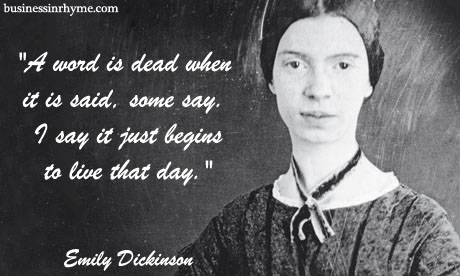
Daily verse with purpose: Emilliy Dickinson
 Business in Rhyme