This limerick goes in reverse…

According to some resources, today, May 12. is the Limerick day. It is also believed that origins of limerick poetry form can be traced back to 14th century. They are short, easy to compose, often speaking of sexual, ironic and humorous connotations. The name itself derives from the Irish town of Limerick and by many critics is not respected as a valid poetry form. Nevertheless, in the defense of limericks, it is believed that even Shakespeare wrote them.

If you want to try on your own to write a limerick follow the rules:

  • the last word in lines 1, 2, and 5 must rhyme and contain 8-9 syllables each;
  • the last word in lines 3 and 4 must rhyme and contain 5-6 syllables each.

One of the most famous writers of limericks is Edward Lear and his book of Nonsense, full of funny and witty verses:

“There was an Old Man who supposed,
That the street door was partially closed;
But some very large rats,
Ate his coats and his hats,
While that futile old gentleman dozed.”

or consider this one by Zach Weiner of the comic “Saturday Morning Breakfast Cereal”:

“This limerick goes in reverse

Unless I’m remiss

The neat thing is this:

If you start from the bottom-most verse

This limerick’s not any worse.”

Have you tried writing limericks? Share with us in the comments below.


If you liked this post and you are interested in getting more inspiration for your creativity, sign up for our free bimonthly newsletter.

Kahlil Gibran’s timeless wisdom on the purpose of poetry and meaning of work

kahlil-gibran

Kahlil Gibran, born in Lebanon, was a poet, artist, philosophical essayist and a novelist,who emigrated to New York in 1885. His work, written both in Arabic and English was very much influenced by the European modernists of the nineteenth century, with deep mystical, philosophical and spiritual understanding of the world.

Gibran had simple, yet direct style and he used writing to liberate himself; to portrait immigrant life of his family and topics relating to alienation, disruption, industry that eats natural beauty – were often present in his work. For him, poetry was an ideal vehicle to transcend the feelings of emptiness, longing and a way to communicate most intimate desires:

Poetry is a deal of joy and pain and wonder, with a dash of the dictionary. Trees are poems the earth writes upon the sky, We fell them down and turn them into paper, That we may record our emptiness.

How we experience the world around us and allow our mind to make it’s on meaning and relations, that’s how our language is going to be:

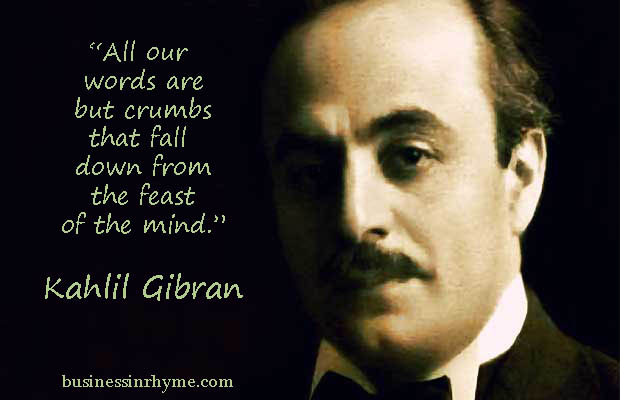
All our words are but crumbs that fall down from the feast of the mind.

He also recognized that without innate feeling and sense of love, all our efforts in any life direction are simply futile. In his, maybe the most popular piece “The Prophet” (1923) in 26 prose poems he discusses and shares his view  on most intriguing topics of human kind, ranging from marriage, laws and friendship to the meaning of work, punishment, pain and joy. Even though it wasn’t seen as a piece of distinct value among American critics, it achieved cult status among American youth for several generations.

For Gibran work equals love:

And all urge is blind save when there is knowledge,
And all knowledge is vain save when there is work,
And all work is empty save when there is love;
And when you work with love you bind yourself to yourself, and to one another, and to God.
And what is it to work with love?

Work is love made visible.
And if you cannot work with love but only with distaste, it is better that you should leave your work and sit at the gate of the temple and take alms of those who work with joy.
For if you bake bread with indifference, you bake a bitter bread that feeds but half man’s hunger.

Once we fuel our work with passion and love, it’s much probable that we will achieve our goals. And there is nothing more joyful, than the alignment of our values, passions and purpose. Than work is not just work. It becomes eager part of life, intentional and deliberate living, bringing meaning to all aspects of our lives.

If you would like further to explore similar topics, I recommend:


If you liked this post and you are interested in getting more inspiration for your creativity, sign up for our free bimonthly newsletter.


Are you losing readership? Probably you are making one of these 3 mistakes

NadineGordimer

When I was younger, I didn’t like very much to read. I liked books and I liked to collect them, but because of the nature of my studies and later my work, I was already so much time “wrapped” in books (researching specialized information) that I didn’t find any interest in spending my free time reading, again. 🙂 So, poetry and prose were not much on my reading menu. But while reading, what I liked the most is that I can search for targeted information whenever I need it and access it any time.

Now, with time my needs and wants changed. I do enjoy reading more poetry and prose. I find it relaxing and comforting. It enhances my writing, my creativity, my way of thinking and self-confidence, my knowledge of languages…the benefits are numerous. I still do search for certain information, relating to skills and knowledge I’m interest in, but the existence of Internet in last 20 years has changed that for us in many ways.

So, one of the reasons to see a decline in your reading stats might be:

1.You don’t know who are you writing for.

You need to know your audience; what are their needs and wants, because it changes with time and evolves. As a writer you need to be able to sense their reading pulse and offer types of information that will attract and intrigue them. Writing also means fostering a community, sharing mutual insights and experiences. This is the first thing that needs to be cleared up, and it will undoubtedly improve your writing too.

2. You don’t recognize the purpose of your writing.

Here, I mean you do need to have clearly defined  what kind of information you are offering; As I said, people do like targeted information, especially if you are a non-fiction writer. As a fiction writer do you have recognizable style, writing voice that your readers can relate to.

3. Your writing is more like ‘a stale pond’ instead of a ‘running river’.

What I mean is that do you offer fresh content on regular basis? Is your content related to contemporary topics and events that people are genuinely interested in?

Do you blindly follow one literary style or do you like to experiment? The point is even in the actual action of writing we do need to be somehow innovative and creative. You like haikus? Great! Next time try to write a longer story. Maybe you could share how actually you like writing short forms. Why? What is there that excites you? Believe it or not, your readers want to read that stuff as well. How do you create, what invigorates you. Share small pieces of you in new, affirmative ways and watch your audience grow.

Do you have any tips and tricks on attracting more readers? Please share in the comments below 🙂


If you liked this post and you are interested in getting more inspiration for your creativity, sign up for our free bimonthly newsletter.

How to use poetry as a self-development tool

hafez

We all know how change can be scary, wanting from you to let go of your previous beliefs and habits and pushing you out of your comfort zone. It’s a work you have to do on your own and there is no right way on how to embrace change on your growth journey. I often like to say that we will meet success in life, once we are able to master ourselves.

What I mean by that?

Let me explain:

Becoming too much immersed and attached to our ego can transform into a real hinder and obstacle on our path of self-improvement. Once we are able to conquer our mind, the self-awareness of who we truly are begins to expand. The motivation and inspiration behind the process is unique, personal and for that purpose we can use variety of tools. Hence plain reading text-books and taking workshops will do little unless you become really motivated and inspired to take a leap towards positive change.Poetry can be noninvasive tool that in  one non-judgmental manner helps you improve your life. It can improve your creativity, decision-making and you can become even more empathetic. When you are inspired by the poetry you read, when you write your own thoughts, change occurs silently, unnoticeably removing fear, bringing maturity to personality at all levels. That’s why I think that it can be a better approach to self-development than reading self-help books and learning lessons like at school class.

Here are just few examples how you can use poetry for self-development purposes:

Find inspirational poems and read them as often as you can.

Select about 5-10 poems that you like and that really ‘speak’to your heart. They should be aligned with your personal goals and what you want to achieve in life.

Write them down in your notebook.

By writing down the words, it’s easier for words to enter your subconsciousness, you are giving them life.You are already creating new experience while connecting with the words in a meaningful way. You can also write down any new idea or comment that comes to your mind while reading the poems.

Find your own inspirational meaning.

Read your poems slowly, absorbing in every stanza. You can use those poems even for a meditation practice. Find most suitable interpretation behind the poet’s words that is motivational for you. You will be more open to what writer is trying to tell you and you will pave your own road towards achieving self-development goals.

Inspired by poems, develop your own affirmative sayings.

Affirmations are powerful way for us to take action. By repeating them we become more inclined to make a change – we will experience desired results only by taking timely inspired actions, where fear is replaced by curiosity about our own potentials and ego by desire to become a better person.

Life is like a sandwich!

Birth as one slice,
and death as the other.
What you put in-between
the slices is up to you.

Is your sandwich tasty or sour?

Allan Rufus


If you liked this post and you are interested in getting more inspiration for your creativity, sign up for our free bimonthly newsletter.

Would you like to support Business in Rhyme?

After many months of indecision, Business in Rhyme has got its Facebook page. I don’t want this Facebook page just to be a replica of what’s already written on the blog, but I truly believe that we can build community around this main topic – writing and poetry can enhance our creativity and contribute to our personal development. In that sense, I see also this page as a space where we can share some beautiful thoughts/poems and with joint forces spread the word about this idea.

You will have the opportunity to publish and popularize your work on the page (through interesting prompts and challenges), maybe inspired by some posts and topics on the blog, which will eventually contribute to better promotion of your poetry and writing and the idea itself.

So what do you think, are you in? 🙂

Here is the link www.facebook.com/businessinrhyme

Hermann Hesse on happiness, writing and how to say ‘yes’ to life

herman-hesse

Hermann Hesse’s life and literary quest was always preoccupied with constant search for meaning of life and faith. He was born into a Protestant-Pietist family of missionaries, preachers and theologians, but somehow Christianity didn’t offer him answers he was looking for. Soon, very much influenced by Hinduism, Buddhism and Taoism, he developed his own notion that humanity actually belongs to some kind of Universal truth that goes beyond any religion and metaphysical explanation. In most of his work, especially in his spiritual poetry he always emphasized the importance of living in the now: on letting go and finding contentment within ourselves.

Whenever in doubt, he invites us to look in nature, observe the flow of life that goes around us and how we are part of that life. It is upon us to say yes to life, to affirm that we are part of some eternal life force and intelligence bigger than us; that we need to trust life and ourselves.

He writes:

Trees are sanctuaries. Whoever knows how to speak to them, whoever knows how to listen to them, can learn the truth. They do not preach learning and precepts, they preach, undeterred by particulars, the ancient law of life.

A tree says: A kernel is hidden in me, a spark, a thought, I am life from eternal life. The attempt and the risk that the eternal mother took with me is unique, unique the form and veins of my skin, unique the smallest play of leaves in my branches and the smallest scar on my bark. I was made to form and reveal the eternal in my smallest special detail.

A tree says: My strength is trust. I know nothing about my fathers, I know nothing about the thousand children that every year spring out of me. I live out the secret of my seed to the very end, and I care for nothing else. I trust that God is in me. I trust that my labor is holy. Out of this trust I live.

When we are stricken and cannot bear our lives any longer, then a tree has something to say to us: Be still! Be still! Look at me! Life is not easy, life is not difficult. Those are childish thoughts. Let God speak within you, and your thoughts will grow silent. You are anxious because your path leads away from mother and home. But every step and every day lead you back again to the mother. Home is neither here nor there. Home is within you, or home is nowhere at all.

So the tree rustles in the evening, when we stand uneasy before our own childish thoughts: Trees have long thoughts, long-breathing and restful, just as they have longer lives than ours. They are wiser than we are, as long as we do not listen to them. But when we have learned how to listen to trees, then the brevity and the quickness and the childlike hastiness of our thoughts achieve an incomparable joy. Whoever has learned how to listen to trees no longer wants to be a tree. He wants to be nothing except what he is. That is home. That is happiness.

Hermann Hesse, Bäume. Betrachtungen und Gedichte

Life is not good or bad. It is what it is. If we dislike something it is mirrored part of ourselves that we don’t like.

If you hate a person, you hate something in him that is part of yourself. What isn’t part of ourselves doesn’t disturb us.

When it comes to writing, if it is something we really want to do in life, we will find the way to work for us. Once we recognize that we have that gift to share with world, gift and value of our own vulnerability,  that we accept and admire it with all virtues and flaws – that is real happiness. Words can be seen as our proof of existence and how we use them makes the whole difference.

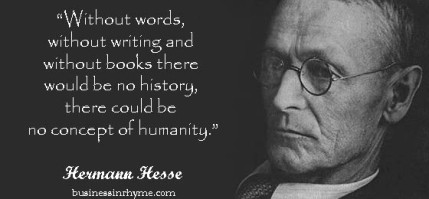
“You must find your dream, then the way becomes easy. Happiness is a how; not a what. A talent, not an object. Without words, without writing and without books there would be no history, there could be no concept of humanity.

In the following poem I think that Hesse so vividly and accurately in the same time managed to capture the notion of happiness and why we are all during our lives so allured with it:

Happiness

If luck you chase, you have not grown
enough for happiness to stay,
not even if you get your way.

If, what you lost, you still bemoan,
and grasp at tasks, and dash and dart,
you have not known true peace of heart.

But if no wishes are your own,
and you don’t try to win the game,
and Lady Luck is just a name,

then tides of life won’t reach your breast
and all your strife
and all your soul will rest.

I hope that his thoughts will help you and inspire you in your further creative endevours. You can complement this reading with Mark Strand’s take on creativity, what writing haiku can teach us and little tips on how to develop your own mindfulness practice.


If you liked this post and you are interested in getting more inspiration for your creativity, sign up for our free bimonthly newsletter.
How poetry enhances development of explicit organizational knowledge

doris-lessing

In this article, I have in depth described how poetry can be closely related to accessing our tacit knowledge, which in our business world can bring us lot of advantage. Tacit knowledge is represented by all our skills that are not only shaped by our education, but mostly through our life conditions, environment, culture, ext. We could say that tacit knowledge is everything undefined, inexplicable, unknown yet perceived knowledge by one person – usually rooted deeply in the subconsciousness and its largely based on any internalized information.

In the paper “Cooking up a storm: Flavoring organizational learning with poetry” author Grisoni L., argues that poetry can go a step further and actually

create a fusion between tangible, rational and explicit knowledge and tacit or implicit knowledge, providing opportunities to access new organizational knowledge; emotional richness, texture and flavored nuance to organizational knowledge and learning.”

In the mentioned paper, poetry is used as a creative research method and as such it contributes to development of new forms of knowledge. Poetry reveals what is hidden, beneath the ordinary organizational behavior, procedures and policies.

The case study for the paper is based on a group of 60 middle and senior managers from a single organization and they were asked to form small groups of three, share their stories and experiences from their working environment. Listeners would capture key words from these stories and together the small group would develop short poems using the haiku poetic form.

Here are some of the presented haikus:

Change risk move frightened

Thought safe, hidden fear revealed

Moved, sparkling sunshine

Ongoing concern – always

People in need, a start

Towards positive change!

Member of team

Develop role, career

Encouraged, valued.

After successful presentation of hauikus, conclusions that emerged are that working with poetry holds the potential to capture emotion and express the un-sayable with passion, truth and intensity. It provides a supportive underpinning to discussions relating to emotions, which form an important part of the organizational learning literature, surfacing and facilitating dialogue about these issues in a way that other processes may not access.

What’s also interesting is that we do create explicit form of knowledge where our skilled performance is  delivered in new ways through social interaction. In this research paper has been shown that poetry is a wonderful medium for doing that. But, how else can poetry help us in business setting? Any thoughts? Please share in the comments below.

Knowledge

Now that I know
That passion warms little
Of flesh in the mold,
And treasure is brittle,
I’ll lie here and learn
How, over their ground,
Trees make a long shadow
And a light sound.
Louise Bogan

If you liked this post and you are interested in getting more inspiration for your creativity, sign up for our free bimonthly newsletter.
5 ways you can reconnect with your own creativity

earl_nightingale

Being creative is not only doing, making stuff or problem solving. Creativity originates from our deepest desires and most sincere aspirations. For me personally, actual act of creating is an act of self-love. It might sound weird to some of you, but if you think more clearly it is true. Any creative expression is an expression of Self in given time and place. The more we show appreciation and kindness towards ourselves, the more creative we become.

Now, I’m not talking about vanity and pretentious, selfish self-love where you neglect and disrespect other people in order to fulfill some personal gains. I’m talking about just being gentle and kind in our thoughts and actions towards ourselves.

When you have problem to connect with your creative side, it’s like pushing away from us the part that needs the most attention; that needs to be understood and nurtured.

Personally when I’m experiencing something like this, usually there is some other underlying cause that distracts me and keeps me from having that intimate encounter with creativity.

There are few things you can do in order to reestablish that connection we all need:

1.Stop criticizing yourself and your work.

As I said, every creative work is a result of our self-expression in given moment and place. Just accept it like that. Once you approve of your own work, your positive changes can start to happen.

2. Stop comparing yourself to others.

You are unique and everything you do is unique. Don’t try to ‘fit in’.You don’t have to belong to any movement, style, group…just be yourself. Work on being better for your own sake, not to be approved by others.

3. Stop sabotaging yourself and start forgiving instead.

You made mistakes in the past. You could’ve done, planned, executed, written, painted, composed, sung, danced, calculated… better, but that’s in the past. You gave your best at the time, considering the understanding, awareness, knowledge that you had and the conditions you were in. Only by letting go we can allow fresh creativity to enter.

4. As you are kind to you mind, be kind to your body.

For long time I didn’t recognize the connection between the foods we eat and how we feel and create. Apparently there is a huge influence of what we are eating on how we are able to perform in any part of our lives. Learn more about your own body, what it needs to feel invigorated, vital and full of energy. Incorporate your favorite movements, walks, dance or exercise.

5. Don’t take everything too seriously.

Now, I’m not saying being reckless or irresponsible. But it’s important to have fun at least in some moments, because by being more joyful we become more open to new ideas, and opportunists.Creativity has that therapeutic quality and once we leave behind all ‘musts and shoulds’, it’s easier to approach our problem differently. And by looking at the world differently,  creativity finds its way towards us – when you least expect it.


If you liked this post and you are interested in getting more inspiration for your creativity, sign up for our free bimonthly newsletter.
 

What’s the future of poetry? ~ conclusions from the Belgrade Poetry Festival 2016

svetski dan poezije

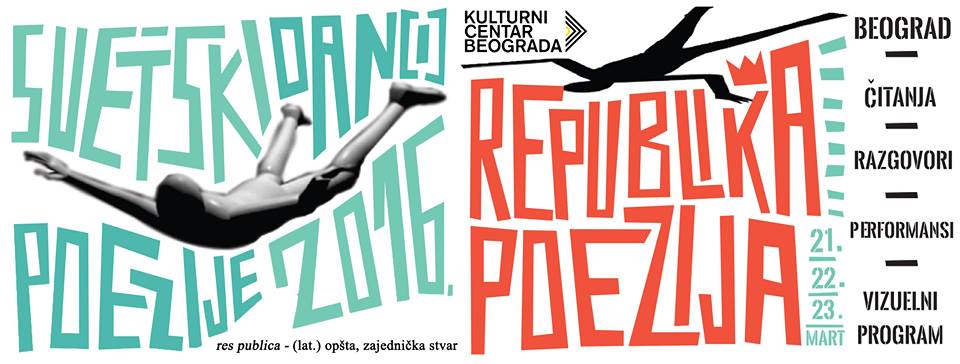
This year I happened to be in Belgrade while traditional poetry ceremony “World Poetry Day(s) 2016” was taking place. This event has been organized by the Belgrade Cultural Center and it was announced that this year’s festival will be dedicated to the relationship between contemporary poetry and society, and the possibility of cooperation of poets, visual artists, and film and theater authors.

Under the name “Republic of Poetry” festival has demonstrated that poetry has once again become an autonomous symbolic territory within which it is possible to develop creative potentials in the wider field of poetry practice.

The festival hosted many diverse participants from around the world like: Jerome Rothenberg, Gerhard Falkner, Maria Grazia Kalandrone, Jaka Zeleznikar, Ursula Kiesling and many others.

Through performances and debates, festival has proven that poetry hasn’t been immune to the phenomenon of globalization and that it is transforming poetry extensively in comparison to previous decades. One of the main conclusions of the festival is that poetry is turning again to experiment, revitalizing thus historical avant garde and neo-avant garde. Poets and artists do have a need for more complex response to  the events we are all exposed to and in order to share their experiences they strive to multimedia expressions combining different resources. As a result, the prevailing poetic practices are transforming under this occurrence. Poets are incorporating some structural elements of other art forms (music, visual arts, theater and dance) while erasing the visible bounders among artistic expressions. Some new literary phenomena are emerging, such as new media poem, which is being created with help of new technologies. Also, the transnational poetic practice can be seen today as one of those emancipatory practices, even though is on the margins of the cultural scene.

Part of festival program was performed on some unconventional locations in Belgrade like clubs, city streets and public transport – with aim to promote more poetry among citizens.

Great focus has been also on discussions about poetry like it’s relations to politics and aesthetics and where is the place of feminism and women’s voices in poetry.

This festival as it tried to answer some questions, it has also opened many new discussions that need to be addressed in the future.

What are your thoughts on future of poetry?

In the Silver Mines

Life in the silver mines nears its end
and soon the time will come
for everyone to take responsibility
for what they didn’t say
the people passing by
touched my cotton shirts
swinging on the line
and my window smashed a thousand times
and Franz Kafka
who sat next to me
in the classroom overlooking the playground
I remember him each time
I fall drunk upon a feather pillow
and put my arms around the fields of grain
swaying in the wind
silently and soundlessly
I will escape people one day
into the forest
that will never become a flooring mill
into the sky
sending rain for eyelashes stuck shut

Zvonko Karanovic


If you liked this post and you are interested in getting more inspiration for your creativity, sign up for our free bimonthly newsletter.
Are you an introvert? Poetry can help you access your inner treasures

hawking

I presume I’ve always been an introvert. And when I was younger I looked at that as a drawback, a negative side. For many years I’ve silently longed to be one of those cool kids that easily steal affection, that with just small gesture or smile so quickly make new friends and become leaders of ‘ the pack’.

I was kind of opposite of all that: only having few friends at the time, never liked to talk about myself – instead I’ve become an ideal ‘shoulder for crying’. As a highly individualistic, books were my favorite company and I never had a problem to spend time alone, with myself. Also, as an introvert I’m somehow on the constant quest for deeper meanings, understandings and knowing. As a motivation, that can be a great advantage in any research profession for example, but somewhere along the way in the recent years, I’ve noticed my introvert side has even grown. That is something I didn’t expect to happen in my late thirties, but it did. And here is where poetry helped me a lot: to express my feelings, thoughts and experiences which I’m not comfortable to share in classical mundane communication.

Poetry can be that articulate tool that gives the voice to those hidden parts of us: sensitive, beautiful, vulnerable, brave, but weak, dark and frightening in the same time. Connection to poetry is always personal and deep that goes to the farthest roots of our being and helps us recognize, accept and communicate who we are: who we truly are. To anyone who is struggling with finding direction in life, self doubt and self acceptance, poetry can help reveal those hidden treasures, strengths that moves us forward; helps us discover our place in the world. In your writing and reading poetry you can find intimacy you might be lacking in an extroverted and often shallow world we are living in.

Having poetry in my life have certainly helped me to better communicate my needs and feelings and generally to cope with pressures of the fast paced world. If you do recognize yourself to be an introvert, introducing more poetry into your life can bring that sensation of nourished soul, that we are taking care of us; that we can find home where ever we are.

There is a place where the sidewalk ends
and before the street begins,
and there the grass grows soft and white,
and there the sun burns crimson bright,
and there the moon-bird rests from his flight
to cool in the peppermint wind.

Let us leave this place where the smoke blows black
and the dark street winds and bends.
Past the pits where the asphalt flowers grow
we shall walk with a walk that is measured and slow
and watch where the chalk-white arrows go
to the place where the sidewalk ends.

Yes we’ll walk with a walk that is measured and slow,
and we’ll go where the chalk-white arrows go,
for the children, they mark, and the children, they know,
the place where the sidewalk ends. 

Shel Silverstein


If you liked this post and you are interested in getting more inspiration for your creativity, sign up for our free bimonthly newsletter.