3 simple truths about your online presence

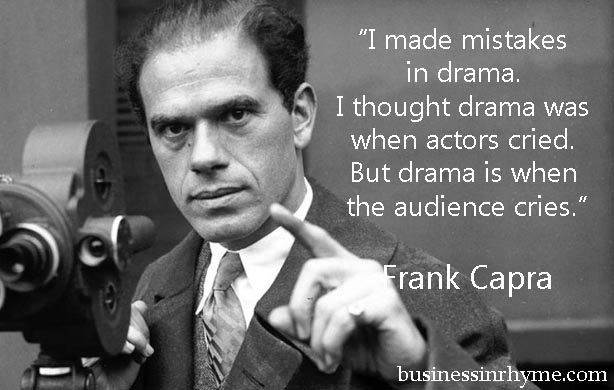
frank capra

In one of my previous posts I talked about the importance of building your community of supporters, people who share your view of the world and values –your tribe as some refer to it.

And when I think of community, I think in every aspect of it: people in physical community are organized and engaged in certain activities and mostly are oriented towards shared goals, values and trust.

Well, much of that we can apply to our online community as well:

  1. Engagement. For fostering mutual trust we need interaction, honest exchange of information and responsiveness to inflow of new ideas, opinions and views. In every community, communication is a two-direction street, a beating heart of your online presence. No matter how large community you might think you have, empty number without discussion and healthy exchange of ideas is like living in an empty, cold, dark cave when from time to time you stumble upon some living creature, and the only sound returning to you is your echo … I always encourage even having smaller group, but the one that is your real audience, ready to complement your every victory and comfort you in your small omissions…that is warm and feisty; that in the same time can understand you and guide you. One simple way to improve engagement is a call for action. Invite your audience to share their experiences, their views, problems… by honoring them in this way your empty and cold cave is transforming into a warm home, filled with real emotions.
  1. Sharing is caring. In old times, before the internet era, companies were in charge of disseminating information, which means they had better control of what kind of information went into the ether. Now we have a different problem: we are facing the challenge of getting the right information. People are turning to internet and social media to dig up what they need to know. In order for your content to be noticed, It has to be relevant to your audience, that is helpful and contributes to improving their lives in some way; entertaining or provides different experience. That’s why sharing is important. It’s your ritual of giving pieces of your time, knowledge and energy and this type of investment that adds value, is building even stronger connections of trust – among you and your target audience.
  1. Make your message clear and focused as much as possible. In other words, find your writing niche. I like to read poetry, for example. But even in poetry I have preferences: I like long, prose poems, with lot of mythology even Gothic atmosphere entwined. So the writings of Margaret Atwood, W. B. Yeats and Kelly Boyker appeal to me very much. Or surrealist approach to poetry.

So, even in your writing, when you try to be narrow as much as possible, you attract right people. If you write to be liked by everyone-chances are you hardly get noticed. People like to feel special, like you are writing specifically for them or referring to their specific experience. When people identify with the message you are sharing, they like to talk about it, share it further: in simple words – your community is growing.

And of me say the fools:
With my poetry
I violated the sky’s commands.
Said who
Love is
The honor-ravager of the sky?
The sky is my intimate.
It cries if I cry,
Laughs if I laugh
And its stars
Greatens their brilliance
If
One day I fall in love.
What so
If in the name of my beloved I chant,
And like a chestnut tree
In every capital I, her, plant.

Fondness will remain my calling,
Like all prophets.
And infancy, innocence
And purity.
I will write of my beloved’s matters
Till I melt her golden hair
In the sky’s gold.
I am,
And I hope I change not,
A child
Scribbling on the stars’ walls
The way he pleases,
Till the worth of love
In my homeland
Matches that of the air,
And to love dreamers I become
A diction-ary,
And over their lips I become
An A
And a B.

Nizar Qabbani
If you liked this post and you are interested in getting more inspiration for your creativity, sign up for our free bimonthly newsletter.

Poetry as an act of prayer, ritual and belief: the case of Slavic Mythology

Nordic, Greek and Roman mythologies are very well known and explored in literature – through science fiction and poetry writing, from anthropological, religious and ethnological point of view. Old Slavic mythology is lesser known and popular, yet very rich in folktales, rituals, mythological creatures. It was a part of the belief system that Old Slavs treasured and celebrated: a multi-theist system of Gods, spirits and “lower beings” that influenced each part of their lives. To old Slavs their Gods are the founts of life, power and happiness. Gods, worshiped for millennia gave the meaning to existence, and protective notion to old Slavs. They were celebrated through rituals and songs – similar to many indigenous traditions.

In some remote Balkan regions, these rituals and songs are still present. Probably due to the reason that when old Slavs adopted Christianity, many of the old, Pagan customs found their place in the new belief system, just disguised under another name and purpose. My father, for example used to tell me about the songs and customs that were performed in his village during spring and summer – because peasants believed that it will influence the yield of the harvest and that it will help them to ‘cheer up’ the will of the Gods (like God Perun, that governed thunders and fire). In order to invoke the rain villagers would perform ritual: a girl, called do-do-la wearing a skirt made of fresh green knitted vines and small branches, sings and dances through the streets of the village, stopping at every house, where the hosts sprinkle water on her.

Following and celebrating religious holidays actually still impacts agricultural activities in many Balkan regions.

This poem I wrote below “Raingirl” was inspired by the ‘dodola’ ritual:

The face of the Earth is crunched,

wrinkled in furrows

burrows, like mouths are widely open

towards the sky with prayer for dull clouds.

Bodies of trees are broken and bowed.

Meadows bald,

leafs curled in sears, in the color of hell.

Some of animals can be seen

soulless, crouching on their celebrity red carpets

dreaming of rain.

It’s time for a Raingirl.

You will recognize her as a young maid,

dressed in rugs, with wreath around her head

adorned with wheat, flowers and grass.

Barefoot she would walk across the village,

her long hair trotting after her. She dances

and sings dow-down-la, dow-down-la while

milking her heavenly cows.

An orphan, as such adored among hearths.

Sometimes she would fly over woods and fields,

to awaken blossoms and green parchments,

as messaged by the God of Thunder.

As first drops appear, tree hands, grass blades, uprooted sinews

unroll their palms, tongues,

tired of summer soberness

in hope to imbibe a little bit of milk.

Raingirl smiles and as she suddenly appeared

in same fashion she evanesces in the mist

with her downy flock.

When we will see a raingirl again?

Once the Sun becomes this angry, heavy. In pain.

Our ancestors, not only in Slavic traditions believed that songs and poems do have a tremendous power to help us sustain even the most difficult times – that type of strength we still can nourish inside ourselves.

If you liked this post and you are interested in getting more inspiration for your creativity, sign up for our free bimonthly newsletter.


Being multi-creative: a curse or a blessing in disguise?

01f/03/arve/g2036/040

This story you are reading  turned out to be longer than I wanted/expected, but it was never intended for bragging about my achievements: on the contrary…

When I was 5 years old I wanted to be a rock star.

That apparently didn’t happen. Then, at age of six I had to be satisfied with short ballet lessons. Soon, already at a school a fling towards poetry was quickly forgotten and “heavy” stuff like math, physics and chemistry took place. I grew up in an environment and belief system that only by being a good pupil/student, hard working in some technical field would only pay off. In high school somehow I got fascinated with magnetic fields,  earthquakes and volcanoes (although in my home country there isn’t almost any). Yet it was interesting scientific field, unexplored enough to satisfy my hunger for knowledge…Strangely enough, due to some circumstances I got a chance to work in the medical field and apply my engineering knowledge in a completely different way! A gratifying experience that introduced me to a whole new world. Nevertheless, I worked in research for several years, when I fell in love with sustainability. Again, my curiosity was awaken and I branched into a PhD research, connecting geophysics, management and sustainability.  And that’s how I led my life until my early thirties. In the meantime I took language courses (English, Italian, Dutch..), dance lessons, ext. I traveled across Europe, Australia, New Zealand, Oceania, Africa..Taught at the University and worked as a consultant for big corporations…As a great fan of mythology I drifted into learning astrology as well, which is still my active hobby…

Then first health issues began to appear (with some I’m still dealing with) and obviously something was wrong. We sometimes pay high prices for our high ambitions, yet something inside  is driving us to move forward. Being multi-creative, curios about the world and having many interests turned out to be both curse and a blessing in disguise, for me. You simply don’t know how to stop, but insights and revelations thrill you all the time; you always feel like you are playing; that you have insatiable need for new and that you have inexhaustible source of energy.

In very interesting post How to Deal with Multipotentialite Burnout,” Wapnick articulates how we may go “too far” in pushing the boundaries of our capacities to keep achieving.

It’s a collapse. Complete mental exhaustion. While most people experience burnout from time to time, creative people who have multiple interests are prone to hitting this point more frequently and more intensely. It makes sense, considering how passionately curious we are, and how easy it is for us to lose ourselves in our projects.”

As much as I am the proponent of creativity, it really can have a dark side – which I have also experienced. And today I would say that the key is balance – as much is for every multi-creative person of great importance to honor each part of their creative soul.

It’s what keeps them alive and empowers them. But not at the expense of health or that something else you need to sacrifice. The timing is also crucial. In my case, if I could do something differently, I would do things at much easier pace.

Often people ask me: “But, don’t you want to specialize in just one field, to become a great expert”? And I say “No. I strive for experience, for taste of something new; there is always a drive to learn something new.”

A common denominator for most of my creative outlets is research and writing. And that’s what I mostly do now, but at much slower pace..and I read a lot of poetry! 🙂

About year and a half ago, poetry silently again entered my life and many things changed for better – even my health since poetry has a healing properties for me. After some time thinking I decided to share my positive experience about poetry in this blog and explore further how it can be beneficial in our stressing work life.

So, if you recognize yourself as a multi-creative person, never neglect your needs. But, instead of ‘everything now and here’, enjoy in your creativity with ease and be compassionate towards yourself; strive for contribution, adding value in what you do, and never shy from learning. It’s a prerequisite for any type of growth.

When  you do things from your soul, you feel a river

moving in you, a joy.

When actions come from another section, the feeling

disappears.  Don’t let

others lead you.  They may be blind or, worse, vultures.

Reach for the rope

of God.  And what is that?  Putting aside self-will.

Because of willfulness

people sit in jail, the trapped bird’s wings are tied,

fish sizzle in the skillet.

The anger of police is willfulness.  You’ve seen a magistrate

inflict visible punishment.  Now 

see the invisible.  If you could leave your selfishness, you

would see how you’ve

been torturing your soul.  We are born and live inside black water in a well.

How could we know what an open field of sunlight is? Don’t

insist on going where

you think you want to go.  Ask the way to the spring.  Your

living pieces will form

a harmony.  There is a moving palace that floats in the air

with balconies and clear

water flowing through, infinity everywhere, yet contained

under a single tent.

Rumi

The Poet’s Manifesto

To set the tone for a year ahead, as an experiment, I’ve decided to post a poem I wrote recently, inspired by some of the poems I’ve read here on WordPress. My poetry is heavy and melancholic, in the form of prose poems and this is quite different and out of my comfort zone 🙂 –  I hope it will motivate you and inspire you in your writing poetry.

The Poet’s Manifesto by Maja S. Todorovic

I am the poet.

You are the poet.

Poetry is everywhere:

in your squinting eyes due to  the bright Sun beams;

in the smell of your first morning coffee;

in the smile of your friend when he sees you;

in the angry voice of your boss, when he teases you;

in the playful butterfly resting on your fingertips;

in the warm, passionate breath on your lover’s lips;

in the barking of your neighbor’s dog;

in the dense fog, heavy autumn rain;

in your unbearable pain.

That’s why you write:

you don’t need to explain,

to confess,

to impress,

anyone, just in vain.

You write because you feel,

you experience,

unsaid, unknown, unseen,

unheard, words unthrown.

You don’t write for adoration

or appreciation.

You don’t write for praise,

someone else to be amazed.

Your poem is your breathing.

Your poem is your existence.

Your poem is your persistence

to continue dreaming.

Words and letters, surprised

gathered here to take off their masks

to let you know:

whenever in doubt –just write!

Your creativity is well disguised.

Sometimes is shy,

encourage it to shine:

– just write!


The poet view on climate change

We are fast approaching the end of December and here, in the Netherlands is one of the warmest winter months ever recorded – so global warming is becoming a “hot topic” in every possible sense! The video bellow points out to a bit different look at climate change. It’s fun and entertaining and I hope you’ll enjoy it is as much as I did 🙂

3 little secrets of Shakespeare’s huge success

shakespeare

William Shakespeare is one of the most famous British  poets and writers. He had quite turbulent and dynamic professional life and all those conditions did influence the quality and trajectory of his work. He was probably already  working as an actor and writer in London when in 1593 theaters become closed due to severe outbreak of the plague.

We can note that as a turning point in his work when he diverts from the business of scriptwriting to the pursuit of art and patronage. Aware that at the moment he can’t pursue his career in theatrical marketplace, he devotes his writings to the eighteen-year-old Henry Wriothesley, third Earl of Southampton. Venus and Adonis, and later published Lucrece opens the door for him to position himself as a professional author and to reap wider attention of aristocracy.

These facts reveal Shakespeare’s ability to seize the opportunity and employ his talents and skills in such way that he didn’t let his current conditions limit him in his work – so that’s the first secret of his success: we should always seek and explore different ways to express ourselves – which can ultimately take us to something even greater.

Documents also witness that William Shakespear was in partnership in an acting company in London, the Lord Chamberlain’s Men, which after the crowning of King James I, in 1603, changes its name to the King’s Men. Shakespear was aware that ‘two heads are smarter than one’ and joint force can lead to much bigger success. From all accounts, the King’s Men company was very popular and the second secret to Shakespear success was his appreciation and awareness of the power of co-creation: that we shouldn’t try always to do everything on our own but rather strive to make meaningful connections and partnerships – which is beneficial for each side involved.

William Shakespeare’s early plays were written in the traditional style for that time – nevertheless he is also very well known for the innovative moments in his writings. Sometimes he would adapt the traditional style to his own needs, using metaphors and rhetorical phrases that didn’t always naturally follow the story plot. He didn’t fear using new words in front of the audience like ‘captious’, ‘intenible’, ‘multitudinous’ and ‘incarnadine’ which quickly found their place in the English vocabulary. This explains his third little secret: he didn’t stride from experimentation and innovation. In order to survive in the business world we need to be brave, try new things and take risks.

Surely, even nowadays we can learn a lot from Shakespeare’s entrepreneurial approach to doing business – being that art, management or writing.

(Biography resources: Poetry Foundation and biography.com)

I’ve just stolen your best idea!

Elizabeth Gilbert

“How come?” You might ask. “Is it even possible, simultaneously, but independently come to a pretty much same idea?”

It’s a tough question. Yet through history there are many evidences of multiple discoveries, especially in science, where researchers independently came to same conclusions and results. For example, the case of electromagnetism: Joseph Henry, lesser known American scientist and engineer, discovered the electromagnetic phenomenon of self-inductance. He also discovered mutual inductance, independently of Michael Faraday, but Faraday was the first to publish his results. In later years, two scientists did meet and collaborated but in the scientific world Faraday reaped all credits and praise.

Oxygen, chemical element was discovered independently by Carl Wilhelm Scheele, in Uppsala, in 1773 or earlier, and Joseph Priestley in Wiltshire – yet the Priestley took the credits since he managed to publish his work first. Antoine Lavoisier, a French chemist, also discovered oxygen in 1775, was the first to recognize it as an element, and coined its name “oxygen” – which comes from a Greek word – meaning “acid-former”.

But this kind of phenomena is not limited to scientific work only. In her newly published book, Elizabeth Gilbert shares her own experience – when two people come to pretty much same idea – even when it comes to writing a novel. She had an amazing story for a novel and she wanted to write it for years. During that time a lot of personal and family changes happened in her life and it simply kept her from completely devoting to writing. And all the time she struggled. One day she accidentally finds out that a friend of hers and a fellow writer, Ann Patchett, came to pretty much same idea about the novel (the plot and geographical location just resembled too much). Her friend manages to publish the story with noticeable success and at that particular moment she new that somehow it wasn’t ‘her novel’ and that idea simply found other and better conditions to flourish. She further notes:

The worst and most destructive conclusion I could’ve drawn was that Ann Patchett had stolen my idea. That would have been absurd, because Ann had never even heard of my idea…People convince themselves that they have been robbed, when they have not, in fact been robbed. Such thinking comes from scarcity  – from a belief that the world is a place of dearth and that there will never be enough of anything to go around.

And I completely agree with this point of view. We do live in the ocean of ideas. Especially in the Internet era we have almost limitless access to acquired knowledge and information resources. And every one of us is a fishermen. Each day, each minute we try to catch new ideas and make them work for us. But like with every fishing process:

  • are we patient enough to wait for the right catch?
  • is our ‘fishing rod’ strong enough to sustain even the biggest catch?
  • and do we have a developed plan what shall we do with our catch – if we are not fast enough it might just jump over the deck back to the sea!

In other words – even coming to a good idea is usually the easy part. But the conditions, our skills, our determination and devotion to a process will ultimately determine if our idea is going to fruition into something valuable or maybe somewhere, in the other part of the world, someone else has invested more energy, time and other resources to implement similar idea. Each idea has to be welcomed, nourished in such conditions that it has all that it needs to grow.

What I truly believe is that the idea cannot be stolen.  Actually that exact fear that we might not be the first is keeping us from our ‘best creative self’. What we can do is to try strategically to position ourselves and our idea and prepare in advance for the work ahead: along the way reexamine our objectives  – it will help us stay on the course with our creative project and make important decisions.


Restorative power of poetry: remembering your own truth

Hildegard_hero

We can find many connections between poetry and its transformative influence on human lives – especially its healing power. Going back as far as mythology takes us, it is very well known fact that the Greek God Apollo, the son of Zeus and Titan Leto, was the God of music, poetry but also the God of healing, transferring the knowledge of medicine to humans and the God of truth.

In Chinese language, for instance the word poem is comprised of two characters  – one meaning word, the other meaning temple. So poem is something that is sacred, the ultimate truth.

In many indigenous cultures, illness is viewed as a state in which an individual is distancing himself from his true nature – both physically and emotionally. If we observe a healing as a process coming back to harmony, to wholeness, poetry can be seen as a healing tool, with a restorative component.

Traditional worship practices in many tribal structures are gatherings, accompanied with dance, rhythm, songs and trance. Sacred narratives and beliefs are deeply based in Nature and are rich with the symbolism of seasons, weather, plants, animals, earth, water, sky and fire. The mode of prayer, a poetic narrative is seen as coming back to Nature, reinforcing the feelings of love and acceptance.

Many poets, emerging in our newer history were trained physicians: John Keats, Oliver Wendell Holmes Sr. and William Carlos Williams  who wrote:

It is difficult
to get the news from poems
yet men die miserably every day
for lack
of what is found there.        

Today, poetry is accepted as a proven healing method and there are many associations that train and accredit poetry therapists. In particular, the American Poetry Therapy Association has approach that they use a set of poems that their patients discuss and then those poems become a model — even a template — for individuals to write their own poems.

Poet, author and retired university professor David B. Axelrod further notes:

The process helps people get their feelings out and into words. Generally, I don’t worry about the form the writing takes at the outset. I will help someone find the poem within the words they first write. Whatever the methodology, yes, poetry, and story writing, can be a healthy outlet. The results of poetry therapy, if not forced into any specific form, can also trigger marvelously original creations.

No matter which poetry you prefer: spiritual words by Rumi, mythological expression of W. B. Yeats or modern linguistic experimentation of E. E. Cummings, words can pave a path to your own wisdom; help you find that missing puzzle inside that you need to feel whole again and hear your wakeup call for inspired action in the world.

When I am asked

how I began writing poems,

I talk about the indifference of nature.

It was soon after my mother died,

a brilliant June day,

everything blooming.

I sat on a gray stone bench

in a lovingly planted garden,

but the day lilies were as deaf

as the ears of drunken sleepers

and the roses curved inward.

Nothing was black or broken

and not a leaf fell

and the sun blared endless commercials

for summer holidays.

I sat on a gray stone bench

ringed with the ingenue faces

of pink and white impatiens

and placed my grief

in the mouth of language,

the only thing that would grieve with me.

Lisel Mueller

5 components of the winning productivity

Voltaire - best philosopher in austere times notes and queries

Simplifying our schedule and work environment are first steps in gaining our productivity back. Hence, staying productive and turning it into a habit, requires also a work from our side. Here, I propose few approaches that can help you become and stay productive.

Prioritize three main tasks.

In this digital age, when technology is conquering every inch and second of our life, many people use to-do lists to stay organized. What really counts is the intention we put behind our planning. No to-do list or planning is effective unless we act upon it: strategically and efficiently. In other words, pile of things you schedule yourself to do with a reminder  that will beep somewhere in the background can only make you more nervous and anxious.

First thing you can do to increase your productivity at work is two prioritize three main tasks you need to do for the next day. The best thing is to write them down, before sleep. In that sense you are putting yourself forward, intentionally preparing your mind for the things that need to be done next day. Late dr Wayne Dyer used to call that “let your ideas marinate over night”.

Become an early riser.

If there are any parts of your life you would like to improve – squeezing in some time for exercising, eating healthier or simply stop being late all the time, you need to start building your morning routine, one that focuses around your needs.

Do less important and repetitive tasks when your productivity is low.

Observe yourself: note at which times your attention and concentration levels are not at their best and do tasks that don’t require that much of your energy.

Kill that nagging perfectionist inside.

No matter how good we are at our work, efficient and reliable, many people simply are never satisfied we the work they produce. But this not affecting only them, but also the people they work with. I had a colleague that what ever she was doing, she did it at such slow pace, the rest of us would always need to wait for her to finish report, to come at the meeting on time and ext. Her work was good, yet she was never satisfied, always in need to correct, add, erase…you get the picture. Now, I’m not the proponent of sloppy work, but at some point you need to put the limits and say “This is good enough – for the conditions, resources, time given – I produced a hell of good job!” – Instead of  terrorizing yourself inside with achieving unreachable perfection for never-ending goal!

Take meaningful breaks.

Take enough rest during your working hours since it can help you feel energized during the day. Instead of stressing about the things you still need to do, try to reflect upon the things you’ve already done: that sense of relief and gratitude for the things you already did, will set you on the right foot for other things ahead of you.

Why sit ye idly dreaming all the day,
While the golden, precious hours flit away?
See you not the day is waning, waning fast?
That the morn’s already vanished in the past?

When the glowing noon approaches, we will rest
Who have worked through all the morning; but at best,
If you work with zeal and ardor till the night,
You can only make the wasted moments right.

Think you life was made for dreaming, nothing more,
When God’s work lies all unfinished at your door?
Souls to save and hearts to strengthen–ah! such work,
Such a richly freighted labor, who would shirk?

Then arise, O idle dreamer! Dreams are sweet,
But better flowers are growing at your feet.
If you crush, or pass unheeding, idle friend,
You shall answer for their ruin in the end.

Ella Wheeler Wilcox

Are you a ‘deep reader’? 3 reasons why you should nurture this habit

lewis

With expanding technology, the way information is transmitted and ultimately perceived by the recipient is rapidly changing. Short messages, texting and visual content is replacing and interrupting the habit of slow reading, which is focused on understanding the meaning and reinforces deep immersion in the written word.

Raymond Mar, a psychologist at York University in Canada, and Keith Oatley, a professor emeritus of cognitive psychology at the University of Toronto explore how habit of slow, deep reading has influence on our behavior and perception of the outer world. Their studies have shown that this type of reading enables individuals easier to accept other peoples point of view.

In a study, researches Maja Djikic and Keith Oatley (2014) at University of Toronto, came to similar results, where they concluded that beside developing the empathetic characteristics, readers were able to act in more altruistic ways. Researches have gone even a step further where they claim that deep, immersive reading can lead to destabilizing personality, making it more receptive to inner experiences.

This type of enjoyment of exploring other people’s mental states can lead to something that is referred to as a pleasure reading. Slow, progressive reading gives deep readers time to reflect upon their reading, analyze and form their own opinions.

Even C.S. Lewis in his highly acclaimed work “An Experiment in Criticism” emphasize the importance of reading.

Those of us who have been true readers all our life seldom fully realize the enormous extension of our being which we owe to authors. We realize it best when we talk with an unliterary friend. He may be full of goodness and good sense but he inhabits a tiny world. In it, we should be suffocated. The man who is contented to be only himself, and therefore less a self, is in prison. My own eyes are not enough for me, I will see through those of others. Reality, even seen through the eyes of many, is not enough. I will see what others have invented…. In reading great literature I become a thousand men and yet remain myself. Like the night sky in the Greek poem, I see with a myriad eyes, but it is still I who see. Here, as in worship, in love, in moral action, and in knowing, I transcend myself; and am never more myself than when I do.

If you are already a ‘bookworm’ these findings probably haven’t surprised you. Yet we do need to remind ourselves from time to time that written shortcuts, and fast scrolling though a gigabytes of irrelevant information cannot replace a cozy afternoon with a book, that “intimate conversation” between you and your favorite author.

Come hither, Boy, we’ll hunt to Day
The Book-Worm, ravening Beast of Prey,
Produc’d by Parent Earth, at odds
(As Fame reports it) with the Gods.
Him frantic Hunger wildly drives
Against a thousand Authors Lives:
Thro’ all the Fields of Wit he flies;
Dreadful his Head with clust’ring Eyes,
With Horns without, and Tusks within,
And Scales to serve him for a Skin.
Observe him nearly, lest he climb
To wound the Bards of ancient Time,
Or down the Vale of Fancy go
To tear some modern Wretch below:
On ev’ry Corner fix thine Eye,
Or ten to one he slips thee by.

Thomas Parnell