Poetic inspiration: Unlock your untold story

unlock_untoldstory_poetry

Unlock that untold story

residing in you,

for once you

break the chains of yesterday,

you will find the way to your most

creative self.

Maja S. Todorovic


If you liked this post and you are interested in getting more inspiration for your creativity, sign up for our free monthly newsletter.

4 simple ways to make your poetry blog stand out

4 simple ways to make your poetry blog stand out

We all know that writing and reading poetry is a unique experience. Words are our tool we use to portrait emotional journey where we want to take our reader. But do we always succeed in that? I pose this question not that much from the writing point of view, but more how do we select and arrange environment where we display our poems. In our blogging space we need to offer an opportunity for that experience to become alive and ‘consume’ our reader.

There are certain ways you can improve your blog to represent who you are and let your writing really stand out.

Chose a theme that allows your words to be the focus.

We do live in the digital era where is emphasis on photographic beauty and memory. But here what matters are your words. Simple, elegant themes that reinforce the power of your words and enable your poems to pop-up are more pleasant to your reader. It should support your writing voice and emotion it transcends.

I always prefer minimalist aesthetics as it sheds all the unimportant stuff away. So if you write a poem, or a quote, story and use just one or two images, that is much more appealing to your reader than scrolling through the crowded screen of unnecessary information. Playing around with different typography can help you accentuate what you think is crucial for reader to notice.

Do you really need all that widgets ‘lingering’ around?

In past few months I’ve experimented with sveral themes and widgets and decided to keep those that I think are beneficial to the reader. The same comes with the menu and header information. I’m usually interested to browse what general topics blog has to offer, and maybe archive. A shortcut for people to follow blog by email, RSS and social media buttons is also good to keep.

I do follow and read a lot of blogs and often I come across those that have duplicate widgets which is quite unappealing (you don’t need to display the same information in sidebar and footer, right?). It doesn’t matter do you blog just for hobby, to fill up your spare time or you are a professional writer: neat looking blog is what invites people in to read your writing. With a tiny effort you can really make your blog clean and easy approachable for reader.

Yes, about page is important.

So you do have a blog. And you share your work. Guess what, people will often like to know more about you –  there is nothing inherently wrong with that. You control what information you put but I think having that about page and few sentences where you give bits of yourself can be beneficial. Even better, as a poet why don’t write interesting poem about your blog/your writing?

I, for example in the beginning had a short version of my CV, which is not that much related to what I’m doing here (except from the creativity part) and I realized it was too heavy. Than I completely rewrote it. Now my about page in more humorous and fun way accentuates just few really important facts about me and my blogging.

For more professional author biography here I share best tips on how to write it.

Offer different formats of your work.

As a writer/poet this is an area you can further explore. Many people prefer audio formats. You can record reading of your poems and use sound cloud services to share your readings. It might be your work or poems from other popular poets. It’s good to know that we all differently digest information and we need to use technology to our advantage – in a way it will support our work, not hinder it.

In a nutshell, your content is your branding. Let it shine. We are here for love of writing and reading, and that’s where all the magic happens. With these given tips, “shower” your faithful readers with regular writing and you will see how your community will grow.


If you liked this post and you are interested in getting more inspiration for your creativity, sign up for our free monthly newsletter.

Poetic inspiration: The Power of Poetry

poetry_dosage

Poetry comes in small packages,

because all you need is a tiny dosage

of concentrated emotion to

electrify your whole being.

Maja S. Todorovic


If you liked this post and you are interested in getting more inspiration for your creativity, sign up for our free monthly newsletter.

4-step process to achieving your creative goals every day

4-step process to achieving your

In our already very busy lives, the pressure to do more and perform better seems to grow, even though we stay with the same amount of hours in a day. The to-do lists are getting on popularity with all accompanying tools like apps, digital notebooks and ext. just for you to become more productive. Still, there is an underlying question: we might be able to do more, but with what quality? I am always for quality over quantity, since it is less stressful and you will be more satisfied with the work you’ve done.carnegie

So how you can organize your day, in order to meet all your desired creative goals?

Cut the long to-do list short.

So the first step in this process I would recommend for you to clearly and realistically go through your daily tasks/goals, make priorities and choose only those that are really important.

Define what’s really important to you.

In order to retain that initial drive for accomplishing our goals, it is crucial to focus ourselves on the tasks that serve our purpose, that will benefit us in the long run. Only when you divert your thinking to work on what really matters, you begin to more appreciate your time and what you do with it.

Notice when are your high energy levels.

As everything around us has its cyclic rhythm so do we. Life is made of cycles and seasons so we need to observe ourselves in what part of the day we are most productive. That’s the power we should harness as much as we can. Follow the flow of your own rhythms instead of pedaling against the stream. I’m for example a morning person and I build my daily routine around those pick energy levels to take the maximum advantage of it.

Focus only at one task at the time.

Multitasking is a myth busted long time ago. It’s a deceiving feeling you are getting more things done, while what it does it’s quite the opposite. You might initially do more, but the tiredness and stress that accumulates simply adds up to long-term exhaustion. For many years, I personally was very proud of my multitasking skills. Yes, I managed to do more things, but at the end of the day I was always left with some ’empty’ feeling, like something was missing. And that was strange, because the purpose of the multitasking is to do more things and get that feeling of accomplishment and satisfaction, right? Until several years ago I realized that key source of my stress was that endless try to get everything done, fast and in short period of time. Than I began to declutter my schedule and get more focus on what’s really important. The biggest lesson I learnt is when you approach your obligations, strategically, with end result in mind, your focus will sharpen and your energy won’t get dissipated on meaningless activities. While remaining on doing one thing at the time, completely present in the moment, actually our effectiveness with time can grow, since it allows you to enjoy your work, simply to be immersed in your creativity. In Buddhist traditions, the philosophy is to do everything slowly and deliberately, with complete concentration. Put your mind completely on the task and try to avoid distractions.

If you have big projects, then break them into small pieces and do segment by segment, one step at a time.

How do you spare time for your creativity? Please, share in the comments below.


If you liked this post and you are interested in getting more inspiration for your creativity, sign up for our free bimonthly newsletter.

9 best practices that can drive your editing process, part II

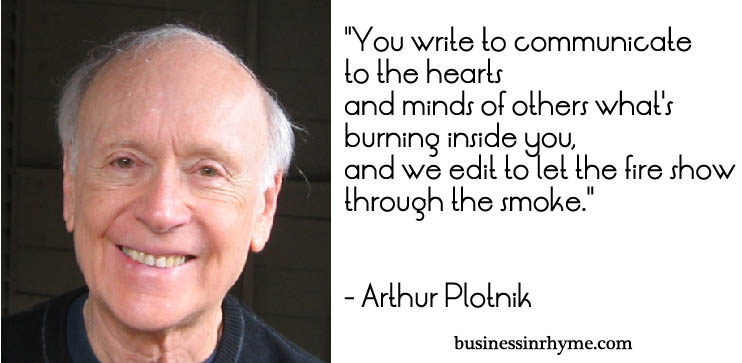
Art-Plotnik

In the first part of this blog post I shared some of my favorite practices that can help you become more efficient when it comes to editing. But there are more things you can do to become even more productive:

  • Track Your Bad Habits.  If you want to be better at your writing and editing, try to notice your typical mistakes and actions. Commonly misusing a word or phrase? Highlight that word or write it on a sticky note somewhere you will see it often. It will remind you not to use it and think of more creative ways to say something. One thing that really works for me is to write myself notes  for anything I need to correct. It’s a learning process in progress and how your writing improves, less things you will want to fix.
  • Try reading it backwards. This is a bit weird, but it helps you become more aware of what you wrote. Begin with the last sentence and move up from there. You can see does your writing builds momentum, some sort of positive tension of expectation: words play with your logic and your focus improves – you can better sense the fluency and rhythm of your writing
  • Don’t be hard on your self. The truth is there is no perfect writing. Your task is to do your best with given time-frame, conditions and knowledge you have. That has to be enough.

Now, my students often used  to ask me: “Can you over-edit your work and how that can harm your writing?” and I think it’s a good question to answer.

Over-editing can prevent you from sharing your knowledge and message with rest of the world. Your writing doesn’t have to be 100% perfect in order to help and inspire someone. When you you are tempted not to publish your work, that’s almost the same as you have erased all of your work – it can’t help anyone if it’s hidden in your computer folders. Instead of torturing yourself  over grammatical perfection, ask yourself does your writing brings any value to your readers? The next thing is, it simply kills your productivity. Over-editing wastes time and energy. It’s tiring, it sucks the inspiration out of your body and mind.

How to recognize you are over-editing?

  • you are endlessly rewriting what you already wrote, without moving on to write something new. That holds the danger of you losing your own writing voice and the purpose of your writing. When you edit your piece too many times, you can end up editing every drop of life out of it. A conversational style is becoming more popular and you shouldn’t shy from it. It helps you connect with your readers and express your won personality through words. Even in business communication you need to stir up your writing and avoid being too stiff;
  • you let fear command your editing and you start to doubt something you previously considered good.
  • you sense something is wrong or missing but you can’t figure it out and that keeps you stuck at one page.

So, what to do about it?

Our habit to over – edit is connected with critical side of our brain that seeks approval and strives for impossible perfectionism. One little trick that might help is to make notes for yourself what you want to accomplish in writing that day – bring intentionality to your writing.

Monitor your self-talk and tell yourself you’ll deal with it later. You might be saying to yourself something like “This is just too boring.” Or “I’m a really bad writer.” The trick is to be conscious of it. Then, answer to yourself in kind and gentle way–

“I’m writing right now the best I can;  I’ll deal with these concerns later.”

This kind of silent promise you give to yourself shuts down that resentful critic and allows more space for creativity.

Many of us spend more time editing than on the actual writing. Editing is a just a tool that helps us improve what we already wrote, but it doesn’t determine are you bad or good writer. What mostly matters is the idea and the purpose behind it.

Now, it’s your turn: do you have any editing tricks to share with us?


If you liked this post and you are interested in getting more inspiration for your creativity, sign up for our free bimonthly newsletter.

9 best practices that can drive your editing process, part I

blake morrison

This is one of the topics I haven’t written about on the blog before and finally that time came. I know how it is hard to edit your own writing and I will share what in my experience has brought me the most effectiveness in this area.  This post will be divided in two parts and I hope it will help you in your editing process as well.

One of the first things I noticed, depending on your genre of writing and worth keeping in mind is that:

  • Editing of non-fiction writing is far different from editing fiction writing – there are more factors involved that constitutes making a good story, character than in developing an instructional texts, for example.
  • When you are writing an e-book, that requires different format and ‘packaging’ in comparing to your shorter versions you write for an online community like blog posts.
  • A paper copy of your book is very hard to correct (actually once it goes in printing that’s about it) than comparing to a digital version of your work.
  • Your final version of the manuscript that goes to agents, publishers or to be used as reference in some way (like student books) requires that you give all you’ve got to make it understandable and comprehensive as much as possible.

Now, when you spend years in some form of writing, your editing approach evolves as much as your writing. How your writing improves, somehow your need for editing is adapting – still, I always aim to stay true to myself in my communication. That’s the core rule.

Nevertheless, there are few effective tricks that help me become more productive in my editing:

1. Reading out loud.

Only by reading your writing out loud you can get the feel how it gets perceived by the reader. You notice the rhythm and fluency of your words. It can help you immensely.

To carefully edit, read it out loud a few times, and then move on.

2.Let it ‘marinate’ over night.

It gives you an opportunity to observe your writing from fresh and clear perspective; it helps you restore your inspiration and tap into your own creativity – than any revision goes smoothly and you are able to express your thoughts more eloquently.

3. Edit in intervals.

When you read your writing, a lot of things might bug you at the same time: poor grammar, repeating phrases, mushy sentences…When you edit, try to focus on only one thing at the time. For example:

The first time, go through content, cohesion and rhythm of your writing. Are there any ideas that are disconnected, gaps of information, ext? Reading out loud helps you find these omissions. Or even better –  read the piece out loud to someone unfamiliar with the subject and listen to where they start asking questions or looking for clarity. That means you haven’t explained something well enough, and requires further elaboration.

The second time pay attention to your structure and with what impression leaves you the piece as a whole when read? Is there anything you need to emphasize? Does the format supports the purpose of your writing? Always format accordingly to your requirements to show your professionalism. It’s easier for readers to digest information presented and editors prefer industry-standard formatting.

The third time you edit, focus on details, typos and grammar. Probably  you’ve already found some of these by reading your work twice before. Some tips you can use here include:

– use action verbs instead of passive ones;

– avoid using grammar expletives;

– don’t dwell too much on punctuation rules.

Do you know your 5 most frequent words you use in your writing? Overuse of certain words can make your writing repetitive, boring, uninviting. Don’t be afraid to use different words especially in fiction like slang, words from different languages and less used phrases. I like to use slang or terms of natural phenomenon when I want to accentuate a situation or a character. It can spice up your writing and make it more interesting. Can that confuse your reader? Maybe, but look at it like you are offering your reader an opportunity to learn something new. A tiny dash of mysteriousness in your writing can do no harm – on the contrary – it gives special charm and flavor to your piece.

In the next part we’ll talk more about how to silent that inner critique that simply sabotages our editing productivity.

How does your editing process look like?


If you liked this post and you are interested in getting more inspiration for your creativity, sign up for our free bimonthly newsletter.

Visualize with words (creativity exercise)

jonathan-swifts

I like to call visualization : strategic thinking while having fun. When you read about principles of strategic thinking it might sound too managerial and business oriented, but it is actually a sort of visualization: where you tactfully visualize and plan your desired outcome. Once you develop the ability to relive in your mind what you would like to experience, you are somehow training and preparing your mind (and body)  to achieve  in matching that picture with your performance.

Often guided meditations and visualization exercises are tools with aim to awaken all of your senses and help you more easily and vividly imagine you succeeding in your goals.

But also your writing can help you in visualizing what you want. You know you read good book if writer is capable in his words to put you in the center of the story – where you have impression you are experiencing everything written.

So the next exercise I will propose will help you not only in your visualization, but also you are practicing your writing.

Exercise is very simple, yet effective:

Your task is to name three things, topics, projects – what ever you are working on (or would like to achieve) and describe them using words you never used before to describe them; how that accomplishment looks like, feels like. Try to be descriptive as much as you can, use your senses and be precise – write a poem about it.

Let’s give it a try:

  1. First word: writing

Leaving engraved deep trails, beyond all boundaries and false confinements. Soundless I’m heard above all mountains and below every ocean; materialized thoughts in the smell of graphite, focused desires in every beat of pen on paper, caught ideas with smiley face, released drama in every vowel.

Where and when I offer me to you.

2. Second word: coaching

In service, empowering,  alignment of what I am with fruitful response: where other side becomes glitter in its own eyes and smiles with confidence and determination, air is filled with blooming possibilities and every atom of my knowledge is transferred and received openly, crushing any doubt, inability and disbelief.

3. Third word: creativity

Every moment, every day is new and gives new beginning; different, weird and enjoyable – there’s nothing to be afraid, no reason to hide. It’s warm, exciting, giggly, live, sharp, focused and likes to dance and cuddle.

In the sea of everything existing, it’s the laughter that connects, inspires and teach: with every key stroke, plaudit nod and  receptive silence.

It’s making unbelievable desirable, silly sensible and complex simple, but truthful.

So this is my take on the exercise. Now it’s your turn. Do you use visualization in your work? Does it help you in your writing? Please share in the comments below.

And therefore, though thy name shall pass away,
   Even as a cloud that hath wept all its showers,
Yet as that cloud shall live again one day
   In the glad grass, and in the happy flowers,
So in thy thoughts, though clothed in sweeter rhymes,
Thy life shall bear its flowers in future times.
A Vision Of Poesy (an excerpt)
Henry Timrod

If you liked this post and you are interested in getting more inspiration for your creativity, sign up for our free bimonthly newsletter.

One simple, foolproof tactic that improves your writing dramatically

Sholem_Asch

There are many ways we can approach our writing. And if you are reading this, you are probably a writer who knows how writing is important: it’s how you communicate, how you record your ideas, memories, feelings, – you share who you are, and your knowledge.

But even more important it is how you build your world, your reality and the most deepest connection with your true self. It helps you sort out through the piles of information you absorb each day and you learn what you want and don’t want. It can be a remarkable foundation for our business and work as it gives us confidence and power to make an impact in a bigger, better, and more meaningful way.

Often in my posts you will recognize that I emphasize all these traits of writing and encourage you to just write – no matter what, how, where… These are free writing forms with only one goal in mind: tap into your own inspiration and creativity.

But today I will offer you a bit different approach that helped me immensely. Next time when you sit to write, bring intentionality to your writing. By that I mean to have more clear focus and understanding of what you want to write and why you want to write it.

When I’m writing, I always have three questions in the back of my mind:

  • Is what I want to say clear and understandable enough? My writing, for me to be satisfied with it, has to reflects who I truly am and transcend my message to the world in the right way. Some other questions regarding to this that can help you is to ask yourself: does it have the impact I want to create? Is this conveying the right drama, or humor? Is it thought provoking and what kind of value does it bring to my readers?
  • This second question turned out to be huge for me: Did I structure this for the best possible impact? When I was working on my PhD proposal, I remember I had an informal meeting with my mentor  and I came with a lot of papers, notes, ideas I collected somewhere during initial research..But the best advice she gave me then, is to make an outline, a backbone of my thesis which will guide me along the way of my writing. Why that became so important? Because it helps you set the boundaries in your research and writing – if you ‘spill yourself’ all over the place, without focus what information is important and what’s not – you will just get lost. It helps you to stay focused and on track. This is especially applicable to longer forms of writing –  no matter fiction or non-fiction.  Of course, you can edit and improve your initial outline as your work progresses and new ideas come into play, but it enables for your writing to get aligned with your values and contribution you want to achieve.
  • How can I improve this? With all my current knowledge and view on the subject I try to improve what I wrote, usually by simplifying it. I reread what I wrote for several times – not looking so much for punctuation errors or typos, but to make sure I’m satisfied with everything I’ve written.  I need to distance myself for a couple of hours or I leave it ‘marinate’ over night and that gives me the best perspective on my writing.

You become a better writer by focusing on the task at hand and recognizing what’s not working for you.  You are not satisfied with your descriptions or narrations? Well, dive into those and only by practice and persistence you will improve your weak points in writing.

These three questions enable me to strategize my writing, stay true to my self, my core values and share my knowledge in such way  that it has a valuable impact. So next time, in your writing try to answer those questions and observe how that influences your writing. You might be surprised with the results 🙂


If you liked this post and you are interested in getting more inspiration for your creativity, sign up for our free bimonthly newsletter.

3 secrets to turn your fear of rejection into a mastery of productivity

plath

Work that is rejected: one of the writer’s worst nightmares. It simply happens that we sometimes put hours, weeks, months and even years into our writing, but it keeps being rejected all over again. And very soon there is a background ‘cheering’ voice: “I completely suck! I should quit writing, there is no use. I’m just losing my time!”

And what to do then? Should we quit writing all together? Just sit in the corner and complain over our bad luck? Or is there something we can do to turn that process and experience into something positive and productive? Looking from psychological point of you, expert John Amodeo, PhD claims:

On a cognitive level, we may be afraid that rejection confirms our worst fear — perhaps that we’re unlovable, or that we’re destined to be alone, or that we have little worth or value. When these fear-based thoughts keep spinning in our mind, we may become agitated, anxious, or depressed.

A big part of our fear of rejection may be our fear of experiencing hurt and pain. Our aversion to unpleasant experiences prompts behaviors that don’t serve us.

Being human, we long to be accepted and wanted. It hurts to be rejected and to experience loss”

Further more, accepting that feeling of failure that is true for us can have a completely counter effect on our whole being, driving us away from what we are passionate about, what keeps us alive. It negatively impacts our health, our relationships and our life in general. How to turn all that experience into an opportunity to grow?

  1. Acknowledge your fear of rejection

Once we acknowledge that there is a fear residing within us, that our work at this time maybe is not at its best-this is actually a first step to combat fear in positive way. By accepting that this fear doesn’t serve us, opens the door for us to move through that fear and explore what’s on the other side. By having that more gentle, kind and less criticizing relationship with our feelings that appear as a result of rejection,  we can “reset” our creative self more quickly and seize the opportunity hidden within our fear.

  1. It’s a part of the process that every writer has to go through.

Nobody is born as an excellent writer. Every writer has to work on their writing craft, refining their style, improving and editing every word they write. It takes time, courage and a lot of effort –  it’s simply a continuous work in progress.

Joshua F. Millburn in his essay How to improve your writing: 3 tips says that if your want to improve your writing: ”Sit in the chair.” Sounds to easy?

These four words changed my life. For a long time, I was an aspiring writer—which meant I didn’t write much. Sure, I aspired daily, but I didn’t make writing a priority. Instead, I spent time passively parked in front of glowing screens: watching TV, perusing Facebook, checking email. I didn’t become a writer until I developed a writing habit. People don’t learn how to write via osmosis; it takes work. So forget word count or page count—focus instead on sitting in the chair distraction-free, writing for at least an hour a day. Do this for a month and you will improve more than you thought possible.

  1. By embracing your rejection graciously, you are already improving your writing.

Once we become grateful for our experiences, we are more able to let go. It gives us clarity and our willingness to learn and put additional effort comes to forefront. Give back yourself permission to enjoy writing. It fuels our persistence to improve ourselves, not only in writing. No matter how many rejection letters pile up, you can use them to improve your skills. And not only will you improve skills, you readiness to write under certain conditions will improve: time you need to write something with a deadline; you get better acquainted with the writing market and that will shorten your time you need to do the research. You become familiar with your fear and with ease you recognize possible mistakes you can mitigate on time.

With each rejection you learn how to be better – as the quality of your writing improves, so does your efficiency.

How do you deal with rejection? Does it impact your writing? Please, share your experience in the comments below.


If you liked this post and you are interested in getting more inspiration for your creativity, sign up for our free bimonthly newsletter.
Poetry: a savior that comes when you least expect it

Gao Xingjian

Many of us, engaged in reading and writing are aware of transformative power of poetry, healing power and artistic value it brings to our lives. But how far does that really goes? Can you be saved by a poem?

In this enlightening interview, poet an writer Kim Rosen loudly answers, yes:

In the aha! moment that occurs when the mind bursts open—at a breathtaking metaphor or an insight or a chiming among the words—all levels of being human come into alignment. You feel a sudden integration of body, mind, heart and soul. The fragmentation that many experience in the multitasking onrush of modern life cannot withstand a good poem.

For many years she even feared poetry, thinking it was some kind of elite club, secluded for some ‘special’ and very important people. But on the verge of suicidal depression, poetry came when she most needed and literary saved her life:

In the midst of a suicidal depression, poetry poured back into my life, touching me in a way no spiritual or psychological teaching had been able to—literally saving me. The healing did not come through writing poems or even through reading them. It came when I discovered that taking a poem I loved deeply into my life and speaking it aloud caused a profound integration of every aspect of me—physical, emotional, mental and spiritual. I felt a wholeness I had never before experienced.

Further, she proposes we find a poem that really speaks to us and learn it by heart: read it loud as often as we can until it engraves somewhere deep in our soul and help flourish some better and more supportive thoughts. It can help you establish better relationship with yourself and explore sides of your being you didn’t even knew existed before. That’s what poetry does.

But what about writing your own poetry?

Dr. James W. Pennebaker, one of the most widely published researchers on the benefits of writing, says in his book, “Opening Up: The Healing Power of Expressing Emotions”, that writing about emotional topics improves the immune system by reducing

stress, anxiety and depression, improves motivation and aids people in securing new jobs.

About my own personal experience,  I wrote in this post how poetry came back into my life. And it happened to be that sacred, little place I was looking for to be only mine, that I could decorate, erase, fill, create or destroy the way I wanted. I didn’t have to offer any excuses, explanations or justifications for me being me.That kind of comfort is priceless. You learn to accept yourself just the way you are and you see that world isn’t some ugly place that want to make you miserable. It’s the way you see it and live it. That’s why I say: “Writing poetry helps me fall in love with the world, all over again!”

What are your reasons for having poetry in your life?

I didn’t trust it for a moment
but I drank it anyway,
the wine of my own poetry.

It gave me the daring to take hold
of the darkness and tear it down
and cut it into little pieces.

Lalla Ded. (Lalleshwari) (1320–1392)