Where is the inexhaustible source of inspiration for your writing?

disraeli

I’m going to be quite bold in my next statement and say that it lies in you. You are your most valuable and inexhaustible well of inspiration for any story, poem, article or blog post you want to write. Sounds strange? Now, before you dismiss the rest of the article, let me elaborate a bit:

Often times, we look for external stimulants, information for guidance and ideas for our writing. But I believe that our own actual, raw and vivid experiences are our truest guides in which direction our writing should go. Every event, relationship, travel, struggle, joy, pain, suffering, reasons to be happy…are our best source of inspiration. When you share sincere bits of your personalities, these are the parts that people can relate to most.

You can write a beautiful poem about your ordinary everyday trip to a grocery store (like an ode to strawberries 🙂 ), you can write how technology impacts your life or how you love or dislike your current job…you can write about your need to write..you can find inspiration in children which can trigger some childhood memory and evoke new poem to be written.

But everything is in you. We can just look for some external motivators like current circumstances, sounds or place we are at the moment (I wrote a few poems while being on the plane 🙂 ) that will inspire our writing .

Jorges Luis Borges once said:

A writer – and, I believe, generally all persons – must think that whatever happens to him or her is a resource. All things have been given to us for a purpose, and an artist must feel this more intensely. All that happens to us, including our humiliations, our misfortunes, our embarrassments, all is given to us as raw material, as clay, so that we may shape our art.”

Lessons we learned in our life journey are our greatest teachers and I believe also a huge inspiration for anything further we do in life. And so with writing. I have found that when I share what I learned in my life so far – it’s like opening the door to even greater source of inspiration and it helps me avoid in future some of the mistakes I made in the past.

Or you can write about what you would like to experience – let your wishes and desires simply go wild with your imagination.

As long as you write what you know to be true in life, how you perceive life, beauty, love, pain, suffering..you simply can’t go wrong with that. You are unique and extraordinary human being with universal skills and experiences. Share and write about that, and your writing will be nothing less but exquisite.

I love all beauteous things,
I seek and adore them;
God hath no better praise,
And man in his hasty days
Is honoured for them.

I too will something make
And joy in the making!
Altho’ tomorrow it seem’
Like the empty words of a dream
Remembered, on waking.

Robert Seymour Bridges 


If you liked this post and you are interested in getting more inspiration for your creativity, sign up for our free bimonthly newsletter.
 

Writing poetry takes courage and a dash of craziness (and how is that good for you, as a writer)

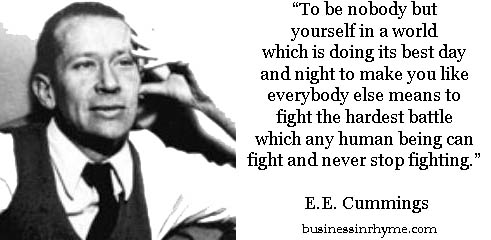
cummings

Confronting blank page takes courage? It might sound silly to many, but if you are a writer, especially a poet, you probably know what I mean:

It takes courage to spend time with yourself and dig deep, to the darkest and scariest parts of yourself and let them shine through your poems.

Only very few are brave enough to go somewhere place quiet, shut down the noise of the outer world and start listen to themselves; to hear who they truly are, and with open heart receive what ever they encounter. All experiences full of disappointments, grief, hurts, desires and happiness live and expand in each of these verses that we can read in the poems of those brave enough to write about their feelings. And they give us opportunity to live them also.

It takes courage to accept who you are and be honest about it.

Poetry is so personal on the one hand and universal on the other, that you simply can’t fake it. In every poem, your writing is like stripping your soul to the bare bones, where you become even more vulnerable. But that doesn’t make you anything more weak – that brevity adds up to your uniqueness that world is hungry for.

It takes courage to write, despite all the negative connotation that majority of people hold against poetry and simply not to care.

Some people simply don’t like poetry. There maybe many reasons for that. But also, there are not very supportive of those who does enjoy writing poetry. And it takes courage to continue to write and share our thoughts, no matter the impressions. I love what Jesse Graves, an assistant professor of English at East Tennessee State University said on the topic in this article:

For me, poetry expresses more about what it is like to be alive in the world today than any other art form. For a poem to work, it needs to address matters of the heart and of the head in almost equal measure. Since there is no interference between the reader and the text, poetry can deal with emotions in an intellectual way, and deal with abstractions in a way that evokes feelings.

It does take courage to try writing poems, especially if you are going to share them with others. Students also have to be willing to enter an unknown territory, even if I give them an assignment to write about, or a form, like a sonnet, they still have to find their own way into the subject matter. There is no real blueprint for how to write a poem..

It takes courage to write poetry and constantly juggle between loving and hating your own writing.

There are days when writing for you is like breathing – that without it you simply couldn’t live. But there are also days when you are unsatisfied with anything you write and you simply need a break. And that’s completely O.K. Actually that distancing yourself from writing can reignite your passion and it takes courage to do that also.

And someone might just call you crazy because you see world a bit differently: you see the joy in the heavy autumn storm, the warmth in the cold winter day or beauty in your teared bag and spilled groceries on the street. For me personally, writing poetry brings the opportunity to see and embrace life’s little imperfections in humble, and sometimes humorous way: instead of dwelling on how everything is wrong and complain – just to accept it, make the best of what I can in given situation and write a great poem about it 🙂

Poetry is everywhere, it just needs editing.

is what James Tate once said, and we are not even aware how much truth there is in those words.

All these aspects, contribute to forming one, in my opinion, a divine process that happens while you write poetry. It shapes you into a person you are supposed to be, the writer you strive to be. And for that kind of growth you do need courage – to accept your weirdness and just enjoy the ride.

It is in the small things we see it.
The child’s first step,
as awesome as an earthquake.
The first time you rode a bike,
wallowing up the sidewalk.
The first spanking when your heart
went on a journey all alone.
When they called you crybaby
or poor or fatty or crazy
and made you into an alien,
you drank their acid
and concealed it.

Later,
if you have endured a great despair,
then you did it alone,
getting a transfusion from the fire,
picking the scabs off your heart,
then wringing it out like a sock.
Next, my kinsman, you powdered your sorrow,
you gave it a back rub
and then you covered it with a blanket
and after it had slept a while
it woke to the wings of the roses
and was transformed.

Anne Sexton


If you liked this post and you are interested in getting more inspiration for your creativity, sign up for our free bimonthly newsletter.
This limerick goes in reverse…

According to some resources, today, May 12. is the Limerick day. It is also believed that origins of limerick poetry form can be traced back to 14th century. They are short, easy to compose, often speaking of sexual, ironic and humorous connotations. The name itself derives from the Irish town of Limerick and by many critics is not respected as a valid poetry form. Nevertheless, in the defense of limericks, it is believed that even Shakespeare wrote them.

If you want to try on your own to write a limerick follow the rules:

  • the last word in lines 1, 2, and 5 must rhyme and contain 8-9 syllables each;
  • the last word in lines 3 and 4 must rhyme and contain 5-6 syllables each.

One of the most famous writers of limericks is Edward Lear and his book of Nonsense, full of funny and witty verses:

“There was an Old Man who supposed,
That the street door was partially closed;
But some very large rats,
Ate his coats and his hats,
While that futile old gentleman dozed.”

or consider this one by Zach Weiner of the comic “Saturday Morning Breakfast Cereal”:

“This limerick goes in reverse

Unless I’m remiss

The neat thing is this:

If you start from the bottom-most verse

This limerick’s not any worse.”

Have you tried writing limericks? Share with us in the comments below.


If you liked this post and you are interested in getting more inspiration for your creativity, sign up for our free bimonthly newsletter.
9 literary journals that want your poems – now!

One of the things I like to do in my leisure time is to brows some very interesting online literary magazines as it helps in my inspiration but I also like to be informed about the newest trends in literature and writing styles.

As a result of my research I managed to compile a list of 9 magazines that pretty much on regular basis accept submissions for new poems and prose, and of course you might find some of them interesting in your publication process.

So here it is:

1.Hootreview. This is maybe one of my favorite. They focus on a micropoetry and microfiction, giving a real chance to aspiring writers.

2.32poems. They accept unsolicited poetry year round and also simultaneous submissions. As a rule, preference is given to shorter poems that fit on a single page (about 32 lines). For more visit their guidelines page.

3.Aleola journal of poetry and art.

This journal of poetry and prose was created to preserve the vanishing species known as “enjoyable poetry”. Ours is not the poetry or fiction enjoyed by connoisseurs of modernism today, filled with inexplicable juxtapositions of meaningless words that leave the reader feeling confused, fatigued, and overcome by a vague ennui. No; the sole requirement for our poetry and prose is that it expands the mind, captures the interest, and can be enjoyed by the average reader. We welcome nature poems, imagistic poetry, humor, and literature that tells a story.

4. Allegro poetry magazine aims to publish the best contemporary poetry. March and September issues are for general poems and June and December for poems on a set theme. It is a UK based online magazine, published four times a year.

5.Knot magazine is currently accepting submissions for fall issue. They have a large spectra of poetry genres included. Worth checking it out.

6.Juked. In publication since 1999, this is an independent journal that appears online as well as in annual print issues. They don’t adhere to any particular themes or tastes and are fond of aspiring writers 🙂

7.Rattle. This magazine accepts submissions all year around and if your are into translating poems – this is a place for you.

8. Thrush. If you like to experiment with your writing and flirt with unusual, thrush journal is one of the best publication references you can get:

Our taste is eclectic. We want poems that move us, a strong sense of imagery, emotion, with interesting and surprising use of language, words that resonate.  We want fresh. We want voice.

Established and new poets are encouraged to submit. Experimental poetry is fine, randomness is fine also. However, we do not want experimental and random just for the sake of calling it such. No long poems. We prefer a poem that will fit on one page. We are not interested in inspirational poetry or philosophical musings.

9. Contrary. As the name of the journal says it deals with contrary issues, thoughts, attitudes, questions…Publishes 4 times a year and new, summer cycle is open until June 1st. Don’t miss this opportunity, on the contrary! 🙂

I hope you find this list interesting and it helps you in your publishing journey.


If you liked this post and you are interested in getting more inspiration for your creativity, sign up for our free bimonthly newsletter.


Results of NaPoWriMo experiment

The April month is over so is the napowrimo. I successfully went through, publishing every day a poem, along with all scheduled posts. Most of the poems were result of free-writing so I won’t go into the quality of writing, but there are other benefits that I noticed as a result of this frequent scheduled poetry scribble.

1.During the month I felt much more emotionally stable.

On a few occasions I had some difficult situations and even though I didn’t channel my stress through poetry, the actual act of writing was a great tool for me to divert my thoughts into something creative instead to rewind in my head something that is already in the past. It turned out to be a great mindfulness tool for me.

2. It made me productive in other areas as well.

When you do something you like, it really can fuel you with beautiful energy and gives you drive to get involved in other tasks. My working hours were joyes and filled with vigor to accomplish as much as I can.

3. I came up with ideas much easier.

Even though I didn’t use poetry as a brainstorming tool, I noticed I came up with new ideas with ease, without any struggle and doubt. It felt quite natural just to follow already ignited thoughts and that was the half of job done.

If you were participant in the NaPoWriMo, how that impacted your daily routine? Please share your experience and insights in the comments below.


If you liked this post and you are interested in getting more inspiration for your creativity, sign up for our free bimonthly newsletter.

Are you losing readership? Probably you are making one of these 3 mistakes

NadineGordimer

When I was younger, I didn’t like very much to read. I liked books and I liked to collect them, but because of the nature of my studies and later my work, I was already so much time “wrapped” in books (researching specialized information) that I didn’t find any interest in spending my free time reading, again. 🙂 So, poetry and prose were not much on my reading menu. But while reading, what I liked the most is that I can search for targeted information whenever I need it and access it any time.

Now, with time my needs and wants changed. I do enjoy reading more poetry and prose. I find it relaxing and comforting. It enhances my writing, my creativity, my way of thinking and self-confidence, my knowledge of languages…the benefits are numerous. I still do search for certain information, relating to skills and knowledge I’m interest in, but the existence of Internet in last 20 years has changed that for us in many ways.

So, one of the reasons to see a decline in your reading stats might be:

1.You don’t know who are you writing for.

You need to know your audience; what are their needs and wants, because it changes with time and evolves. As a writer you need to be able to sense their reading pulse and offer types of information that will attract and intrigue them. Writing also means fostering a community, sharing mutual insights and experiences. This is the first thing that needs to be cleared up, and it will undoubtedly improve your writing too.

2. You don’t recognize the purpose of your writing.

Here, I mean you do need to have clearly defined  what kind of information you are offering; As I said, people do like targeted information, especially if you are a non-fiction writer. As a fiction writer do you have recognizable style, writing voice that your readers can relate to.

3. Your writing is more like ‘a stale pond’ instead of a ‘running river’.

What I mean is that do you offer fresh content on regular basis? Is your content related to contemporary topics and events that people are genuinely interested in?

Do you blindly follow one literary style or do you like to experiment? The point is even in the actual action of writing we do need to be somehow innovative and creative. You like haikus? Great! Next time try to write a longer story. Maybe you could share how actually you like writing short forms. Why? What is there that excites you? Believe it or not, your readers want to read that stuff as well. How do you create, what invigorates you. Share small pieces of you in new, affirmative ways and watch your audience grow.

Do you have any tips and tricks on attracting more readers? Please share in the comments below 🙂


If you liked this post and you are interested in getting more inspiration for your creativity, sign up for our free bimonthly newsletter.

4 ways to rekindle your love for writing

gloriaanzaldua

As everything goes in life, so the writing process can has its ups and downs. Motivation can come in cycles, and it can be hard to stay on track with writing. Hence, there are some tricks you can employ in order to have that persistent inspiration and willingness to record your thoughts and story.

1.Write, scribble, jot, journal..even when you don’t feel like doing it and what ever your write you think is just pure rubbish.

Taking action of actual writing can serve as a huge motivator and the more you immerse yourself in the process of writing, the more confidence you will regain. Especially after taking some break, writing can seem to us a bit rusty and uncompelling, but all you need is to practice. With practice you become better – as you become better, the more joy for writing you will feel.

2. Keep faith in the creative process.

Self-doubt and fear that we are not creative enough, good enough or original enough is a negative self-talk that only puts barriers between you and your writing. You are creative and your inner-self will find the best ways for expression: you need to trust the creative process, no matter the time, the tries and teared papers. That belief in the creative process is what fuels imagination and allows the path of self-expression to be found and enjoyed.

3. Be persistent every day; every day make time for your writing.

Don’t treat your writing like an occasional hobby that you do from time to time. Make it a habit. Make time every day to pursue your passion for writing. Once you taste that productive side of writing, that satisfaction will further give you strength to continue writing; to think more clearly; faster focus on what you want to say with your writing. You are really refining your writing craft this way.

4. When nothing works distance yourself.

If nothing form above works, don’t push yourself too much. Let it rest, leave it for a couple of days or for ever long you feel like. It will help you clear you mind and get in touch with your creative side. Read what you’ve written, think what would you like to change and how to continue.

This is something I do whenever I’m writing. I make initial draft, and the following days I continue – it’s a great way to regain perspective on your own thoughts and observe your writing more objectively.

Do you sometimes lose passion for writing? What’s your advice in regard to that?

Her even lines her steady temper show;
Neat as her dress, and polish’d as her brow;
Strong as her judgment, easy as her air;
Correct though free, and regular though fair:
And the same graces o’er her pen preside
That form her manners and her footsteps guide.

Anna Lætitia Barbauld


If you liked this post and you are interested in getting more inspiration for your creativity, sign up for our free bimonthly newsletter.


Writerly wisdom from three famous poetesses

dorothyparker

As there are no two identical writers in the world, every approach to writing is unique and different. What might work for someone, might not work for somebody else. Hence, today I want to share with you some literary advice I came across, from famous poetesses, that are both inspirational and motivational.

The first is Maya Angelou. When asked in this interview, how she writes poem, this was her answer:

Like a pianist runs her fingers over the keys, I’ll search my mind for what to say. Now, the poem may want you to write it. And then sometimes you see a situation and think, “I’d like to write about that.” Those are two different ways of being approached by a poem, or approaching a poem.

You have to get to a very quiet place inside yourself. And that doesn’t mean that you can’t have noise outside. I know some people who put jazz on, loudly, to write. I think each writer has her or his secret path to the muse. I’m told one writer stands for six hours with a typewriter on a podium—he stands and types. And I know a woman who has her computer in a closet and she goes in, closes the door, and, with her back to the door and her face to the wall, she writes.

You need to develop your own little, meaningful rituals and find what works best for you to get creative juices flowing.
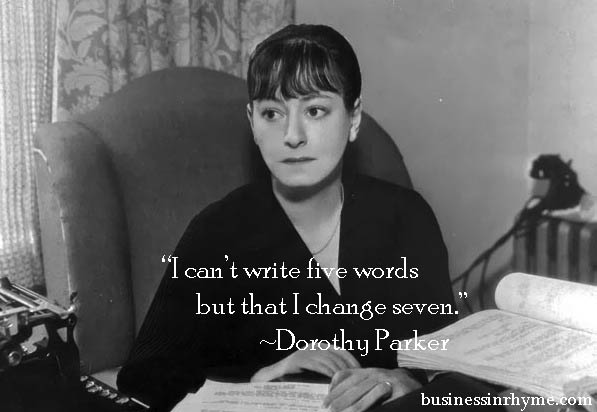
The next one is Dorothy Parker, poet, short story writer, critic and satirist who claims that editing is what gives value to writing:

I can’t write five words but that I change seven. Editing is vital.

Her writing is concise, edgy and carefully phrased, like in this short poem:

Razors pain you;
Rivers are damp;
Acids stain you;
And drugs cause cramp.
Guns aren’t lawful;
Nooses give;
Gas smells awful;
You might as well live. 

And the third advice comes from young Sarah Key, best known for her bold and raw slam poetry. Young writers and poets are often the carriers of new trends and movements and this is how she sees writing poetry:

Poetry is like pooping. If there’s a poem inside of you, it needs to come out. I want people to think of poetry as more human, less sacred. You don’t have to get paid for your writing to be a writer. I know many people who work nine-to-five in a cubicle and then come home to write for themselves. Their words are often just as powerful, moving, and valid as anything I’ve written, if not more so. write a poem once a week and doodle once a day. Create something that brings you joy.

The rest of the interview you can read here. Her words are encouragement for everyone who wants to write, and you are a writer if you say you are. You need to believe in yourself and that there is no perfect writing.

I hope these tips will help you in search for your own writing muse 🙂


If you liked this post and you are interested in getting more inspiration for your creativity, sign up for our free bimonthly newsletter.


7 tips for improving your creative writing skills

budington kelland

As a writer, you don’t want to be just good or average. You want to be better; you want to improve your skills and you want to have your own recognizable style. Well, all that doesn’t happen overnight. It takes courage, perseverance, consistency in your writing attempts – no matter the rejections, lack of time or inspiration. Your writing can improve with practice and I will share here some tips you might find helpful:

1.Don’t find time – make time for your writing

As I said in the above introductory paragraph, it’s of great importance that you schedule regular time for your creativity, every day. When you have an idea, jot it down – don’t ignore it and let it flourish on your paper. You never know when inspiration will strike, so be prepared with little notebook by your side.

2. Don’t fear rejection

Show the world your creative power – maybe through blog, writing platforms or even through writing journals and open competitions. It’s a great way to practice your writing, refine your own style and maybe your story, poem, article gets published and recognized by editors – you don’t have anything to lose.

3.Join the community

There are many forums and other forms of networks where you can practice along with other fellow writers as response to different topics and prompts. It’s a great opportunity to get feedback about your writing and share your struggles and accomplishments.

4. Challenge yourself

As a poet you might try short story writing. It will provoke your thinking, channel your ideas in different directions. The more you step out of your comfort zone, the more your writing will mature and grow.

5.Read a lot; and then read some more!

Reading is a prerequisite to any good writing. It will not only enrich your vocabulary, but it will give you confidence that you can write too; that you can improve your writing skills and that there is experience and emotion residing inside of you, a story that needs to be told and shared with the world.

6.Feed your soul with some art

Visit museums, exhibitions, go to concerts and listen to music; dance and sing – enjoy other expressions of creativity as it can further inspire your writing. Diverse emotions that come from different senses can generate a feeling that we are creative beings and sometimes that is all you need for writing ideas to spark and come forth into your consciousnesses.

7.Don’t try to invent hot water – every time!

What I mean by this is that many writers are afraid that they are not original enough; that something similar already exists, that every story and poem is already written and told. But I want to remind you that you are unique person with unique points of view and unique experiences. No one can steal and copy that. As long as you are true to yourself it will be reflected in your writing.

How do you work on improving your writing? Please share your experiences in the comments below.


If you liked this post and you are interested in getting more inspiration for your creativity, sign up for our free bimonthly newsletter.


Want to improve your writing? Practice receptivity and allowing

holzer

Being receptive and allowing creative flow are somehow two basic modalities that we have to work with in order to engage in creative process. Today’s post is intentionally dedicated to this topic since if we manage to divert these two modalities  to “work for us” – it’s a sure way to combat any type of creative blockage. It might be more suitable for writers beginners, but I think that we all need from time to time to remind ourselves of some basic approaches.

What does it mean being receptive? You probably have noticed that in my writing I often use term ‘tune in with your inner self, inner being’. And that what it exactly means being receptive. You can consciously prepare yourself for receptivity by having faith and trust in that moment, that very second that your mind already knows everything that it needs to know to be fully creative, open and expressive. To sink in to your deep creative core you can practice meditative, rhythmic breathing that is connecting your awareness to what is flowing to you in each moment. Engage your senses, don’t shut down that feelings, let them freely find their space and meaning in your blank page – in that very moment. In order to keep that initial spark, in the quietness of your mind you can ask yourself: what is it that I need/want to say? What did I want to write about?

Ideas will come and start to accumulate and your task is only to write, without hesitation or any type of editing on the go. Something that was bugging you about your creative project, piece your were working on months ago might resolve and just what you needed can appear. Never waste your writing because that just might be the missing puzzle in your future work.

The second part of the process is something I call allowing. Allow yourself, give permission to yourself to write, create – no matter how many disapprovals, rejections, judgments you might received in the past. That negative voice in the back of our mind can block us from engaging in creative work and that’t the last thing you want to do.

You create and write for your own sake, for your own being to feel alive, attuned with creative force around us. You are in charge of your motivation, actions and willingness. And next time, when negative voice speak from nowhere all of a sudden, write everything the opposite.

That negative voice can say something like:

Nobody is interested in anything I have to say.”

And you can write your affirmation:

‘I’m interested in what I have to say. I want to say. I need to say. I write because I want to say!’

‘There is no money in writing. It’s a wasted time.’

and your affirmation:

‘If I write more I will get better in this craft; being better means more opportunities to be published; being published opens possibilities to get a new source of income.’

or

‘I write because I love to write. I don’t need money from writing.’

This is one way to respond to that negative self-talk. Allow yourself just to be creative and you’ll be amazed how your writing improves.

Poetry to us is given
As stars beautify the heaven,
Or, as the sunbeams when they gleam,
Sparkling so bright upon the stream ;
And the poetry of motion
Is ship sailing o’er the ocean
Or, when the bird doth graceful fly,
Seeming to float upon the sky;
For poetry is the pure cream
And essence of the common theme.

Poetic thoughts the mind doth fill,
When on broad plain to view a hill ;
On barren heath how it doth cheer
To see in distance herd of deer.
And poetry breathes in each flower
Nourished by the gentle shower,
In song of birds upon the trees
And humming of busy bees.
‘Tis solace for the ills of life,
A soothing of the jars and strife;
For poets feel it a duty
To sing of both worth and beauty.

James McIntyre


If you liked this post and you are interested in getting more inspiration for your creativity, sign up for our free bimonthly newsletter.