4 ways to rekindle your love for writing

gloriaanzaldua

As everything goes in life, so the writing process can has its ups and downs. Motivation can come in cycles, and it can be hard to stay on track with writing. Hence, there are some tricks you can employ in order to have that persistent inspiration and willingness to record your thoughts and story.

1.Write, scribble, jot, journal..even when you don’t feel like doing it and what ever your write you think is just pure rubbish.

Taking action of actual writing can serve as a huge motivator and the more you immerse yourself in the process of writing, the more confidence you will regain. Especially after taking some break, writing can seem to us a bit rusty and uncompelling, but all you need is to practice. With practice you become better – as you become better, the more joy for writing you will feel.

2. Keep faith in the creative process.

Self-doubt and fear that we are not creative enough, good enough or original enough is a negative self-talk that only puts barriers between you and your writing. You are creative and your inner-self will find the best ways for expression: you need to trust the creative process, no matter the time, the tries and teared papers. That belief in the creative process is what fuels imagination and allows the path of self-expression to be found and enjoyed.

3. Be persistent every day; every day make time for your writing.

Don’t treat your writing like an occasional hobby that you do from time to time. Make it a habit. Make time every day to pursue your passion for writing. Once you taste that productive side of writing, that satisfaction will further give you strength to continue writing; to think more clearly; faster focus on what you want to say with your writing. You are really refining your writing craft this way.

4. When nothing works distance yourself.

If nothing form above works, don’t push yourself too much. Let it rest, leave it for a couple of days or for ever long you feel like. It will help you clear you mind and get in touch with your creative side. Read what you’ve written, think what would you like to change and how to continue.

This is something I do whenever I’m writing. I make initial draft, and the following days I continue – it’s a great way to regain perspective on your own thoughts and observe your writing more objectively.

Do you sometimes lose passion for writing? What’s your advice in regard to that?

Her even lines her steady temper show;
Neat as her dress, and polish’d as her brow;
Strong as her judgment, easy as her air;
Correct though free, and regular though fair:
And the same graces o’er her pen preside
That form her manners and her footsteps guide.

Anna Lætitia Barbauld


If you liked this post and you are interested in getting more inspiration for your creativity, sign up for our free bimonthly newsletter.
 

Writerly wisdom from three famous poetesses

dorothyparker

As there are no two identical writers in the world, every approach to writing is unique and different. What might work for someone, might not work for somebody else. Hence, today I want to share with you some literary advice I came across, from famous poetesses, that are both inspirational and motivational.

The first is Maya Angelou. When asked in this interview, how she writes poem, this was her answer:

Like a pianist runs her fingers over the keys, I’ll search my mind for what to say. Now, the poem may want you to write it. And then sometimes you see a situation and think, “I’d like to write about that.” Those are two different ways of being approached by a poem, or approaching a poem.

You have to get to a very quiet place inside yourself. And that doesn’t mean that you can’t have noise outside. I know some people who put jazz on, loudly, to write. I think each writer has her or his secret path to the muse. I’m told one writer stands for six hours with a typewriter on a podium—he stands and types. And I know a woman who has her computer in a closet and she goes in, closes the door, and, with her back to the door and her face to the wall, she writes.

You need to develop your own little, meaningful rituals and find what works best for you to get creative juices flowing.
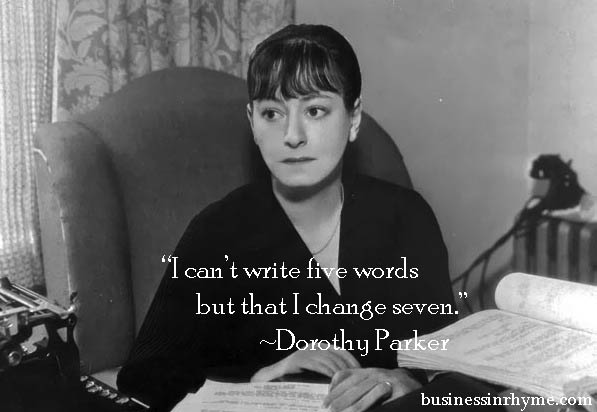
The next one is Dorothy Parker, poet, short story writer, critic and satirist who claims that editing is what gives value to writing:

I can’t write five words but that I change seven. Editing is vital.

Her writing is concise, edgy and carefully phrased, like in this short poem:

Razors pain you;
Rivers are damp;
Acids stain you;
And drugs cause cramp.
Guns aren’t lawful;
Nooses give;
Gas smells awful;
You might as well live. 

And the third advice comes from young Sarah Key, best known for her bold and raw slam poetry. Young writers and poets are often the carriers of new trends and movements and this is how she sees writing poetry:

Poetry is like pooping. If there’s a poem inside of you, it needs to come out. I want people to think of poetry as more human, less sacred. You don’t have to get paid for your writing to be a writer. I know many people who work nine-to-five in a cubicle and then come home to write for themselves. Their words are often just as powerful, moving, and valid as anything I’ve written, if not more so. write a poem once a week and doodle once a day. Create something that brings you joy.

The rest of the interview you can read here. Her words are encouragement for everyone who wants to write, and you are a writer if you say you are. You need to believe in yourself and that there is no perfect writing.

I hope these tips will help you in search for your own writing muse 🙂


If you liked this post and you are interested in getting more inspiration for your creativity, sign up for our free bimonthly newsletter.


Would you like to support Business in Rhyme?

After many months of indecision, Business in Rhyme has got its Facebook page. I don’t want this Facebook page just to be a replica of what’s already written on the blog, but I truly believe that we can build community around this main topic – writing and poetry can enhance our creativity and contribute to our personal development. In that sense, I see also this page as a space where we can share some beautiful thoughts/poems and with joint forces spread the word about this idea.

You will have the opportunity to publish and popularize your work on the page (through interesting prompts and challenges), maybe inspired by some posts and topics on the blog, which will eventually contribute to better promotion of your poetry and writing and the idea itself.

So what do you think, are you in? 🙂

Here is the link www.facebook.com/businessinrhyme

Mind mapping through poetry (creativity exercise)

plutarch

Since our creativity can be unpredictable, often times we can find ourselves having that huge idea, but still not managing to record all details, write everything down without losing a bit of it.

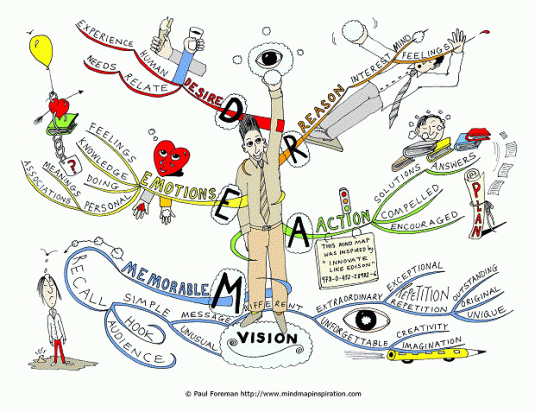
So today, I want to to share with you my impressions about little tool I use regularly to brainstorm a problem, or a project idea that I have found to be quite helpful. It’s mind mapping – with a twist. Probably most of you are aware of this technique but as the old Latin proverb says, “Repetition is the mother of all knowledge.” Mind mapping can help you become more creative, train your visual thinking, memory, and solve problems more effectively.

The basic notion behind this technique is to visually capture, connect and sort out information, or even get a great amount of information under control in order to generate new and fresh ideas.

The process is quite simple:

  1. You put in the center (of your paper) your main idea.
  2. Around that idea, now write all other topics that relates to your idea, establishing new relations among main and side topics.
  3. It’s almost like forming a tree where each branch further drives you to generate more details and more connections.
  4. And now the twist: try to think of this map you are building like it is a poem.

Dream-Vision

Instead of dry listing topics and ideas, with the words and phrases you chose, give your map a rhythm, lyrical note. Use adjectives, describe emotions related to your idea, expectations, why is it important. Imagine you are writing a concrete poem for example.

In this manner, your project will become more vivid and real to you. You are actually mapping your visualization, through words giving your senses the chance to “live” everything in your mind. By “breathing” in that emotion with your words, positive energy, you become more eager to put everything in work and apply solutions you came up with. It’s fun and interesting way to brainstorm every time you need more clarity and focus.

Now, this technique can be used for writing actual poems, novels and books (great as a storytelling technique as well) , but it can help you even in your vacation planning and job search.

What do you think? Worth a try? Please share your thoughts in the comments, below.


If you liked this post and you are interested in getting more inspiration for your creativity, sign up for our free bimonthly newsletter.
NaPoWriMo day 12: Aurora alert (index poem)

Borealis bright,

counterpart,

deactivated:

encounter in between invisible lines

fragile in the morning with

glandular geomagnetic particle osmosis.

He likes rainbow, but

I, there is no I in threesome.

Journey to the fake space Odyssey during

Kp>7!

Longitudinal or Latitudinal?

Mmmmmmmm…

Nada! Usted comprendes nada!


Olive skin you get under:

  • pretty low frequencies
  • questioning everything
  • reasoning where it doesn’t belong
  • Solar flares attack

trying to satisfy stormy weather.


Ultrasound inspection just under my feet acquiring

velocity of the Northern lights:

We need to be there tonight to

X-ray previously charged love.

You and I, preforming the language of stars,

zip-locked by sparkling green stain in the sky.

Maja S. Todorovic

Hermann Hesse on happiness, writing and how to say ‘yes’ to life

herman-hesse

Hermann Hesse’s life and literary quest was always preoccupied with constant search for meaning of life and faith. He was born into a Protestant-Pietist family of missionaries, preachers and theologians, but somehow Christianity didn’t offer him answers he was looking for. Soon, very much influenced by Hinduism, Buddhism and Taoism, he developed his own notion that humanity actually belongs to some kind of Universal truth that goes beyond any religion and metaphysical explanation. In most of his work, especially in his spiritual poetry he always emphasized the importance of living in the now: on letting go and finding contentment within ourselves.

Whenever in doubt, he invites us to look in nature, observe the flow of life that goes around us and how we are part of that life. It is upon us to say yes to life, to affirm that we are part of some eternal life force and intelligence bigger than us; that we need to trust life and ourselves.

He writes:

Trees are sanctuaries. Whoever knows how to speak to them, whoever knows how to listen to them, can learn the truth. They do not preach learning and precepts, they preach, undeterred by particulars, the ancient law of life.

A tree says: A kernel is hidden in me, a spark, a thought, I am life from eternal life. The attempt and the risk that the eternal mother took with me is unique, unique the form and veins of my skin, unique the smallest play of leaves in my branches and the smallest scar on my bark. I was made to form and reveal the eternal in my smallest special detail.

A tree says: My strength is trust. I know nothing about my fathers, I know nothing about the thousand children that every year spring out of me. I live out the secret of my seed to the very end, and I care for nothing else. I trust that God is in me. I trust that my labor is holy. Out of this trust I live.

When we are stricken and cannot bear our lives any longer, then a tree has something to say to us: Be still! Be still! Look at me! Life is not easy, life is not difficult. Those are childish thoughts. Let God speak within you, and your thoughts will grow silent. You are anxious because your path leads away from mother and home. But every step and every day lead you back again to the mother. Home is neither here nor there. Home is within you, or home is nowhere at all.

So the tree rustles in the evening, when we stand uneasy before our own childish thoughts: Trees have long thoughts, long-breathing and restful, just as they have longer lives than ours. They are wiser than we are, as long as we do not listen to them. But when we have learned how to listen to trees, then the brevity and the quickness and the childlike hastiness of our thoughts achieve an incomparable joy. Whoever has learned how to listen to trees no longer wants to be a tree. He wants to be nothing except what he is. That is home. That is happiness.

Hermann Hesse, Bäume. Betrachtungen und Gedichte

Life is not good or bad. It is what it is. If we dislike something it is mirrored part of ourselves that we don’t like.

If you hate a person, you hate something in him that is part of yourself. What isn’t part of ourselves doesn’t disturb us.

When it comes to writing, if it is something we really want to do in life, we will find the way to work for us. Once we recognize that we have that gift to share with world, gift and value of our own vulnerability,  that we accept and admire it with all virtues and flaws – that is real happiness. Words can be seen as our proof of existence and how we use them makes the whole difference.

“You must find your dream, then the way becomes easy. Happiness is a how; not a what. A talent, not an object. Without words, without writing and without books there would be no history, there could be no concept of humanity.

In the following poem I think that Hesse so vividly and accurately in the same time managed to capture the notion of happiness and why we are all during our lives so allured with it:

Happiness

If luck you chase, you have not grown
enough for happiness to stay,
not even if you get your way.

If, what you lost, you still bemoan,
and grasp at tasks, and dash and dart,
you have not known true peace of heart.

But if no wishes are your own,
and you don’t try to win the game,
and Lady Luck is just a name,

then tides of life won’t reach your breast
and all your strife
and all your soul will rest.

I hope that his thoughts will help you and inspire you in your further creative endevours. You can complement this reading with Mark Strand’s take on creativity, what writing haiku can teach us and little tips on how to develop your own mindfulness practice.


If you liked this post and you are interested in getting more inspiration for your creativity, sign up for our free bimonthly newsletter.