
Tag: poetry
Daily verse with purpose: Jean Cocteau
A community: what it means for you and your (writing) business
Humans are social beings. No matter how we might enjoy solitude (for many reasons, like creativity, that’s already written throughout this blog), we want to satisfy that need for belonging to a group that shares our vision, interests; who can help us find and deliver our purpose. In this post I emphasized the importance of defining our message that will resonate with who we really are, what we stand for, what we believe and our true values. It’s a way we brand ourselves.
I would say that this is the first step in creating your community. Community is about interaction and engagement based on trust where reciprocity is the absolute law. The more value and contribution you put out there, the more like-minded people you will attract. How physically the exchange of information will go is of lesser importance. Being that blog, twitter, facebook, podcast … or a chit-chat with a friend over coffee – each time you communicate you build your community. Sure, some people come and go, but community is a live thing: it changes and evolves along with you. With your growth and your contribution, your audience grows, matures, breathe, dream, eat, sleep, just as you do! In other words, how much work and effort you put in your community, there is a higher probability for your message to be heard at broader scope. In return, your supporters will help you grow your business.
One of the vital ingredients that you need to provide while building your community is a personal touch. Most people best relate to struggles, little victories and specific experiences of their peers. They easily identify their own needs and wants, which is a force in building an audience. By sharing our story with them we give an opportunity to people to learn from us as well.
There is no one out there with your skills, your experiences, but you. And you bring that uniqueness to your community, that ‘quirkiness’ that differentiate you from other people. It’s a sure way to building your right audience.
And is also true that people easily get destracted, with life going too fast and information that is bombarding all our senses. What you deliver to your community has to be focused and relevant message and on the regular basis. Distraction leads to oblivion.
And your community has to be well pampered with all goodness you can provide, because at the end of the day how much you have been of service to your community, will show the real support you have.
As long as you stick to these rules, your community will start to manifest and yet you will never have to impose any self-promotion and marketing. Your behavior, communication and contribution, in my opinion is the best marketing tool you can apply.
Good we must love, and must hate ill,
For ill is ill, and good good still ;
But there are things indifferent,
Which wee may neither hate, nor love,
But one, and then another prove,
As we shall find our fancy bent.
If then at first wise Nature had
Made women either good or bad,
Then some wee might hate, and some choose ;
But since she did them so create,
That we may neither love, nor hate,
Only this rests, all all may use.
If they were good it would be seen ;
Good is as visible as green,
And to all eyes itself betrays.
If they were bad, they could not last ;
Bad doth itself, and others waste ;
So they deserve nor blame, nor praise.
But they are ours as fruits are ours ;
He that but tastes, he that devours,
And he that leaves all, doth as well ;
Changed loves are but changed sorts of meat ;
And when he hath the kernel eat,
Who doth not fling away the shell?
John Donne
Daily verse with purpose: Plato
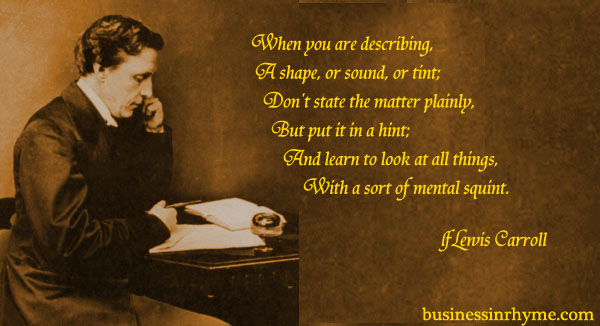
Daily verse with purpose: Lewis Carroll
Write a book – without even knowing it!

I’ve always been curios and hungry for knowledge: to explore, research and eventually tell the world about my findings. My first intentions were never to become a writer or published author, but with time I evolved into one. The funny thing though is, that in my early school years I never liked to write literally essays and school approach to poetry was dreadful! So my early inclinations towards poetry, quietly faded away, until few years ago when my interest simply rekindled itself and I began to experience so much benefits from writing and reading poetry.
At the University, writing scientific papers and factual reports became very natural to me. When I seriously decided to devote to academic career this type of writing and communicating were so habitual that writing papers had its own flow and rhythm. Pretty much the same was with my lectures.
And before I knew it, I actually wrote a PhD thesis. And a PhD thesis with little modifications became one book. My lectures with little wrapping and structure became my second! I’ve published so far three books (and I think right now I’m working on my forth 😉 ).
So what I want to say is that there are endless ways how you can write a book, without even a real intention on writing it. It’s important that you enjoy writing. It might develop into something significant or not. Who knows? But as long as you invest yourself in the process, without thinking too much on why and how, your real literally genius will shine through.
Did you know for example that The Artist’s Way “hatched out” from a sheet of paper with tips for Julia Cameron to give to students at her writing classes?
Or that Escape from Cubicle Nation originates from blog post series?
For you is important to track and record your ideas; something that you have already written – is it finished or you want something else to add to it?
In other words, if you so desperately want to write a book, try not to write one!
Maybe you already have a blog, a diary, jotted collection of articles, short stories, verses, quotes, thoughts, questions, lectures…?
Maybe you’ve written a thesis, a paper or already have undeveloped e-book?
Or you like to record your thoughts with your smartphone or even have a gallery of pictures that you find inspiring?
All of that can be turned into a book, worth reading and worth publishing – as long as it represents who you are, your values and your true nature.
In this post I further explore professional benefits and opportunities you can experience by being consistent in your writing.
Your life is actually a book you write every day – you choose how you leave your mark. I vote for ink and paper!
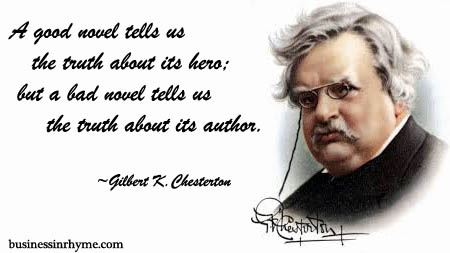
Daily verse with purpose: G. Chesterton
Daily verse with purpose: Ernst Hemingway

4 things nobody tells you about managing creativity
Often when I think of poetry I find many similarities with the way we induce innovative thinking. Language and words are our main tools. In innovation practice, ideas and knowledge are our tools that bring forth an idea into life. But not any idea: it has to be the right idea. Just as much as the poem has to use the right words to translate an emotion; an experience. The order of words, their flow and rhythm need to be comprised in the best possible way – in the same fashion, an innovative idea needs to solve the problem, improve function or usage.
Poets need a large vocabulary to ‘play’ with; arrange and disarrange words (even invent new ones) to precisely convey their meaning, simulate tone and voice: so does innovators and design thinkers need a deep knowledge of science, engineering, management and business processes to deliver an innovative product.
Yet, doesn’t everything happen in desired moment when we need it. A lot of factors and conditions influence the process of innovative thinking, no matter how much we try to take the control of situation (having the tools and skills we need, time and space, and other resources).
We too much dwell on the speed of innovation, becoming to much obsessed with competition, costs, who delivers innovation.
Questions about what creativity really is, how to harness creative potential that every employee carries and fostering creative spirit for the higher good (contribution and purpose) are neglected and overlooked. In between those moments, real creative solutions somehow slip through the cracks of management rules, policies, principles. In the end, many organizations experience product saturation and volatile stagnation.
There is poem by Ted Hughes: The Thought Fox
I imagine this midnight moment’s forest:
Something else is alive
Beside the clock’s loneliness
And this blank page where my fingers move.
Through the window I see no star:
Something more near
Though deeper within darkness
Is entering the loneliness:
Cold, delicately as the dark snow,
A fox’s nose touches twig, leaf;
Two eyes serve a movement, that now
And again now, and now, and now
Sets neat prints into the snow
Between trees, and warily a lame
Shadow lags by stump and in hollow
Of a body that is bold to come
Across clearings, an eye,
A widening deepening greenness,
Brilliantly, concentratedly,
Coming about its own business
Till, with a sudden sharp hot stink of fox
It enters the dark hole of the head.
The window is starless still; the clock ticks,
The page is printed.
After reading the poem, it is obvious that he tells a story about the struggle poet has while writing. But it can have a much deeper meaning: we can put an analogy in this poem to a struggle we face while in any type of creating. It poses questions: what generates creative idea, can we ‘catch’ it on time, how to make that ‘element of surprise’ part of our every day life and welcome it, open-handed? Is it even possible?
Creativity can be seen as something that is alive but hidden, mysterious. It looks for loneliness, isolation to show its face:
‘Though deeper within darkness
Is entering the loneliness’
In the beginning is gentle and cautious. We have to observe it with care, not to scare our “fox” idea:
‘A fox’s nose touches twig, leaf;
Sets neat prints into the snow’
And then, there is a breakthrough moment, powerful – even bombastic, when all gentleness is gone, when idea appears in its full dimension and brightness:
‘Till, with a sudden sharp hot stink of fox
It enters the dark hole of the head’
The poem suggests, to some extent creativity includes tactful and careful planning, a lot of brevity, but we cannot always predict when exactly is going to ‘strike’. Can we prepare for the creativity “attack”? The best we can do is to be open and responsive to the signs it leaves for us; to awaken that childhood curios nature (even in business organizations) when we ‘spy with our little eye’ every spark, just ready to let it ignite our creative spirit.
Daily verse with purpose: W. Shakespeare

 Business in Rhyme