One simple, foolproof tactic that improves your writing dramatically

Sholem_Asch

There are many ways we can approach our writing. And if you are reading this, you are probably a writer who knows how writing is important: it’s how you communicate, how you record your ideas, memories, feelings, – you share who you are, and your knowledge.

But even more important it is how you build your world, your reality and the most deepest connection with your true self. It helps you sort out through the piles of information you absorb each day and you learn what you want and don’t want. It can be a remarkable foundation for our business and work as it gives us confidence and power to make an impact in a bigger, better, and more meaningful way.

Often in my posts you will recognize that I emphasize all these traits of writing and encourage you to just write – no matter what, how, where… These are free writing forms with only one goal in mind: tap into your own inspiration and creativity.

But today I will offer you a bit different approach that helped me immensely. Next time when you sit to write, bring intentionality to your writing. By that I mean to have more clear focus and understanding of what you want to write and why you want to write it.

When I’m writing, I always have three questions in the back of my mind:

  • Is what I want to say clear and understandable enough? My writing, for me to be satisfied with it, has to reflects who I truly am and transcend my message to the world in the right way. Some other questions regarding to this that can help you is to ask yourself: does it have the impact I want to create? Is this conveying the right drama, or humor? Is it thought provoking and what kind of value does it bring to my readers?
  • This second question turned out to be huge for me: Did I structure this for the best possible impact? When I was working on my PhD proposal, I remember I had an informal meeting with my mentor  and I came with a lot of papers, notes, ideas I collected somewhere during initial research..But the best advice she gave me then, is to make an outline, a backbone of my thesis which will guide me along the way of my writing. Why that became so important? Because it helps you set the boundaries in your research and writing – if you ‘spill yourself’ all over the place, without focus what information is important and what’s not – you will just get lost. It helps you to stay focused and on track. This is especially applicable to longer forms of writing –  no matter fiction or non-fiction.  Of course, you can edit and improve your initial outline as your work progresses and new ideas come into play, but it enables for your writing to get aligned with your values and contribution you want to achieve.
  • How can I improve this? With all my current knowledge and view on the subject I try to improve what I wrote, usually by simplifying it. I reread what I wrote for several times – not looking so much for punctuation errors or typos, but to make sure I’m satisfied with everything I’ve written.  I need to distance myself for a couple of hours or I leave it ‘marinate’ over night and that gives me the best perspective on my writing.

You become a better writer by focusing on the task at hand and recognizing what’s not working for you.  You are not satisfied with your descriptions or narrations? Well, dive into those and only by practice and persistence you will improve your weak points in writing.

These three questions enable me to strategize my writing, stay true to my self, my core values and share my knowledge in such way  that it has a valuable impact. So next time, in your writing try to answer those questions and observe how that influences your writing. You might be surprised with the results 🙂


If you liked this post and you are interested in getting more inspiration for your creativity, sign up for our free bimonthly newsletter.
4 ways to rekindle your love for writing

gloriaanzaldua

As everything goes in life, so the writing process can has its ups and downs. Motivation can come in cycles, and it can be hard to stay on track with writing. Hence, there are some tricks you can employ in order to have that persistent inspiration and willingness to record your thoughts and story.

1.Write, scribble, jot, journal..even when you don’t feel like doing it and what ever your write you think is just pure rubbish.

Taking action of actual writing can serve as a huge motivator and the more you immerse yourself in the process of writing, the more confidence you will regain. Especially after taking some break, writing can seem to us a bit rusty and uncompelling, but all you need is to practice. With practice you become better – as you become better, the more joy for writing you will feel.

2. Keep faith in the creative process.

Self-doubt and fear that we are not creative enough, good enough or original enough is a negative self-talk that only puts barriers between you and your writing. You are creative and your inner-self will find the best ways for expression: you need to trust the creative process, no matter the time, the tries and teared papers. That belief in the creative process is what fuels imagination and allows the path of self-expression to be found and enjoyed.

3. Be persistent every day; every day make time for your writing.

Don’t treat your writing like an occasional hobby that you do from time to time. Make it a habit. Make time every day to pursue your passion for writing. Once you taste that productive side of writing, that satisfaction will further give you strength to continue writing; to think more clearly; faster focus on what you want to say with your writing. You are really refining your writing craft this way.

4. When nothing works distance yourself.

If nothing form above works, don’t push yourself too much. Let it rest, leave it for a couple of days or for ever long you feel like. It will help you clear you mind and get in touch with your creative side. Read what you’ve written, think what would you like to change and how to continue.

This is something I do whenever I’m writing. I make initial draft, and the following days I continue – it’s a great way to regain perspective on your own thoughts and observe your writing more objectively.

Do you sometimes lose passion for writing? What’s your advice in regard to that?

Her even lines her steady temper show;
Neat as her dress, and polish’d as her brow;
Strong as her judgment, easy as her air;
Correct though free, and regular though fair:
And the same graces o’er her pen preside
That form her manners and her footsteps guide.

Anna Lætitia Barbauld


If you liked this post and you are interested in getting more inspiration for your creativity, sign up for our free bimonthly newsletter.
 

Writerly wisdom from three famous poetesses

dorothyparker

As there are no two identical writers in the world, every approach to writing is unique and different. What might work for someone, might not work for somebody else. Hence, today I want to share with you some literary advice I came across, from famous poetesses, that are both inspirational and motivational.

The first is Maya Angelou. When asked in this interview, how she writes poem, this was her answer:

Like a pianist runs her fingers over the keys, I’ll search my mind for what to say. Now, the poem may want you to write it. And then sometimes you see a situation and think, “I’d like to write about that.” Those are two different ways of being approached by a poem, or approaching a poem.

You have to get to a very quiet place inside yourself. And that doesn’t mean that you can’t have noise outside. I know some people who put jazz on, loudly, to write. I think each writer has her or his secret path to the muse. I’m told one writer stands for six hours with a typewriter on a podium—he stands and types. And I know a woman who has her computer in a closet and she goes in, closes the door, and, with her back to the door and her face to the wall, she writes.

You need to develop your own little, meaningful rituals and find what works best for you to get creative juices flowing.
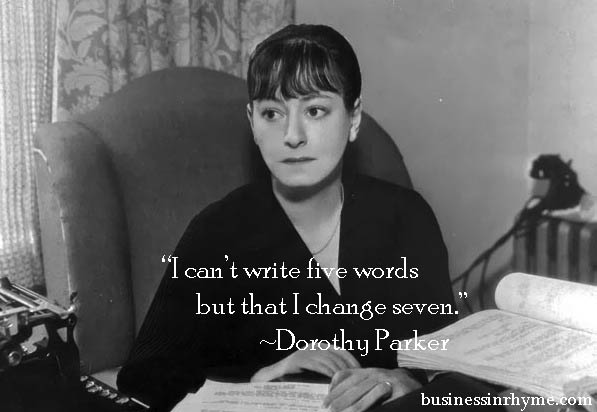
The next one is Dorothy Parker, poet, short story writer, critic and satirist who claims that editing is what gives value to writing:

I can’t write five words but that I change seven. Editing is vital.

Her writing is concise, edgy and carefully phrased, like in this short poem:

Razors pain you;
Rivers are damp;
Acids stain you;
And drugs cause cramp.
Guns aren’t lawful;
Nooses give;
Gas smells awful;
You might as well live. 

And the third advice comes from young Sarah Key, best known for her bold and raw slam poetry. Young writers and poets are often the carriers of new trends and movements and this is how she sees writing poetry:

Poetry is like pooping. If there’s a poem inside of you, it needs to come out. I want people to think of poetry as more human, less sacred. You don’t have to get paid for your writing to be a writer. I know many people who work nine-to-five in a cubicle and then come home to write for themselves. Their words are often just as powerful, moving, and valid as anything I’ve written, if not more so. write a poem once a week and doodle once a day. Create something that brings you joy.

The rest of the interview you can read here. Her words are encouragement for everyone who wants to write, and you are a writer if you say you are. You need to believe in yourself and that there is no perfect writing.

I hope these tips will help you in search for your own writing muse 🙂


If you liked this post and you are interested in getting more inspiration for your creativity, sign up for our free bimonthly newsletter.


Write a book – without even knowing it!

micheal butor

I’ve always been curios and hungry for knowledge: to explore, research and eventually tell the world about my findings. My first intentions were never to become a writer or published author, but with time I evolved into one. The funny thing though is, that in my early school years I never liked to write literally essays and school approach to poetry was dreadful! So my early inclinations towards poetry, quietly faded away, until few years ago when my interest simply rekindled itself and I began to experience so much benefits from writing and reading poetry.

At the University, writing scientific papers and factual reports became very natural to me. When I seriously decided to devote to academic career this type of writing and communicating were so habitual that writing papers had its own flow and rhythm. Pretty much the same was with my lectures.

And before I knew it, I actually wrote a PhD thesis. And a PhD thesis with little modifications became one book. My lectures with little wrapping and structure became my second! I’ve published so far three books (and I think right now I’m working on my forth 😉 ).

So what I want to say is that there are endless ways how you can write a book, without even a real intention on writing it. It’s important that you enjoy writing. It might develop into something significant or not. Who knows? But as long as you invest yourself in the process, without thinking too much on why and how, your real literally genius will shine through.

Did you know for example that The Artist’s Way “hatched out” from a sheet of paper with tips for Julia Cameron to give to students at her writing classes?

Or that  Escape from Cubicle Nation originates from blog post series?

For you is important to track and record your ideas; something that you have already written – is it finished or you want something else to add to it?

In other words, if you so desperately want to write a book, try not to write one!

Maybe you already have a blog, a diary, jotted collection of articles, short stories, verses, quotes, thoughts, questions, lectures…?

Maybe you’ve written a thesis, a paper or already have undeveloped e-book?

Or you like to record your thoughts with your smartphone or even have a gallery of pictures that you find inspiring?

All of that can be turned into a book, worth reading and worth publishing – as long as it represents who you are, your values and your true nature.

In this post I further explore professional benefits and opportunities you can experience by being consistent in your writing.

Your life is actually a book you write every day – you choose how you leave your mark. I vote for ink and paper!


3 tips to recognize your authentic writing voice

grillet

Your writing has a color, sound, feel…just as your natural voice. It translates who you are and is your tool for communication. Making some effort into “crafting and fine tuning” your writing voice is worth your time and energy. It doesn’t matter are you a content developer, fiction writer or you blog just for a hobby, it is essential for you to find that uniqueness inside of you – express it and let it live.

There are some tricks you can employ and that can guide you towards your better writing – better you writing.

Some of the first things you need to ask yourself is who is reading your stuff? Who is your audience? When you are writing, try to imagine your ideal reader and write according to that feeling. What would your reader interest? What would make them smile? What would make them think deeper? What kind of value you can bring to your reader?

The next important thing is to pay attention to how do you feel while writing. Does it exhaust you or it invigorates you? Is it like something you MUST do or is something playful, enjoyable for you to do?

How honest and open are you while writing? Are you always finely wrapped in your security blanket or you explore topics and genre that are out of your comfort zone? That’s good. People can sense in your writing when you are open or you are playing on the safe side. It can be a huge motivation to make your writing worth attention and reading. Being you and being vulnerable is OK – people can more relate to you in such way. We all know that our stories are governed by our subconscious mind. We all have unresolved inner conflicts, doubts, insecurities. Give yourself permission to say things in your own way. You need to own your writing and don’t hide behind other people’s opinions and words. That’s being authentic and unique.

And finally, ask yourself is this something I would like to read? Your answer is the best guidance in which direction your writing is going.

Do you think you have found your authentic writing voice? Tell us about it in the comments.