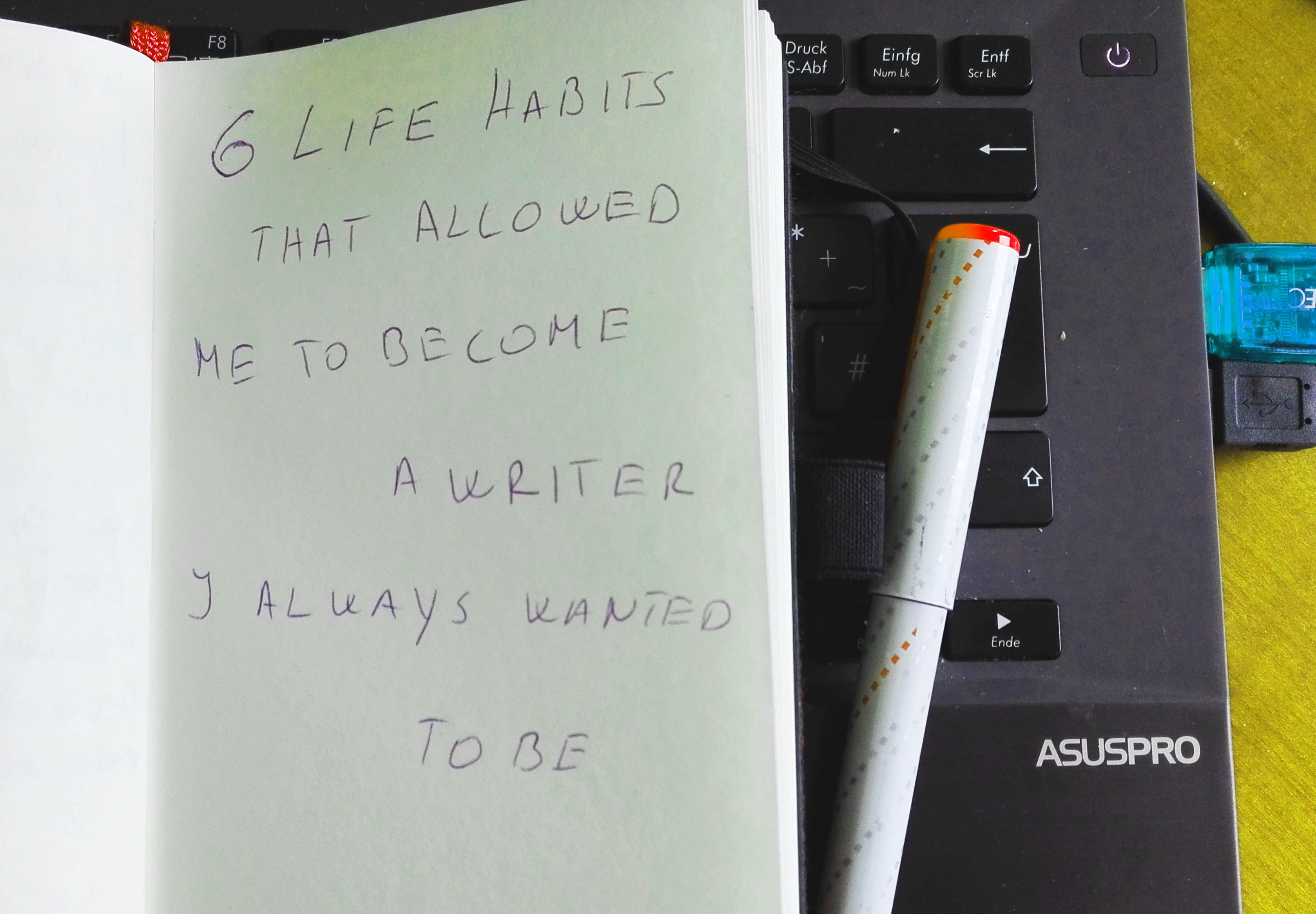
6 life habits that allowed me to become a writer I always wanted to be

lifehabits_writing

I guess, ever since I entered my graduate studies, I was involved in some sort of writing: assignments, seminars – later came academic papers, books and presentations. But all that writing was somehow constrained – I had to obey certain rules, to follow procedures and satisfy requirements I was asked to. As all that can be fun and is a learning path – it lacked freedom. For me, becoming a writer I always wanted to be, means writing what I want, when I want, under my own terms – to share my experiences and have opportunity to contribute to larger community. And blogging is a fabulous way of doing that. Business in Rhyme really allowed me to explore topics I previously didn’t have time for or I didn’t know how to communicate. Finally I think I’m on the right track of becoming a writer I always strove to be deep in side with needed courage and strength to endure.

In the last seven yeas a lot of things changed in my life. Previously, in my home country I worked as University professor, and a business consultant, which led to being ‘stretched’ between my work with students, writing textbooks and doing research for projects.

Coming to the Netherlands brought a lot of challenges, meaning I didn’t know what I really wanted:  to teach, to do research or something else. In the meantime I kept my ongoing projects at the University. Along the way with my move and adjustments in the new country, first health issues appeared in the form of thyroid dysfunction and peripheral neuropathy as a side effect. I knew something has to change: to take life much easily, pay more attention to myself and what I really needed.

So my first change and habit I developed is

1.Always assessing my needs

When you from very active and vibrant person become someone who lacks energy, has a lot of pain and struggle with everyday activities, you start to ask yourself questions like:

How did I get here?

What went wrong?

What is it that I actually need?

In that process I started to remove anything that didn’t serve me anymore: clutter, habits, ‘stale’ relationships… I started to meditate, devote most of time to myself and nurturing my peace. I realized I didn’t want to live a hectic academic life I so ‘adored’ and was proud of. But there is so much more to life than being busy – like learning about your real needs, writing and reading poetry that earlier I didn’t have time for. And all those realizations culminated in this blog. Here I’m finally a writer always wanted to be: with no degrees, grades, awards – it’s just me,  pure me translated in words.

The second one is:

2. Cleaning my diet

The process of simplification I embarked on meant also evaluation of what I was putting in my system and how that has contributed to my conditions. I now eat so simply that my friends usually laugh at me 🙂 But it means I’m pain free, medication free, and it takes less time to prepare my meals. Eating more fruits and leafy greens (in their raw state) brings clarity and patience you need in order for your creativity to flourish. Improving your digestion, sleep, energy levels – all that is vital to exploit your real creative potential.

3.Creating meaningful morning routine

I was always a morning person. I use that time to start my day with setting right attentions, with loose schedule so I can achieve desired outcome without stress. Doing some short exercises, meditation or yoga helps me refocus my thoughts and concentrate on the tasks ahead of me.

4.Reading more poetry

This is a habit I wish so many people acquire. Benefits of reading poetry are numerous, but fulfillment it brings to my inner self is immeasurable. Having that another lens to look at world is enjoyment and amazement I now need every day.

5.Enjoying solitude

I am quite individualistic when it comes to work and I’ve always enjoyed hours in solitude to sort my thoughts and figure things out. The same applies to my writing. Spending time ‘alone with myself’ enables me to have that internal conversation and dive deep in search for both answers and questions I explore further on paper.

6.Change of scenery

Whenever I’m confused or I don’t know how to articulate what I want to say, changing my environment helps a lot – being that going for a walk, short travels or vacations. All that contributes to inflow of fresh ideas, creative opportunities and stirs your imagination. Changing environment brings inevitably change of our perspective on things. Sometimes that is all you need to start/continue writing.

So this is my list of habits that helped me improve and devote more time to writing. I wholeheartedly encourage you to assess your needs and habits – look for space where you can devote more of your energy to writing and become a writer you always dreamed of.


If you liked this post, please share! For getting more inspiration for your creativity, sign up for our free monthly newsletter.

Poetic inspiration: Unlock your untold story

unlock_untoldstory_poetry

Unlock that untold story

residing in you,

for once you

break the chains of yesterday,

you will find the way to your most

creative self.

Maja S. Todorovic


If you liked this post and you are interested in getting more inspiration for your creativity, sign up for our free monthly newsletter.

4 simple ways to make your poetry blog stand out

4 simple ways to make your poetry blog stand out

We all know that writing and reading poetry is a unique experience. Words are our tool we use to portrait emotional journey where we want to take our reader. But do we always succeed in that? I pose this question not that much from the writing point of view, but more how do we select and arrange environment where we display our poems. In our blogging space we need to offer an opportunity for that experience to become alive and ‘consume’ our reader.

There are certain ways you can improve your blog to represent who you are and let your writing really stand out.

Chose a theme that allows your words to be the focus.

We do live in the digital era where is emphasis on photographic beauty and memory. But here what matters are your words. Simple, elegant themes that reinforce the power of your words and enable your poems to pop-up are more pleasant to your reader. It should support your writing voice and emotion it transcends.

I always prefer minimalist aesthetics as it sheds all the unimportant stuff away. So if you write a poem, or a quote, story and use just one or two images, that is much more appealing to your reader than scrolling through the crowded screen of unnecessary information. Playing around with different typography can help you accentuate what you think is crucial for reader to notice.

Do you really need all that widgets ‘lingering’ around?

In past few months I’ve experimented with sveral themes and widgets and decided to keep those that I think are beneficial to the reader. The same comes with the menu and header information. I’m usually interested to browse what general topics blog has to offer, and maybe archive. A shortcut for people to follow blog by email, RSS and social media buttons is also good to keep.

I do follow and read a lot of blogs and often I come across those that have duplicate widgets which is quite unappealing (you don’t need to display the same information in sidebar and footer, right?). It doesn’t matter do you blog just for hobby, to fill up your spare time or you are a professional writer: neat looking blog is what invites people in to read your writing. With a tiny effort you can really make your blog clean and easy approachable for reader.

Yes, about page is important.

So you do have a blog. And you share your work. Guess what, people will often like to know more about you –  there is nothing inherently wrong with that. You control what information you put but I think having that about page and few sentences where you give bits of yourself can be beneficial. Even better, as a poet why don’t write interesting poem about your blog/your writing?

I, for example in the beginning had a short version of my CV, which is not that much related to what I’m doing here (except from the creativity part) and I realized it was too heavy. Than I completely rewrote it. Now my about page in more humorous and fun way accentuates just few really important facts about me and my blogging.

For more professional author biography here I share best tips on how to write it.

Offer different formats of your work.

As a writer/poet this is an area you can further explore. Many people prefer audio formats. You can record reading of your poems and use sound cloud services to share your readings. It might be your work or poems from other popular poets. It’s good to know that we all differently digest information and we need to use technology to our advantage – in a way it will support our work, not hinder it.

In a nutshell, your content is your branding. Let it shine. We are here for love of writing and reading, and that’s where all the magic happens. With these given tips, “shower” your faithful readers with regular writing and you will see how your community will grow.


If you liked this post and you are interested in getting more inspiration for your creativity, sign up for our free monthly newsletter.
Poetic contemplation: William Stafford on writing, pursuing your life dreams and accepting your true nature

williamstafford_Quote_poetry

William Stafford is an American contemporary poet and writer. Born in 1914,  his early teenage and adult years were marked with effort to support  family by doing various seasonal jobs. As the eldest of five children he grew up appreciating books and nature.  He received a BA and an MA from the University of Kansas at Lawrence and, in 1954, a PhD from the University of Iowa.

As a registered pacifist, Stafford worked in camps and projects during the second world war. In 1948 he began to teach at Lewis and Clark College. His first poetry collection was published in his later years (when he was 48) and it won the National Book Award in 1963. For his lifetime he published more than 65 volumes of prose and poetry and won many literary prizes. His poetry at first glance looks simple, yet contains profound truth and revelation, if examined deeper (source)

He truly believed that everyone of us is a writer, a poet at heart, just people lack persistence and vision:

Everyone is born a poet – a person discovering the way words sound and work, caring and delighting in words. I just kept on doing what everyone starts out doing. The real question is: Why did other people stop?”

Writing is constant process of exploration and that’s what constitutes a good writer:

 You don’t need many words if you already know what you’re talking about. A writer is not so much someone who has something to say as he is someone who has found a process that will bring about new things he would not have thought of if he had not started to say them.”

Every  word has to find its own right time and place and nothing is more powerful than that:

In winter, in the dark hours, when others
were asleep, I found these words and put them
together by their appetites and respect for
each other. In stillness, they jostled. They traded
meaning while pretending to have only one.

Monstrous alliances never dreamed of before
began. Sometimes they last. Never again
do they separate in this world. They die
together. They have a fidelity that no
purpose or pretense can ever break

And all of this happens like magic to the words
in those dark hours when others sleep.

In Stafford’s work we can easily observe entwined topics of self-acceptance and belief in retaining one’s true nature. He writes:

I heard a bird congratulating itself
all day for being a jay.
Nobody cared. But it was glad
all over again, and said so, again.

Too many times we pay more attention on what others have to say about us, than what we think about ourselves. And these words by William Stafford are great reminder:

They miss the whisper that runs
any day in your mind,
“Who are you really, wanderer?”–
and the answer you have to give
no matter how dark and cold
the world around you is:
“Maybe I’m a king.

Everyone of us has its own path to follow. Our purpose in life is with our desires, goals and thriving for better to pave that path. Conditions and circumstances might change, but not our attentions, values and desire for contribution – fear should never interrupt the way you lead your life:

There’s a thread you follow. It goes among
things that change. But it doesn’t change.
People wonder about what you are pursuing.
You have to explain about the thread.
But it is hard for others to see.
While you hold it you can’t get lost.
Tragedies happen; people get hurt
or die; and you suffer and get old.
Nothing you do can stop time’s unfolding.
You don’t ever let go of the thread.

And whenever we have doubts we can return to nature, divine silence that contains all our questions and answers: our task is to search for ones that belong to us:

Some time when the river is ice ask me
mistakes I have made. Ask me whether
what I have done is my life. Others
have come in their slow way into
my thought, and some have tried to help
or to hurt: ask me what difference
their strongest love or hate has made.

I will listen to what you say.
You and I can turn and look
at the silent river and wait. We know
the current is there, hidden; and there
are comings and goings from miles away
that hold the stillness exactly before us.
What the river says, that is what I say.

Stafford’s contemplative poetry offers very deep and nurturing outlook on purpose in life. For further examining this topic, you can complement this reading with thoughts from other poets:

Kahlil Gibran’s timeless wisdom on the purpose of poetry and meaning of work

The poetic determination: Ella Wheeler Wilcox on positive thinking and how that impacts success in life


If you liked this post and you are interested in getting more inspiration for your creativity, sign up for our free bimonthly newsletter.

Practicing this exercise will make you more confident in your creative work

creativity confidence

Most of the confidence we develop throughout the years stem from our past experiences – predominantly on how other people perceived us and our work. Not gaining enough recognition, pile of rejection letters and even just a random bad comment can blow away all our creative self-esteem – that many people stop creating all together. Paying too much attention on other people opinions can instill  fear that  paralyzes not only our creative outlets but practically our complete approach to life. That kind of attitude leads to isolation, avoidance of trying new things and not sharing our accomplishments with the world.

The good news is that we have control of our feelings towards what creatively we can offer to the world.

When you get to the root of this problem, it’s all about belief and what we chose to believe. You can chose to believe that:

  • you are creative person,
  • your creativity matters,
  • you can add value and improve other people’s lives through your creativity.

The most important opinion is the one we hold for ourselves. From there you build and harness your confidence. Once you are aligned with who you are, and you truly believe  you are creative person, no one can destabilize your confidence – on the contrary. Your positive creative offerings and your abilities to create expand, grow and gain more interaction with the world. That’s what creating really means.

By now you are already guessing that we can use poetry as an effective tool to create more beneficial beliefs for us.

In this case, poetry can help us implement presuppositions to improve our confidence and strengthen positive attitudes towards creativity. This technique is often used in NLP (Neuro-Linguistic Programming)

A presupposition is simply a statement or belief that is assumed to be valid.

It can be something like this:

I am a creative person and I have everything I need to create.

I share my work as it inspires others to learn and create.

I can finish any task by taking small steps.

There is no failure, only certain results.

Success is possible for me.

Now  think of any situation in your creative pursuits where you would like to gain more confidence. Close your eyes and imagine vividly you are doing that activity right now. Imagine each detail, smell, touch, as you observe yourself, notice your feelings, how your senses react.

For example you don’t feel comfortable submitting your written work to journals, you fear rejection and that prevents you from sharing your work:

It might feel like this:

“My heart is pounding, and I mean really hard pounding! What’s wrong with me? It’s just a poem anyway. They might not like it, it’s not such a big deal! But look my hands are trembling and suddenly I feel so cold! I can’t believe I already forgot to spell, I’ll never finish this application letter. Look at other writers here,  they all have already published their work! Who am I? My writing is not good enough, the criteria is too high, I can’t compete with that!”

In the next step pick one of the statements (or write your own). For example:

There is no failure, only certain results.

and apply it to your situation and imagine what would it look like where you totally believe this to be true. How would your writing life be different? Close your eyes and notice how you now perceive the situation whilst holding this new truth for you. Notice what you see, hear, feel and write a poem about it.

I chose you, to be fertile soil for my words. As you have been for so many poets before me, who inspired me, taught me and gave me the strength to write even more. Reading your pages gives me warmth and sense of belonging. It’s peaceful anticipation and only words are important. If I can’t nest my words in your lap, well they can’t fail. They have strong wings to fly farther and farther…until they find new home in someone else’s heart, cradle on the pages that will spread my joy of writing. If you don’t chose my words as I have chosen you, you are not destiny carved in a stone.

This is just one stop in my creative journey. You can’t stop the words. You can’t erase the words. In their eternity we arrange them one moment in time. This moment might not be mine, but the next, and the next and the next is.

After you finish exercise, think how this new belief may altered your perception: do you feel any different about the initial situation? Are there any actions you are going to take and when?

In our example it might be something like:

“Yes, I like this literary journal and I can submit my work there. If they reject it, I can apply elsewhere. It doesn’t mean I am a bad writer. They just might not like my style, but certainly there is right journal for my poems to be published.”

You can play around with different statements and situations and with time you will notice how your confidence increases. You pay more attention on what you can learn and improve than on the (false) judgments other people might hold against you.

I like this poetic approach as it feels more empowering and positive to me, instead of ‘dry’ writing. Poetry allows us to taste and experience situations differently: it’s magical what it can do for us and our confidence -practically in any area of our lives. It shifts your mood and the rhythm and melody you put into your thinking gives it another vibe, that positive feeling gets easier ’embedded’ into your subconsciousness.

And remember: confidence is a state of mind – you can get there with little persistence and practice.


If you liked this post and you are interested in getting more inspiration for your creativity, sign up for our free bimonthly newsletter.

4-step process to achieving your creative goals every day

4-step process to achieving your

In our already very busy lives, the pressure to do more and perform better seems to grow, even though we stay with the same amount of hours in a day. The to-do lists are getting on popularity with all accompanying tools like apps, digital notebooks and ext. just for you to become more productive. Still, there is an underlying question: we might be able to do more, but with what quality? I am always for quality over quantity, since it is less stressful and you will be more satisfied with the work you’ve done.carnegie

So how you can organize your day, in order to meet all your desired creative goals?

Cut the long to-do list short.

So the first step in this process I would recommend for you to clearly and realistically go through your daily tasks/goals, make priorities and choose only those that are really important.

Define what’s really important to you.

In order to retain that initial drive for accomplishing our goals, it is crucial to focus ourselves on the tasks that serve our purpose, that will benefit us in the long run. Only when you divert your thinking to work on what really matters, you begin to more appreciate your time and what you do with it.

Notice when are your high energy levels.

As everything around us has its cyclic rhythm so do we. Life is made of cycles and seasons so we need to observe ourselves in what part of the day we are most productive. That’s the power we should harness as much as we can. Follow the flow of your own rhythms instead of pedaling against the stream. I’m for example a morning person and I build my daily routine around those pick energy levels to take the maximum advantage of it.

Focus only at one task at the time.

Multitasking is a myth busted long time ago. It’s a deceiving feeling you are getting more things done, while what it does it’s quite the opposite. You might initially do more, but the tiredness and stress that accumulates simply adds up to long-term exhaustion. For many years, I personally was very proud of my multitasking skills. Yes, I managed to do more things, but at the end of the day I was always left with some ’empty’ feeling, like something was missing. And that was strange, because the purpose of the multitasking is to do more things and get that feeling of accomplishment and satisfaction, right? Until several years ago I realized that key source of my stress was that endless try to get everything done, fast and in short period of time. Than I began to declutter my schedule and get more focus on what’s really important. The biggest lesson I learnt is when you approach your obligations, strategically, with end result in mind, your focus will sharpen and your energy won’t get dissipated on meaningless activities. While remaining on doing one thing at the time, completely present in the moment, actually our effectiveness with time can grow, since it allows you to enjoy your work, simply to be immersed in your creativity. In Buddhist traditions, the philosophy is to do everything slowly and deliberately, with complete concentration. Put your mind completely on the task and try to avoid distractions.

If you have big projects, then break them into small pieces and do segment by segment, one step at a time.

How do you spare time for your creativity? Please, share in the comments below.


If you liked this post and you are interested in getting more inspiration for your creativity, sign up for our free bimonthly newsletter.

Identity: ACRONYM

I’m happy to share with you that my poem ‘Acronym’ has been published on Poetry Corner, under theme “Identity: All of Me”. This is my third poem published outside businessinrhyme.com and it’s starting to be exciting 🙂

Kuli Kohli's avatar

8 AM

It’s time for a square outfit

and

Smile No.3

I look further in my agenda:

7 PM

My apron is due,

Pizza Hut perfume.

11 PM

I’m a wild cat

with lipstick, cherry red.

So many roles to play:

Daughter, Mother

Sister, Friend

Colleague, Boss

Student, Teacher

Wife, Lover.

So many acronyms to wear:

Miss, Mrs.

B.Sc., M.Sc

Ph.D.

When it’s time for me?

To wear I?

by Maja S. Todorovic

Maja is an educator and writer, currently living in the sunny Hague. When she is not busy with rhyme, she munches on the bowl of fruit and pretends to do some yoga – or at least that’s how she would like to spend her time.

View original post

9 best practices that can drive your editing process, part II

Art-Plotnik

In the first part of this blog post I shared some of my favorite practices that can help you become more efficient when it comes to editing. But there are more things you can do to become even more productive:

  • Track Your Bad Habits.  If you want to be better at your writing and editing, try to notice your typical mistakes and actions. Commonly misusing a word or phrase? Highlight that word or write it on a sticky note somewhere you will see it often. It will remind you not to use it and think of more creative ways to say something. One thing that really works for me is to write myself notes  for anything I need to correct. It’s a learning process in progress and how your writing improves, less things you will want to fix.
  • Try reading it backwards. This is a bit weird, but it helps you become more aware of what you wrote. Begin with the last sentence and move up from there. You can see does your writing builds momentum, some sort of positive tension of expectation: words play with your logic and your focus improves – you can better sense the fluency and rhythm of your writing
  • Don’t be hard on your self. The truth is there is no perfect writing. Your task is to do your best with given time-frame, conditions and knowledge you have. That has to be enough.

Now, my students often used  to ask me: “Can you over-edit your work and how that can harm your writing?” and I think it’s a good question to answer.

Over-editing can prevent you from sharing your knowledge and message with rest of the world. Your writing doesn’t have to be 100% perfect in order to help and inspire someone. When you you are tempted not to publish your work, that’s almost the same as you have erased all of your work – it can’t help anyone if it’s hidden in your computer folders. Instead of torturing yourself  over grammatical perfection, ask yourself does your writing brings any value to your readers? The next thing is, it simply kills your productivity. Over-editing wastes time and energy. It’s tiring, it sucks the inspiration out of your body and mind.

How to recognize you are over-editing?

  • you are endlessly rewriting what you already wrote, without moving on to write something new. That holds the danger of you losing your own writing voice and the purpose of your writing. When you edit your piece too many times, you can end up editing every drop of life out of it. A conversational style is becoming more popular and you shouldn’t shy from it. It helps you connect with your readers and express your won personality through words. Even in business communication you need to stir up your writing and avoid being too stiff;
  • you let fear command your editing and you start to doubt something you previously considered good.
  • you sense something is wrong or missing but you can’t figure it out and that keeps you stuck at one page.

So, what to do about it?

Our habit to over – edit is connected with critical side of our brain that seeks approval and strives for impossible perfectionism. One little trick that might help is to make notes for yourself what you want to accomplish in writing that day – bring intentionality to your writing.

Monitor your self-talk and tell yourself you’ll deal with it later. You might be saying to yourself something like “This is just too boring.” Or “I’m a really bad writer.” The trick is to be conscious of it. Then, answer to yourself in kind and gentle way–

“I’m writing right now the best I can;  I’ll deal with these concerns later.”

This kind of silent promise you give to yourself shuts down that resentful critic and allows more space for creativity.

Many of us spend more time editing than on the actual writing. Editing is a just a tool that helps us improve what we already wrote, but it doesn’t determine are you bad or good writer. What mostly matters is the idea and the purpose behind it.

Now, it’s your turn: do you have any editing tricks to share with us?


If you liked this post and you are interested in getting more inspiration for your creativity, sign up for our free bimonthly newsletter.