Original vs. authentic writing: what are the differences and similarities?

Stephen-Fry

This is one of my favorite topics I’d liked to discuss with my students. With emerging IT technology, inevitably came a ‘cut and paste’ revolution and for many students just wanting to finish their essays and seminars looked as an easy way out.

But here we are not talking only about lower grades for lack of motivation or not doing the assignment the right way: it’s a trap that many carelessly fall into and something like that can easily become a habit. And once something like that becomes a habit, we simply forget to write and discuss ideas in our way, to use our own words and interpretation.

So one of the things that my students taught me is to respect any authentic and honest writing; a writing that comes from an independent thought process – no matter how many mistakes or “wrong views” it might hold. It’s authentic.

Now, too many people often simply terrorize themselves that for something to be valuable and worth reading/hearing has to be original. And the truth is, in our contemporary world where the exchange of information is at such high rate, is very difficult to produce that completely original idea, that doesn’t resemble anything else.

I remember when I was doing my masters degree project. It was a huge task, where I had to mathematically process over 1, 5 million data. It took almost a year to do it (it was 15 years ago so computers were much slower :)). And I also knew at that time that as a young scientist my chances to discover something new or make a remarkable scientific breakthrough (that many scientists before me already did) are very close to zero. And I did get results very similar to already existing. But I did it anyway. And you might wonder why? Well, it was my scientific journey, which means I did it my way. During that process I learnt a lot not only about physics, geology and mathematics, but also about myself and my own expectations. At the end, I gave my own interpretation of results and it was just tiny contribution to already vast worldly resources and databases on the topic. But this one was performed by me and that made it authentic and original in the same time. It’s been years now that I’m out of solar-terrestrial physics, but my work is still cited by many scientists.

And that’s what nowadays we need the most: more of a authenticity. Once you write something on any topic in your own words, the way you talk in your everyday life – it makes it authentic and original in the same time. So I encourage you, when ever you write, write from the heart; when you allow yourself just to be you, discarding any worry are you original, innovative, interesting, attractive enough – you become all of that. You are an original.

Writing

by Howard Nemerov

The cursive crawl, the squared-off characters

these by themselves delight, even without

a meaning, in a foreign language, in

Chinese, for instance, or when skaters curve

all day across the lake, scoring their white

records in ice. Being intelligible,

these winding ways with their audacities

and delicate hesitations, they become

miraculous, so intimately, out there

at the pen’s point or brush’s tip, do world

and spirit wed. The small bones of the wrist

balance against great skeletons of stars

exactly; the blind bat surveys his way

by echo alone. Still, the point of style

is character. The universe induces

a different tremor in every hand, from the

check-forger’s to that of the Emperor

Hui Tsung, who called his own calligraphy

the ‘Slender Gold.’ A nervous man

writes nervously of a nervous world, and so on.

Miraculous. It is as though the world

were a great writing. Having said so much,

let us allow there is more to the world

than writing: continental faults are not

bare convoluted fissures in the brain.

Not only must the skaters soon go home;

also the hard inscription of their skates

is scored across the open water, which long

remembers nothing, neither wind nor wake.

(source: poetryfoundation.org)


If you liked this post and you are interested in getting more inspiration for your creativity, sign up for our free bimonthly newsletter.
Can poetry help us resolve social issues?

hirschfeild

When I first started this blog, my intention was to explore the benefits that poetry can bring to the world of business; how can we become better in what we do, by improving our creativity, leadership skills, cognitive and strategic thinking, communication, tacit knowledge and ext. With time, blog evolved into something much more and deeper and on a few occasions I’ve also wrote about the transformative power of poetry.

Recently, I came a cross an article, an interview with poet Jane Hirshfield where she shares her view on how poetry can help us move forward in dealing with even bigger social problems:

I think we know the world needs changing. Things are going awry left and right. I firmly believe that in our very practical, technological, and scientific age, the values of all the arts, but of poetry in particular, are necessary for moving the world forward. I’m talking about things like compassion, empathy, permeability, interconnection, and the recognition of how important it is to allow uncertainty in our lives.

One of the current great problems in the world is fundamentalism of every kind – political, spiritual — and poetry is an antidote to fundamentalism. Poetry is about the clarities that you find when you don’t simplify. They’re about complexity, nuance, subtlety. Poems also create larger fields of possibilities. The imagination is limitless, so even when a person is confronted with an unchangeable outer circumstance, one thing poems give you is there is always a changeability, a malleability, of inner circumstance. That’s the beginning of freedom.

With these beautiful words, I think she captured the true essence of poetry; its purpose and reason for existence: every poem is like taking a journey to a different world where everything is possible and we can truly chose our experiences and taste liberation in every sense.

In her wonderful book “Ten Windows: How Great Poems Transform the World.” Jane Hirshfield, further explores hidden strength that poetry holds and especially focuses on the beauty of uncertainty, not knowing everything – just enjoying to be.

And today, I invite you when you write, at least for a minute stop asking yourself questions on how, where, why – liberate yourself from any false predicaments and just be present, sink into your own being and feel your inner world; connect with your own subtle energies, where self-acceptance and self-trust takes place – you might be surprised how your reality change.

By allowing ourselves to transform our inner world, we are transforming the world around us as well.

Some stories last many centuries,
others only a moment.
All alter over that lifetime like beach-glass,
grow distant and more beautiful with salt.

Yet even today, to look at a tree
and ask the story Who are you? is to be transformed.

There is a stage in us where each being, each thing, is a mirror.

Then the bees of self pour from the hive-door,
ravenous to enter the sweetness of flowering nettles and thistle.

Next comes the ringing a stone or violin or empty bucket
gives off – 
the immeasurable’s continuous singing,
before it goes back into story and feeling.

In Borneo, there are palm trees that walk on their high roots.
Slowly, with effort, they lift one leg then another.

I would like to join that stilted transmigration,
to feel my own skin vertical as theirs:
an ant-road, a highway for beetles.

I would like not minding, whatever travels my heart.
To follow it all the way into leaf-form, bark-furl, root-touch,
and then keep walking, unimaginably further. 

Jane Hirshfield


If you liked this post and you are interested in getting more inspiration for your creativity, sign up for our free bimonthly newsletter.
 

7 alternative business models that every writer should consider

Tim_O'Reilly

Once you have written your book, promoted and eventually got some satisfactory sales – is not the place where job around your book is finished. No, no 🙂 actually, this is an opening opportunity for you further to establish and build a credible business around your book. You might also think that this is applicable only to non-fiction authors, but it doesn’t have to be. Even as a fiction writer, there is a lot you can share with people and teach what you know. And you can translate that in multiple revenues of income. Mostly this falls into category of product-service-system business models, where around the product you offer, your clients/customers can enjoy  variety of related services.

Here is the list of interesting business model variations that I think every published author should consider:

  1. Speaking opportunities. Published book in your area of interest gives you the opportunity to position yourself as an expert in the given field. Through established and growing relationships, networks and community you can gain speaking opportunities and expand your writing business.
  2. Coaching. Are you good at your writing? Or you published a book about something else you are good at? Well there are other people who could benefit from your knowledge. This is an excellent way of starting an online coaching business – you can easily and effectively do your coaching using skype (facetime, ext.) and help people from all around the world.
  3. Online courses, webinars, training sessions. This is quite similar to  coaching, but you have a bit larger audience: you can use your book as the foundation for an online training session or workshop. This is an excellent opportunity to virtually deliver educational programs and gain international clients.
  4. Subscription/membership program. Your book can be a foundation for a membership program where you offer additional exclusive content only to subscribers (on a monthly basis for example). Being your content “in the how to” category or short stories series, this is an excellent chance to secure steady stream of passive income.
  5. Information products. Every book can be easily upgraded/transformed in a workbook, mobile app, podcast..
  6. Certification. If you have developed your own techniques and methodologies that are effective in some way, you can offer certification programs to consultants/writers/coaches who want to teach your methods. In a way they are becoming your ambassadors, promoting further your business and brand.
  7. Online portal/journal. If you like to couple your love of writing with research you can start your own portal or journal, related to topics you are interested in. It is seen as an excellent opportunity to engage with other writers and generate valuable and interesting content. It can vary from poetry to retail or politics. Nevertheless, depending on the traffic your site generates you can ‘sell’ space on your website to interested third parties for advertisements.

Each of these models is a way that writer can deeper explore real entrepreneurial possibilities. Each of them require further time and investment. Yet the purpose of this article is to emphasize that inclination and affection for writing doesn’t have to end there: it can further fuel our creativity and combined with other talents (being that ours or other’s people) can lead to results with much broader impact.

3 simple truths about your online presence

frank capra

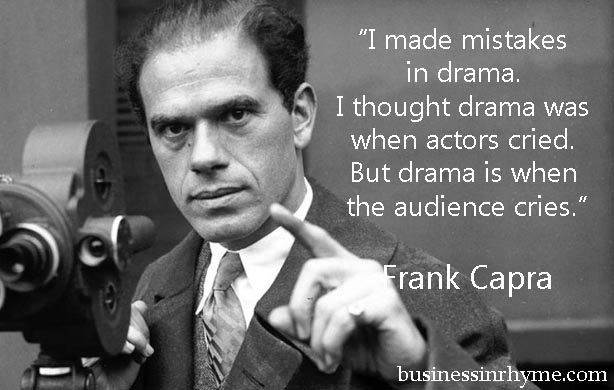
In one of my previous posts I talked about the importance of building your community of supporters, people who share your view of the world and values –your tribe as some refer to it.

And when I think of community, I think in every aspect of it: people in physical community are organized and engaged in certain activities and mostly are oriented towards shared goals, values and trust.

Well, much of that we can apply to our online community as well:

  1. Engagement. For fostering mutual trust we need interaction, honest exchange of information and responsiveness to inflow of new ideas, opinions and views. In every community, communication is a two-direction street, a beating heart of your online presence. No matter how large community you might think you have, empty number without discussion and healthy exchange of ideas is like living in an empty, cold, dark cave when from time to time you stumble upon some living creature, and the only sound returning to you is your echo … I always encourage even having smaller group, but the one that is your real audience, ready to complement your every victory and comfort you in your small omissions…that is warm and feisty; that in the same time can understand you and guide you. One simple way to improve engagement is a call for action. Invite your audience to share their experiences, their views, problems… by honoring them in this way your empty and cold cave is transforming into a warm home, filled with real emotions.
  1. Sharing is caring. In old times, before the internet era, companies were in charge of disseminating information, which means they had better control of what kind of information went into the ether. Now we have a different problem: we are facing the challenge of getting the right information. People are turning to internet and social media to dig up what they need to know. In order for your content to be noticed, It has to be relevant to your audience, that is helpful and contributes to improving their lives in some way; entertaining or provides different experience. That’s why sharing is important. It’s your ritual of giving pieces of your time, knowledge and energy and this type of investment that adds value, is building even stronger connections of trust – among you and your target audience.
  1. Make your message clear and focused as much as possible. In other words, find your writing niche. I like to read poetry, for example. But even in poetry I have preferences: I like long, prose poems, with lot of mythology even Gothic atmosphere entwined. So the writings of Margaret Atwood, W. B. Yeats and Kelly Boyker appeal to me very much. Or surrealist approach to poetry.

So, even in your writing, when you try to be narrow as much as possible, you attract right people. If you write to be liked by everyone-chances are you hardly get noticed. People like to feel special, like you are writing specifically for them or referring to their specific experience. When people identify with the message you are sharing, they like to talk about it, share it further: in simple words – your community is growing.

And of me say the fools:
With my poetry
I violated the sky’s commands.
Said who
Love is
The honor-ravager of the sky?
The sky is my intimate.
It cries if I cry,
Laughs if I laugh
And its stars
Greatens their brilliance
If
One day I fall in love.
What so
If in the name of my beloved I chant,
And like a chestnut tree
In every capital I, her, plant.

Fondness will remain my calling,
Like all prophets.
And infancy, innocence
And purity.
I will write of my beloved’s matters
Till I melt her golden hair
In the sky’s gold.
I am,
And I hope I change not,
A child
Scribbling on the stars’ walls
The way he pleases,
Till the worth of love
In my homeland
Matches that of the air,
And to love dreamers I become
A diction-ary,
And over their lips I become
An A
And a B.

Nizar Qabbani
If you liked this post and you are interested in getting more inspiration for your creativity, sign up for our free bimonthly newsletter.

3 tips to nail your book presentation

Nicholas-Boothman

When you write a book actually it’s not even the half work done. The most difficult part is yet to come and that is marketing ans selling your book. In this chain of activities, beside writing an amazing book and author bio – there are still significant things you can do to increase the selling prospects of your book: writing a captivating book presentation (synopsis) and giving a splendid pitch!

It can be a very difficult and daunting task since there’s so many things you want to include and you think that everything is equally important.

Now, there are probably some technical rules that you would need to follow, like number of words and paragraphs, (editors and agents will probably have their own requirements when it comes to how long they expect synopses to be) but my writing books so far, taught me that the essence of  book presentation should incorporate three approaches that I’m going to share with you now. It can be applied both to oral presentation and the written synopsis of the book.

It doesn’t matter if you are a fiction or non-fiction writer: many inexperienced authors make a beginners mistake and that is:

  1. Not everything is about them as writers – on the contrary!

Instead of forcing an attitude “me, me, me” and how good your book is, your focus should be on your audience – your potential readers, publisher, book sellers. In your presentation you need people who are listening and reading your stuff to put in the center of the action and make them feel that the presentation and the book in question is addressing them personally.

2. Become a mentor

Put yourself in your reader’s chair: what kind of experience does your book transcends? What your readers can learn? If your goal is to entertain them, what are the attractive points of the book you can emphasize?

Your book presentation shouldn’t be just a short version of already written story/text: make your audience a hero, take them on journey, give them new insights – make them WANT that book. And here, you are only their guide and mentor that navigates them through these new exciting adventures. As a writer, and mentor you’ve already traveled this journey and think of your presentation as a way to pass on the skills and knowledge you acquired.

3. Chose humility as your biggest asset

When you don’t try to steal all the spotlight, your point of view change. You’ll become more humble in understanding and communicating with your audience. While carefully crafting your book presentation, think of the benefits that your audience will get by reading your book; share your knowledge and wisdom in such way that is inviting, attractive and hard to say no to: your story needs to instill confidence, empathy, training, advice, tools or just fun – what ever is the value your book is providing.

I know this is a quite different approach to writing a book presentation/synopsis, yet in my experience it turned out to be very beneficial.

Once you try to think as your potential reader and in your presentation you accentuate what your reader should ‘take from a book’ – everything becomes much easier and clearer.

The Poet’s Manifesto

To set the tone for a year ahead, as an experiment, I’ve decided to post a poem I wrote recently, inspired by some of the poems I’ve read here on WordPress. My poetry is heavy and melancholic, in the form of prose poems and this is quite different and out of my comfort zone 🙂 –  I hope it will motivate you and inspire you in your writing poetry.

The Poet’s Manifesto by Maja S. Todorovic

I am the poet.

You are the poet.

Poetry is everywhere:

in your squinting eyes due to  the bright Sun beams;

in the smell of your first morning coffee;

in the smile of your friend when he sees you;

in the angry voice of your boss, when he teases you;

in the playful butterfly resting on your fingertips;

in the warm, passionate breath on your lover’s lips;

in the barking of your neighbor’s dog;

in the dense fog, heavy autumn rain;

in your unbearable pain.

That’s why you write:

you don’t need to explain,

to confess,

to impress,

anyone, just in vain.

You write because you feel,

you experience,

unsaid, unknown, unseen,

unheard, words unthrown.

You don’t write for adoration

or appreciation.

You don’t write for praise,

someone else to be amazed.

Your poem is your breathing.

Your poem is your existence.

Your poem is your persistence

to continue dreaming.

Words and letters, surprised

gathered here to take off their masks

to let you know:

whenever in doubt –just write!

Your creativity is well disguised.

Sometimes is shy,

encourage it to shine:

– just write!


9 traits successful entrepreneurs and authors have in common

JOHN LE CARRE AT HOME, CORNWALL, BRITAIN - 07 DEC 2003...Mandatory Credit: Photo by Jonathan Player / Rex Features ( 440663F ) John le Carre JOHN LE CARRE AT HOME, CORNWALL, BRITAIN - 07 DEC 2003

Many times we get involved in a writing and publishing – just by accident; with first no intention of doing it and often as a side effect of our other activities. First book I ever published was a textbook for University needs. It was developed with purpose to help students who were following my courses, and really, except writing it – I didn’t have much else to do:  printing, publishing, distribution..everything was taken care of. And I didn’t have to go too deep into the details of the publishing process.

My second book, was more a commercial one, with specific focus on small and micro-enterprises. I got a deal with one very small publisher in Belgrade, but the hardest part of the work was on me: networking, marketing, speaking engagements, ext. In a way as a published non-fiction writer I became an entrepreneur, since my book became a product that needed to be marketed and eventually sold. It was for first time I was doing something like that on my own – of course I made a lot mistakes, but I also learned a few things (mostly about myself and how it is hard to be an entrepreneur in the writing business).

To be a successful published author (both traditionally and self-published) you need some skills that are characteristics of a successful entrepreneurs. Your book is your product, and you want to take advantage of every little thing that can help you spread the word about your latest written gem.

What can an author learn form a successful entrepreneur?

Do your research.

Like with any other product, you need to do your homework and research how much of the similar is out there: being your fiction story or a ‘practical guide’ your are developing. How is it relevant for your market? Do you even know your market? Probably you won’t figure out everything at once, but even before starting to write a book, you need to be well informed.

Be prepared first to test the waters before taking a deep dive.

As much knowledge you might already have, what I mean by this is that there are going to be many trials and errors taking turns in your publishing attempts, since rarely first book becomes a huge success (or a bestseller) -just as entrepreneurs at the beginning have many ideas, but often one or two become feasible and economically viable. It takes time, and the first book, like a first idea, can often be just a step towards something much bigger, with higher impact.

Be persistent and focused.

Like in any business, an author needs to be focused and resilient in his attempts to make his book a high selling product. These abilities enable both  the entrepreneur  and author to keep going when the outlook is not favorable. The first book from Jack Canfield, a well known self-help guru, was originally rejected by 144 publishers. When he finally did get a publishing contract, a publisher wasn’t very optimistic: he said he’d be lucky to sell 20 000 books. Yet, a book sold in over 400 000 copies and became a bestseller. That’s the power of persistence at work!

Be persuasive.

As an entrepreneur, if you are in search for an investment funds, no matter how the great idea is, investors are far more interested in an already running company with developed business model and well defined products. They need to know they are investing in something worth while. The same comes with your publishing efforts: If you want to publish a traditional way, why would a publisher offer you a contract? You have to give publishers a reason to sign you, and just having a good book idea is not always enough. You need to be persuasive and convincing, develop a persuasive author bio and book presentation. In self-publishing is even harder: you need to convince the whole world in your idea. And just as any entrepreneur you bite the bullet, go out and do it.

Conquer ‘the marketing’ mountain.

Most people, being artists, writers or engineers are simply horrified by the term marketing (I’m the first in the line!) and I do believe that developing a high quality product (book), that is focused on contribution and purpose, that offers people a way to experience something new and different is the best promotional aspect – product speaks for itself. Yet, for people to try (read) your product first have to know it even exists! That’s the toughest job of the entrepreneur and author: to spread the word. Marketing creates demand for the product. Even before the product (book) launch. Later, the quality of the product will do the rest.

Develop your support system.

You can’t do everything on your own. It’s simple as that. You need someone who is already knowledgeable of the business in question, that can guide you and offer assistance. Someone who is trustworthy. Mostly that falls into marketing arena, because as I said it’s the hardest part of any business venture.

Think in terms of revenue streams.

Every business has a business model. So does a writer. Not only does writer can sell book, but there are other forms to translate a book into a different type of product: an online course, webinars, some type of coaching ext. Or delivering the existing product in a different format (audio book) or dividing it into a series of smaller products. This topic will be in detail addressed in one of the future posts. Here you can learn about alternative ways to earn money as a poet.

Building meaningful relationships.

In this post I go in length on the importance of community and how to develop one.

Here community are not only your readers, but any contact in the value chain of getting your book out there: from booksellers who will recommend your book, editors and illustrators that will dress your book and your readers who will impatiently absorb in every word you’ve written and come back asking for more. Once you build your community, it is an ongoing process maintaining it and growing it further, because in the long run the more you invest in your relationships, the more it will pay off later – especially when other products come in.

Be prepared to learn.

Along the way you will be amazed of how much you learn about yourself and how you are improving yourself in general. Every contact you make, sales pitch or presentation your are improving your communication skills, you are meeting new people and you are becoming a member of a whole new world: publishing world. Juts being part of the writing and publishing process is gratifying enough because you are creating, developing, contributing and you are leaving something behind you, as a fruit of your creative efforts.


Are you ready to enter a new relationship? 9 luscious ways to seduce your reader with your writing!

John Cheever

You as a writer and author, while building your audience are becoming a brand. And your writing is your best branding and marketing tool that exists. Words, emotions, message you transcend through your writing is that magnet that attract readers who share your values and point of view. But once they jump into your writing boat, you and your readers began to interact and build certain relationships; things become different, and a little bit complicated. But you as a writer, don’t want the status: It’s complicated. You want the status: Engaged.

Think about it for a second:

When you are in a relationship with someone and you enjoy it:

  • it is a person you are looking forward to see;
  • it someone you care about and like spending time with;
  • it’s probably someone who shares your values as well;
  • you interact on the basis of mutual trust.

Even classical marketing is moving from brand oriented marketing to marketing that is oriented towards building relationships.

To truly understand what kind of impact is your writing having on your readers you can ask yourself these questions:

Did my writing enabled me to build meaningful connections with my readers?

If not, what can I do to emulate the positive dynamics of such relationships?

  • It has to be a content your reader likes spending time reading;
  • It has to offer something of interest that makes your reader want to  expect fresh content and read it again;
  • That content deals with topics your reader cares about and shares his values.

In order to achieve these objectives you can apply certain tactics through your content:

  1. Offer your readers opportunity to know about you and don’t be afraid to show your vulnerability. In that way you are engraving that human component in your writing and building foundation for future relationship.
  2. Offer understanding, compassion; be helpful through your writing.
  3. Use catchy anecdotes and funny stories that are amusing and captivating.
  4. Show you’re interested in their perspective on things, even if it doesn’t agree with your own.
  5. Don’t be afraid to repeat yourself. What I mean is that pretty much the same message you deliver you can say in different ways and modes of expressing. People digest information differently. I remember while I was working with students, the more graphics I used, the students at the class were more ‘tuned in’ with the information, absorbing it in with wide open eyes, not wanting anything to miss. So use visuals as well, audio features, retell what you have to say in different ways.
  6. Be chatty. Start a conversation by asking questions.
  7. Always spice up everything with your quirkiness, with something that makes you different and that can enrich your content to the level it is worth remembering and sharing.
  8. Let your readers know that you are accountable and professional, but throw some ball once in a while. Add some playfulness in your writing because too much of serious approach can be sobering and counter effective.
  9. But never go across the line of NOT being you. What ever you write, be true to yourself because dishonesty leads to mistrust and deceit and like in any relationship, your reader might just break up with you and your writing (remember: rebound can be painful 😉 ).

Why does this written doe bound through these written woods?
For a drink of written water from a spring
whose surface will xerox her soft muzzle?
Why does she lift her head; does she hear something?
Perched on four slim legs borrowed from the truth,
she pricks up her ears beneath my fingertips.
Silence – this word also rustles across the page
and parts the boughs
that have sprouted from the word ‘woods.’
Lying in wait, set to pounce on the blank page,
are letters up to no good,
clutches of clauses so subordinate
they’ll never let her get away.

Wislawa Szymborska

A community: what it means for you and your (writing) business

community

Humans are social beings. No matter how we might enjoy solitude (for many reasons, like creativity, that’s already written throughout this blog), we want to satisfy that need for belonging to a group that shares our vision, interests; who can help us find and deliver our purpose. In this post I emphasized the importance of defining our message that will resonate with who we really are, what we stand for, what we believe and our true values. It’s a way we brand ourselves.

I would say that this is the first step in creating your community. Community is about interaction and engagement based on trust where reciprocity is the absolute law. The more value and contribution you put out there, the more like-minded people you will attract. How physically the exchange of information will go is of lesser importance. Being that blog, twitter, facebook, podcast … or a chit-chat with a friend over coffee – each time you communicate you build your community. Sure, some people come and go, but community is a live thing: it changes and evolves along with you. With your growth and your contribution,  your audience grows, matures,  breathe, dream, eat, sleep, just as you do! In other words, how much work and effort you put in your community, there is a higher probability for your message to be heard at broader scope. In return, your supporters will help you grow your business.

One of the vital ingredients that you need to provide while building your community is a personal touch. Most people best relate to struggles, little victories and specific experiences of their peers. They easily identify their own needs and wants, which is a force in building an audience. By sharing our story with them we give an opportunity to people to learn from us as well.

There is no one out there with your skills, your experiences, but you. And you bring that uniqueness to your community, that ‘quirkiness’ that differentiate you from other people. It’s a sure way to building your right audience.

And is also true that people easily get destracted, with life going too fast and information that is bombarding all our senses. What you deliver to your community has to be focused and relevant message and on the regular basis. Distraction leads to oblivion.

And your community has to be well pampered with all goodness you can provide, because at the end of the day how much you have been of service to your community, will show the real support you have.

As long as you stick to these rules, your community will start to manifest and yet you will never have to impose any self-promotion and marketing. Your behavior, communication and contribution, in my opinion is the best marketing tool you can apply.

Good we must love, and must hate ill,
For ill is ill, and good good still ;
But there are things indifferent,
Which wee may neither hate, nor love,
But one, and then another prove,
As we shall find our fancy bent.

If then at first wise Nature had
Made women either good or bad,
Then some wee might hate, and some choose ;
But since she did them so create,
That we may neither love, nor hate,
Only this rests, all all may use.

If they were good it would be seen ;
Good is as visible as green,
And to all eyes itself betrays.
If they were bad, they could not last ;
Bad doth itself, and others waste ;
So they deserve nor blame, nor praise.

But they are ours as fruits are ours ;
He that but tastes, he that devours,
And he that leaves all, doth as well ;
Changed loves are but changed sorts of meat ;
And when he hath the kernel eat,
Who doth not fling away the shell?

John Donne


Write a book – without even knowing it!

micheal butor

I’ve always been curios and hungry for knowledge: to explore, research and eventually tell the world about my findings. My first intentions were never to become a writer or published author, but with time I evolved into one. The funny thing though is, that in my early school years I never liked to write literally essays and school approach to poetry was dreadful! So my early inclinations towards poetry, quietly faded away, until few years ago when my interest simply rekindled itself and I began to experience so much benefits from writing and reading poetry.

At the University, writing scientific papers and factual reports became very natural to me. When I seriously decided to devote to academic career this type of writing and communicating were so habitual that writing papers had its own flow and rhythm. Pretty much the same was with my lectures.

And before I knew it, I actually wrote a PhD thesis. And a PhD thesis with little modifications became one book. My lectures with little wrapping and structure became my second! I’ve published so far three books (and I think right now I’m working on my forth 😉 ).

So what I want to say is that there are endless ways how you can write a book, without even a real intention on writing it. It’s important that you enjoy writing. It might develop into something significant or not. Who knows? But as long as you invest yourself in the process, without thinking too much on why and how, your real literally genius will shine through.

Did you know for example that The Artist’s Way “hatched out” from a sheet of paper with tips for Julia Cameron to give to students at her writing classes?

Or that  Escape from Cubicle Nation originates from blog post series?

For you is important to track and record your ideas; something that you have already written – is it finished or you want something else to add to it?

In other words, if you so desperately want to write a book, try not to write one!

Maybe you already have a blog, a diary, jotted collection of articles, short stories, verses, quotes, thoughts, questions, lectures…?

Maybe you’ve written a thesis, a paper or already have undeveloped e-book?

Or you like to record your thoughts with your smartphone or even have a gallery of pictures that you find inspiring?

All of that can be turned into a book, worth reading and worth publishing – as long as it represents who you are, your values and your true nature.

In this post I further explore professional benefits and opportunities you can experience by being consistent in your writing.

Your life is actually a book you write every day – you choose how you leave your mark. I vote for ink and paper!