The Poet’s Manifesto

To set the tone for a year ahead, as an experiment, I’ve decided to post a poem I wrote recently, inspired by some of the poems I’ve read here on WordPress. My poetry is heavy and melancholic, in the form of prose poems and this is quite different and out of my comfort zone 🙂 –  I hope it will motivate you and inspire you in your writing poetry.

The Poet’s Manifesto by Maja S. Todorovic

I am the poet.

You are the poet.

Poetry is everywhere:

in your squinting eyes due to  the bright Sun beams;

in the smell of your first morning coffee;

in the smile of your friend when he sees you;

in the angry voice of your boss, when he teases you;

in the playful butterfly resting on your fingertips;

in the warm, passionate breath on your lover’s lips;

in the barking of your neighbor’s dog;

in the dense fog, heavy autumn rain;

in your unbearable pain.

That’s why you write:

you don’t need to explain,

to confess,

to impress,

anyone, just in vain.

You write because you feel,

you experience,

unsaid, unknown, unseen,

unheard, words unthrown.

You don’t write for adoration

or appreciation.

You don’t write for praise,

someone else to be amazed.

Your poem is your breathing.

Your poem is your existence.

Your poem is your persistence

to continue dreaming.

Words and letters, surprised

gathered here to take off their masks

to let you know:

whenever in doubt –just write!

Your creativity is well disguised.

Sometimes is shy,

encourage it to shine:

– just write!


Write a book – without even knowing it!

micheal butor

I’ve always been curios and hungry for knowledge: to explore, research and eventually tell the world about my findings. My first intentions were never to become a writer or published author, but with time I evolved into one. The funny thing though is, that in my early school years I never liked to write literally essays and school approach to poetry was dreadful! So my early inclinations towards poetry, quietly faded away, until few years ago when my interest simply rekindled itself and I began to experience so much benefits from writing and reading poetry.

At the University, writing scientific papers and factual reports became very natural to me. When I seriously decided to devote to academic career this type of writing and communicating were so habitual that writing papers had its own flow and rhythm. Pretty much the same was with my lectures.

And before I knew it, I actually wrote a PhD thesis. And a PhD thesis with little modifications became one book. My lectures with little wrapping and structure became my second! I’ve published so far three books (and I think right now I’m working on my forth 😉 ).

So what I want to say is that there are endless ways how you can write a book, without even a real intention on writing it. It’s important that you enjoy writing. It might develop into something significant or not. Who knows? But as long as you invest yourself in the process, without thinking too much on why and how, your real literally genius will shine through.

Did you know for example that The Artist’s Way “hatched out” from a sheet of paper with tips for Julia Cameron to give to students at her writing classes?

Or that  Escape from Cubicle Nation originates from blog post series?

For you is important to track and record your ideas; something that you have already written – is it finished or you want something else to add to it?

In other words, if you so desperately want to write a book, try not to write one!

Maybe you already have a blog, a diary, jotted collection of articles, short stories, verses, quotes, thoughts, questions, lectures…?

Maybe you’ve written a thesis, a paper or already have undeveloped e-book?

Or you like to record your thoughts with your smartphone or even have a gallery of pictures that you find inspiring?

All of that can be turned into a book, worth reading and worth publishing – as long as it represents who you are, your values and your true nature.

In this post I further explore professional benefits and opportunities you can experience by being consistent in your writing.

Your life is actually a book you write every day – you choose how you leave your mark. I vote for ink and paper!


3 tips to recognize your authentic writing voice

grillet

Your writing has a color, sound, feel…just as your natural voice. It translates who you are and is your tool for communication. Making some effort into “crafting and fine tuning” your writing voice is worth your time and energy. It doesn’t matter are you a content developer, fiction writer or you blog just for a hobby, it is essential for you to find that uniqueness inside of you – express it and let it live.

There are some tricks you can employ and that can guide you towards your better writing – better you writing.

Some of the first things you need to ask yourself is who is reading your stuff? Who is your audience? When you are writing, try to imagine your ideal reader and write according to that feeling. What would your reader interest? What would make them smile? What would make them think deeper? What kind of value you can bring to your reader?

The next important thing is to pay attention to how do you feel while writing. Does it exhaust you or it invigorates you? Is it like something you MUST do or is something playful, enjoyable for you to do?

How honest and open are you while writing? Are you always finely wrapped in your security blanket or you explore topics and genre that are out of your comfort zone? That’s good. People can sense in your writing when you are open or you are playing on the safe side. It can be a huge motivation to make your writing worth attention and reading. Being you and being vulnerable is OK – people can more relate to you in such way. We all know that our stories are governed by our subconscious mind. We all have unresolved inner conflicts, doubts, insecurities. Give yourself permission to say things in your own way. You need to own your writing and don’t hide behind other people’s opinions and words. That’s being authentic and unique.

And finally, ask yourself is this something I would like to read? Your answer is the best guidance in which direction your writing is going.

Do you think you have found your authentic writing voice? Tell us about it in the comments.

“Collage” your way to creativity: let the rebel out!

creativity

You know those days when you have, like a hundred ideas what you would like to do, to write, but somehow you are having hard time to convey and articulate your idea? It’s there, you almost have a breakthrough but your thoughts are fast racing and nothing is coming out. Maybe we should try another way of expressing it?

In the post Organize your own creativity workshop! I propose having an inspiration box, with collected items that we like, that are inspirational to us. We can go step further and by selecting different items that appeal to us, we can try to express our idea or come up with a new one, by rearranging items in a collage.

The idea here is that we challenge ourselves, as much as a situation, a question, a problem that we have.

In this essay I came across interesting fact.The author, Marjorie Perloff states:

In the spring of 1912, Picasso pasted a piece of oilcloth printed with a trompe l’oeil chair-caning pattern to the surface of a small, oval canvas representing a still life on a café table, and then “framed” the composition with a piece of coarse rope, he was challenging the fundamental principle of Western painting from the early Renaissance to the late nineteenth century–namely, that a picture is a window on reality, an imaginary transparency through which an illusion is discerned.   For collage typically juxtaposes “real” items–pages torn from newspapers, color illustrations taken from picture books, letters of the alphabet, numbers, nails–with painted or drawn images so as to create a curiously contradictory pictorial surface.  For each element in the collage has a kind of double function: it refers to an external reality even as its compositional thrust is to undercut the very referentiality it seems to assert.  And further: collage subverts all conventional figure-ground relationships, it generally being unclear whether item A is on top of item B or behind it or whether the two coexist in the shallow space which is the “picture.”

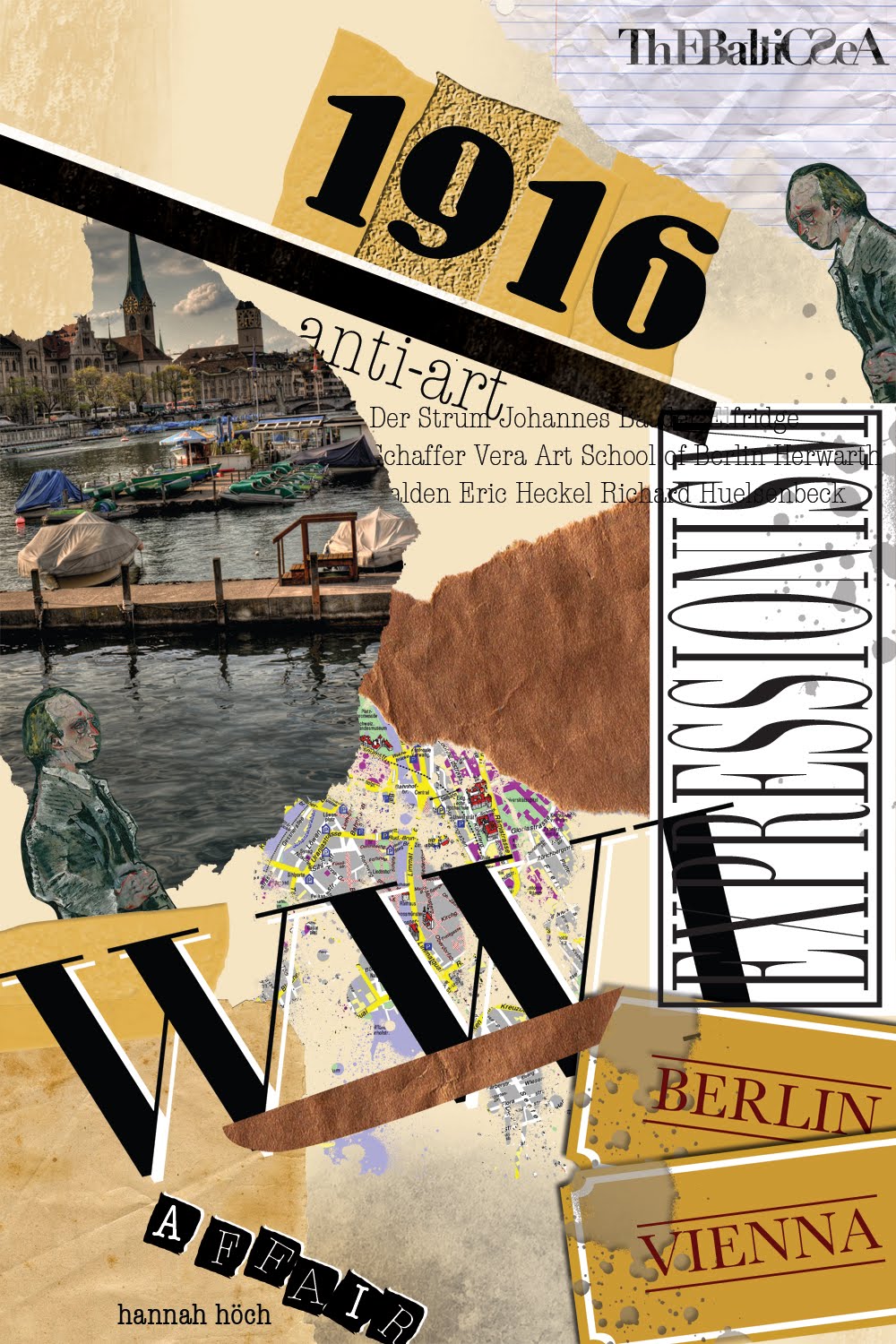
A collage as an art form was especially popular in dada movement. Many artists used this technique to provoke their unconscious  thinking and explore metaphysical origins of reality. For example Hans Arp was famous for making a series of collages based on chance; he would stand above a sheet of paper, let squares of contrasting colored paper fall on the larger sheet’s surface, and then he would glue the squares – in any position they took by falling. Arp was interested in I-Ching fortune telling (where coins fallen by chance we interpreted for future forecasting) and he was curios what kind of visceral reaction would his art produce.

1916-dada                        Arp-gold-squares-p

Raoul Hausmann                                                     Hans Arp

So how can you use technique of collaging to exercise your creativity?

The basic idea is for you to find small items, pictures, texts and letters from newspaper –anything that moves you and that you can rearrange into your own collage poem. By collaging your items, a new reality will start to form. Prune anything you find excess and look at new relations, surprises, metaphors, combinations. Your mind will try to justify any item by its origin, position, dimension. This is an excellent exercise for your creative rebel, to shout, to say, to sing, to whisper anything in particular you can’t. Let this collage poem be the messenger of your creativity. This exercise is a fun to do in groups also, as a team building game, an exercise in leadership skills, perhaps. Possibilities are endless – don’t restrain yourself – it’s good to rebel from time to time 🙂

After Experience Taught Me by Martin Buber

Take the first two fingers of this hand;
Fork them out—kind of a “V for Victory”—

Whether there might be something whose discovery
Would grant me supreme, unending happiness.

And jam them into the eyes of your enemy.
You have to do this hard. Very hard. Then press

No virtue can be thought to have priority
Over this endeavor to preserves one’s being.


Excercise your creativity through poetry, part III

kintz

Extensive research in area of cognitive science and intellectual skills suggests that intuitive understanding of seeing problems in new ways, analytical ability and effective communication of ideas to others are strong precursors of innovative thinking. Sternberg, R. J. (1986). in “Intelligence applied: Understanding and increasing your intellectual skills” in detail covered this topic.

In other words, sometimes is easy to come up with a good idea, but how we formulate idea, how it “goes into the world” and becomes persevered by the environment, strongly influence the possibility of the idea to become viable.

In the part I and part II of these series, I offered some suggestions on generating new ideas. Hence, writing poetry makes use of all three previously mentioned intellectual skills. Poetry can help us not only with writing and coming up with new ideas but also how to present our idea, make it more attractive to our audience or clients. That’s one of the reasons why I love poetry so much: it really help us work on our confidence, on our belief that we can contribute to something greater than ourselves, that we can provide value by sharing our knowledge and passion.

So for boosting your creative flow I have a little exercise to propose:

Next time you work on new idea, project, script – write like a small presentation of your idea in the form of a poem. Then read it out loud and imagine you have to present (“sell”) your idea to someone (agent, customers, managers ext). How does it feel? Is it empowering or you sense your idea lacks something? Pay attention to your posture: does you body naturally straights up while you read and present? Or you are quailed, with shrugged shoulders, impatient to finish your reading? Are you satisfied with the outcome or you are uncomfortable and insecure? Is your idea understandable? What else you could include in your poem? What kind of reaction you would like to provoke?

Your intuitive guidance, that inner knowing will tell you are you on the right track with your idea. If it doesn’t work try again. Between the verses is your hidden treasure to perfecting your idea.

You can go step further and organize a real audience for pitching your idea-poem. Listen and watch them. Did you capture their attention, how did they react? Your idea, transmuted through poem has to provide experience, to be uplifting, different from already seen and heard.

Note down your observation and work on the refinement of your idea. It will get you closer to your desired result – where both you and your clients enjoy the fruits of your work.

Take back this virgin page

by Thomas Moore

Take back the virgin page,
White and unwritten still,
Some hand more calm and sage
The leaf must fill.
Thoughts come as pure as light,
Pure as even you require:
But oh! each word I write
Love turns to fire.

Yet let me keep the book;
Oft shall my heart renew,
When on its leaves I look,
Dear thoughts of you.
Like you, ’tis fair and bright;
Like you, too bright and fair,
To let wild passion write
One wrong wish there!

Haply, when from those eyes
Far, far away I roam,
Should calmer thoughts arise
Tow’rds you and home;
Fancy may trace some line
Worthy those eyes to meet,
Thoughts that not burn, but shine,
Pure, calm, and sweet.

And as, o’er ocean far,
Seamen their records keep,
Led by some hidden star
Through the cold deep;
So may the words I write
Tell thro’ what storms I stray,
You still the unseen light
Guiding my way.

For every poet who wants to get published

Silvia Plath

In times when we are all overloaded with information, coming from all sorts of media sources, it is hard to be noticed and keep someone’s interest. I think that this is the biggest problem that most writers struggle with, especially poets. It’s true, poetry always had its devoted fans, yet is less popular than other forms of art. As it is easy to start your own blog and publish your work, it is hard to get through among other writers and get published in literary journal or anthology. Not to mention earning from your own writings – some people think it equals science-fiction!

“Poetryhasvalue” is a fabulous resource for all aspiring poets as Jessica Piazza documents her journey on submitting her poems to paying literally journals. Getting to know her experiences can help you avoid certain pitfalls and direct you towards choosing the most appropriate journal according to your genre, writing style and of course, your goals. Is your goal to make a living from your writings or you are on the quest to gain more popularity and get people acquainted with your work? It will determine which literally journal and magazines suit you best. For more about the author of this project visit www.jessicapiazza.com

Poetry and storytelling: part II

It has been said that next to hunger and thirst, our most basic human need is for storytelling.

               ~Khalil Gibran

In the first part of this blog post series you got a glimpse of how important storytelling is for a business, especially for entrepreneurs. Today, I will discuss in more length, about specific techniques we can use in our storytelling and what poetry can teach us about that – especially narrative poems.

Narrative poem is one of the oldest form of literature and is a traditional way of capturing and delivering knowledge and experience – in the form of epic tales with exciting rhythm, rhyme, repetition which makes them easy to remember and share. And that’s what every entrepreneur wants: his story and message to be remembered and shared.

So what important lessons narrative poems can teach us and what should every entrepreneur incorporate into his storytelling?

1.Frame your story

What is it that you want to tell? You have to be very specific and craft your story around it. It also means choosing your character that will lead the audience through story, in many compellin141888-142934g ways – dramatic, funny, full of surprises. It has to deliver vivid pictures and excitement in order to keep the audience’s attention. Once you accomplish that, it’s easier to fine tune other details.
 

2.And…action!

Don’t bother with setting the scene and too much explanations. Lead the audience to immediate action; overflow them with emotions you want them to experience – people always remember how you made them feel.

3.Activate all five senses

An effective story, do take care of a “big picture”, but also pays attention to small details. Give your audience the opportunity to sweat, get freezing hands, smell the roses … All 5 senses have to be activated for your story to awaken interest, experience and to be memorable. In that way your message will be understood and worth sharing.

4.Don’t be afraid to repeat yourself

Repetition is crucial in learning. Think of your key phrases and words that you can use in smart way, so your story is easier to remember. Don’t overdo it, because otherwise you can make it boring and shallow. Martin Luther King in his famous speech used the phrase “I have a dream” eight times during that speech, which made it so powerful and energetic.

The following poem is an example of effective use of narrative to describe an ordinary job, but one that can touch our hearts in so many different ways:

Sending Flowers by Hannah Stephenson

The florist reads faces, reaches into the mouths of customers.
Turns curled tongues into rose petals,

teeth clinking against one another into baby’s breath.
She selects a cut bloom, a bit of leaf,

lays stem alongside of stem, as if building a wrist
from the inside. She binds them

when the message is right, and sighs at the pleasure
of her profession. Her trade:

to wrangle intensity, to gather blooms and say, here,
these do not grow together

but in this new arrangement is language. The florist
hands you a bouquet

yanked from your head, the things you could not say
with your ordinary voice.

So next time you want to tell your story, try to implement these tips – or even write your own narrative poem – you will certainly get the wanted attention.

Exercise your creativity through poetry, part II

When you invite people to share in your miracle, you create future allies during rough weather.”
― Shannon L. Alder

In this post I intent to recommend some interesting writing exercises, but they are supposed to be done in groups. So grab some of your “pen-friends”, painted-cartoon-of-two-people-talking-for-kiki-by-katy-973x1024play together and see how can you inspire and help each other become more creative.

These exercises can be also performed in the business setting, they’re fun and can be a great way to break out of the ordinary working routine.

Inspired by discovered

Each of you, players, has to write down a rare fact about yourself that most people don’t know about (it can be a secret 😉 ) on a piece of paper, fold it and exchange it with others randomly. Caught by surprise about unknown facts you may find your own fountain of creativity! Write a poem about it and see where it takes you.

Pantomime

Let one of your friends or coworkers gesture with hands: your task is to describe what you see, what you experience and jot it down in words in the form of poem. This can be quite intriguing way of stimulating our creative capabilities, as is discussed in this article, using two hands to explain something prompts the brain to consider issues from multiple perspectives. To spice up a bit, try everything that you write to put in rhyme (in my previous post I explained the benefits of putting boundaries during our brainstorming sessions and how that can stimulate creativity further).

What’s wrong with this picture?

Visual stimulation can unleash your imagination in the most exciting ways. You can pick some random picture and each of players has to make a story in the form of poem, inspired by the picture. Afterwards, you can all debate and see whose story is the most interesting or you can take it step further and compile all stories into one: it has to be believable and follow some logical structure. It’s best suited for groups of two, three people.

With certain moderation you can use these ideas for your own creativity exercises. If you by any chance try them, share your thoughts in the comments below.

It couldn’t be done by Edgar Albert Guest

Somebody said that it couldn’t be done,
    But, he with a chuckle replied
That “maybe it couldn’t,” but he would be one
    Who wouldn’t say so till he’d tried.
So he buckled right in with the trace of a grin
    On his face. If he worried he hid it.
He started to sing as he tackled the thing
    That couldn’t be done, and he did it.

Somebody scoffed: “Oh, you’ll never do that;
    At least no one has done it”;
But he took off his coat and he took off his hat,
    And the first thing we knew he’d begun it.
With a lift of his chin and a bit of a grin,
    Without any doubting or quiddit,
He started to sing as he tackled the thing
    That couldn’t be done, and he did it.

There are thousands to tell you it cannot be done,
    There are thousands to prophesy failure;
There are thousands to point out to you one by one,
    The dangers that wait to assail you.
But just buckle it in with a bit of a grin,
    Just take off your coat and go to it;
Just start to sing as you tackle the thing
    That “couldn’t be done,” and you’ll do it.


Are poets born, taught or both?

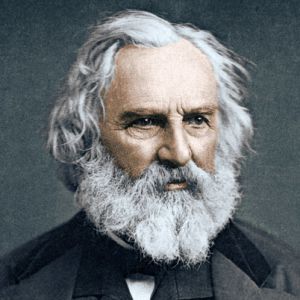
This post is inspired by the poem “The Poet And His Songs” written by Henry Wadsworth Longfellow and it goes like this:MTE5NDg0MDU1MDQ0NTg5MDcx

As the birds come in the Spring,
We know not from where;
As the stars come at evening
From depths of the air;

As the rain comes from the cloud,
And the brook from the ground;
As suddenly, low or loud,
Out of silence a sound;

As the grape comes to the vine,
The fruit to the tree;
As the wind comes to the pine,
And the tide to the sea;

As come the white sails of ships
O’er the ocean’s verge;
As comes the smile to the lips;
The foam to the surge;

So comes to the Poet his songs,
All hitherward blown
From the misty land, that belongs
To the vast Unknown.

His, and not his, are the lays
He sings; – and their fame
Is his, and not his; – and the praise
And the pride of a name.

For voices pursue him by day,
And haunt him by night,
And he listens, and needs must obey,
When the Angel says: Write!

and it left me wondering: are we born writers and poets with innately need to write and create or is it something we discover with time and then put effort and energy into it in order to develop better writing skills? I mean, we all can work to improve our abilities in any area, but are we born with notion that writing is supposed to be our life calling (or any other profession, for that matter)? Do you simply “know” that you must write in order to be yourself, to express your true nature? As Longfellow says “so comes to the Poet his songs…from the misty land…to the vast Unknown”.

For me, some sort of writing was always present. During my career it evolved into scientific writing, yet the most natural way for me to write is in the form of poem – and it showed early in my childhood.

As Marina Abramovic likes to say:

 For me, art is like breathing. You don’t question if you breathe, you have to breathe. So if you wake up in the morning and you have to realize an idea, and there’s another idea, and another, maybe you are really an artist. It doesn’t make you a great artist, it just makes you an artist. To become a great artist is a huge undertaking! So it’s really important, that instinct. You need the instinct to do it”.

There is no doubt that further developing skills requiers hard work – to move from ordinary to extraordinary. But do we need that “special thing” to carry inside in order to go beyond the average crowd? What are your thoughts, please share in the comments bellow.